Mold removal and remediation in Alys Beach, Florida requires specialized processes tailored to the region's humid subtropical climate and unique white masonry architecture. Under Florida law, professional remediation involves independent initial mold assessment, strict engineering containment, HEPA air filtration, physical removal of affected materials, and post-remediation clearance verification to protect both structural integrity and indoor air quality.
Understanding Mold Dynamics in Alys Beach Architecture
Alys Beach, situated along Scenic Highway 30A in Walton County, Florida, is renowned for its distinctive Bermudan and Mediterranean-inspired architecture. Properties here feature solid concrete block construction, crisp white stucco finishes, interior courtyards, and tile roofs built to withstand severe coastal weather. However, the Gulf Coast environment presents severe moisture management challenges. High ambient relative humidity—often exceeding 80% during summer months—combined with persistent ocean breezes and intense solar heating creates a microclimate where indoor moisture must be continuously managed.
Alys Beach Moisture & Mold Dynamics:
- High Ambient Humidity (Coastal Gulf Environment)
- Solar Pumping (Drives vapor through exterior stucco/masonry)
- HVAC Thermal Bridging (Cold interior walls meet warm exterior vapor)
- Unoccupied Seasonal Vacancies (HVAC setbacks elevate indoor RH%)
- Result: Indoor Relative Humidity > 60% leads to Fungal Spore Germination
Mold spores require three primary elements to colonize structural materials: a organic nutrient source (such as drywall paper, wood framing, dust, or adhesives), warm temperatures, and moisture (relative humidity consistently above 60% or direct liquid water intrusion). In Alys Beach homes, several specific architectural and environmental factors drive mold growth:
- Thermal Mass and Solar Pumping: Solid masonry walls store heat and moisture. When sunlight warms damp exterior stucco, it creates vapor pressure that drives moisture inward through porous concrete toward air-conditioned, cooler interior spaces—a phenomenon known as solar pumping.
- HVAC Condensation and Sizing: High-performance cooling systems running in high-humidity zones can produce massive volumes of condensate. If condensate drain lines clog, or if an HVAC system is oversized and short-cycles (cooling air quickly without running long enough to remove moisture), elevated indoor humidity results.
- Seasonal Property Vacancy: Many luxury residences in Alys Beach serve as second homes or rental properties. When properties remain unoccupied with HVAC systems set to high temperature thresholds or turned off, indoor relative humidity rapidly rises into the fungal growth zone.
- Coastal Envelope Intrusion: Wind-driven rain from tropical systems can penetrate subtle cracks in stucco, flashing around parapet walls, or seals around custom windows and loggias, trapping water within wall assemblies.
Florida Regulatory Framework and Standards (F.S. 468)
To protect consumers from predatory practices, the state of Florida strictly regulates the mold assessment and remediation industry. Understanding these legal frameworks ensures property owners receive compliant, objective services.
Licensing Separation under Florida Law
Under Florida Statutes Chapter 468, Part XVI, the Florida Department of Business and Professional Regulation (DBPR) oversees the licensing of Mold Assessors (MRSA) and Mold Remediators (MRSR).
Florida Statute 468:
- Licensed Mold Assessor
- Performs initial inspection
- Conducts air/surface sampling
- Writes Remediation Protocol
- Performs Final Clearance (PRV)
- Licensed Mold Remediator
- Builds containment barriers
- Runs HEPA air scrubbers
- Removes contaminated materials
- Executes physical cleaning
To eliminate financial conflicts of interest, Florida law explicitly prohibits a single firm from performing both mold assessment and mold remediation on the same property within a 12-month period (F.S. 468.8419).
- Mold Assessor (MRSA): Inspects the property, takes air and surface samples, identifies moisture sources, and drafts a formal Mold Remediation Protocol detailing the exact scope of work required.
- Mold Remediator (MRSR): Executes the physical cleanup, containment, material removal, and sanitization strictly according to the assessor's written protocol.
- Post-Remediation Verification (PRV): The independent Mold Assessor returns after work is complete to re-inspect and re-test the area, issuing a formal clearance report confirming the space has returned to normal ecology.
Industry Technical Standards: ANSI/IICRC S520
Professional remediators operating in Alys Beach adhere to the ANSI/IICRC S520 Standard for Professional Mold Remediation. This standard categorizes indoor spaces into three conditions of fungal contamination:
- Condition 1 (Normal Ecology): An indoor environment that may contain normal background levels of mold spores and settled dust, but shows no active growth or abnormal contamination.
- Condition 2 (Settled Spores): An indoor environment contaminated with settled mold spores or fungal fragments that arose from an active growth source elsewhere, but where active growth is not directly present on the localized surface.
- Condition 3 (Actual Growth): An indoor environment affected by active fungal growth and high spore density on structural components or interior contents.
The Step-by-Step Professional Remediation Process
Resolving a mold incident in an Alys Beach residence requires a disciplined sequence of engineering controls and physical containment to ensure spores do not cross-contaminate unaffected living areas or high-end furnishings.
- Initial Assessment & Protocol Design: Independent Assessor inspects, samples, and publishes formal remediation scope.
- Containment & Negative Air Setup: Polyethylene barriers erected; HEPA air scrubbers vent air to exterior, creating pressure drop.
- Controlled Material Removal & HEPA Vacuum: Porous materials removed under negative pressure; masonry/non-porous scrubbed with anti-microbials.
- Structural Drying & Sanitization: LFE dehumidifiers and air movers drop moisture content of structural framing below 15%.
- Post-Remediation (PRV) Clearance & Rebuild: Independent Assessor re-tests area; clears property for rebuild and occupancy upon passing results.
1. Initial Assessment and Protocol Writing
Before any equipment is placed, a Florida-licensed Mold Assessor conducts a comprehensive moisture audit using thermal imaging (infrared) cameras, moisture meters, and air/surface sampling (spore traps or surface swabs). The assessor publishes a written protocol defining:
- The exact boundary of containment zones.
- The required air exchange rates for negative air machines.
- Which structural components can be restored vs. removed.
- Target moisture content levels for remaining materials.
2. Engineering Containment and Negative Pressure
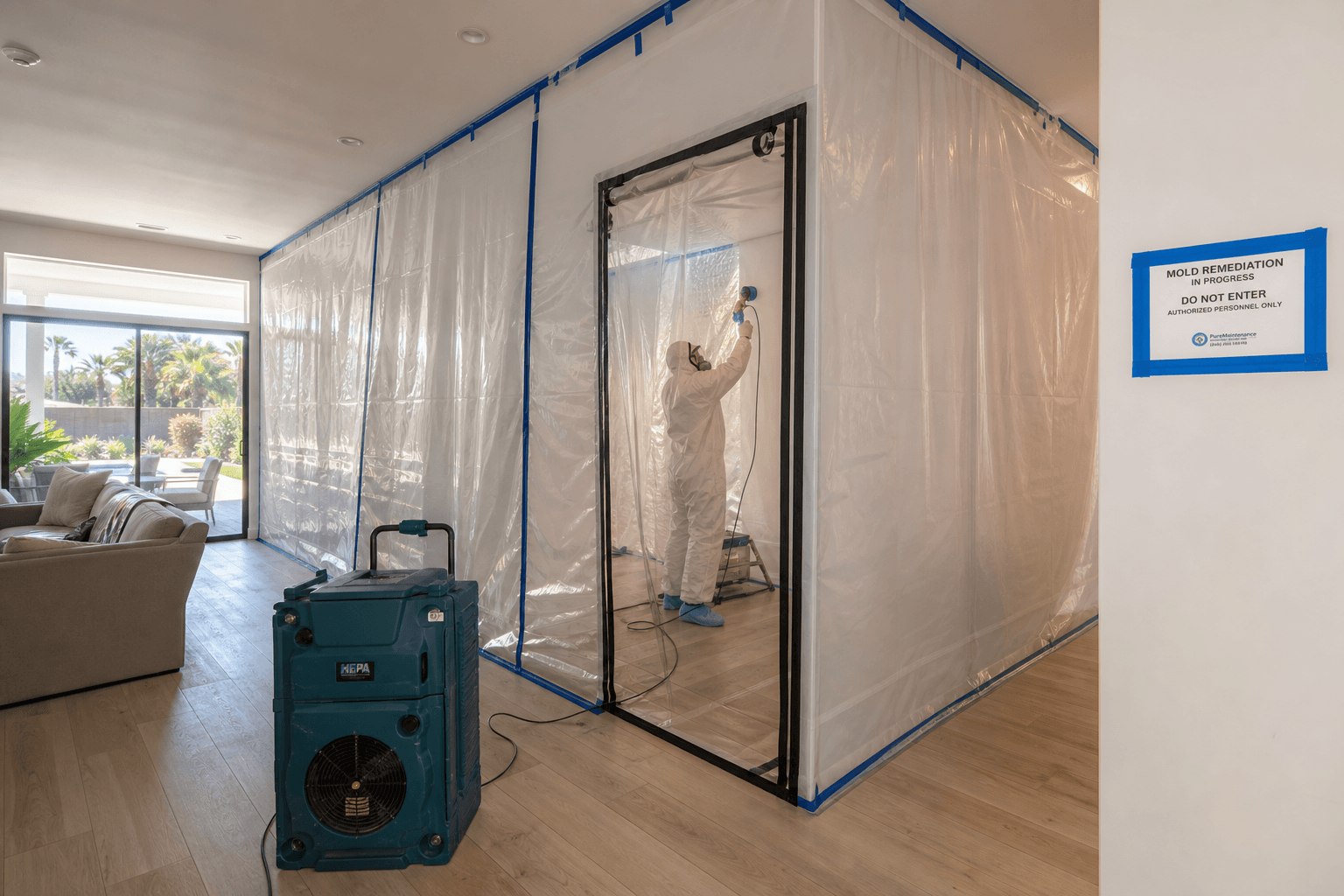
To prevent volatile organic compounds (VOCs) and fungal spores from spreading through the property, remediators establish containment barriers using heavy-duty (6-mil) flame-retardant polyethylene sheeting sealed with specialized tape.
Critical containment features include:
- Decontamination Chambers: Air locks with flap doors that allow technicians to enter and exit without releasing contaminated air.
- Negative Air Pressure Systems: Industrial HEPA (High-Efficiency Particulate Air) filtration units pull air out of the containment space and exhaust it outside the home. This creates lower atmospheric pressure inside the containment wall than outside it, ensuring air flows inward through any minor seams, preventing spore escape.
- HVAC Isolation: Supply and return vents within the work zone are sealed completely to stop spores from entering ductwork.
3. Controlled Demolition and Removal
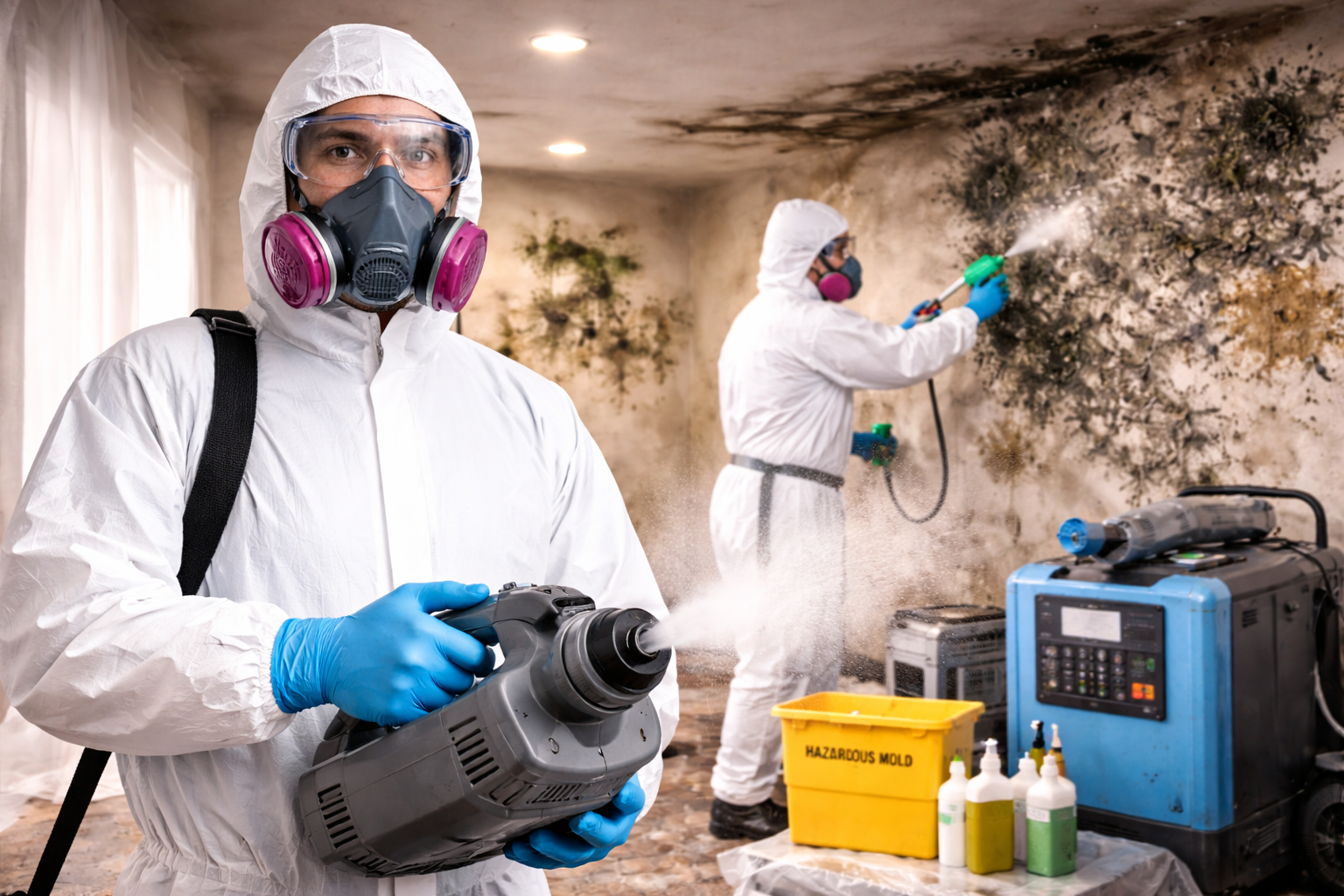
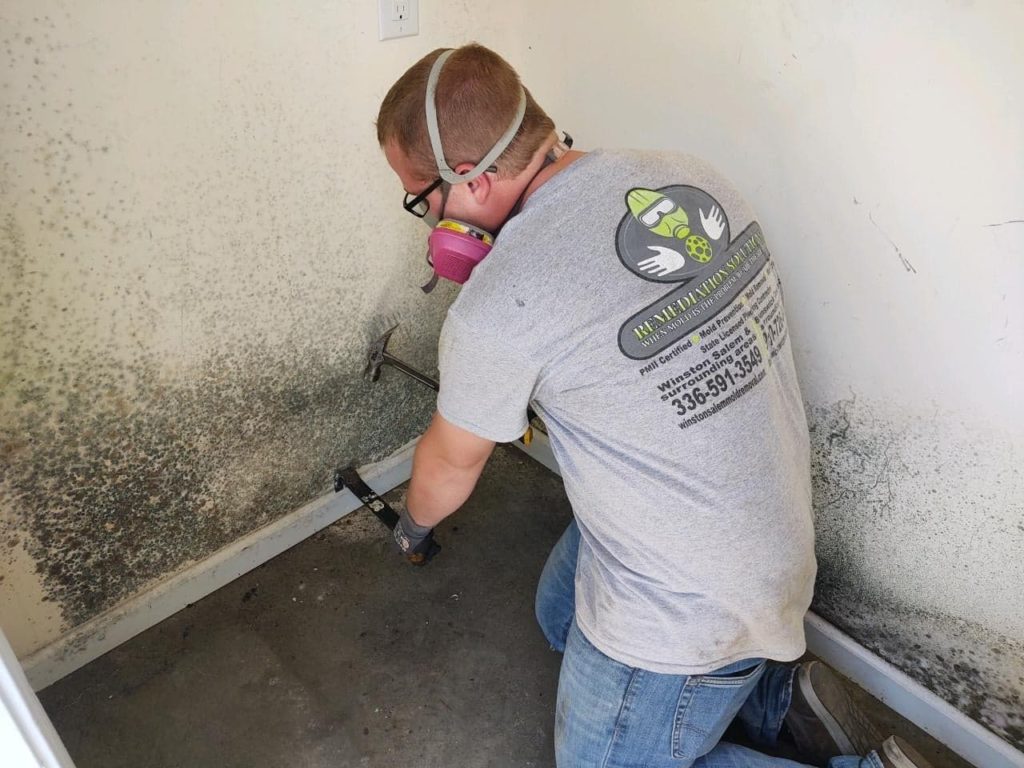
Porous building materials affected by Condition 3 mold growth cannot be fully sanitized because fungal hyphae (root structures) penetrate deep below the surface. Remediators remove drywall, sound-dampening insulation, carpet, underlayment, and compromised ceiling tiles under negative pressure. Materials are misted to prevent spore aerosolization, double-bagged in 6-mil poly bags, wiped clean on the exterior, and removed from the property.
4. Surface Cleaning and Media Blasting
Non-porous materials (such as metal fixtures or glass) and semi-porous structural elements (such as concrete block walls, masonry surfaces, and heavy timber subframing) are remediated in place:
- HEPA Vacuuming: Surfaces are vacuumed with units containing certified HEPA filters capable of capturing particles down to 0.3 microns at 99.97% efficiency.
- Damp Wiping / Scrubbing: Surfaces are washed using EPA-registered antimicrobial, fungicidal disinfectants.
- Soda or Dry-Ice Blasting: For deep penetration into timber framing or masonry walls without chemical residue, specialized abrasive blasting removes organic staining and fungal roots cleanly.
5. Structural Dehumidification and Drying
Removing visible mold is insufficient if moisture remains in structural assemblies. Commercial-grade Low Grain Refrigerant (LGR) dehumidifiers and high-velocity axial air movers drop wood moisture content (WMC) below 15% and concrete moisture levels to acceptable equilibrium relative humidity (ERH). Technicians track psychrometric data (temperature, relative humidity, specific humidity, and dew point) daily until structural dry-standard metrics are satisfied.
6. Post-Remediation Verification (PRV)
Once cleaning and drying are complete, the remediator conducts a thorough visual inspection and HEPA-vacuums all containment surfaces. The independent Mold Assessor returns to conduct PRV testing:
- Visual Inspection: Checking for dust, debris, water staining, or visible growth within containment.
- Air Clearance Testing: Air samples are taken inside the containment zone and compared against baseline control samples taken outside the home.
- Clearance Certificate: If indoor spore counts are lower than outdoor background counts and showing a healthy species composition, the assessor issues a formal clearance certificate, allowing containment teardown and build-back.
Technical Comparison: Mold Removal Methods and Metrics
The following reference matrix outlines key engineering parameters, tools, and regulatory standards applied during remediation projects in coastal Florida:
| Parameter / Stage | Technical Standard / Target Metric | Primary Equipment & Materials | Operational & Regulatory Requirement |
|---|---|---|---|
| Initial Assessment | Baseline outdoor vs. indoor spore count ratio (< 1.0 ideal) | Thermal imaging (IR), pin/pinless moisture meters, calibrated air pumps | Conducted strictly by a DBPR-licensed Mold Assessor (F.S. 468) |
| Containment Isolation | Negative pressure differential of ≥ -0.02 inches of water column (in. w.c.) | 6-mil flame-retardant polyethylene, negative air machines with HEPA filters | Must isolate HVAC return/supply vents; establish decontamination airlocks |
| Air Filtration | 99.97% efficiency at 0.3 microns; min 4 to 8 air changes per hour (ACH) | Industrial HEPA Air Scrubbers, ducting kits | Continuous operation 24/7 throughout demolition and cleaning stages |
| Material Removal | Complete excision of porous Condition 3 materials | Oscillating multi-tools, HEPA vacuums, 6-mil disposal bags | Damp-misting to prevent spore aerosolization; double-bagging protocol |
| Structural Drying | Wood Moisture Content (WMC) < 15%; Relative Humidity (RH) < 50% | LGR Dehumidifiers, axial air movers, moisture probes | Daily logging of psychrometric readings (Grains Per Pound / GPP drop) |
| Clearance Verification | Match Condition 1 ecology; fungal spore types consistent with ambient air | Airborne spore trap cassettes, surface swab culture kits | Performed by an independent Assessor before containment removal |
Mold Removal vs. Mold Remediation: Key Distinctions
Property owners often use the terms "mold removal" and "mold remediation" interchangeably, but in technical and legal settings, they represent distinct concepts:
MOLD REMOVAL (Surface-Level)
- Process: Bleach/Surface Spray, Cosmetic Wipe, Source Ignored
- Temporary fix; mold recurs because moisture remains.
MOLD REMEDIATION (Comprehensive Standard)
- Process: Moisture Identification, Containment, HEPA Filter, Material Excision, Structural Drying, Third-Party Clearance Verification
- Complete solution; restores space to normal Condition 1 ecology.
Mold Removal: Refers to the physical wiping, bleaching, or scrubbing of surface growth. Because mold spores exist everywhere in background air, absolute "removal" of every single spore from a home is scientifically impossible. Surface-level removal without moisture correction leads to rapid recurrence.
Mold Remediation: A comprehensive, science-based restoration process. Remediation addresses root-cause moisture issues, isolates contaminated zones, removes un-cleanable materials, cleans remaining surfaces to standard thresholds, and verifies that indoor air quality matches or exceeds baseline ambient conditions.
Preventative Strategies for Alys Beach Property Owners
Given the harsh coastal climate of the Florida Panhandle, preventing mold growth requires proactive moisture management strategies built into building design and routine maintenance.
1. Supplemental Whole-Home Dehumidification
While central HVAC systems cool indoor air, high-end coastal properties often require dedicated, whole-home mechanical dehumidification (such as units integrated directly into duct systems). These systems maintain relative humidity below 50% year-round, even during intermediate seasons (spring and autumn) when cooling demand is low but outdoor humidity remains sky-high.
2. Smart Thermostat and Humidistat Integration
For seasonal properties, installing smart thermostats equipped with humidistat overrides is vital:
- Set cooling points between 72°F and 75°F when occupied.
- When unoccupied, set thermostats to maintain relative humidity below 55% rather than setting a strict high-temperature threshold (e.g., 80°F), which can allow moisture accumulation during prolonged rainy spells.
- Deploy remote moisture leak sensors beneath HVAC air handlers, water heaters, dishwashers, and washing machines that transmit instant alerts to property managers.
3. Stucco and Envelope Maintenance
The brilliant white exterior stucco of Alys Beach properties serves as the primary barrier against weather intrusion. Property owners should establish routine inspection protocols:
- Inspect parapet flashing, stucco control joints, and window sealant beads annually for micro-fissures.
- Re-seal masonry using breathable, elastomeric coating systems designed for marine environments that keep liquid water out while allowing interior water vapor to escape.
- Ensure roof drains (scuppers) and interior courtyard drain basins stay clear of debris to prevent standing water near foundations.
Cost Considerations and Insurance Factors in Walton County
The cost of mold remediation in Alys Beach varies widely based on square footage, accessibility, extent of structural penetration, and material finish levels.
Cost Variables
- Minor Contamination (Localized bathroom leak, isolated vanity): $1,500 to $3,500. Covers small containment, basic drywall removal, structural drying, and clearance testing.
- Moderate Contamination (HVAC condensate failure affecting multiple rooms): $4,000 to $12,000. Covers multi-room containment, duct sanitization/replacement, subfloor drying, and extensive structural cleaning.
- Major Contamination (Unaddressed humidity failure during summer vacancy or major storm penetration): $15,000 to $50,000+. Involves extensive structural demolition, continuous negative air scrubbing, high-end timber/masonry restoration, and major build-back costs.
Insurance Coverage Dynamics
In Florida, homeowners insurance coverage for mold damage depends heavily on the policy origin and cause of loss:
Water Damage / Mold Event:
Sudden & Accidental Peril (e.g., Burst Pipe, Sudden AC Line Break)
- COVERED BY INSURANCE (Subject to Policy Caps: e.g., $10k limit)
Gradual / Maintenance Failure (e.g., Unaddressed Humidity, Deferred Maintenance)
- NOT COVERED BY INSURANCE (Claim Denied / Owner Responsible)
Sudden and Accidental Perils: Most standard property insurance policies cover mold remediation only if it results directly from a covered sudden water line burst or appliance rupture.
Policy Caps: Many Florida coastal insurance policies carry explicit mold remediation sub-limits (typically capped at $10,000 unless an optional endorsement was purchased).
Gradual Neglect Exclusions: Damage resulting from long-term humidity neglect, lack of HVAC operation during vacancy, or unaddressed exterior roof/stucco leaks over time is routinely excluded from coverage.
Frequently Asked Questions
Can I clean mold on drywall myself using household bleach?
No. Chlorine bleach is largely ineffective on porous building materials like drywall or bare wood. Bleach consists mostly of water; the chlorine chemical remains on the surface while water penetrates into the porous substrate, feeding the fungal roots below and causing mold to return quickly. Porous materials with Condition 3 mold growth must be physically cut out and replaced.
How long does the professional mold remediation process take?
A typical remediation project takes between 3 to 7 business days from containment setup to final post-remediation verification testing. Severe structural drying or complex demolition projects involving custom architectural woodwork or concrete masonry can extend timelines to two weeks or longer.
Why does Florida law prohibit the same company from assessing and remediating mold?
Florida Statute 468.8419 mandates strict separation between Mold Assessors and Mold Remediators to protect consumers from conflicts of interest. If a single company inspected the property, prescribed the scope of work, performed the cleanup, and verified its own work, there would be a financial incentive to overstate the damage or clear incomplete remediation work.
How do I know if mold has spread into my HVAC system?
Signs of HVAC contamination include persistent musty odors when the fan turns on, visible dark spotting around supply register vents, unexplained allergies or respiratory irritation among occupants, and high relative humidity inside the home. A licensed mold assessor can take air and swab samples directly inside the air handler unit and trunk ductwork to confirm contamination.
What relative humidity level should I maintain in my Alys Beach home while away?
Keep relative humidity strictly below 50% to 55%. Setting your smart HVAC system or dedicated whole-home dehumidifier to maintain humidity thresholds rather than just air temperature prevents water vapor condensation on cool wall surfaces during hot, humid summer weeks.
Recommended Next Steps
If you suspect mold contamination in your Alys Beach residence, follow this sequence of actions to protect your health and investment:
- Engage an Independent Licensed Mold Assessor: Hire a Florida-licensed Mold Assessor (MRSA) with no financial ties to any remediation contractor to perform baseline testing and author a certified Remediation Protocol.
- Contact Your Insurance Provider: Review your property policy limits and report the claim promptly if the source of water intrusion stems from a sudden, accidental water release.
- Hire a Licensed Mold Remediator: Select a Florida-licensed Mold Remediator (MRSR) experienced in coastal masonry construction to execute the written protocol under containment.
- Require Post-Remediation Verification (PRV): Ensure containment remains standing until your independent Assessor completes PRV testing and issues a formal written clearance report.
- Upgrade Moisture Controls: Install whole-home dehumidification systems, smart leak detectors, and high-precision humidistats to prevent future moisture accumulation.