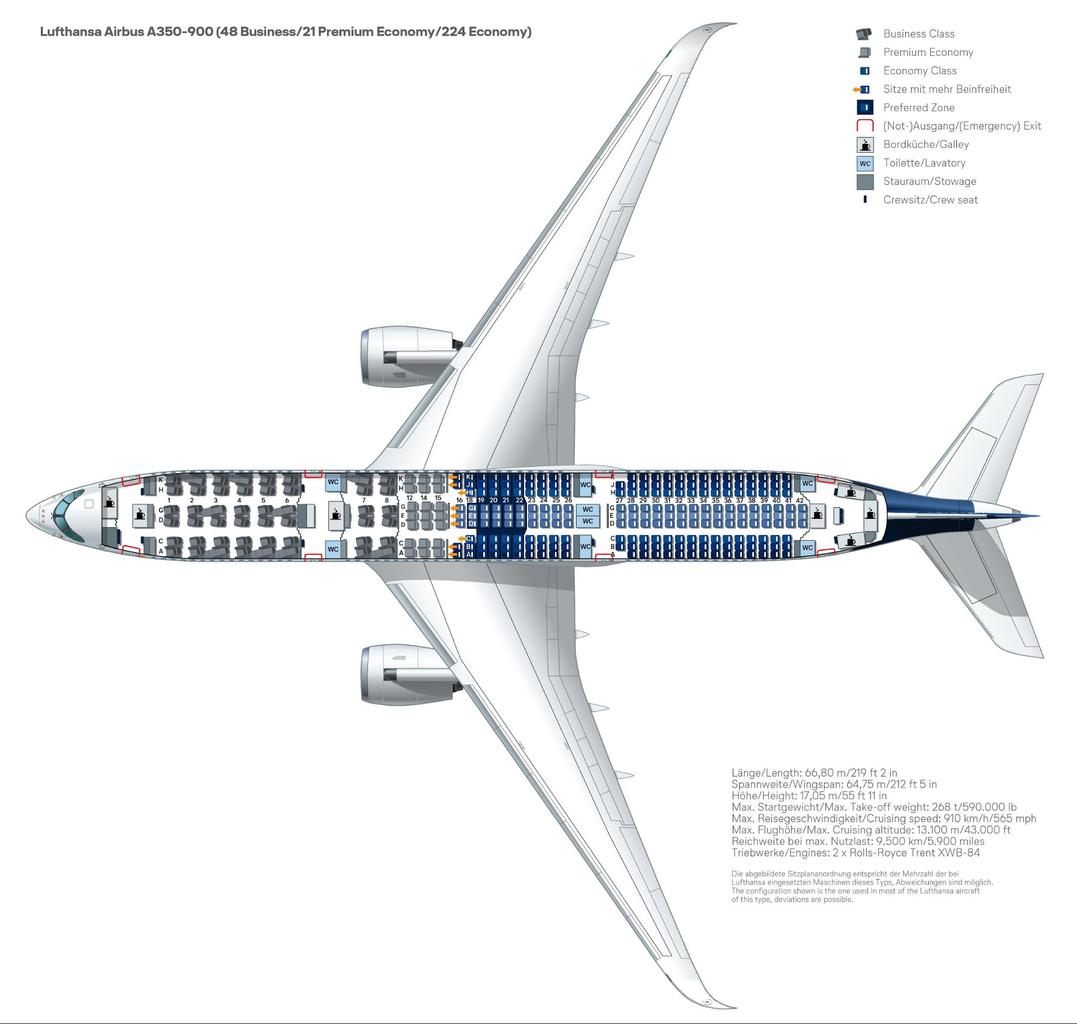
The Airbus A350-900 seat map typically features a wide-body, twin-aisle configuration designed to accommodate between 300 and 350 passengers in a standard three-class layout. Renowned for its "Airspace" cabin, the aircraft offers a 3-3-3 arrangement in Economy, a 2-3-2 or 2-4-2 in Premium Economy, and a 1-2-1 direct-aisle access layout in Business Class.
The Airbus A350-900 has become the backbone of modern long-haul aviation. As of 2026, it remains one of the most technologically advanced aircraft in the sky, favored by airlines for its fuel efficiency and by passengers for its superior cabin comfort. Understanding the nuances of the A350-900 seat map is essential for any traveler looking to maximize their comfort during a 10-to-15-hour flight. Because the aircraft's fuselage is wider than previous generations, it allows for more vertical sidewalls and larger overhead bins, creating a sense of space that is immediately noticeable upon boarding.
The Architecture of the Airspace Cabin
The fundamental appeal of the A350-900 lies in the "Airspace" cabin philosophy developed by Airbus. Unlike older aircraft that feel cramped due to the curvature of the fuselage, the A350-900 utilizes carbon-fiber-reinforced plastic (CFRP) construction. This material is stronger and lighter than aluminum, allowing the fuselage to be shaped with a more rectangular cross-section.
For the passenger, this translates to more shoulder room in window seats and higher ceilings throughout the aircraft. The seat map is generally divided into three or four distinct cabins. The forward section is almost universally dedicated to Business Class, followed by a smaller, more exclusive Premium Economy cabin, and finally, one or two large Economy Class sections extending to the rear of the aircraft.
Cabin Pressurization and Humidity
While not visible on a seat map, the physical environment of the A350-900 significantly impacts how seats feel. The aircraft is pressurized to 6,000 feet rather than the industry-standard 8,000 feet. This higher pressure, combined with advanced humidity control systems, reduces the effects of jet lag and dehydration. When you are looking at a seat map and deciding between a mid-cabin or rear-cabin seat, remember that the air quality is consistent throughout, but the noise levels are lowest in the forward sections, ahead of the massive Rolls-Royce Trent XWB engines.
Business Class: The Gold Standard of Layouts
In 2026, the standard for A350-900 Business Class is a 1-2-1 configuration. This layout ensures that every passenger has direct aisle access, eliminating the need to climb over a neighbor. However, not all 1-2-1 layouts are created equal.
Reverse Herringbone vs. Staggered Suites
Most premier carriers, such as Qatar Airways and Cathay Pacific, utilize a reverse herringbone design. In this seat map layout, seats are angled away from the aisle toward the windows or toward the center. This provides maximum privacy and a consistent "bed" length.
Alternatively, airlines like Delta (with their Delta One Suites) or Lufthansa (with the Allegris product) often use a staggered layout. In these seat maps, some seats are located directly next to the window, while others are "aisle-aligned" with a large console between the seat and the window. When viewing a seat map for a staggered configuration, savvy travelers always look for the "true" window seats—the ones where the seat is physically flush against the aircraft wall—to maximize privacy and views.
The Rise of the Business Class Suite
A significant development reflected in recent A350-900 seat maps is the inclusion of sliding privacy doors. These suites create a "room in the sky." If you are analyzing a seat map for an airline like British Airways or Qatar, the presence of these doors often means the seats are slightly wider at the shoulder but may feel more enclosed at the footwell.
Premium Economy: The Middle Ground
The Premium Economy cabin on the A350-900 is typically situated between Business and Economy, often separated by a galley or a bulkhead. This cabin usually consists of 21 to 35 seats.
Configuration and Pitch
The seat map for Premium Economy is almost always a 2-3-2 or 2-4-2 arrangement. Because the A350-900 fuselage is 221 inches wide, a 2-3-2 layout offers an incredibly spacious experience with seats that are 18.5 to 19 inches wide.
The seat pitch—the distance from one point on a seat to the same point on the seat in front—usually ranges from 35 to 38 inches. On a seat map, the most desirable seats in this cabin are the front-row bulkhead seats. These offer significant legroom, though they often have IFE (In-Flight Entertainment) screens tucked into the armrest, which can slightly reduce seat width.
Economy Class: Maximizing Space in 3-3-3
The vast majority of A350-900 seat maps utilize a 3-3-3 configuration in Economy. This is the design Airbus intended for the aircraft, providing 18-inch wide seats, which is the "comfort standard" for long-haul travel.
The 3-4-3 High-Density Exception
While 3-3-3 is the norm, some low-cost or high-density carriers have opted for a 3-4-3 layout. This significantly reduces seat width to roughly 17 inches. When reviewing a seat map before booking, it is crucial to verify the seating rows. If you see "ABC-DEFG-HJK" labeling, you are looking at a 10-abreast (3-4-3) configuration, which is considerably more cramped than the standard 9-abreast (3-3-3) layout.
Seat Pitch and Recline
Economy pitch on the A350-900 generally falls between 30 and 32 inches. On the seat map, the "extra legroom" seats are typically found at the emergency exit rows (often Rows 30 or 35, depending on the airline) and the bulkhead rows at the start of the Economy section.
Comparative Overview of A350-900 Configurations
The following table compares the typical seat map specifications for major global carriers operating the A350-900 in 2026.
| Airline | Business Layout | Premium Economy | Economy Layout | Total Seats | Key Feature |
|---|---|---|---|---|---|
| Singapore Airlines | 1-2-1 (Staggered) | 2-4-2 | 3-3-3 | 253 | Ultra-wide Business seats |
| Qatar Airways | 1-2-1 (QSuite) | N/A | 3-3-3 | 283 | Private doors in Business |
| Delta Air Lines | 1-2-1 (Suites) | 2-4-2 (Select) | 3-3-3 | 306 | Delta One Suite doors |
| Lufthansa | 1-2-1 (Allegris) | 2-3-2 | 3-3-3 | 293 | Various seat lengths |
| Cathay Pacific | 1-2-1 (Herringbone) | 2-4-2 | 3-3-3 | 280 | Excellent ergonomics |
| Finnair | 1-2-1 (AirLounge) | 2-4-2 | 3-3-3 | 278 | Non-reclining Business shell |
Strategic Seat Selection: Identifying the Best and Worst Seats
When looking at an A350-900 seat map, several "hidden" factors can influence the quality of your flight. Using a map isn't just about finding an open spot; it’s about understanding the geometry of the plane.
Seats to Avoid
- Last Row of Any Cabin: These seats often have limited recline and are located directly in front of a galley or lavatory, leading to increased foot traffic and noise.
- Misaligned Windows: Because of the structural ribs of the aircraft, some rows on the seat map may be listed as "window" seats but actually face a blank wall. This is common in rows immediately behind the wing.
- Proximity to Lavatories: On the A350-900 seat map, look for the "L" or toilet icons. Seats within two rows of these areas are subject to light pollution and noise throughout the night.
The "Sweet Spot" Seats
- The "A" and "K" Seats in Business Class: In a 1-2-1 configuration, these are almost always true window seats. In staggered layouts, verify that the console is on the aisle side to ensure you are tucked away from traffic.
- Exit Row 30/35 (A, C, H, K): These seats often offer "infinite" legroom because there is no seat directly in front. However, be aware that these can be colder due to the door's proximity and lack under-seat storage during takeoff and landing.
- The "Twin" Seats: Some A350-900 configurations feature a taper at the very rear of the fuselage where the 3-3-3 layout transitions to 2-3-2. These pairs of seats are ideal for couples, as they provide extra space between the seat and the window wall.
Technology and In-Flight Entertainment (IFE) Integration
The seat map is also a guide to the technological interface of the aircraft. On the A350-900, IFE systems are usually integrated into the seatback in front of you.
- Screen Size: In 2026, most A350 Business Class cabins feature 18-to-22-inch 4K monitors. Premium Economy usually offers 13-to-15-inch screens, while Economy provides 10-to-12-inch screens.
- Power Supply: Most seat maps will indicate power availability. On the A350, it is standard to have Universal AC power and USB-C ports in Business and Premium Economy. In Economy, power is sometimes shared (e.g., two outlets for every three seats), so checking the map for power icons is vital for travelers with multiple devices.
- Connectivity: The A350-900 is equipped with Ku-band or Ka-band satellite Wi-Fi. The antenna is typically located on top of the fuselage above the mid-section of the Economy cabin.
Maintenance and Cabin Refresh Cycles
As we move through 2026, many of the original A350-900s delivered in the mid-2010s (to launch customers like Qatar Airways and Vietnam Airlines) have undergone or are undergoing cabin refreshes. This means the seat map you see today might be different from the one used a year ago.
When searching for a seat map, always check the aircraft code. A "359" is the standard A350-900, but some airlines use internal codes (like 35H or 35G) to differentiate between different cabin configurations (e.g., those with more Business Class seats for premium routes vs. those with higher Economy counts for leisure routes).
Frequently Asked Questions
Which seat is the quietest on the Airbus A350-900?
The quietest seats are located in the forward Business Class cabin, as far away from the engines as possible. Within the Economy cabin, seats located ahead of the wing (usually rows 15–25, depending on the airline's configuration) are significantly quieter than those in the very back, where the roar of the exhaust and aerodynamic noise are more pronounced.
Does the A350-900 have "bins" at the window seats in Business Class?
Unlike the Boeing 777 or the Airbus A380 upper deck, the A350-900 does not typically have side-wall storage bins at the window seats. However, because the overhead bins are so large (designed to fit five roll-aboard bags in every two-row section), there is rarely a struggle for luggage space, even in a full Economy cabin.
Are bulkhead seats better on the A350-900?
Bulkhead seats offer the advantage of no one reclining into your space. However, they have drawbacks: your IFE screen is often on a swivel arm or mounted high on the wall, and your legroom might be restricted by the physical wall if you are very tall. In Business Class, bulkheads often provide a larger footwell (the "cubby" where your feet go when the seat is flat) compared to other rows.
How do I know if my A350-900 has the new "First Class" or just Business?
Only a few airlines, such as Lufthansa and Air France, have introduced a true First Class cabin on the A350-900. On a seat map, this will appear as a single row (Row 1 or 2) with only 3 or 4 seats in a 1-1-1 or 1-2-1 layout. Most A350-900s top out at Business Class.
Is the window alignment good on the A350-900?
Generally, yes. The A350 was designed with passenger experience in mind, so most rows align well with the windows. However, avoid the rows directly over the wing spar (usually middle of the plane) if you want a clear downward view, as the massive wing of the A350 (which has a 212-foot span) will block much of the scenery.
Final Recommendation for Travelers
When consulting an Airbus A350-900 seat map overview, the primary goal should be to verify the class configuration of your specific flight. Before finalizing your seat selection, cross-reference the airline's seat map with your personal priorities: choose the forward cabin for silence, the bulkhead for legroom, or the "true" window seats in Business Class for maximum privacy. For Economy passengers, the 3-3-3 layout is your best friend—ensure your airline hasn't moved to a 10-abreast configuration to guarantee the 18-inch seat width that makes the A350 one of the most comfortable long-range aircraft in operation in 2026.