Agency management software for auto insurance is a centralized digital platform that automates policy administration, lead tracking, and carrier communications. In 2026, these systems act as the operational backbone for agencies, integrating real-time telematics data, comparative rating engines, and AI-driven customer service tools to improve efficiency and maintain regulatory compliance across various jurisdictions.
For modern insurance professionals, the shift from manual entry to automated ecosystems is no longer a luxury but a requirement for survival. The auto insurance market is characterized by high transaction volumes, frequent policy updates, and a consumer base that demands instant gratification. To meet these demands, agency management software (AMS) has evolved into a sophisticated suite of tools tailored specifically to the nuances of vehicle-related risk and coverage.
The Essential Role of Agency Management Software in Auto Insurance
At its core, an AMS provides a "single source of truth" for an agency. For those specializing in auto insurance, this means managing a complex web of vehicle identification numbers (VINs), driver histories, state-mandated coverage limits, and lienholder information. The software serves as a repository for every interaction, document, and financial transaction associated with a policy.
In 2026, the primary value proposition of these systems lies in their ability to reduce "friction" in the sales and service cycle. By automating the retrieval of Motor Vehicle Reports (MVRs) and Comprehensive Loss Underwriting Exchange (CLUE) reports, the software allows agents to provide accurate quotes in minutes rather than hours. This speed is critical in a landscape where consumers often shop for coverage via mobile devices while standing on a dealership lot.
Furthermore, the software manages the lifecycle of the policy beyond the initial sale. It tracks renewals, handles endorsements (such as adding a new driver or vehicle), and organizes the documentation required for claims processing. Without a robust AMS, an auto insurance agency faces significant risks, including data silos, missed renewal opportunities, and potential errors and omissions (E&O) claims.
Core Features Tailored for Auto Insurance Agencies
While general agency management systems exist, the auto insurance niche requires specific functionalities to handle the high-velocity nature of the business.
1. Advanced Comparative Rating
Comparative rating is the most critical component for an auto insurance agency. This tool allows an agent to input a prospect's data once and receive real-time quotes from dozens of different carriers. In 2026, these engines have moved beyond basic price comparisons. They now incorporate "appetite guides," showing which carriers are most likely to accept a specific risk profile (e.g., high-risk drivers or classic car owners) before the agent even submits the application.
2. Telematics and IoT Integration
As of 2026, usage-based insurance (UBI) has become a standard offering. Modern AMS platforms integrate directly with telematics providers and OEM (Original Equipment Manufacturer) data streams. This allows agents to monitor client driving habits and suggest proactive premium adjustments. The software can alert an agent if a client’s "safety score" drops, providing an opportunity for a consultative check-in that can prevent future rate hikes or policy cancellations.
3. Automated Document Management and E-Signatures
The volume of paperwork in auto insurance—from ID cards to SR-22 filings—is substantial. A specialized AMS automates the generation and delivery of these documents. Integration with secure e-signature platforms ensures that applications are legally binding and archived instantly. This eliminates the need for physical filing and reduces the time spent on administrative "busy work."
4. CRM and Automated Marketing
Customer Relationship Management (CRM) within an AMS focuses on the unique milestones of an auto policy. The software can trigger automated emails or SMS messages for policy renewals, birthday greetings, or "cross-sell" opportunities (such as suggesting a personal umbrella policy to a client with high-value vehicles). In 2026, AI-driven sentiment analysis within the CRM can even flag clients who seem dissatisfied based on their communication patterns, allowing for rapid retention efforts.
Technical Architecture and Integration Standards
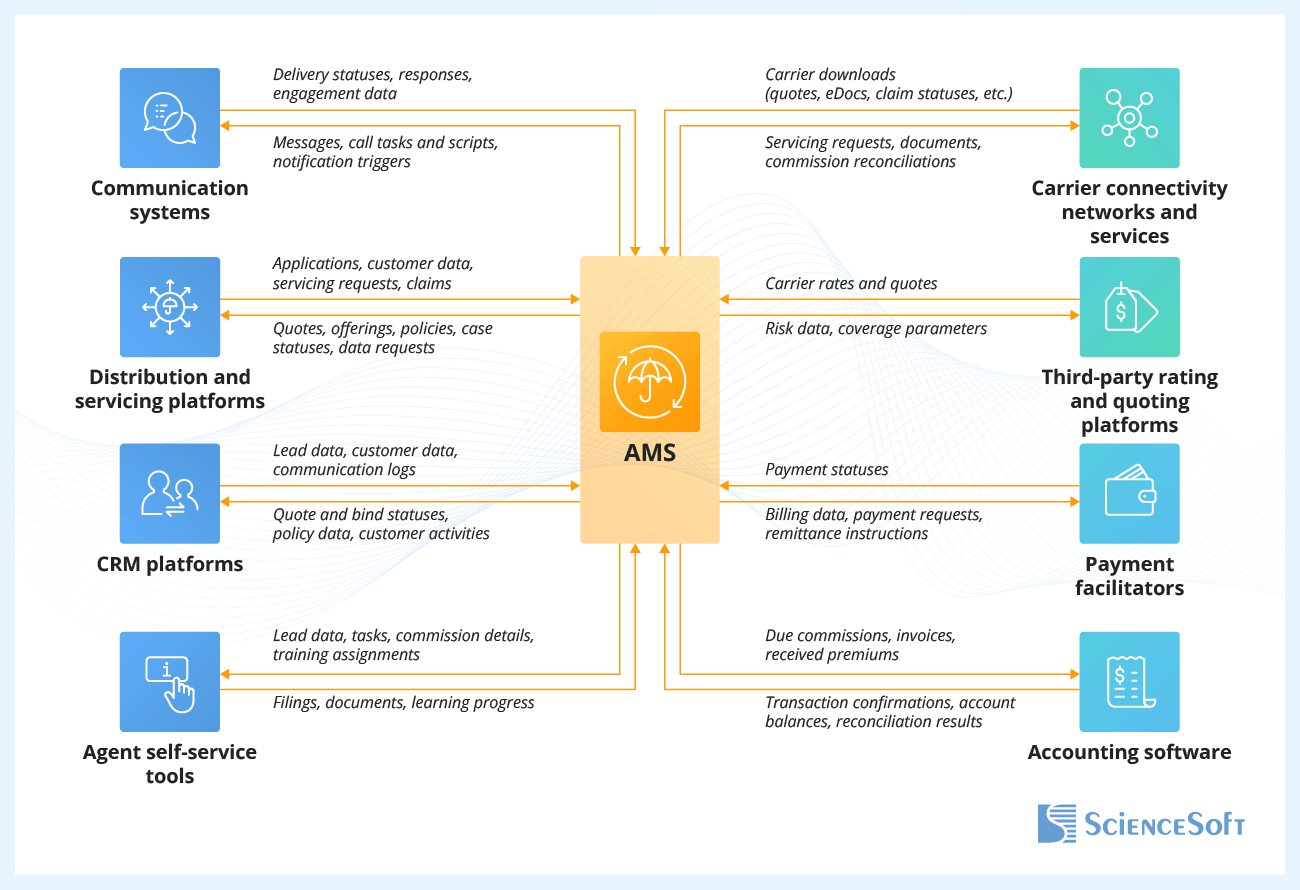
The efficacy of agency management software depends heavily on its ability to communicate with external entities. This is achieved through several standardized protocols and technical frameworks.
- ACORD Standards: The Association for Cooperative Operations Research and Development (ACORD) sets the global standards for insurance data. A high-quality AMS uses ACORD XML standards to ensure that data sent from the agency to the carrier is interpreted correctly, preventing data entry errors that could lead to incorrect premiums.
- IVANS Downloads: IVANS is the industry standard for secure data exchange. Most modern AMS platforms utilize IVANS to automatically "download" policy updates, commission statements, and claims information from carriers directly into the agency’s database every night.
- API-First Design: In 2026, the most flexible systems are built with an API-first architecture. This allows agencies to plug in third-party tools—such as specialized chatbots, advanced analytics dashboards, or custom mobile apps—without needing to overhaul their core software.
Comparing Top Agency Management Solutions in 2026
The following table provides a snapshot of the leading software solutions utilized by auto insurance agencies. These platforms vary in their technical depth and target agency size.
| Software Name | Primary Target | Key Strength for Auto Insurance | Integration Capability |
|---|---|---|---|
| Vertafore (AMS360) | Mid-to-Large Agencies | Deep financial reporting and multi-state compliance. | Industry-leading (IVANS & specialized APIs) |
| Applied Systems (Epic) | Large/Enterprise Agencies | Massive scalability and global document standardization. | High (Comprehensive cloud ecosystem) |
| EZLynx | Small-to-Mid Agencies | Integrated comparative rater and consumer-facing portal. | High (Built-in rater synergy) |
| HawkSoft | Independent Agencies | Workflow-centric design and ease of use for staff. | Moderate (Focuses on core stability) |
| AgencyMatrix | Non-Standard/Retail | Low-cost entry point with strong basic automation. | Moderate (Best for high-volume, simple risks) |
The Impact of AI and Machine Learning in 2026
Artificial Intelligence has moved from a buzzword to a functional component of agency management software. For auto insurance, AI serves several specific purposes:
Predictive Underwriting Aids: While carriers do the final underwriting, the AMS can provide agents with a "pre-score" based on historical data. This helps agents manage client expectations and select the right carrier faster.
Automated Policy Auditing: AI algorithms scan new policy downloads from carriers to ensure they match the original quote. If a premium or coverage limit differs from what was promised to the client, the software flags the discrepancy for immediate human review.
Claims Triage: When a client reports an accident, the AMS can use machine learning to categorize the severity and suggest the next best actions, such as dispatching a preferred glass repair shop or initiating a rental car reservation.
Implementation Costs and Operational Considerations
Investing in an AMS is a significant financial and operational commitment. Costs in 2026 generally follow a SaaS (Software as a Service) model, but there are several layers to consider:
- Subscription Fees: These typically range from $100 to $500 per user per month, depending on the feature set and the volume of data managed.
- Implementation and Data Conversion: Moving data from an old system to a new one is the most challenging part of the process. Vendors often charge a one-time fee (ranging from $2,000 to $20,000+) to map and migrate legacy data.
- Third-Party Add-ons: Features like advanced comparative rating or text messaging services often require separate subscriptions that must be factored into the total cost of ownership.
- Training: Staff must be trained not just on how to click buttons, but on the new workflows enabled by the software. A failed implementation is rarely due to the software itself; it is usually due to a lack of "buy-in" and training.
Frequently Asked Questions
Can agency management software help with SR-22 filings?
Yes. Most modern systems tailored for auto insurance have built-in templates for SR-22 forms. They can automatically populate the required data from the client’s file and, in many cases, electronically file the form with the state's Department of Motor Vehicles (DMV) through carrier integrations. This reduces the risk of errors that could lead to a client’s license suspension.
Is cloud-based software better than on-premise solutions?
By 2026, cloud-based (SaaS) solutions have become the industry standard. Cloud platforms offer superior data security, automatic updates, and the ability for agents to work remotely or from mobile devices. On-premise solutions are largely obsolete due to the high costs of server maintenance and the difficulty of integrating with modern, web-based carrier APIs.
How does the software handle multi-policy discounts?
Advanced AMS platforms utilize "household" views. This means the software recognizes when a client has both an auto policy and a homeowners or renters policy. It can track multi-policy discounts across different carriers (if applicable) and alert the agent if a change in one policy (like canceling a home policy) will negatively impact the premium of the auto policy.
Does an AMS help with compliance and audits?
Absolutely. One of the primary functions of an AMS is to maintain an immutable log of all activities. If a state regulator or a carrier conducts an audit, the agency can produce a complete history of every quote, policy change, and communication. This "paper trail" is essential for defending against E&O claims and ensuring the agency follows state-specific insurance laws.
Can I use the software on a mobile phone?
Most top-tier agency management systems in 2026 offer dedicated mobile apps or "responsive" web interfaces. These allow agents to look up policy details, upload photos of vehicle damage directly to a claim file, and send digital ID cards to clients while on the move.
Practical Recommendation for Selecting Software
When choosing agency management software for an auto-focused agency in 2026, do not start with the feature list. Instead, start with your workflow. Document the step-by-step process your staff takes from the moment a lead calls to the moment the policy is bound.
Look for a system that automates the most time-consuming parts of that specific workflow—usually data entry and comparative rating. Request a "sandbox" or trial period where your most experienced agent can test the software with real-world scenarios, such as a multi-vehicle policy with a teen driver. Finally, prioritize vendors that offer robust data migration support, as the integrity of your historical data is your agency's most valuable asset.