Workers' compensation is a specialized form of insurance that provides wage replacement and medical benefits to employees who suffer job-related injuries or illnesses, in exchange for mandatory relinquishment of the employee's right to sue their employer for negligence. Understanding how this system functions is essential for maintaining workplace compliance, protecting worker rights, and managing corporate financial risk.
The Fundamental Purpose of Workers' Compensation
The modern workers' compensation system operates as a historic legislative compromise. Before state-regulated insurance frameworks were established, injured workers had to sue their employers in tort court to recover damages. This process was slow, costly, and frequently unsuccessful if the employer could prove the worker contributed to the accident or assumed the risk of the job.
Under the modern framework, fault is largely removed from the equation. Whether an injury is caused by employer negligence, worker error, or standard operational hazards, the employee is generally entitled to swift, no-fault medical care and partial wage replacement. In exchange, employers are shielded from catastrophic civil lawsuits that could otherwise bankrupt a business.
This framework creates a predictable economic environment. Insurers collect premiums calculated by payroll size and risk classification, pools are managed, and injured workers receive medical treatment without enduring protracted legal battles. However, navigating this system requires a firm grasp of state-specific statutory regulations, administrative deadlines, and procedural requirements.
Core Benefits Provided by Workers' Compensation
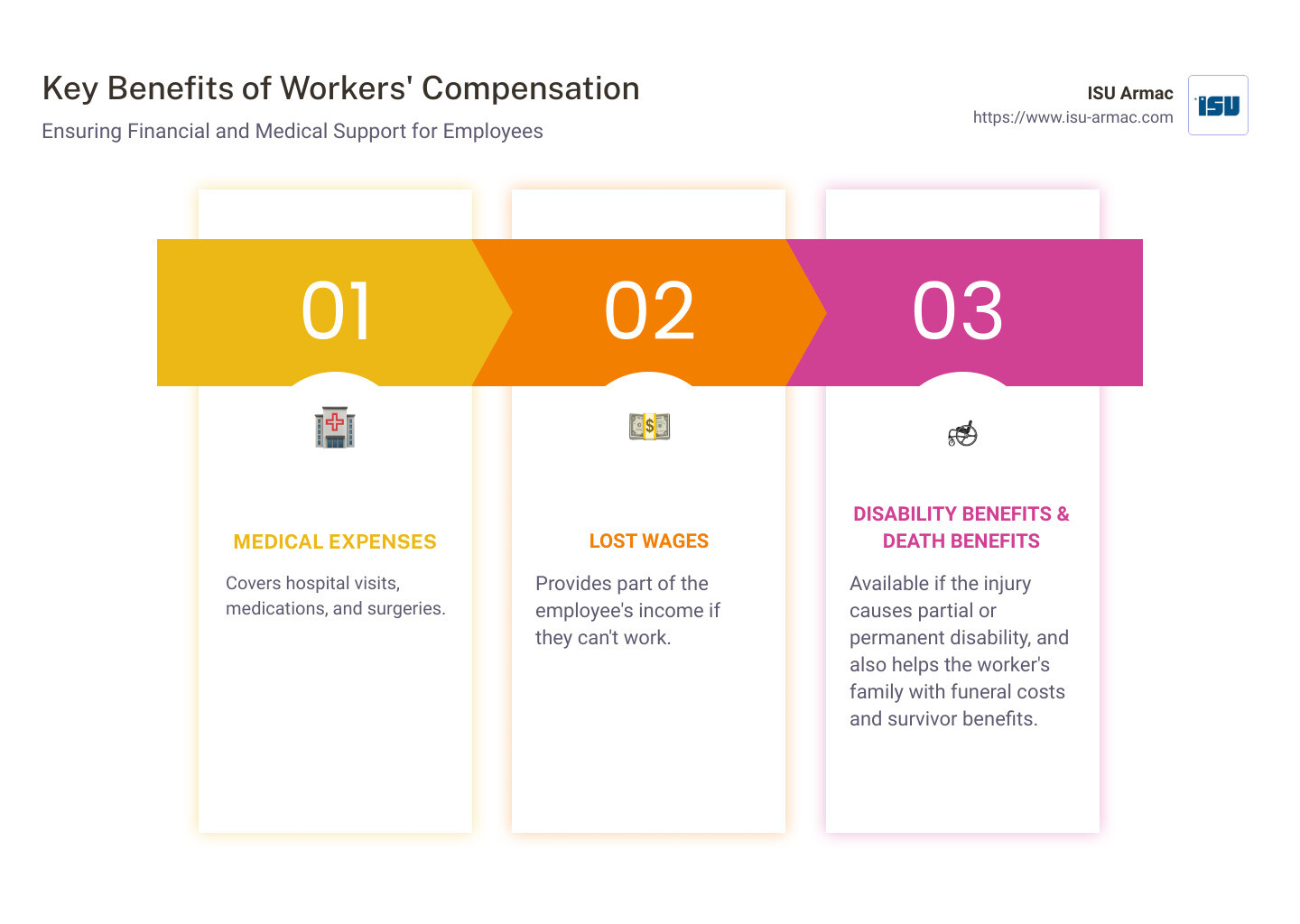
When a workplace injury or occupational illness occurs, the affected individual may be eligible for several distinct categories of benefits. These benefits are designed to cover immediate medical needs, offset lost earnings during recovery, and provide long-term support for permanent impairments.
Medical Treatment Benefits
All reasonable and necessary medical care related to a workplace injury is covered under standard workers' compensation policies. This includes emergency room visits, surgeries, prescription medications, physical therapy, durable medical equipment, and mileage reimbursement for travel to and from medical appointments. Crucially, the injured worker typically must see physicians approved by the employer's insurance carrier, depending on state regulations.
Wage Replacement (Disability) Benefits
If an injury prevents an employee from working, wage replacement benefits compensate for lost income. These are typically categorized by duration and severity:
- Temporary Total Disability (TTD): Paid when an employee is completely unable to work for a temporary period during recovery.
- Temporary Partial Disability (TPD): Paid when an employee can work in a restricted or reduced capacity while recovering, earning less than their pre-injury wage.
- Permanent Partial Disability (PPD): Paid when an employee reaches maximum medical improvement (MMI) but retains a permanent functional loss of a body part or system.
- Permanent Total Disability (PTD): Paid when an injury leaves an employee permanently and completely unable to engage in any gainful employment.
Vocational Rehabilitation
When an injury prevents a worker from returning to their previous occupation, vocational rehabilitation services assist with retraining, job placement, educational assistance, and resume development to help re-enter the workforce in a new capacity.
Death Benefits
In the tragic event of a fatal workplace injury, surviving dependents—typically spouses and minor children—receive financial compensation for lost financial support, alongside provisions for reasonable funeral and burial expenses.
How Claims Are Filed and Processed
The lifecycle of a workers' compensation claim follows a strict sequential process. Adhering to each step and statutory deadline is critical to ensure benefits are approved and disbursed without interruption.
Injury Occurs
Immediate Medical Attention
Employee Notifies Employer
- Employer Files First Report
- Insurance Investigation
- Claim Approved/Denied
- Insurance Investigation
- Employer Files First Report
Immediate Notification: The injured worker must report the incident to their employer as soon as possible. Most jurisdictions enforce strict statutory limits, ranging from a few days to 30 days. Delaying notification can result in claim denial.
Seeking Medical Care: For life-threatening emergencies, the worker should go to the nearest hospital. For non-emergencies, the employee must coordinate with the employer or insurer to see an authorized medical provider within the network.
Filing the Employer Report: The employer must complete a First Report of Injury (FROI) form and submit it to their insurance carrier and the state workers' compensation board within mandated deadlines.
Insurance Review and Determination: The insurance adjuster investigates the claim to verify that the injury arose out of and in the course of employment. The insurer then issues a formal acceptance or denial of the claim.
Dispute Resolution: If a claim is denied or benefits are disputed, either party can request a hearing, mediation, or arbitration through the state's administrative agency governing labor and industrial relations.
Insurance Structures and Funding Mechanisms
Employers cannot simply opt out of workers' compensation in most jurisdictions. They must secure coverage through specific state-sanctioned mechanisms to remain legally compliant.
| Coverage Type | Description | Primary Suitability |
|---|---|---|
| Private Insurance | Policies purchased from commercial property and casualty insurance carriers licensed in the state. | Most standard commercial businesses and private employers. |
| State Funds | Monopolistic or competitive state-run insurance funds that provide coverage directly to employers. | Businesses operating in states with exclusive state-fund mandates (e.g., Ohio, Washington). |
| Self-Insurance | Large corporations meeting strict financial solvency and asset thresholds that pay employee claims directly. | Enterprise-level organizations with predictable loss histories and substantial capital reserves. |
| Group Self-Insurance | Associations of similar employers pooling resources and risk to self-insure collectively under state oversight. | Trade groups, professional associations, and homogeneous industry clusters. |
Insurance premiums are not arbitrary; they are calculated using a complex formula involving the employer's total payroll, the risk classification code associated with the industry, and the company's Experience Modification Rate (EMR). The EMR compares an employer's actual historical losses against the expected losses for similar businesses in the same industry. An EMR below 1.0 indicates a safer-than-average safety record, lowering premiums, while an EMR above 1.0 increases insurance costs due to a higher frequency or severity of past claims.
Common Pitfalls and Troubleshooting Disputed Claims
Navigating the workers' compensation landscape frequently introduces friction between employers, insurers, and injured workers. Recognizing common points of failure helps mitigate disputes and ensures smoother administrative processing.
Missed Deadlines
Failing to report an injury within the statutory timeframe is one of the most frequent reasons claims are denied. Employers must establish clear internal reporting protocols to ensure workers understand that every incident—no matter how minor it initially appears—must be documented immediately.
Independent Medical Examinations (IMEs)
Insurance carriers frequently require injured workers to undergo an Independent Medical Examination by a physician chosen and paid for by the insurer. Discrepancies between the treating physician's assessment and the IME doctor's findings often lead to benefit termination. Injured workers have the right to challenge IME findings through administrative legal channels.
Pre-Existing Conditions
Insurers may contest liability by arguing that an injury or chronic pain stems from a pre-existing medical condition rather than a workplace incident. Comprehensive medical history documentation and diagnostic imaging taken immediately following the accident are essential to prove the aggravation or direct causation of the workplace event.
Independent Contractors vs. Employees
A major point of legal contention involves classification. Generally, statutory workers' compensation requirements apply only to W-2 employees, not true 1099 independent contractors. However, misclassification lawsuits are common, and regulatory boards look beyond contracts to examine the actual level of control an employer exerts over the worker's schedule and methods.
Frequently Asked Questions
What types of injuries are covered under workers' compensation?
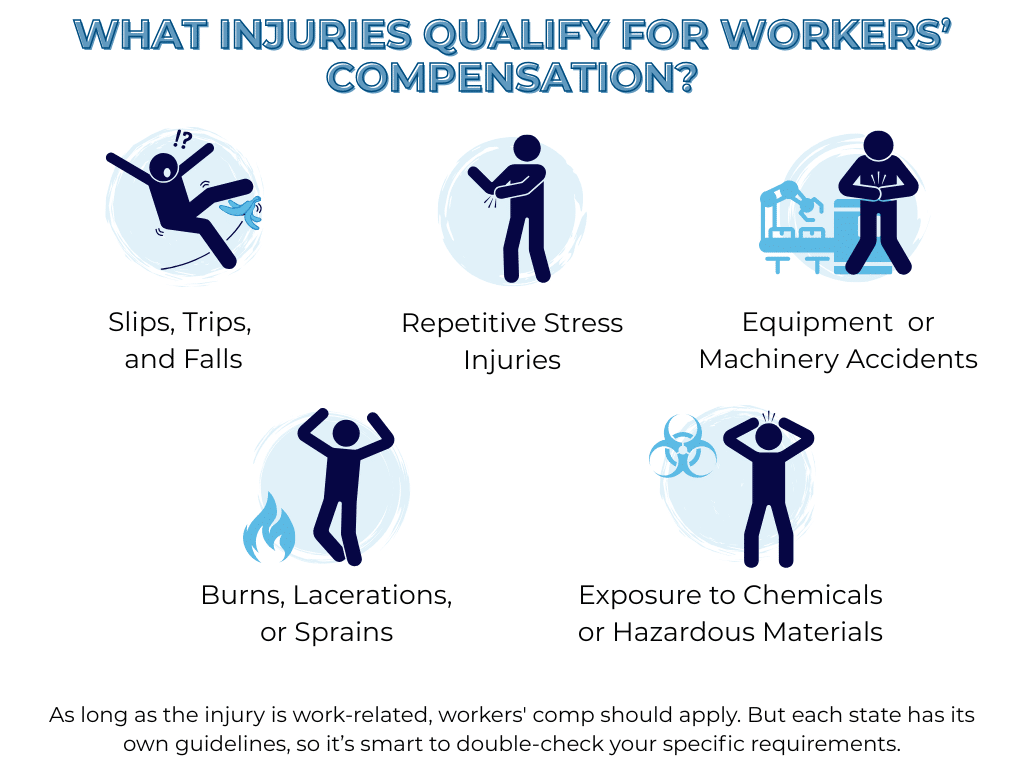
Workers' compensation covers accidental physical injuries sustained while performing job duties, occupational diseases caused by long-term workplace exposure (such as mesothelioma or carpal tunnel syndrome), and mental health conditions resulting from sudden workplace trauma or specific state-recognized occupational stressors. Commuting to and from work is generally excluded.
Can I choose my own doctor for a workplace injury?
This depends entirely on state law and employer-managed care networks. In some jurisdictions, employees must select from a pre-approved list of physicians provided by the employer or insurance carrier for a designated period. In other states, employees retain the right to see their own doctor from the outset.
What happens if my workers' compensation claim is denied?
If an insurance carrier denies a claim, the injured worker has the right to file an appeal or a formal claim petition with the state's workers' compensation board or industrial commission. This triggers a legal process involving administrative hearings, submission of medical evidence, and potentially testimony before an administrative law judge.
Does workers' compensation cover independent contractors?
Traditionally, independent contractors are excluded from mandatory workers' compensation coverage because they operate as separate business entities. However, if a hiring organization exerts significant behavioral and financial control over a worker, regulatory agencies may reclassify them as an employee, making the business liable for unpaid premiums and retroactive benefits.
Can an employer fire me for filing a workers' compensation claim?
No. State and federal laws strictly prohibit employers from retaliating against employees for exercising their legal rights to file a workers' compensation claim. Retaliatory discharge, demotion, or harassment constitutes wrongful termination, opening the employer to separate civil litigation outside the workers' compensation system.
Practical Next Steps
For employers, compliance begins with verifying that current insurance policies meet state statutory limits, conducting regular workplace safety audits, and posting mandatory employee rights notices in common areas. For employees who have suffered an injury, immediate action is paramount: report the incident in writing to a supervisor, seek authorized medical evaluation promptly, and maintain meticulous records of all medical documentation, communications, and lost work time. Consulting with an employment or workers' compensation attorney is advisable if complex disputes or denials arise.