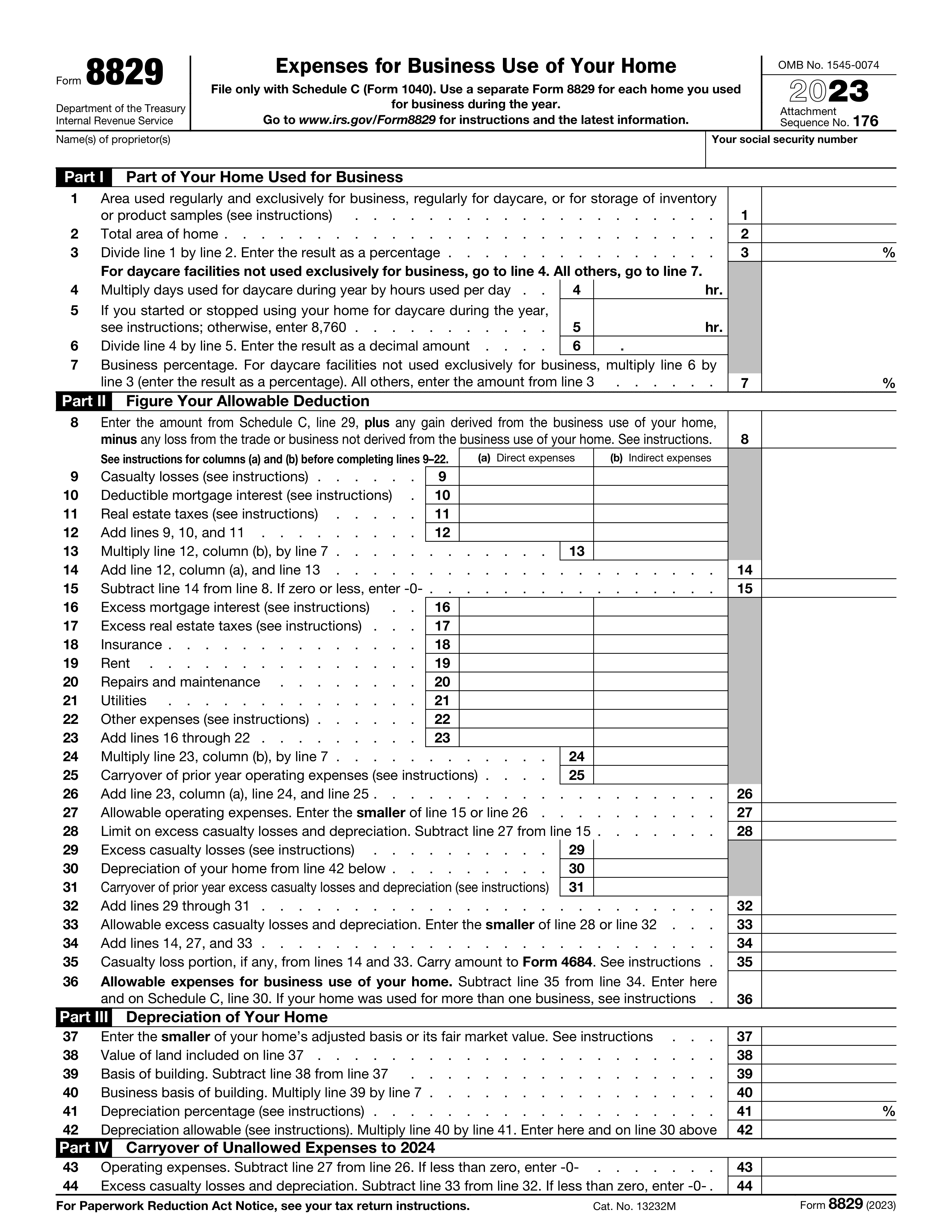
IRS Form 8829, Expenses for Business Use of Your Home, is the primary tax document used by sole proprietors and certain partners to calculate the deductible portion of home-related expenses. By filing this form alongside Schedule C, taxpayers can offset their business income with qualified costs associated with the exclusive and regular use of a portion of their residence for professional activities.
Understanding the Purpose of Form 8829
For millions of self-employed individuals, the home office is the headquarters of their professional operations. The Internal Revenue Service (IRS) recognizes that maintaining a business environment incurs specific overhead costs. Form 8829 serves as the mathematical bridge between your personal living expenses and your business-related deductions.
When you operate a business from home, you cannot simply deduct all your housing costs. The IRS requires a strict allocation based on the square footage of the space used for business compared to the total square footage of your home. Form 8829 guides you through this allocation process, ensuring that you only claim the percentage of utilities, mortgage interest, insurance, and repairs that directly pertain to your professional workspace.
Prerequisites for Eligibility
Before attempting to complete Form 8829, you must satisfy the IRS requirements for a home office deduction. These rules are stringent and are designed to prevent the commingling of personal and professional expenses.
1. Exclusive Use The portion of your home used for business must be used solely for business purposes. If you use your home office to watch television, host guests, or as a play area for children, it fails the "exclusive" test. While there are minor exceptions—such as storing inventory or running a daycare facility—the general rule requires that the space be dedicated entirely to your trade or business.
2. Regular Use Occasional or incidental use of a home office does not qualify. The area must be used on a regular basis for the conduct of your business. This usually means you are performing core business tasks in that specific space consistently throughout the tax year.
3. Principal Place of Business Your home office must be your principal place of business. This is determined by looking at where you perform your most important administrative or management activities and where you spend the most time. If you have another office location for your business, you generally cannot claim the home office deduction unless the home space is used substantially for administrative tasks and you have no other location to perform them.
Structure of Form 8829
Form 8829 is logically divided into sections that take you from calculating your business square footage to finalizing your total deductible amount.
Part I: Part of Your Home Used for Business
In this section, you determine the "business percentage." You will input the total square footage of your home and the square footage specifically allocated to your business. This ratio is the engine of the form; almost all subsequent expense calculations are multiplied by this percentage.
Part II: Figure Your Allowable Deduction
This section is where you list your actual expenses. These are categorized into "direct" expenses (costs that apply only to the business part of the home, such as painting the office) and "indirect" expenses (costs that apply to the whole house, such as mortgage interest or electricity).
Part III: Depreciation of Your Home
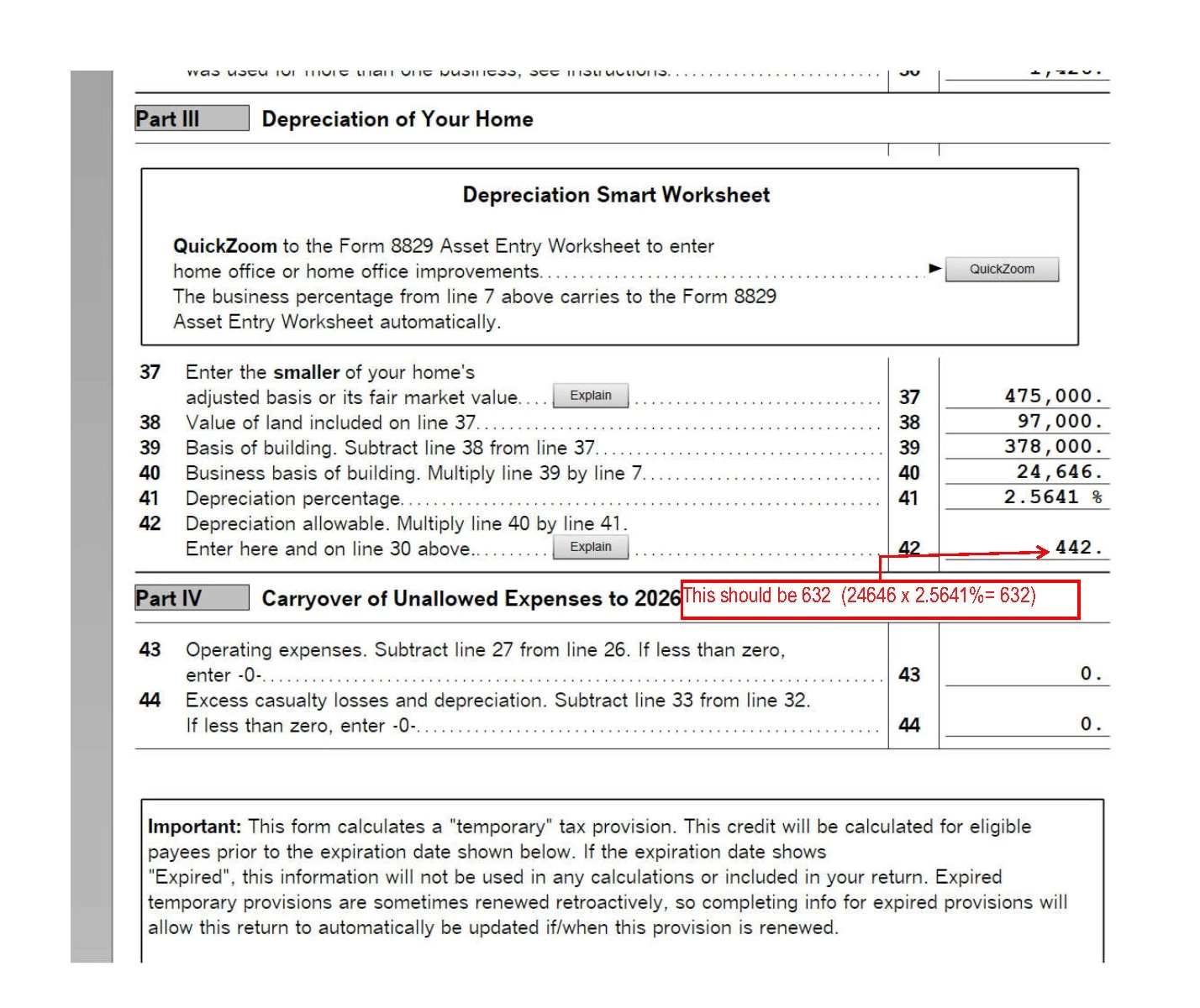
If you own your home, you are entitled to claim depreciation on the business portion of the property. This reflects the wear and tear of the office space over time. Calculating this involves determining the cost basis of your home (excluding the value of the land) and applying the appropriate recovery period provided by the IRS.
Part IV: Carryover of Unallowed Expenses
In some tax years, your business income may be lower than your total home office expenses. Because home office deductions cannot create a net loss for your business, the IRS allows you to carry over excess expenses to future tax years. This section tracks those figures so you do not lose the benefit of those deductions.
Direct vs. Indirect Expenses
To accurately fill out the form, you must distinguish between two types of costs:
- Direct Expenses: These are expenses that benefit only the business part of your home. For example, if you hire a contractor to repair a wall inside your dedicated office, that is a direct expense. You deduct 100% of this cost, provided it is fully related to the business space.
- Indirect Expenses: These are costs that maintain the entire house and therefore benefit both personal and business areas. Examples include your homeowners' insurance, general utility bills, trash removal, and basic home repairs like a new roof. These are multiplied by your business percentage (calculated in Part I) to determine the deductible amount.
The Simplified Option vs. Actual Expenses
In 2013, the IRS introduced a "simplified option" for the home office deduction. It is vital to understand that if you choose this method, you do not use Form 8829.
The simplified option allows you to deduct $5 per square foot of your home used for business, up to a maximum of 300 square feet (a $1,500 maximum deduction). While this is significantly easier to calculate and requires less record-keeping, it often results in a lower tax benefit for homeowners with high mortgage interest or significant maintenance costs. Form 8829 is reserved for those who choose the "actual expenses" method, which allows for the deduction of depreciation and a higher total dollar amount if your housing costs are substantial.
Common Mistakes to Avoid
- Including Land Value in Depreciation: When calculating the value of your home for depreciation, you must exclude the value of the land. Land is not a depreciable asset. Use your property tax statement to find the ratio of land value to building value.
- Double Dipping: You cannot deduct the same expense twice. If you have already deducted a portion of your utility bill on Schedule C as a direct utility expense, do not include it again as an indirect expense on Form 8829.
- Mixing Personal and Business: Ensure your records clearly distinguish between equipment used for personal purposes and equipment dedicated to the business.
- Neglecting the "Principal Place" Rule: Do not assume that any home office qualifies. If you have a separate office building downtown and only occasionally do administrative work at home, your home office likely does not qualify for the deduction.
Comparison of Deduction Methods
| Feature | Actual Expenses (Form 8829) | Simplified Option |
|---|---|---|
| Documentation | Detailed logs, receipts, and square footage | Just square footage (up to 300 sq ft) |
| Depreciation | Required and complex to calculate | Not allowed |
| Deduction Limit | Up to total business income | Maximum $1,500 per year |
| Suitability | Best for high-cost homes/large offices | Best for low-cost homes/simple records |
| Tax Filing | Requires Form 8829 | Reported directly on Schedule C |
Record-Keeping Best Practices
The IRS requires that you maintain adequate records to substantiate your claims. If you are audited, the burden of proof lies with you.
- Floor Plan: Maintain a sketch or blueprint of your home showing the exact square footage of the business area versus the total area.
- Itemized Receipts: Keep a file of all bills related to indirect expenses (utilities, internet, repairs). Even though you only deduct a percentage, you must prove the total amount spent on the household.
- Business Use Logs: While not strictly required by law for every profession, maintaining a calendar or log of business activities in that space strengthens your position if the nature of your business is questioned.
- Depreciation Records: Keep a permanent file of your home’s purchase price, closing costs, and the calculation used to arrive at your depreciation schedule.
Next Steps for Taxpayers
If you are a sole proprietor or independent contractor, your first step is to determine which method—Simplified or Actual Expenses—provides the greater financial benefit. Calculate your total actual expenses for the year, including depreciation, and compare that against the $5-per-square-foot cap of the simplified method.
If the Actual Expense method is higher, collect your property tax records, mortgage interest statements (Form 1098), and utility bills. Ensure you have the square footage measurements for both your office and your entire home. If you are unsure about the classification of a particular expense or the calculation of your home's basis for depreciation, consult with a certified public accountant (CPA) or a tax attorney. Tax laws regarding home offices can be complex, and errors in depreciation calculations can lead to issues when you eventually sell your home.