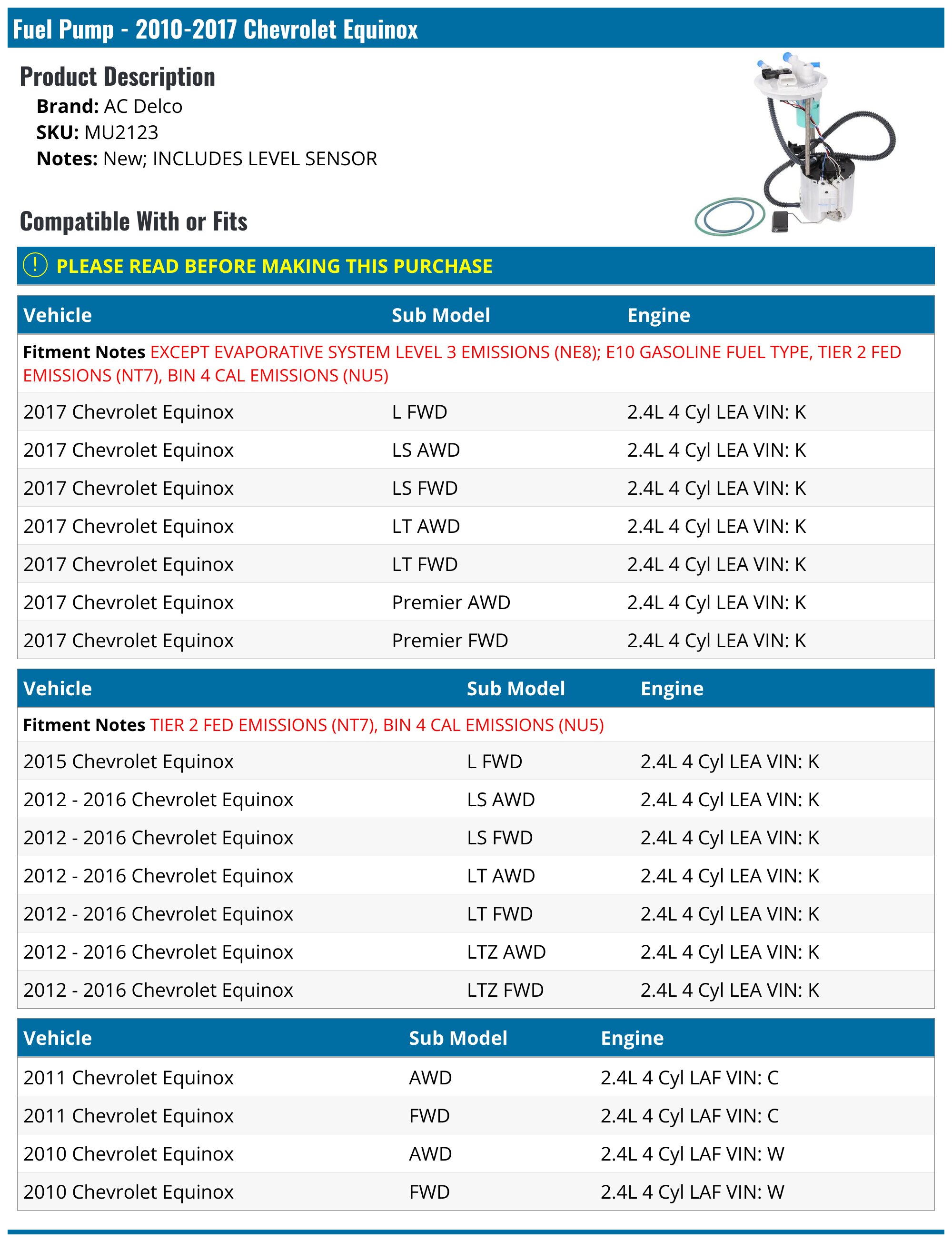
The fuel tank capacity of the 2017 Chevrolet Equinox depends on whether the vehicle is equipped with Front-Wheel Drive (FWD) or All-Wheel Drive (AWD). Front-Wheel Drive models feature an 18.8-gallon (71.2-liter) fuel tank, while All-Wheel Drive configurations come with a larger 20.9-gallon (79.1-liter) fuel tank.
2017 Chevrolet Equinox Fuel Tank Size by Drivetrain
When shopping for or maintaining a 2017 Chevrolet Equinox, understanding the specific fuel tank capacity is essential for calculating trip ranges, estimating fill-up costs, and monitoring fuel efficiency. General Motors engineered the second-generation Equinox—of which 2017 was the final model year—with two distinct fuel tank capacities based on the underlying drivetrain architecture.
Front-Wheel Drive (FWD) Fuel Capacity
All Front-Wheel Drive trim levels (L, LS, LT, and Premier) equipped with either the standard 2.4-liter 4-cylinder engine or the optional 3.6-liter V6 engine carry an 18.8 US gallon fuel tank (approximately 71.2 liters or 15.6 Imperial gallons).
The FWD architecture requires less underbody spacing for rear-axle drive components, but GM utilized an 18.8-gallon composite fuel tank to balance vehicle curb weight, interior floor height, and overall efficiency.
All-Wheel Drive (AWD) Fuel Capacity
All-Wheel Drive configurations across the LS, LT, and Premier trims feature a larger 20.9 US gallon fuel tank (approximately 79.1 liters or 17.4 Imperial gallons). Note that the base L trim was offered exclusively in FWD.
The inclusion of a larger fuel tank on AWD models was a practical engineering choice by Chevrolet. Because AWD components (such as the transfer case, drive shaft, and rear differential) add physical weight and mechanical drag to the vehicle, AWD models consume fuel at a higher rate than their FWD counterparts. To prevent AWD owners from experiencing significantly shorter driving ranges between fill-ups, General Motors installed a 2.0-gallon larger tank to offset the decreased fuel economy.
Engine Options and EPA Fuel Economy Ratings
The overall driving range of the 2017 Chevrolet Equinox is determined by pairing its drivetrain-specific fuel capacity with the vehicle's engine configuration. Chevrolet offered two distinct engines for the 2017 model year: the 2.4-liter Ecotec inline 4-cylinder and the 3.6-liter high-feature V6.
2.4-Liter DOHC 4-Cylinder Engine (LEA)
The standard engine in most 2017 Equinox models is the 2.4-liter Ecotec 4-cylinder, producing 182 horsepower and 172 lb-ft of torque. Featuring spark-ignition direct injection (SIDI) and Variable Valve Timing (VVT), this engine was optimized for daily commuting and highway efficiency.
- FWD 2.4L EPA Estimates: 21 MPG City / 31 MPG Highway / 25 MPG Combined
- AWD 2.4L EPA Estimates: 20 MPG City / 28 MPG Highway / 23 MPG Combined
3.6-Liter DOHC V6 Engine (LFX)
Available on LT and Premier trim levels, the 3.6-liter V6 engine provides a substantial increase in output, delivering 301 horsepower and 272 lb-ft of torque. It incorporates dual overhead camshafts, direct fuel injection, and continuously variable valve timing. While providing significantly stronger acceleration and a maximum towing capacity of up to 3,500 lbs (compared to 1,500 lbs for the 4-cylinder), it consumes fuel at a higher rate.
- FWD 3.6L V6 EPA Estimates: 17 MPG City / 24 MPG Highway / 20 MPG Combined
- AWD 3.6L V6 EPA Estimates: 16 MPG City / 23 MPG Highway / 18 MPG Combined
Estimated Real-World Driving Range
By multiplying the EPA fuel economy ratings by the total fuel capacity, you can estimate the theoretical maximum distance a 2017 Chevrolet Equinox can travel on a single full tank of gasoline.
Total Highway Range = Fuel Tank Capacity (Gallons) × EPA Highway MPG Total Combined Range = Fuel Tank Capacity (Gallons) × EPA Combined MPG
In actual driving conditions, drivers should never plan to run a tank completely to zero. Fuel pumps rely on submersed fuel for cooling and lubrication, and running on absolute empty risks drawing sediment from the bottom of the tank into the fuel delivery lines. However, understanding theoretical range provides a clear benchmark for long-distance travel.
2.4L 4-Cylinder Range Expectations
- 2.4L FWD (18.8 Gal Tank):
- Highway Range: Up to 582 miles (18.8 gal × 31 mpg)
- City Range: Up to 394 miles (18.8 gal × 21 mpg)
- Combined Range: Approximately 470 miles (18.8 gal × 25 mpg)
- 2.4L AWD (20.9 Gal Tank):
- Highway Range: Up to 585 miles (20.9 gal × 28 mpg)
- City Range: Up to 418 miles (20.9 gal × 20 mpg)
- Combined Range: Approximately 480 miles (20.9 gal × 23 mpg)
Notice how the larger 20.9-gallon tank in the AWD 2.4L model effectively normalizes the highway cruising distance, allowing it to achieve a maximum highway range nearly identical to the lighter FWD model.
3.6L V6 Range Expectations
- 3.6L V6 FWD (18.8 Gal Tank):
- Highway Range: Up to 451 miles (18.8 gal × 24 mpg)
- City Range: Up to 319 miles (18.8 gal × 17 mpg)
- Combined Range: Approximately 376 miles (18.8 gal × 20 mpg)
- 3.6L V6 AWD (20.9 Gal Tank):
- Highway Range: Up to 480 miles (20.9 gal × 23 mpg)
- City Range: Up to 334 miles (20.9 gal × 16 mpg)
- Combined Range: Approximately 376 miles (20.9 gal × 18 mpg)
Complete 2017 Chevrolet Equinox Fuel & Range Specification Table
The following comparison details fuel tank dimensions, EPA fuel economy ratings, and estimated total driving ranges for all factory configurations of the 2017 Chevrolet Equinox.
| Drivetrain | Engine | Fuel Tank Capacity (Gallons / Liters) | EPA Rating (City / Hwy / Combined) | Estimated City Range | Estimated Highway Range | Estimated Combined Range |
|---|---|---|---|---|---|---|
| FWD | 2.4L 4-Cylinder | 18.8 gal / 71.2 L | 21 / 31 / 25 MPG | 394 miles | 582 miles | 470 miles |
| AWD | 2.4L 4-Cylinder | 20.9 gal / 79.1 L | 20 / 28 / 23 MPG | 418 miles | 585 miles | 480 miles |
| FWD | 3.6L V6 | 18.8 gal / 71.2 L | 17 / 24 / 20 MPG | 319 miles | 451 miles | 376 miles |
| AWD | 3.6L V6 | 20.9 gal / 79.1 L | 16 / 23 / 18 MPG | 334 miles | 480 miles | 376 miles |
Fuel Requirements and FlexFuel (E85) Capability
Choosing the correct fuel grade ensures optimal engine performance, long-term durability, and proper fuel system operation.
Recommended Gasoline Octane Rating
For both the 2.4L 4-cylinder engine and the 3.6L V6 engine, General Motors specifies the use of 87 octane regular unleaded gasoline (posted as (R+M)/2 on fuel pumps).
- Is Premium Fuel Required? Premium fuel (91 or 93 octane) is not required and is not necessary under normal driving conditions. The engine control module (ECM) is calibrated specifically for 87 octane. Using premium gasoline will not yield noticeable gains in horsepower or fuel economy.
- Ethanol Blend Limits: Standard regular unleaded gasoline containing up to E10 (10% ethanol) or E15 (15% ethanol) is fully approved by GM for use in all non-FlexFuel 2017 Equinox models.
FlexFuel (E85) Compatibility
Certain 2017 Chevrolet Equinox models equipped with the 2.4L 4-cylinder engine were manufactured as FlexFuel vehicles (FFV). These models are capable of operating on standard gasoline, E85 ethanol (a blend of up to 85% ethanol and 15% gasoline), or any combination of the two.
Identifying FlexFuel Capability
To confirm whether a specific 2017 Equinox is FlexFuel compatible:
- Check the exterior tailgate for a FlexFuel emblem.
- Inspect the fuel filler neck or fuel cap for a yellow gas cap or yellow collar marking.
- Cross-reference the 8th digit of the Vehicle Identification Number (VIN). A VIN code of "K" or "1" on 2.4L models generally designates FlexFuel factory equipment.
Impact of E85 Ethanol on Fuel Economy and Tank Capacity
While E85 ethanol often costs less per gallon at the pump, ethanol contains roughly 27% less energy per gallon compared to pure gasoline. Consequently, when running a 2017 Equinox on E85:
- Fuel economy decreases by approximately 25% to 30%.
- EPA estimates for a 2.4L FWD Equinox running on E85 drop to roughly 15 MPG City / 22 MPG Highway.
- The total driving range on an 18.8-gallon tank drops from 582 highway miles down to approximately 413 highway miles.
Owners choosing E85 should calculate the cost-per-mile differential rather than looking strictly at the price-per-gallon saved at the pump.
Low Fuel Light and Reserve Capacity
When the fuel gauge in a 2017 Chevrolet Equinox approaches empty, the Driver Information Center (DIC) illuminates a low-fuel warning symbol accompanied by an audible chime.
How Much Fuel Is Left When the Light Turns On?
On average, the low fuel indicator illuminates when the tank level drops to approximately 2.0 to 2.5 gallons of remaining fuel.
- FWD Models (18.8-Gallon Tank): The light turns on when approximately 16.3 to 16.8 gallons have been consumed.
- AWD Models (20.9-Gallon Tank): The light turns on when approximately 18.4 to 18.9 gallons have been consumed.
Emergency Driving Margin
Depending on vehicle configuration and driving style, a reserve of 2.0 to 2.5 gallons provides a buffer of:
- 2.4L 4-Cylinder: Approximately 40 to 70 miles of remaining travel before total exhaustion.
- 3.6L V6: Approximately 30 to 50 miles of remaining travel.
Risks of Driving on Reserve Fuel
Operating the 2017 Equinox frequently near empty can lead to premature components failure:
- Fuel Pump Overheating: The electric fuel pump is mounted inside the fuel tank and uses surrounding liquid gasoline to dissipate heat. Operating on low fuel exposes the pump motor body, causing elevated operational temperatures that shorten pump lifespan.
- Debris Ingestion: Sediment, rust particles, and moisture naturally settle at the bottom of the fuel tank over time. Operating with extremely low liquid levels increases the likelihood of drawing sediment into the fuel pump strainer, restricting flow, and stressing the high-pressure fuel pump.
- Engine Misfires: Severe cornering or sudden acceleration with under 2 gallons in the tank can cause fuel sloshing, leading to momentary fuel starvation, vapor lock, and ECM misfire codes.
Key Factors That Reduce Fuel Range in the 2017 Equinox
While official EPA figures serve as a baseline, several real-world maintenance items and environmental conditions directly degrade the 2017 Equinox's fuel economy and overall range.
1. High-Pressure Fuel Pump (HPFP) and Direct Injection Wear
The 2.4L Ecotec engine utilizes direct injection operating at pressures up to 2,200 PSI. As these engines age, high-pressure fuel pump internal seals can wear down, leading to subtle fuel dilution in the engine oil or rich air-fuel mixtures. Additionally, intake valve carbon buildup—common in direct-injection engines—can restrict airflow, reducing combustion efficiency and decreasing mileage by 5% to 10%.
2. Oxygen Sensors and EVAP Purge Valve Issues
A sticking Evaporative Emission Control (EVAP) canister purge valve or an aging upstream oxygen ($O_2$) sensor can alter the air-fuel ratio calculations made by the ECM. A stuck-open purge valve draws raw fuel vapors from the charcoal canister continuously, resulting in poor idle, rich running conditions, and reduced fuel efficiency.
3. Tire Pressure and Wheel Alignment
Under-inflated tires increase rolling resistance significantly. For every 1 PSI drop in tire pressure across all four tires, fuel economy drops by roughly 0.2%. General Motors specifies a cold tire pressure of 35 PSI for the 2017 Equinox. Running tires at 28 PSI can decrease total highway range by 25 to 40 miles per tank.
4. Excessive Engine Idling and Cargo Weight
The 2.4L and 3.6L engines consume between 0.2 and 0.4 gallons of fuel per hour while idling. Extended remote start usage in winter or sitting in stopped traffic drains the tank without adding mileage. Additionally, carrying 100 lbs of unnecessary cargo in the rear cargo area degrades fuel efficiency by roughly 1%.
Troubleshooting Common Fuel System Issues
Owners of the 2017 Equinox may occasionally encounter diagnostic trouble codes (DTCs) or physical symptoms related to the fuel storage and delivery system.
Faulty Fuel Level Sensor / Gauge Inaccuracy
If the fuel gauge fluctuates erratically, fails to register a full tank after refueling, or drops suddenly to empty, the culprit is often the fuel level sending unit attached to the fuel pump module inside the tank. Over time, the variable resistor tracks on the sending unit can wear down or suffer from sulfur buildup present in poor-quality fuel. Using high-detergent Top Tier gasoline helps prevent fuel level sensor contamination.
EVAP System Leak Codes (P0442, P0455)
The 2017 Equinox features a capless or quick-turn fuel cap design depending on production run. If the Check Engine Light displays codes P0442 (small EVAP leak) or P0455 (large EVAP leak):
- Inspect the rubber O-ring seal on the gas cap for cracks, dirt, or degradation.
- Ensure the fuel cap clicks securely into place after refueling.
- Inspect the underbody EVAP vapor lines near the gas tank for physical damage, corrosion, or disconnected fittings.
Frequently Asked Questions
How far can a 2017 Chevy Equinox go on a full tank of gas?
A 2017 Chevy Equinox can travel between 376 and 585 miles on a full tank, depending on the engine and drivetrain configuration. The 2.4L 4-cylinder AWD model offers the highest maximum highway range at approximately 585 miles on its 20.9-gallon tank. The 3.6L V6 models average between 376 miles (combined driving) and 480 miles (highway driving).
What size gas tank does a 2017 Chevy Equinox LS have?
The gas tank size depends on the drivetrain rather than the trim level. A 2017 Equinox LS with Front-Wheel Drive has an 18.8-gallon tank, whereas an LS with All-Wheel Drive has a 20.9-gallon tank.
Can you put E85 ethanol in a 2017 Chevy Equinox?
You can use E85 ethanol in a 2017 Equinox only if it is a FlexFuel-designated model (typically 2.4L engines equipped with the FlexFuel package). These vehicles are identified by a FlexFuel badge on the rear tailgate, a yellow gas cap or filler ring, or a "K" or "1" as the 8th digit of the VIN. Non-FlexFuel models and 3.6L V6 models must use standard unleaded fuel with no more than 15% ethanol (E15).
How much gas is left when the fuel light comes on in a 2017 Equinox?
When the low fuel warning light illuminates, approximately 2.0 to 2.5 gallons of fuel remain in the tank. In a 2.4L model, this offers about 40 to 70 miles of remaining range under prudent driving conditions, while in a V6 model, it offers about 30 to 50 miles.
Does the 2017 Equinox take premium gas?
No, the 2017 Chevrolet Equinox does not require premium gas. Both the 2.4L 4-cylinder engine and the 3.6L V6 engine are engineered and calibrated to run on standard 87 octane regular unleaded gasoline.
Recommended Next Steps for Owners
To maintain fuel system health, optimize driving range, and preserve fuel economy on a 2017 Chevrolet Equinox:
- Verify Your Drivetrain: Check your vehicle's registration or look under the rear bumper for a rear axle assembly to confirm whether you have an 18.8-gallon (FWD) or 20.9-gallon (AWD) tank.
- Maintain Recommended Tire Pressures: Keep all four tires inflated to 35 PSI (cold) to prevent excess rolling resistance and fuel degradation.
- Use Top Tier Gasoline: Refuel with Top Tier detergent gasoline to prevent carbon deposits on direct-injection fuel injectors and protect the fuel level sending unit.
- Avoid Running Near Empty: Plan fill-ups when the fuel gauge reaches a quarter tank ($1/4$ full) to extend fuel pump cooling and avoid drawing tank sediment into the delivery lines.