Maroon 5's "Memories" is a heartfelt, minimalist tribute to the band’s late manager and lifelong friend, Jordan Feldstein, who passed away in late 2017. The song serves as a universal anthem for grief and remembrance, utilizing the familiar melody of Pachelbel’s "Canon in D" to evoke nostalgia while celebrating the enduring impact of those who are no longer present.
The Personal Tragedy Behind the Song
To understand the weight of "Memories," one must first understand the relationship between Maroon 5’s frontman, Adam Levine, and the man the song honors: Jordan Feldstein. Feldstein was not just a business associate; he was a childhood friend of Levine and the brother of actors Jonah Hill and Beanie Feldstein. He had managed Maroon 5 since their inception, playing a pivotal role in transforming them from a local Los Angeles act into one of the biggest pop bands in the world.
In December 2017, Feldstein passed away suddenly at the age of 40 due to a pulmonary embolism. The loss sent shockwaves through the music industry and devastated the band. For nearly two years, the group processed this loss privately. When "Memories" was released in September 2019, it served as their first major creative response to that tragedy. As of 2026, the track remains the band's most intimate work, moving away from their usual high-gloss pop-rock production to offer something raw and vulnerable.
The song’s core message is about the "empty chair" at the table. It captures the specific moment during a celebration—a wedding, a holiday, or a simple night at the bar—where the joy of the present is momentarily eclipsed by the realization that someone vital is missing. By framing the song as a toast ("Here’s to the ones that we got"), Levine turns a personal eulogy into a communal experience for anyone who has ever raised a glass to a lost loved one.
Lyrical Analysis: A Verse-by-Verse Breakdown
The lyrics of "Memories" are deceptively simple. While they lack the complex metaphors found in some of the band's earlier work, their directness is exactly what allows the song to resonate with a global audience.
The Opening Toast
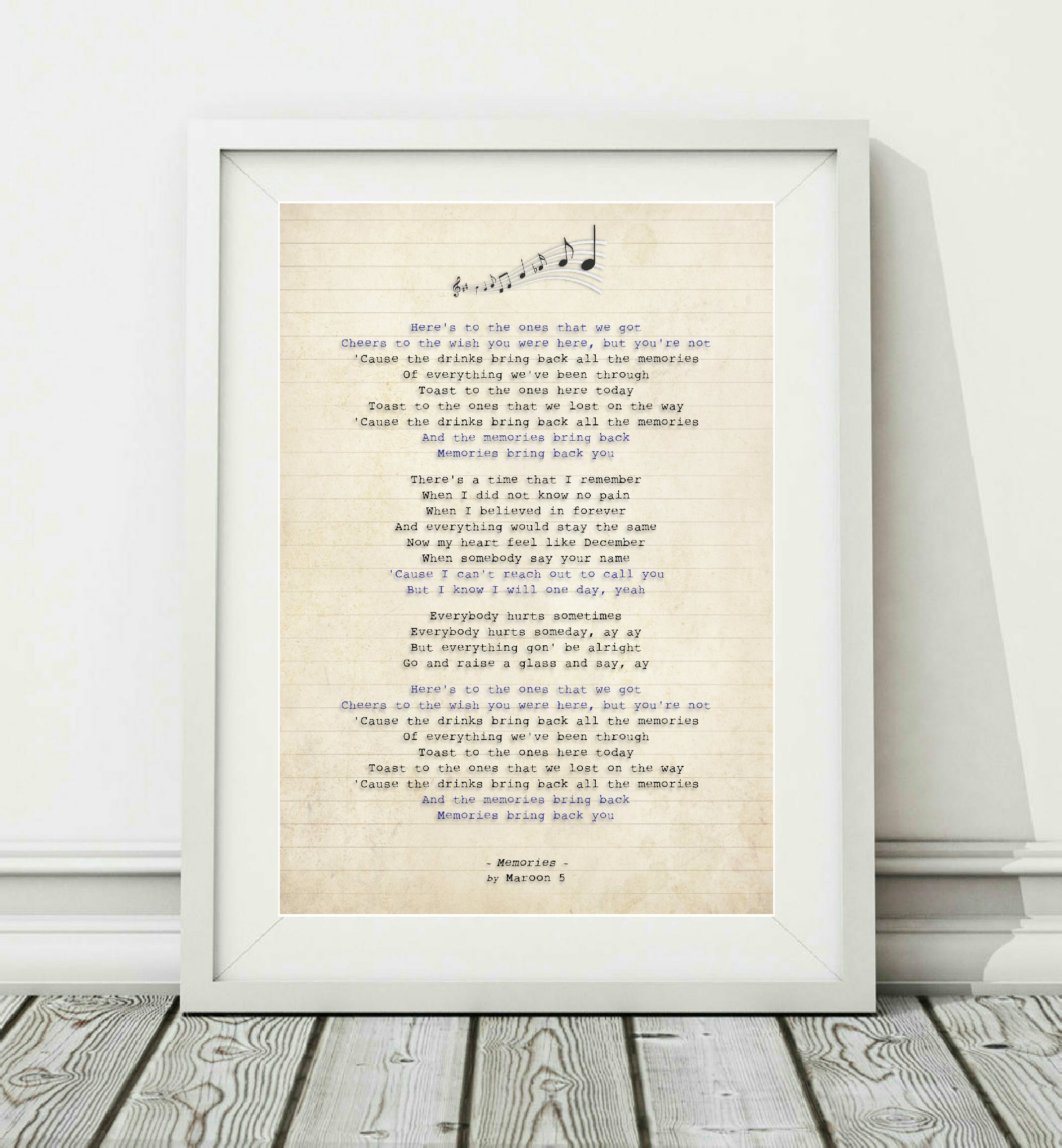
The song begins with the iconic lines: "Here's to the ones that we got / Cheers to the wish you were here, but you're not." This immediately establishes the setting of a "wake" or a celebratory gathering. The use of the word "Cheers" is significant; it suggests that the best way to honor the dead is not through localized mourning, but through the continuation of life and the shared acknowledgment of the impact they had.
The Persistence of Memory
In the first verse, Levine sings about how memories "bring back everything we’ve been through." This highlights the dual nature of grief. Memories are a gift because they keep the person "alive" in our minds, but they are also a burden because they remind us of the permanence of their physical absence. The lyrics acknowledge that as time passes, the pain doesn't necessarily disappear; instead, it becomes integrated into our daily lives.
The Bridge and Emotional Escalation
The bridge introduces a more rhythmic, percussive delivery: "There's a time that I remember, when I did not know no pain / When I believed in forever, and everything would stay the same." These lines speak to the loss of innocence that accompanies the death of a close friend or family member. It marks the transition from the perceived invincibility of youth to the stark reality of mortality. By 2026, many listeners have pointed to this specific section as the most relatable part of the song, as it captures the universal feeling of "before and after" a major loss.
The Musical Foundation: Pachelbel’s Canon in D
One of the most striking technical aspects of "Memories" is its harmonic structure. The song heavily borrows from Johann Pachelbel’s "Canon in D," a Baroque masterpiece composed in the late 17th century.
This was a deliberate choice by the songwriting team, which included Adam Levine, Jon Bellion, and several others. By using a chord progression that is fundamentally ingrained in the Western musical subconscious—often heard at both weddings and funerals—the song creates an immediate sense of familiarity and timelessness.
The "Canon in D" progression provides a steady, cyclical foundation that mimics the circular nature of memory. Just as the melody repeats and builds, our thoughts of the past tend to loop. This musical "hook" is part of what propelled the song to the top of the charts globally; even on the first listen, it felt like a song people had known their entire lives.
| Attribute | Detail |
|---|---|
| Lead Vocalist | Adam Levine |
| Primary Inspiration | Jordan Feldstein (1977–2017) |
| Musical Basis | Johann Pachelbel's "Canon in D" |
| Key Signature | B Major |
| Tempo | 91 BPM |
| Release Date | September 20, 2019 |
| Genre | Pop, Minimalist Ballad |
| Key Songwriters | Levine, Bellion, Hindlin, Johnson, Pollack, Ford, Malik |
The Visual Narrative: Simplicity in the Music Video
The music video for "Memories," directed by David Dobkin (who also directed the band's famous "Sugar" video), is a stark departure from the typical big-budget Maroon 5 production. It features a single, continuous close-up shot of Adam Levine’s face against a dark background.
There are no flashy costumes, no guest stars, and no narrative B-roll. The focus remains entirely on Levine’s emotional delivery. As the song progresses, the camera slowly zooms in, capturing every subtle expression of grief and reflection. This minimalist approach was intended to mirror the "stripped-back" nature of the song itself.
By removing all distractions, the video forces the viewer to confront the emotion of the lyrics directly. At the very end of the video, the screen fades to black with the simple dedication: "For Jordi." This final touch confirms the song's status as a private tribute made public.
Production and Compositional Choices
"Memories" stands out in the Maroon 5 discography because of what is missing from the track. For a band known for groovy basslines and polished synth-pop, "Memories" is remarkably sparse.
- Vocals: Adam Levine’s voice is mixed very "dry," meaning there is minimal reverb or echo. This makes it sound as if he is sitting in the room with the listener, adding to the intimacy.
- Instrumentation: The track relies on a clean electric guitar and subtle keyboard layers. There are no heavy drums or driving percussion. This creates a "hollow" soundscape that reflects the feeling of emptiness associated with loss.
- The "Doo-Doo" Hook: The wordless melody in the chorus is easy to sing along to, which helped the song become a staple for communal gatherings. It functions almost like a hum or a lullaby, providing comfort without the need for complex language.
The involvement of Jon Bellion as a co-writer and producer is also evident in the song’s structure. Bellion is known for his ability to blend sentimental themes with catchy, rhythmic pop sensibilities. His influence helped ensure that while the song is sad, it doesn't feel oppressive; it feels like a release.
Universal Themes and Cultural Legacy
While "Memories" began as a tribute to Jordan Feldstein, its meaning has expanded significantly since its release. In the years following 2019, particularly during the global events of the early 2020s, the song became a global anthem for collective mourning.
In 2026, looking back at the song's trajectory, it is clear that its longevity is due to its adaptability. It has been used in:
- Memorial Tributes: Countless fans have used the audio for videos honoring their own lost family members.
- Graduations: The song is frequently played at commencement ceremonies to honor the "memories" of school years and the friends who have moved on.
- Retrospectives: Sports teams and organizations often use the track for "end of an era" montages.
The song successfully bridges the gap between a "celebrity tribute" and a "personal song for the listener." It doesn't mention Jordan by name in the lyrics, which allows anyone to project their own experiences onto the music.
Comparison to Previous Maroon 5 Ballads
Maroon 5 is no stranger to emotional tracks, but "Memories" represents a specific evolution in their sound.
- "She Will Be Loved" (2002): This earlier ballad is a narrative about unrequited love and protection. It is a story about someone else.
- "Sad" (2012): A piano ballad about a breakup. While emotional, it focuses on romantic loss.
- "Memories" (2019): This is different because it focuses on platonic and familial loss. It deals with the death of a friend rather than the end of a relationship. It is also significantly more minimalist than their mid-2010s output like "Payphone" or "Sugar," showing a band that had matured and felt comfortable stripped of its usual pop armor.
Common Misconceptions About the Song
Despite its clarity, several misconceptions have surfaced regarding "Memories" over the years.
Is it a Christmas song? Because the song features a "toast" and mentions "bringing back memories," it is frequently played during the holiday season. However, it was not written as a holiday track. Its association with December likely stems from the fact that Jordan Feldstein passed away in December, and the holiday season is a time when people most acutely feel the absence of loved ones.
Is it a cover of Pachelbel's Canon? No. While it uses the same chord progression and melody structure, it is an original composition with new lyrics and vocal melodies. It is technically a "re-imagining" or a song that "samples" the harmonic structure of the classical piece.
Did the band split up after this? On the contrary, "Memories" revitalized the band's connection with their audience. It proved that they could still produce massive hits that were grounded in deep, personal substance rather than just radio-friendly hooks.
Frequently Asked Questions
Who exactly was Jordan Feldstein?
Jordan Feldstein was the founder of Career Artist Management (CAM) and managed Maroon 5 from their start as Kara's Flowers through their global superstardom. He was a childhood friend of Adam Levine and the brother of actor Jonah Hill. He passed away in 2017 at age 40.
Why does "Memories" sound like a wedding song?
The song uses the chord progression from Pachelbel's "Canon in D," which is one of the most popular pieces of music played at weddings. This creates a feeling of nostalgia and significance, as the melody is associated with major life milestones.
What is the meaning of the "Doo-doo-doo" part?
The wordless chorus is designed to be a universal "hum." It allows listeners to participate in the song's emotional journey without needing to focus on specific lyrics, making it accessible across different languages and cultures.
Was the song written only by Adam Levine?
No, the song had a large writing team, which is common for modern pop hits. Co-writers included Jon Bellion, Jacob Kasher Hindlin (J Kash), The Monsters & Strangerz, and others. However, the emotional impetus and the dedication were driven by Levine and the band.
How did the public react to the song initially?
Upon release, the song was a massive commercial success, peaking at number two on the Billboard Hot 100. Critics praised its simplicity and emotional honesty, noting that it felt more "human" than some of the band's more electronic-leaning hits from the same era.
Summary of the Song’s Intent
The ultimate goal of "Memories" is to provide a space for reflection. It acknowledges that while life moves forward and new "drinks" are poured, the people we have lost remain a part of our present through the stories we tell and the toasts we make. It is a song about the resilience of the human spirit and the power of friendship to transcend even death.
For those looking for a way to process their own grief or simply wanting to understand the history of this modern classic, "Memories" stands as a testament to the fact that the most personal stories are often the most universal. Whether you are listening to it in 2019 or 2026, the message remains the same: the ones we love are never truly gone as long as we carry their memories with us.