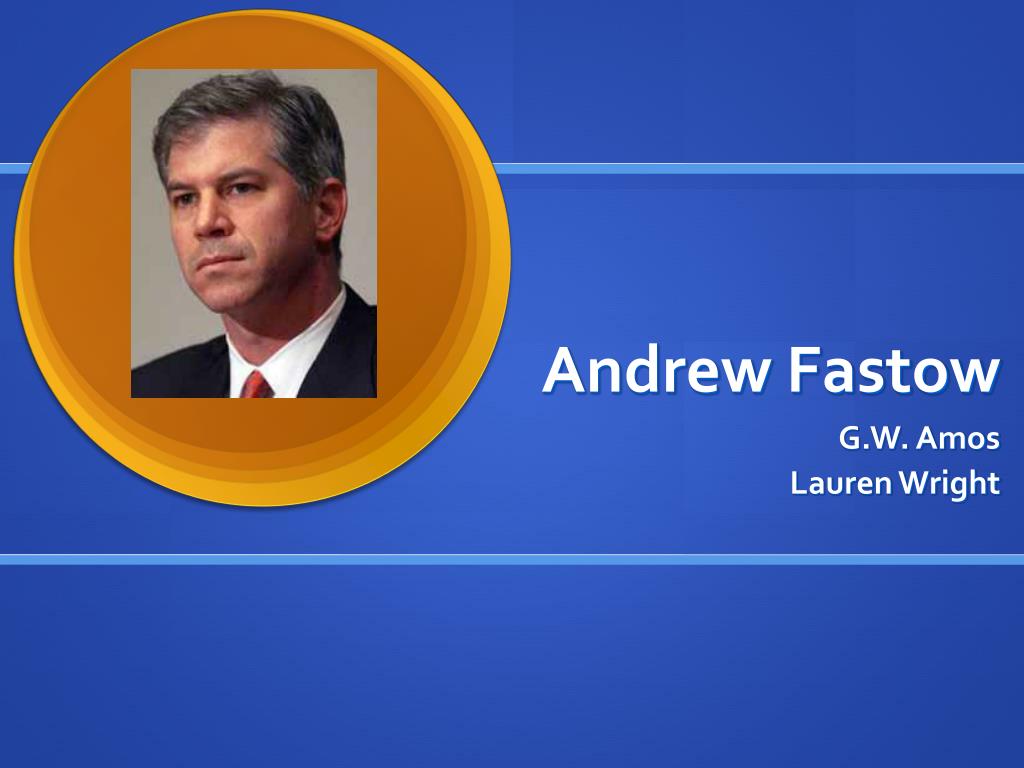
As of 2026, Andrew Fastow, the former Chief Financial Officer of Enron, functions as a prominent consultant and public speaker specializing in corporate ethics, white-collar crime prevention, and the "gray areas" of financial compliance. He spends his professional time advising boards of directors, law schools, and investment firms on how to identify the subtle differences between technically legal maneuvers and ethically sound business practices.
The trajectory of Andrew Fastow is perhaps one of the most complex in the history of American corporate law. Once the architect of the structured finance vehicles that led to the collapse of Enron in 2001, Fastow has spent the last decade and a half reshaping himself as a cautionary tale for modern executives. While many figures associated with the Enron scandal retreated from the public eye, Fastow has leaned into his history, using his former role as an "expert in loophole exploitation" to help others avoid the same pitfalls.
The Modern Role of Andrew Fastow: Consulting and Ethics in 2026
In 2026, Fastow’s career is defined by his unique position as a "reformed" fraudster. His consulting practice is not built on standard accounting procedures but on the psychological and systemic vulnerabilities within corporate hierarchies. He is frequently retained by compliance departments to conduct "internal stress tests," where he analyzes a company’s financial structures to see if they are inadvertently encouraging the same type of "rules-based" but "ethically bankrupt" behavior that he championed at Enron.
His message to modern corporations is distinct: the greatest danger to a company is not the person who breaks the law, but the person who follows the rules exactly as they are written to commit fraud. Fastow argues that at Enron, he was awarded "CFO of the Year" by industry publications specifically because he was so adept at following the letter of the law while violating its spirit. In 2026, this perspective is particularly relevant as companies navigate the complexities of AI-driven financial modeling and decentralized finance (DeFi), which offer new, sophisticated ways to obscure traditional liability.
Key Professional Engagements
- Keynote Speaking: Fastow is a regular at major compliance and ethics conferences, where he often displays his "CFO of the Year" trophies alongside his prison identification card.
- Academic Lectures: He remains a frequent guest lecturer at elite business and law schools (such as Harvard, Stanford, and Rice University), teaching students about the dangers of cognitive dissonance in finance.
- Corporate Advisory: He provides non-legal advice to hedge funds and private equity firms on transparency and risk management.
Understanding the Enron Foundation: The Mechanisms of the Past
To understand Andrew Fastow today, one must understand the technical specifics of what he did at Enron. This context is essential because his current consulting work is a direct inversion of his past actions. In the late 1990s, Fastow pioneered the use of Special Purpose Entities (SPEs), such as LJM, Chewco, and Raptor.
These SPEs were designed to move debt off Enron’s balance sheet and hide investment losses. By technical standards at the time (specifically the 3% rule, where an outside investor only needed to contribute 3% of the entity's capital for it to be considered independent), many of these structures were deemed "legal" by Enron's auditors and legal counsel. However, Fastow personally managed many of these entities, creating a massive conflict of interest and ensuring that the "independent" entities were essentially shells for Enron’s bad debt.
In 2026, Fastow uses these specific historical examples to show how "technical compliance" acts as a shield for misconduct. He explains that the gatekeepers—the auditors at Arthur Andersen and the attorneys—approved his deals because they were looking for a "box to check" rather than examining the underlying economic reality.
The Financial Reality: Net Worth and Restitution
While Fastow was once a multi-millionaire at the height of the Enron era, his financial situation in 2026 is vastly different. As part of his 2004 plea agreement, Fastow forfeited approximately $23.8 million in assets, which included cash, investments, and personal property.
Today, his income is derived primarily from his speaking fees and consulting work. While he maintains a comfortable lifestyle in the Houston area, he is no longer part of the ultra-wealthy elite. The narrative of his "wealth" today is often focused on his ability to earn a living through the transparency of his past crimes. Unlike other white-collar criminals who attempt to hide their history, Fastow’s primary asset in 2026 is his admission of guilt and the granular detail with which he can explain his former deceptions.
| Feature | Enron Era (1998–2001) | Current Status (2026) |
|---|---|---|
| Primary Focus | Off-balance-sheet financing and SPEs | Corporate ethics and loophole prevention |
| Professional Goal | Inflating earnings and hiding debt | Educating on "Gray Area" decision-making |
| Financial Status | Ultra-high net worth (pre-forfeiture) | Moderate/High (Consulting-based) |
| Public Image | Acclaimed "Financial Wizard" | Reformed felon/Ethics educator |
| Legal Standing | Active executive (CFO) | Former inmate; restricted from officer roles |
| Regulatory Framework | Weak oversight (Pre-Sarbanes-Oxley) | High oversight (Post-SOX and modern AI monitoring) |
The "Fastow Philosophy": Rules vs. Ethics
A core component of Andrew Fastow’s work today is his focus on the "Rules vs. Principles" debate. He often highlights that the U.S. generally uses a "rules-based" accounting system (GAAP), whereas many other regions use "principles-based" systems (IFRS).
Fastow argues that a rules-based system invites clever people to find ways around those rules. In his 2026 seminars, he frequently challenges executives to look at their own tax strategies or executive compensation packages. He posits that many of the things companies do today to maximize shareholder value are essentially the same types of "loophole mining" that he practiced at Enron, only they haven't been deemed illegal—yet.
The Problem of "Tone at the Top"
Fastow emphasizes that his actions were not performed in a vacuum. He was encouraged by CEO Jeffrey Skilling and Chairman Kenneth Lay to "keep the stock price up." In 2026, Fastow uses this to teach boards about the "Tone at the Top." If a CEO demands a certain financial outcome and doesn't care how it's achieved, they are effectively instructing their CFO to commit fraud. This lesson is a cornerstone of modern ESG (Environmental, Social, and Governance) criteria, specifically the "G" for governance.
Comparison with Modern Financial Scandals
By 2026, the financial world has seen several major collapses that mirror the Enron situation, including the cryptocurrency exchanges that failed in the early 2020s (such as FTX). Fastow’s commentary often bridges the gap between the "old school" fraud of Enron and the "new school" fraud of the digital age.
He points out that while the technology changes—from SPEs to "re-hypothecated tokens"—the underlying human psychology remains the same. The desire to appear more profitable than one actually is, combined with a lack of transparency and a "check-the-box" compliance culture, inevitably leads to disaster. Fastow’s relevance in 2026 persists because he is one of the few individuals who has navigated the entire lifecycle of a corporate scandal: from the creation of the fraud to the height of success, the subsequent crash, incarceration, and eventual public reckoning.
Practical Lessons for Modern Executives
For any leader looking at "Andrew Fastow today," the practical takeaways are numerous. His evolution provides a blueprint for what to look for within an organization to prevent a similar collapse.
- Question the Complexity: If a financial structure is so complex that the Board of Directors cannot explain it in simple terms, it is a red flag. Fastow’s SPEs were intentionally designed to be incomprehensible to the average observer.
- Beware of "Legal" Fraud: Just because a lawyer or an auditor says something is "legal" doesn't mean it is right, or that it won't be viewed as fraudulent if the company fails.
- Encourage Internal Dissent: At Enron, employees like Sherron Watkins who raised concerns were ignored or marginalized. In 2026, Fastow advocates for a corporate culture where the "brakes" are as valued as the "engine."
- Monitor Incentives: Fastow explains that his own compensation was tied directly to the success of the very entities he was using to hide Enron's losses. Misaligned incentives are the primary driver of unethical behavior.
FAQ: Andrew Fastow in 2026
Did Andrew Fastow go to prison?
Yes. Andrew Fastow pleaded guilty to two counts of conspiracy to commit wire and securities fraud in 2004. He was sentenced to six years in federal prison and was released in 2011. Since his release, he has worked as a consultant and speaker. He served his time at the Federal Correctional Institution in Oakdale, Louisiana.
What is Andrew Fastow’s net worth today?
While an exact public figure for 2026 is unavailable, his net worth is significantly lower than it was during his Enron tenure. After forfeiting more than $23 million and paying extensive legal fees, he does not possess the massive wealth associated with his former executive position. His current income is derived from professional speaking and private consulting.
Is Andrew Fastow allowed to be a CFO again?
No. As part of his settlement with the Securities and Exchange Commission (SEC), Fastow is permanently barred from serving as an officer or director of a publicly traded company. This is why his current professional activities are limited to consulting, teaching, and speaking, rather than operational corporate leadership.
What does Fastow say about Jeffrey Skilling and Kenneth Lay?
In his contemporary presentations, Fastow generally avoids personal attacks on his former colleagues. Instead, he focuses on the collective culture of Enron. He describes a environment where the ends always justified the means and where "cleverness" was prized above all other virtues. He takes full responsibility for his role in the collapse while acknowledging that the systemic pressure to meet earnings targets was a major contributing factor.
How does Fastow influence 2026 corporate compliance?
Fastow influences modern compliance by shifting the focus from "what is legal" to "what is the risk." He helps companies recognize that a focus on pure legality can create a false sense of security. His work has influenced the development of "behavioral compliance" programs, which look at the psychological triggers that lead to white-collar crime.
Recommendation for Next Actions
For corporate leaders, compliance officers, and students of finance, studying Andrew Fastow’s current work offers a rare, "insider-out" perspective on risk. To apply these lessons in 2026, organizations should:
- Conduct an "Ethical Audit": Move beyond standard accounting audits. Evaluate whether your company's current "legal" financial strategies would stand up to public scrutiny if they were revealed on the front page of a newspaper.
- Review Incentive Structures: Ensure that no single executive has an incentive to hide losses or inflate gains through complex, off-balance-sheet maneuvers.
- Invite Divergent Perspectives: Use Fastow's story as a case study in training sessions to encourage employees to speak up when they see "technically correct" but practically misleading financial reporting.
Andrew Fastow today serves as a living reminder that the most dangerous form of deception is the one that follows the rules. In the high-speed, AI-enhanced financial world of 2026, his warnings about the "gray area" are more pertinent than ever.