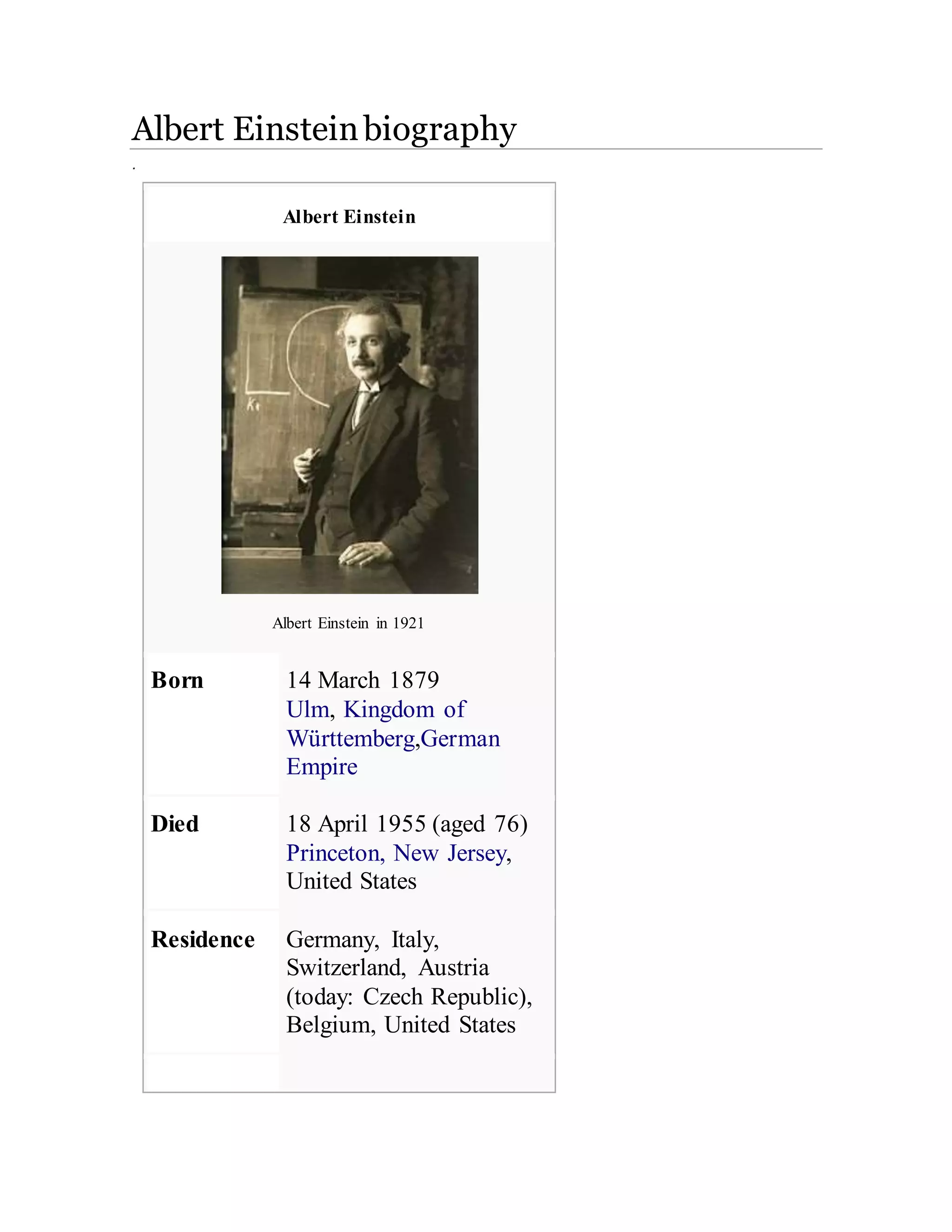
Albert Einstein died at the age of 76 on April 18, 1955, at Princeton Hospital in New Jersey. His death was caused by the rupture of an abdominal aortic aneurysm, a condition he had lived with for several years. Despite his physician's recommendations for surgery, Einstein famously refused, choosing to face the end of his life with dignity and acceptance.
The passing of Albert Einstein was not merely the loss of a prominent physicist; it was the conclusion of a life that redefined our understanding of time, space, and gravity. As we look back from the perspective of 2026, the circumstances surrounding his death remain a subject of intense historical and medical interest, particularly regarding the unauthorized study of his brain and the philosophical stance he took during his final hours.
The Medical Cause: Abdominal Aortic Aneurysm
The primary cause of Einstein’s death was an abdominal aortic aneurysm (AAA). This condition involves a localized enlargement of the abdominal aorta, the main blood vessel that delivers blood from the heart to the rest of the body. When the walls of the aorta weaken, they can bulge outward; if the bulge ruptures, it leads to massive internal bleeding, which is frequently fatal.
Einstein’s struggle with this condition began years before 1955. In 1948, he underwent a procedure performed by Dr. Rudolph Nissen, a pioneering surgeon. At the time, the standard treatment for an aneurysm was to "wrap" it in cellophane to provoke a scarring reaction that might strengthen the arterial wall. While this procedure was successful in prolonging his life for seven years, it was not a permanent cure.
On April 17, 1955, the aneurysm finally ruptured. Einstein was admitted to Princeton Hospital experiencing severe chest and abdominal pain. Doctors suggested a more modern surgical intervention, but Einstein refused. He famously stated, "I want to go when I want. It is tasteless to prolong life artificially. I have done my share; it is time to go. I will do it elegantly." This decision reflected his lifelong commitment to autonomy and his rationalist view of the natural cycle of life.
The Final Hours and Lost Words
Einstein’s final hours were spent at Princeton Hospital, where he continued to work until he was physically unable to hold a pen. Even on his deathbed, he was reportedly working on a draft of a television speech commemorating the seventh anniversary of the State of Israel. This draft, which remained unfinished, showed his continued dedication to both global politics and the quest for a Unified Field Theory—a "theory of everything" that would reconcile gravity with electromagnetism.
A poignant and often-discussed detail of his passing involves his final words. Shortly before he died, Einstein spoke a few sentences in German. Unfortunately, the night nurse on duty, Alberta Rozsel, did not speak German and could not understand or record what he said. Consequently, the final thoughts of one of history’s greatest minds were lost to time. He passed away at approximately 1:15 a.m. on April 18, 1955.
The Controversy: The Unauthorized Autopsy and Einstein's Brain
Perhaps the most controversial aspect of Einstein's death was what occurred during the autopsy. The procedure was performed by pathologist Dr. Thomas Stoltz Harvey. Without the permission of Einstein’s family, Harvey removed Einstein’s brain for study. He later claimed that he felt it was his duty to science to preserve the brain of such a genius for future research.
While Einstein had requested that his body be cremated and his ashes scattered secretly to prevent his resting place from becoming a site of morbid pilgrimage, the removal of the brain complicated this wish. Harvey eventually secured retroactive permission from Einstein’s son, Hans Albert Einstein, on the condition that the results of the research would only be published in scientific journals.
The Journey of the Brain
For decades, Dr. Harvey kept the brain in two glass jars filled with formaldehyde, often stored in a cider box under a beer cooler. He sectioned the brain into approximately 240 blocks and created numerous microscope slides.
Later studies, most notably one published in 1985 by Marian Diamond, suggested that Einstein's brain had a higher-than-average ratio of glial cells to neurons in certain areas, particularly the left parietal lobe. Other researchers, such as Sandra Witelson, noted that his brain lacked a specific groove called the parietal operculum, which might have allowed for more efficient neural connections in regions responsible for mathematical and spatial reasoning. However, many modern scientists remain skeptical, noting that the sample size (one) makes it impossible to draw definitive conclusions about the link between his neuroanatomy and his intellect.
Simple Rites and Cremation
In accordance with his wishes for simplicity, there was no large public funeral or monument. On the afternoon of April 18, 1955, a small, private service was held at a funeral home in Princeton, attended by only a few close friends and family members. His body was cremated later that day at Ewing Cemetery in Trenton, New Jersey.
To ensure that his grave did not become a "shrine," his ashes were scattered by his close friend Otto Nathan and his son Hans Albert. The exact location was never officially disclosed, though it is widely believed they were scattered in or near the Delaware River. This final act of anonymity was consistent with Einstein's humble persona; he viewed his physical form as secondary to the ideas he contributed to the world.
Historical Timeline of Einstein's Final Years
The following table outlines the key events leading up to and immediately following Albert Einstein's death at age 76.
| Date | Event | Significance |
|---|---|---|
| December 1948 | Initial Surgery | Dr. Rudolph Nissen performs a cellophane wrap on Einstein's aneurysm. |
| April 15, 1955 | Initial Rupture | The aneurysm begins to leak, causing Einstein significant physical distress. |
| April 17, 1955 | Hospitalization | Einstein is admitted to Princeton Hospital but refuses further surgery. |
| April 18, 1955 (1:15 AM) | Passing | Einstein dies at the age of 76 in his sleep. |
| April 18, 1955 (Morning) | Unauthorized Autopsy | Dr. Thomas Harvey removes the brain during the standard autopsy procedure. |
| April 18, 1955 (Afternoon) | Cremation | Einstein's body is cremated in a private ceremony at Ewing Cemetery. |
| 1985 | First Major Brain Study | Marian Diamond publishes findings on the glial cell count in Einstein's brain. |
Scientific Legacy at the Time of Death
When Einstein died in 1955, he was in the midst of a intellectual struggle that had occupied him for the better part of thirty years. While the world celebrated him for his earlier work—specifically General Relativity (1915) and the Photoelectric Effect (for which he won the 1921 Nobel Prize)—Einstein himself felt his work was incomplete.
He spent his final years in Room 115 of the Institute for Advanced Study in Princeton, attempting to unify the laws of physics. At the time of his death, the scientific community had largely moved on to quantum mechanics, a field Einstein had helped start but eventually grew skeptical of due to its probabilistic nature. Despite being viewed as somewhat of a "lonely outsider" in his final years, his insistence that the universe must be governed by elegant, certain laws continues to inspire theoretical physicists today. In 2026, the search for a "Theory of Everything" remains the holy grail of physics, directly tracing its lineage back to Einstein's final, unfinished scribbles.
Impact on Society and Culture
Einstein was more than a scientist; he was a global icon of peace and civil rights. In the years preceding his death, he used his platform to speak out against McCarthyism, racism, and the nuclear arms race. His death at age 76 was mourned by world leaders, including President Dwight D. Eisenhower and Israeli Prime Minister David Ben-Gurion.
His passing marked a transition in the public perception of science. He was perhaps the last "celebrity scientist" who was known not just for his discoveries, but for his philosophy on life, religion, and the human condition. His refusal of surgery was seen by many as a final lesson in the importance of living a life of purpose rather than a life of mere duration.
Frequently Asked Questions
Did Albert Einstein die of old age?
No, Albert Einstein died of a specific medical complication: a ruptured abdominal aortic aneurysm. While 76 was a respectable age in 1955, his death was the result of a long-standing vascular condition rather than general senescence or "old age."
What were Albert Einstein’s last words?
Einstein’s last words remain unknown. He spoke them in German to a night nurse at Princeton Hospital, but since she did not speak the language, they were never translated or recorded. He passed away shortly thereafter.
Is Albert Einstein's brain still available for study?
Yes, portions of Albert Einstein’s brain are still preserved. After Dr. Thomas Harvey’s death, the remaining samples were returned to Princeton Hospital and are now held by the National Museum of Health and Medicine in Maryland. Some slides are also on display at the Mütter Museum in Philadelphia.
Why did Einstein refuse surgery before he died?
Einstein believed in a natural end to life. Having already undergone one major procedure in 1948, he felt that attempting to "prolong life artificially" through another surgery in 1955 would be "tasteless." He preferred to accept his fate with the same rationality he applied to his scientific work.
Where is Albert Einstein buried?
Albert Einstein is not buried in a grave. In accordance with his wishes, he was cremated, and his ashes were scattered in an undisclosed location. He did not want a headstone or a monument that would attract crowds.
Who inherited Albert Einstein's estate?
Einstein left his personal papers and intellectual property to the Hebrew University of Jerusalem, which he helped establish. His physical property and personal effects were largely managed by his secretary, Helen Dukas, and his step-daughter, Margot Einstein.
Practical Recommendation for Further Learning
If you are interested in the historical and scientific details of Albert Einstein's life and death, the most authoritative resource is the Einstein Archives Online, maintained by the Hebrew University of Jerusalem. This digital repository contains his personal diaries, scientific manuscripts, and correspondence, providing a primary-source look at the mind of the man who changed our world. For a medical perspective on the history of his treatment, the journals of the American College of Surgeons occasionally feature historical reviews of early aortic aneurysm treatments like the ones Einstein received.