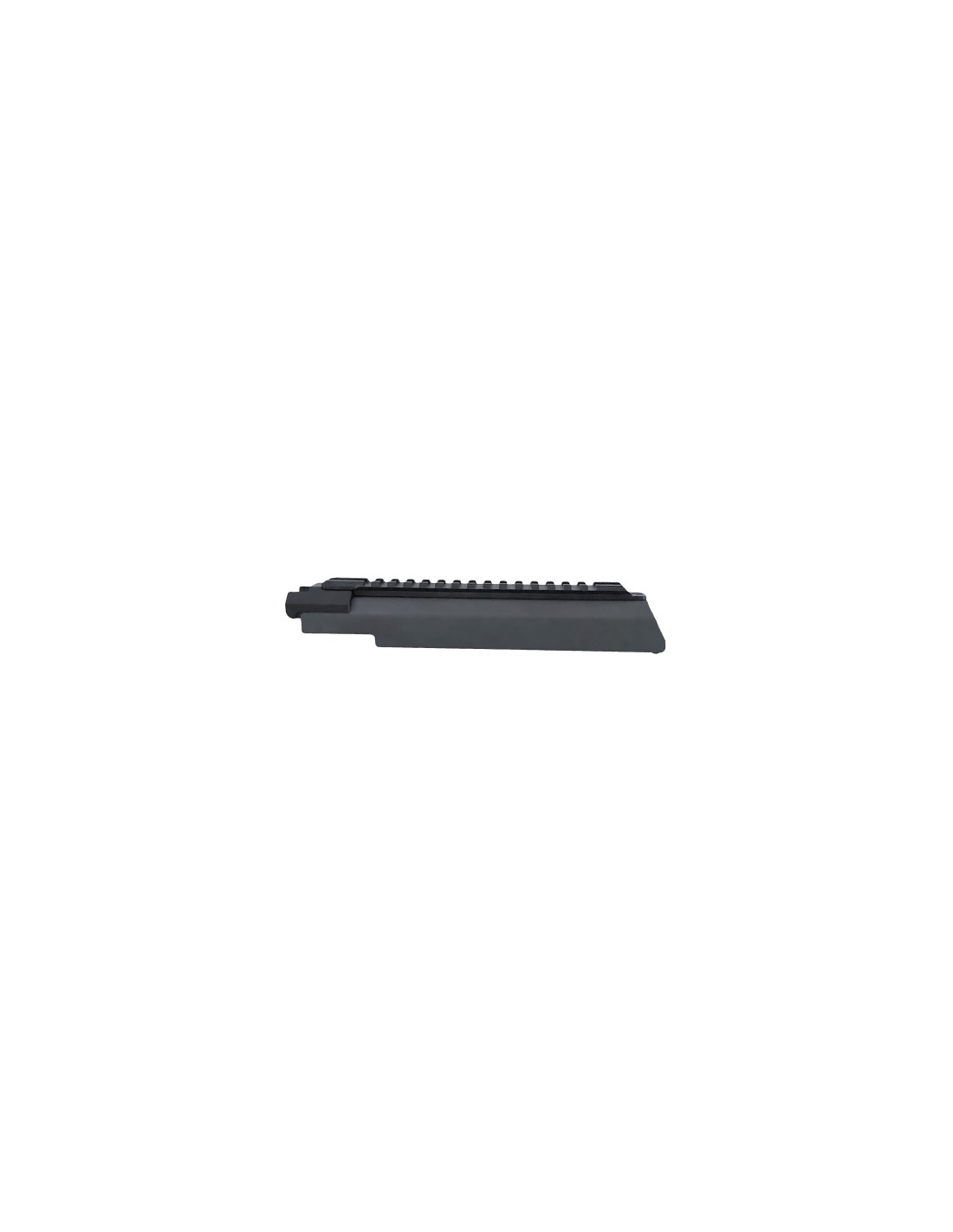
To mount an optic on an AK-platform rifle using a Picatinny rail dust cover, you must replace the standard stamped-metal cover with a specialized, reinforced version that secures to the receiver. High-quality models utilize a hinged front mount or a rear tensioning mechanism to provide a stable, repeatable platform that maintains "zero" during firing and after field stripping.
The AK-47 and its numerous derivatives were designed as rugged, utilitarian tools where "minute of man" accuracy was the standard. In the original Soviet design, the dust cover (or top cover) is a thin piece of stamped steel held in place by friction and the tension of the recoil spring. Because it is not a structural component, it moves during the cycling of the action, making it traditionally unsuitable for mounting optics. However, the modern tactical landscape of 2026 demands the integration of red dots, holographic sights, and low-power variable optics (LPVOs). This necessity has driven the evolution of the AK Picatinny rail dust cover from a flimsy aftermarket gimmick into a serious piece of precision engineering.
The Engineering Challenge: Why Standard AK Covers Fail
The primary obstacle in mounting a Picatinny rail to an AK dust cover is the lack of a repeatable "return to zero." On an AR-15, the rail is machined directly into the upper receiver, which is the same component that holds the barrel and bolt carrier. On a standard AK, the receiver is the chassis, and the dust cover is simply a lid.
When a shot is fired, the bolt carrier group (BCG) slams rearward and then forward. This violent movement, combined with the expanding gases, causes the thin metal of a standard dust cover to vibrate and shift. If a red dot is mounted to that cover, the point of aim will shift with every shot. Furthermore, to clean the rifle, the dust cover must be removed. On a standard rifle, putting the cover back on rarely results in it sitting in the exact same micrometer-level position. For a marksman, this means the rifle must be re-zeroed every time it is maintained—an unacceptable trade-off for professional or competitive use.
Types of AK Picatinny Rail Dust Covers
By 2026, the market has consolidated around three primary design philosophies that solve the stability issue. Understanding these differences is critical before making a purchase.
1. The Hinged "Dog Leg" Design
Popularized by Texas Weapon Systems (TWS) and refined by several other manufacturers, the Dog Leg design replaces the traditional rear sight leaf with a permanent hinge pin. The dust cover is then pinned to this hinge.
- Mechanism: The cover swings upward like a car hood rather than being pulled off. The rear of the cover is held down by a proprietary take-up button on the recoil spring assembly.
- Stability: This provides a very stable front-to-back lockup. Because the front pivot point is fixed to the rear sight block, the rail returns to the same position every time it is closed.
- Trade-offs: You typically lose the traditional rear tangent sight, though most manufacturers offer a "peep sight" that can be mounted to the rear of the Picatinny rail.
2. The Clamping/Tensioning System
Models like the Fab Defense PDC (Picatinny Dust Cover) use a manual tensioning mechanism to eliminate movement.
- Mechanism: These covers feature a hand-tightened dial at the rear. Once the cover is seated, you turn the dial, which expands a wedge against the receiver or hooks into the recoil spring slot to pull the cover tight.
- Stability: This system is remarkably effective at removing the "rattle" found in standard covers. It allows for the retention of the original rear sight leaf.
- Trade-offs: It relies on the user to ensure the dial is tightened to the same degree every time. Over-tightening can potentially interfere with the recoil spring’s travel in some tighter-tolerance rifles.
3. Integrated Rail Systems (Handguard Tied)
The most robust but invasive option involves a dust cover that locks directly into a matching railed handguard. The Zenitco B-33 (and its domestic US equivalents developed following import restrictions) is the gold standard here.
- Mechanism: The dust cover brackets onto a specific lower handguard. This creates a monolithic-style rail that spans from the gas block to the rear of the receiver.
- Stability: This is widely considered the most rigid setup available for the AK platform. It is used by specialized units globally because it handles the weight of heavy optics and night vision bridged across the rail.
- Trade-offs: High cost and high weight. You are forced to use the same manufacturer's handguard, which may not fit all rifle variants without significant filing or fitting.
Metallurgy and Construction Standards
In 2026, the materials used in these covers are as important as the design. A rail is only as good as the metal it is machined from.
- 6061-T6 Aluminum: The industry standard. It is lightweight and provides sufficient strength for red dots and small scouts scopes. It is typically Type III hard-coat anodized to resist wear.
- 7075-T6 Aluminum: Frequently found in high-end options like the newer iterations of the Midwest Industries or Zastava factory railed covers. It offers higher tensile strength and is more resistant to the "peening" that can occur where the bolt carrier hits the underside of the cover.
- Steel Reinforcement: Some hybrid designs use a stamped steel body (to save weight/cost) with a 1913 Picatinny rail riveted or welded to the top. While cheaper, these are prone to the rivets loosening over time due to the AK’s harmonic vibration.
Compatibility: AKM, Yugo, and Milled Receivers
A common mistake is assuming "an AK is an AK." The AK Picatinny rail dust cover must match the specific geometry of your receiver.
| Receiver Type | Standard Features | Compatibility Notes |
|---|---|---|
| AKM (Stamped) | Standard Russian/Eastern Bloc pattern (PSA, WASR-10). | Most common; uses "standard" TWS or Fab Defense models. |
| Yugo/Zastava (M70) | Thicker receiver (1.5mm), different rear trunnion. | Requires Yugo-specific covers; standard AKM covers will be too short. |
| Milled Receivers | Machined from a solid block; no rivets. | Often require minor fitting at the front hinge point; often heavier. |
| AK-74U (Krinkov) | Shortened gas system, factory hinged cover. | Usually requires a specific replacement rail that mounts to the existing hinge. |
Technical Installation: Ensuring a Zero-Hold Fit
Installing an AK Picatinny rail dust cover is rarely a "drop-in" affair, despite what marketing materials may suggest. Because AK tolerances vary wildly between a Bulgarian factory and a US basement build, fine-tuning is necessary.
- The Front Interface: For hinged models, the fitment into the rear sight block (RSB) must be tight. If there is side-to-side play in the hinge, your windage will never be consistent. Many kits include small shims to eliminate this wobble.
- The Recoil Spring Button: The "button" at the back of your recoil spring assembly acts as the primary latch. If your new dust cover has a small gap between the button and the cover's rear opening, the cover will shift forward and back under recoil. Professional installers often "tune" the recoil spring guide or use an oversized button to ensure a "snap-fit" lockup.
- The "Rubber Mallet" Rule: A properly fitted railed dust cover should require a firm tap to seat and a firm push to unlatch. If it drops into place with zero resistance, it is likely too loose to hold a precise zero for magnified optics.
Performance Analysis: What to Expect
Even the best AK Picatinny rail dust cover will not turn a 3-MOA (Minute of Angle) rifle into a sub-MOA precision bolt-action. However, a high-quality rail (like the TWS Dog Leg Gen 3 or the Zenitco B-33) should maintain a shift of less than 1 MOA after being opened and closed.
For a red dot sight used in close-quarters drills, this shift is imperceptible. For a 1-6x LPVO used at 400 yards, a 1-MOA shift equates to 4 inches. Users must weigh this against the alternative: the side-rail mount. The side-rail is technically more stable as it attaches to the receiver wall, but it adds significant width to the rifle, prevents the folding of many stocks, and often sits higher than a dust cover rail, forcing a "chin weld" rather than a comfortable "cheek weld."
Maintenance and Longevity in 2026
In 2026, the longevity of these components has been well-documented. Aluminum rails are susceptible to "rounding" of the Picatinny lugs if steel optic mounts are repeatedly attached and removed with excessive torque. It is recommended to use high-quality torque wrenches (15-20 inch-pounds for most optics) to prevent marring the rail.
Additionally, carbon fouling can build up on the underside of the cover. While this doesn't affect accuracy directly, if the fouling becomes thick enough, it can change how the cover seats against the receiver rails. Regular cleaning of the contact points—where the cover touches the receiver—is essential for maintaining that repeatable zero.
Alternatives to the Railed Dust Cover
If you find the installation of a railed dust cover too daunting or if your specific rifle won't accept one, consider these alternatives:
- Ultimak Gas Tube Rail: Replaces the upper gas tube. Excellent for "scout" style red dots, but it gets extremely hot and can cook cheaper electronics.
- Rear Sight Leaf Rails: Small 3-inch rails that replace only the rear sight. Extremely stable but limits you to very small red dots and offers a very short eye-relief.
- Side Mounts: Using the factory optic rail on the left side of the receiver. This remains the most "purist" way to mount optics, though it is bulkier than a dust cover solution.
FAQ
Does an AK Picatinny rail dust cover actually hold zero?
Yes, provided you use a high-quality model (TWS, Fab Defense, Midwest Industries, or Zenitco) and ensure a tight fit during installation. Cheap, "no-name" railed covers that merely snap into place like the original cover will almost never hold zero under repeated fire.
Can I still use my iron sights?
Most hinged rail covers require the removal of the rear sight leaf. However, most manufacturers provide a way to mount a backup "peep" sight to the rear of the new Picatinny rail, allowing for a longer sight radius than the original factory setup.
Will this fit my Zastava M70 or M90?
Standard AKM covers will not fit Yugo-pattern rifles. You must specifically purchase a "Yugo/Serbian" version of the rail, as the receiver length and the shape of the rear sight block are different from standard Russian patterns.
Is the extra weight of a railed cover significant?
A standard stamped cover weighs about 4 ounces. A heavy-duty railed aluminum cover can weigh between 8 and 12 ounces. While it adds weight, the benefit is usually a better center of balance compared to a heavy side-mount bracket.
Do I need a gunsmith to install this?
Most modern AK Picatinny rail dust covers are designed for "user-level" installation. If you can field strip your rifle and remove a pin with a punch and hammer, you can usually install these. However, if your receiver is out of spec, a gunsmith may be needed to file the contact points for a perfect fit.
Final Recommendation
For the majority of AK owners in 2026, the Texas Weapon Systems Dog Leg Gen 3 or the Fab Defense PDC offer the best balance of price, ease of installation, and zero-retention. If you are building a "duty-grade" rifle where weight and cost are secondary to absolute rigidity, the Zenitco B-33 (or its reputable domestic clones) remains the superior choice. Always prioritize a "tensioned" fit over a "drop-in" fit to ensure your optic stays true through thousands of rounds.