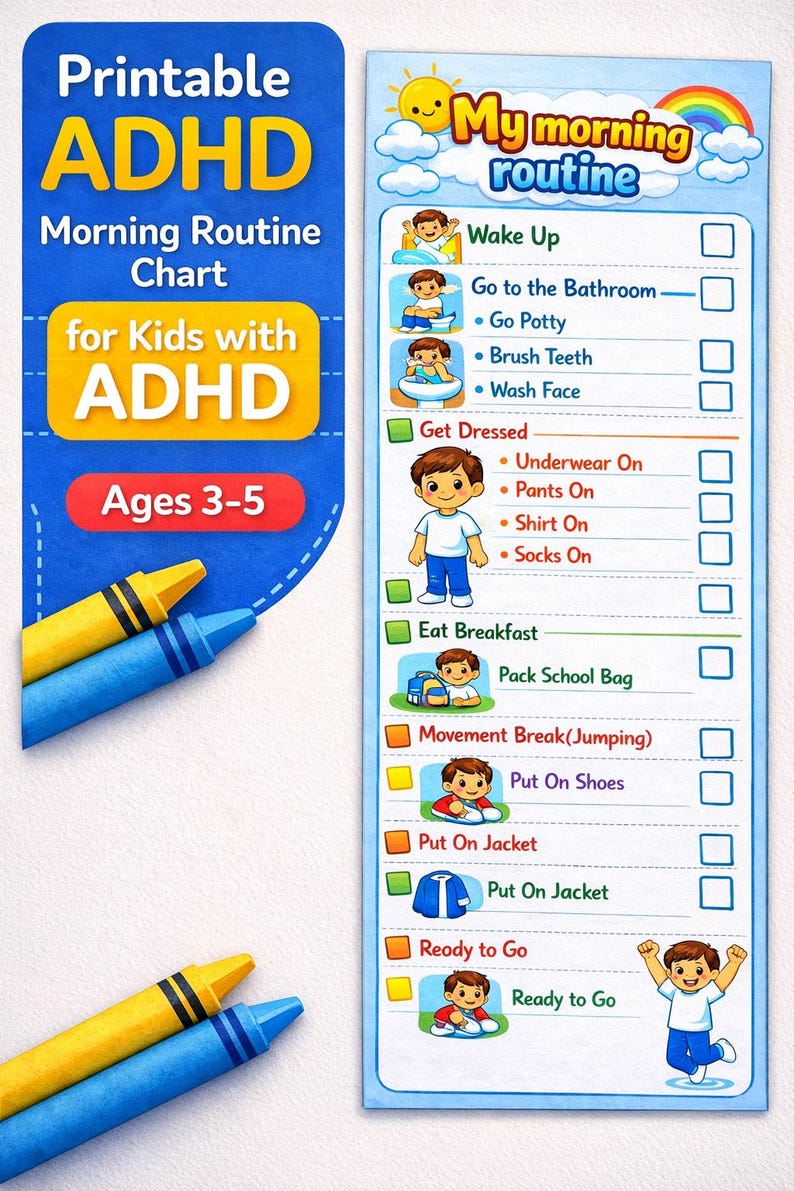
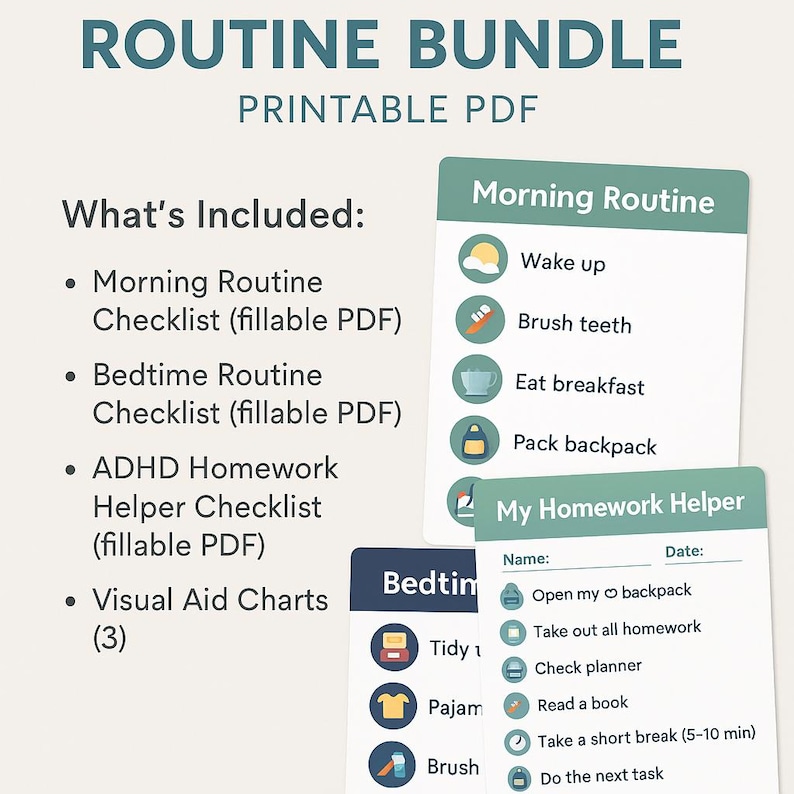
An effective ADHD morning routine checklist externalizes working memory, reduces decision fatigue, and uses structured micro-steps to overcome executive dysfunction. By breaking complex tasks into visual, low-friction actions paired with dopamine rewards, adults with ADHD can systematically bypass task paralysis, reduce time blindness, and establish consistent, calm morning transitions.
Why Traditional Morning Routines Fail ADHD Brains
For neurotypical individuals, waking up and preparing for the day relies on automatic neural pathways that execute routines with minimal conscious effort. For adults with Attention-Deficit/Hyperactivity Disorder (ADHD), mornings represent a high-stakes obstacle course governed by executive dysfunction, delayed circadian rhythms, and impaired working memory.
Understanding the neurological mechanics behind morning friction is the first step toward building a system that actually works.
DISCLAIMER: This guide provides behavioral strategies and visual tools for managing executive dysfunction. It does not constitute medical advice, diagnosis, or treatment. Consult a licensed healthcare professional for medical management of ADHD.
Executive Dysfunction and Sleep Inertia
ADHD is fundamentally a regulation disorder involving executive functions—the suite of cognitive processes managed largely by the prefrontal cortex. These functions include working memory, task switching, emotional regulation, and impulse control.
When an adult with ADHD wakes up, they often experience severe sleep inertia, a temporary state of impaired cognitive performance and grogginess. Research published through the National Center for Biotechnology Information (NCBI) indicates that individuals with ADHD frequently exhibit delayed circadian preference and higher rates of sleep disturbances, such as Delayed Sleep Phase Syndrome (DSPS). Because the transition from sleep to full alertness is neurochemically sluggish, asking an ADHD brain to construct a plan of action while still groggy almost guarantees failure.
The Problem of Decision Fatigue
Every decision requires cognitive energy. Deciding which shirt to wear, what to eat for breakfast, or whether to brush teeth before or after showering consumes finite executive bandwidth.
When a routine relies on real-time decision-making, an ADHD brain experiences decision fatigue almost immediately. Faced with multiple choices, the brain often defaults to low-effort, high-dopamine activities—such as scrolling on a smartphone or getting lost in hyperfocus on an irrelevant task—leading to morning delays and panic.
Time Blindness and Working Memory Deficits
Time blindness refers to the chronic inability to perceive the passage of time accurately. An individual with ADHD might perceive 5 minutes and 45 minutes as identical intervals.
Compounding this issue is impaired working memory, the mental scratchpad used to hold temporary information. A neurotypical brain can keep four or five sequential morning steps in mind ("put on shoes, grab keys, get lunch, pack laptop"). An ADHD working memory frequently drops these items, causing the individual to walk back and forth across the house, misplace essential items, or forget critical steps like taking prescribed medication.
Core Principles of an ADHD-Friendly Morning Checklist
Standard to-do lists fail adults with ADHD because they are often overwhelming, overly rigid, and visually hidden (such as tucked inside a phone app). An effective ADHD morning checklist must be designed according to specific neurodivergent principles.
1. Externalize Everything (Make It Visual)
If a task relies solely on internal memory, it is vulnerable to executive dysfunction. An ADHD checklist must be physically visible in the immediate environment where the actions take place.
- Tactile and Interactive: Use whiteboards, flip-charts, or physical cards that offer tactile feedback when completed. Moving a physical peg or wiping off a marker provides an immediate tactile feedback loop that registers progress in the brain.
- High Contrast and Location-Specific: Place micro-checklists directly at the point of action. A checklist for bathroom tasks belongs on the bathroom mirror, not on a desk in the hallway.
2. Micro-Chunking and Atomic Steps
Vague checklist items like "Get Ready" or "Eat Breakfast" are executive function traps. They contain dozens of hidden sub-steps that trigger task resistance.
Instead, break tasks down into atomic micro-steps:
- Vague: "Make Coffee"
- Micro-chunked: Fill water reservoir $\rightarrow$ Insert coffee pod $\rightarrow$ Press brew button $\rightarrow$ Retrieve mug.
Micro-chunking removes the cognitive burden of organizing the sequence in real time. The brain simply follows the next tiny instruction without needing to evaluate the whole project.
3. Sequential Habit Stacking
Habit stacking, a concept popularized in behavioral psychology, involves anchoring a new desired behavior to an established, automatic habit. For ADHD brains, sequence is everything.
The structure follows a simple formula: $$\text{After I [Established Habit]}, \text{ I will immediately [New Micro-Step]}.$$
- Example: "After I turn off my alarm, I will immediately sit up and drink the glass of water on my nightstand."
- Example: "After I put my coffee mug under the spout, I will immediately take my morning medication."
By linking actions in an unbreakable chain, you eliminate the pause between tasks where distraction typically enters.
4. Dopamine Anchoring
The ADHD brain operates on a baseline deficit of available dopamine, a key neurotransmitter involved in motivation and reward processing. Expecting an ADHD brain to complete a series of non-preferred tasks (shaving, ironing, packing a bag) without a reward mechanism is scientifically unrealistic.
Dopamine anchoring strategically places enjoyable stimuli alongside or immediately following low-dopamine tasks:
- Listen to a preferred podcast or audio book only while getting dressed and making the bed.
- Pair brushing teeth with watching a specific 3-minute video or listening to an upbeat song.
- Reserve a favorite morning beverage exclusively for the period when reviewing the daily schedule.
The Master ADHD Morning Routine Checklist Template
This customizable, three-phase checklist is structured to guide an adult with ADHD from deep sleep inertia to full operational readiness. It separates tasks into distinct physical zones to prevent aimless wandering.
ADHD MORNING ROUTINE: THREE-PHASE FLOW
- PHASE 1: WAKING TRANSITION
- Location: Bedroom
- Goal: Break sleep inertia
- Style: Low-friction physical moves
- PHASE 2: CORE HYGIENE
- Location: Bathroom/Kitchen
- Goal: Self-care & fueling
- Style: Sequential habit stack
- PHASE 3: LAUNCHPAD
- Location: Entryway / Exit
- Goal: Out-the-door readiness
- Style: Double-check verification
Phase 1: The Waking Transition (0–15 Minutes)
Target: Gentle physiological arousal and overcoming bed-lock.
- Feet on the floor: Turn off alarm (located across the room, requiring physical movement).
- Hydrate: Drink full glass of water left on the nightstand the evening before.
- Sensory wake-up: Open curtains immediately for natural light exposure, or turn on a 10,000-lux therapy lamp to signal the circadian system via the supra-chiasmatic nucleus, as recommended by sleep health guidelines from the Sleep Foundation.
- Meds/Supplements: Take prescribed morning medication immediately with water (if applicable and directed by a physician).
- Make the bed (Low-Friction style): Pull duvet straight up. Do not worry about hospital corners; target a basic visual baseline.
Phase 2: Core Survival & Fueling (15–45 Minutes)
Target: Grooming and sustained energy without distraction.
- Bathroom Routine (Habit Stacked):
- Wash face with cool water.
- Brush teeth for 2 minutes (use an electric toothbrush with a built-in timer).
- Apply deodorant and skincare.
- Dress in pre-selected outfit (prepared the night before).
- Fueling (Low-Decision Breakfast):
- Consume a high-protein, low-sugar breakfast (protein supports sustained neurotransmitter production and minimizes mid-morning blood sugar crashes).
- Fill insulated water bottle for the day.
- Enjoy morning coffee or tea after protein intake.
Phase 3: The Launchpad & Out-the-Door (45–60 Minutes)
Target: Securing possessions and transitioning to the work/school environment.
- Launchpad Check (The "EDC" - Everyday Carry):
- Phone (charged).
- Wallet / ID / Cards.
- Keys (attached to lanyard or designated bowl).
- Work bag / Laptop / Charger.
- Medication pouch / Lunch.
- Environmental Sweep (2-Minute Warning):
- Appliances off (coffee maker, curling iron, stove).
- Thermostat adjusted.
- Front door locked.
Comparing Checklist Formats for ADHD
Different ADHD subtypes (Inattentive, Hyperactive-Impulsive, or Combined) respond differently to visual and tactile tools. The table below compares the primary checklist formats to help identify the best fit for your specific executive profile.
| Checklist Format | Best For | Key Advantages | Major Pitfalls / Risks | Optimization Tip |
|---|---|---|---|---|
| Visual Flip-Chart / Slider Board | High time blindness; physical/tactile learners; kids & adults alike | Provides immediate tactile satisfaction; non-digital (zero notification distractions) | Can feel juvenile if not designed sleekly; limited space for detailed notes | Mount directly next to the bathroom mirror or bedroom door frame. |
| Dry-Erase Whiteboard | Dynamic schedules; visual planners; high-creativity brains | Highly customizable; allows color-coding; easy to erase and adjust for structural changes | Easy to accidentally erase; can become visual "wallpaper" if not refreshed | Use bright fluorescent markers; rewrite the sequence weekly to keep it novel. |
| Analog Index Cards (Single Task) | Severe overwhelm; high vulnerability to task paralysis | Eliminates visible multi-task clutter; focuses brain on exactly one atomic action at a time | Cards can easily be misplaced or scattered across rooms | Keep cards on a metal ring; flip to the next card only when current action is done. |
| Dedicated App with Lockouts | Tech-reliant users; people needing auditory alarms | Built-in timers, loud auditory nudges, automatic recurring schedules | High risk of digital distraction (social media, notifications, email) | Use strict app-blocking features during morning hours; disable all non-essential alerts. |
Step-by-Step Implementation Strategy
Implementing a new morning checklist with an ADHD brain must be approached as an iterative experiment, not an all-or-nothing requirement. Perfectionism is a major cause of abandoned systems.
- EVENING PREPARATION
- Pre-select outfit (down to socks & underwear).
- Stage "Launchpad" with keys, bag, and wallet.
- Fill water glass; place meds on nightstand.
- MORNING EXECUTION
- Wake to physical alarm (out of arm's reach).
- Execute visual checklist sequentially.
- Use auditory cues (timers/playlists) for pacing.
- MINIMUM VIABLE ROUTINE (MVR)
- IF overtired/overwhelmed: Switch to 3 Core Tasks.
- (Meds -> Clothes -> EDC Launchpad -> Out the door)
Night-Before Friction Reduction
A successful morning routine begins the previous night. Every task completed before sleep is an executive decision you do not have to make while sleep-inebriated.
- Stage the Launchpad: Designate a single physical spot near the entryway door (a basket, shelf, or table). Place all mandatory out-the-door items here before going to bed.
- Outfit Pre-Selection: Lay out clothing completely—including socks, shoes, and accessories. If weather is unpredictable, check the forecast the night before and make the decision then.
- Breakfast Staging: Set out coffee mugs, dry ingredients, or prep-containers so breakfast requires minimal assembly.
The "Minimum Viable Routine" (MVR) for Low-Capacity Days
ADHD symptoms fluctuate based on sleep quality, stress, hormonal shifts, and burnout. Expecting 100% adherence to a full 60-minute routine every day sets up a cycle of shame.
Establish a Minimum Viable Routine (MVR) for crisis or low-energy days. The MVR contains only non-negotiable survival tasks:
- Medication/Hydration: Take meds with a full glass of water.
- Basic Hygiene: Brush teeth, wash face, put on pre-selected clothes.
- Grab Launchpad Bag: Pick up pre-packed bag containing wallet, keys, and phone.
- Exit: Leave the house.
If a day is difficult, explicitly announce: "Today is an MVR day." This preserves the habit loop without triggering executive failure.
Preventing "Visual Wallpaper" Syndrome
ADHD brains adapt quickly to novel stimuli. A shiny new checklist visual placed on a wall will often become invisible "visual wallpaper" within two to three weeks as the brain normalizes its presence.
To combat this habituation:
- Rotate Colors: Change dry-erase marker colors or sticky note hues every two weeks.
- Change Format: Switch between a slider chart and a flip board when motivation wanes.
- Physical Relocation: Shift the checklist board to a slightly different spot on the wall or mirror to force the eyes to re-engage with it.
Environmental Modifications & Sensory Triggers
A written checklist works best when supported by an environment modified to reduce cognitive load and provide passive time cues.
Time-Anchoring via Audio Playlists
Traditional clocks often fail to assist people with time blindness because reading an analog clock face or digital display requires conscious attention.
Instead, use audio time-anchoring:
- Create a morning playlist that lasts exactly 30 or 45 minutes.
- Assign specific tasks to specific songs:
- Song 1–2: Wake up, stretch, hydrate, brush teeth.
- Song 3–4: Get dressed, skincare.
- Song 5–6: Eat breakfast.
- Final Track: Pack up and exit.
When the music transitions, the auditory shift signals time passing without requiring you to look at a clock.
Smart Lighting Systems
Light exposure regulates melatonin suppression and cortisol production. Using smart light bulbs scheduled to turn on gradually 15–30 minutes before your audio alarm helps lift sleep inertia naturally.
Position high-intensity, daylight-spectrum bulbs in rooms where early morning actions occur (bathroom, kitchen). Bright overhead lighting signals alertness to the brain's visual pathways, reducing the urge to return to bed.
Physical Barriers to Digital Distraction
The smartphone is the ultimate threat to an ADHD morning. Checking a single notification frequently triggers a 30-minute hyperfocus spiral into social media, news, or email.
- Charge Phone Outside Bedroom: Use a standalone alarm clock (or a sunrise simulator alarm) rather than a smartphone.
- App Lockouts: Configure device settings to block browser, email, and social media apps automatically between 10:00 PM and 9:00 AM.
- Grayscale Mode: Set the phone screen to display in grayscale during morning hours. Removing rich colors makes digital screens significantly less stimulating to an ADHD dopamine system.
Frequently Asked Questions
How long should an ADHD morning routine take?
An ADHD morning routine should ideally take between 45 and 60 minutes. Shorter routines (under 30 minutes) often lead to rushed, panic-driven execution that increases anxiety. Longer routines (over 90 minutes) create too many opportunities for distraction and executive breakdown. Keep the core action window concise, focused, and predictable.
What if I consistently forget to look at my checklist?
If you forget to look at your checklist, its physical placement is likely failing to intersect your natural movement path. Attach the checklist directly to an object you must touch every morning—such as the bathroom mirror, the coffee maker handle, or the back of your bedroom door. Additionally, use an auditory nudge, such as a repeating phone reminder, specifically labeled "Look at Checklist."
Should I use a digital checklist app or a physical paper system?
For most adults with ADHD, physical, analog checklists (whiteboards, flip charts, index cards) perform better in the morning than phone apps. Opening a smartphone introduces dozens of high-dopamine distractions (notifications, news, messages) that easily hijack executive focus. If you prefer digital systems, consider dedicated hardware like an e-ink display mounted on the wall that displays your tasks without offering access to web browsing or social apps.
How do I handle mornings when my medication hasn't kicked in yet?
Because stimulant medications typically take 30 to 60 minutes to become effective, structure Phase 1 of your morning checklist around automatic, ultra-low-friction tasks. Keep your medication and water directly on your nightstand so you can take them immediately upon waking. Design the first 30 minutes of your routine around physical actions (showering, getting dressed, making tea) that rely on external visual cues rather than complex mental planning.
What is the single most important habit to fix a chaotic ADHD morning?
The single most impactful habit is creating a designated "Launchpad" the night before. Gathering your essential items—keys, wallet, phone, work bag, and coat—in one specific spot near your exit door eliminates morning hunting loops, reduces panics over lost items, and safeguards your departure time even if the rest of your routine runs late.
Recommended Next Actions
Building an ADHD-friendly morning routine is an ongoing process of tweaking environments and lowering friction. Rather than attempting to overhaul your entire morning tomorrow, select a clear path to build momentum:
- Designate Your Launchpad Today: Find a basket, shelf, or tray near your main entryway. Place your everyday items (keys, wallet, work bag) there tonight.
- Choose One Checklist Format: Select the physical format that best suits your space—a small dry-erase board for the bathroom mirror, an analog flip chart, or printable index cards.
- Draft Your Micro-Steps: Write down your sequence using explicit, small steps rather than broad categories.
- Create Your Minimum Viable Routine (MVR): Define your 3-step emergency routine so you are prepared for low-capacity days without abandoning your structure completely.
For additional clinical background and resources on managing adult ADHD executive dysfunction, consult evidence-based organizations such as CHADD (Children and Adults with Attention-Deficit/Hyperactivity Disorder) or the Attention Deficit Disorder Association (ADDA).