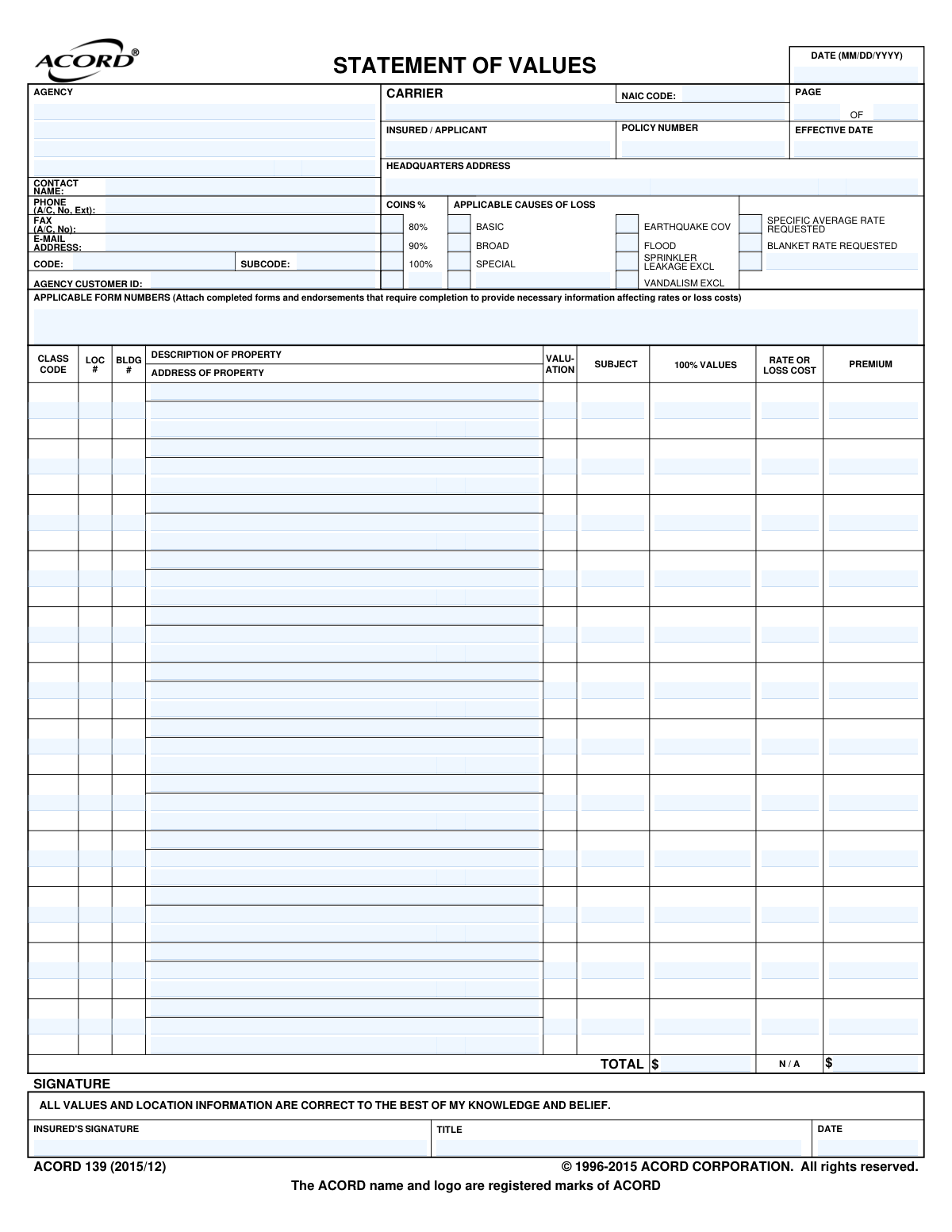
The ACORD 125 (Commercial Insurance Application - Applicant Information Section) is the standardized cover form used by insurance carriers, brokers, and agencies across the United States to gather essential background data on a commercial applicant. It captures core organizational details, premises schedules, operational descriptions, line-of-business requests, prior policy records, and loss history summaries.
What Is the ACORD 125 Form?
Published by the Association for Cooperative Operations Research and Development (ACORD), the ACORD 125 serves as the master information form for commercial lines underwriting. Rather than functioning as a standalone policy request for a single line of coverage, the ACORD 125 acts as the umbrella intake document. It provides underwriters with a consolidated view of who the applicant is, how their business is legally and operationally structured, where their primary physical risks reside, and what policy lines are being requested.
In standard insurance workflows, the ACORD 125 is paired with line-specific supplemental ACORD forms. For instance, if a commercial entity requires general liability, business auto, and commercial property coverage, the agent submits an ACORD 125 alongside ACORD 126 (General Liability Section), ACORD 127 (Business Auto Section), and ACORD 140 (Property Section).
Understanding the layout and line items of the ACORD 125 PDF is critical for commercial insurance agents, brokers, risk managers, and business owners. Missing or inaccurate data on this foundational form can trigger carrier rejections, underwriting delays, misrated policy premiums, or coverage disputes during a claims audit.
Prerequisites and Information Required Before Completion
Before attempting to fill out an ACORD 125 PDF, insurance professionals and business owners should aggregate key financial, operational, and structural records. Collecting these documents in advance ensures data consistency across all submitted schedules and supplemental forms.
- Legal Identity and Tax Identifiers: Exact legal entity name (including any registered DBA/Trade names), Federal Employer Identification Number (FEIN), or Social Security Number (SSN) for sole proprietorships.
- Industry Classification Codes: Standard Industrial Classification (SIC) codes and North American Industry Classification System (NAICS) codes corresponding to the business's primary revenue-generating activities.
- Contact Information: Names, phone numbers, and email addresses for the primary business contact, inspection contact, and accounting/audit contact.
- Location Schedules: Complete physical street addresses (including building or suite numbers) for all owned, rented, or leased operational sites, along with occupancy details, square footage, and employee counts per location.
- Prior Insurance Documentation: Policy numbers, carrier names, expiration dates, limits, and annual premiums for all commercial coverages held over the preceding 3 to 5 years.
- Loss History Records: Official hard-copy loss runs provided by prior insurance carriers covering a minimum of 3 to 5 years, detailing claim counts, total incurred losses, open/closed status, and reserve amounts.
Comprehensive Section-by-Section Breakdown of the ACORD 125
The ACORD 125 form is divided into distinct sections, each designed to answer specific risk-assessment questions for underwriting committees. Below is an exhaustive breakdown of the form’s fields and layout.
| Form Section | Fields and Information Captured |
|---|---|
| ACORD 125 HEADER | Agency Name | Code | Status of Transaction | Applicant Name | FEIN / SSN | NAICS |
| LINES OF BUSINESS REQUESTED | [ ] Commercial General Liability [ ] Commercial Auto [ ] Commercial Property[ ] Workers Compensation [ ] Umbrella/Excess [ ] Cyber/E&O |
| PREMISES INFORMATION | Loc # | Bldg # | Street Address, City, State, Zip | Interest | Occupancy / Ops |
| NATURE OF BUSINESS / GENERAL INFO | Entity Type | Date Started | Yrs at Location | Operational Summary & Questions |
| PRIOR CARRIER & LOSS HISTORY | Year | Coverage Line | Carrier Name | Policy # | Limits | Premium | Loss Records |
| SIGNATURE & FRAUD NOTICES SECTION | Applicant Signature | Date | Producer Signature | National/State Fraud Warnings |
1. Header and Agency Information
The top block of Page 1 establishes administrative routing details.
- Agency / Producer Name and Address: Identifies the insurance brokerage preparing the application, including the licensed agent's contact info.
- Agency Code and Sub-Code: Internal carrier identifiers assigned to the broker by specific insurance companies.
- Transaction Status: Checkboxes specifying whether the submission represents a Quote, Bound policy, Issue Policy, Change, Renewal, or Cancellation.
- Effective / Expiration Date: The proposed inception and termination dates of the requested policy term (typically a 12-month period).
2. Applicant Identification and Legal Structure
This section establishes the precise identity of the party seeking insurance protection.
- Named Insured: Must match the official legal entity registered with the state Secretary of State office. If multiple legal entities operate under common ownership, each must be listed or attached via an additional named insured schedule.
- Mailing Address: The primary administrative address where official notices, billing statements, and policy documents will be delivered.
- FEIN or SSN: The tax identification number used by state rating bureaus and underwriters to verify credit background, corporate identity, and loss histories.
- Legal Entity Structure: Specific boxes must be selected to indicate whether the entity is an Individual (Sole Proprietor), Partnership, Corporation, Limited Liability Company (LLC), Joint Venture, Trust, or Other. Selecting the wrong entity category can affect coverage eligibility and legal defense protections.
- NAICS / SIC Codes: Four-to-six-digit classification codes that establish the baseline hazard index for the business.
3. Lines of Business Requested
This table allows the applicant or broker to indicate which commercial policy types are being applied for concurrently. Checkboxes include:
- Commercial General Liability
- Commercial Auto
- Commercial Property / Building & Personal Property
- Workers Compensation & Employers Liability
- Commercial Umbrella / Excess Liability
- Boiler & Machinery / Equipment Breakdown
- Inland Marine / Transportation
- Crime / Employee Dishonesty
- Cyber Liability & Data Breach
- Directors & Officers (D&O) / Employment Practices Liability (EPLI)
Indicating the requested lines helps underwriters verify whether supplemental ACORD forms are required to complete the submission package.
4. Premises Information Schedule
Underwriters evaluate geographic exposure, property characteristics, and localized hazards using the Premises Information section.
- Location Number (Loc #) and Building Number (Bldg #): Standardized numeric identifiers used throughout all attached ACORD schedules (e.g., ACORD 140 or ACORD 126). Loc #1, Bldg #1 represents the primary headquarters or main physical facility.
- Street Address: Full physical site address. P.O. Boxes are not permitted in this section as physical risk location must be pinpointed.
- Interest: Specifies whether the applicant Owns, Rents, or Leases the site.
- Occupancy / Operations Description: Details what activity takes place at the specific site (e.g., "Corporate Management Office," "Light Electronics Manufacturing," "Warehouse for Retail Inventory").
- Employee Count and Payroll: Displays full-time and part-time employee headcounts and approximate annual payroll allocated to each specific site location.
5. Nature of Business and Operational Overview
This section describes the business's history, core activities, and operational stability.
- Date Business Started: The year and month the commercial entity was formed.
- Years at Current Location: Indicates commercial longevity and lease/property stability.
- Description of Primary Operations: A narrative field summarizing overall business activities, product manufacturing, services rendered, target client demographics, and off-premises operations.
- Inspection and Audit Contacts: Designates the individuals who have authority and access to meet field inspectors or payroll auditors sent by the insurance company.
6. General Information (Underwriting Screening Questions)
Page 2 of the ACORD 125 contains a series of critical Yes/No questions that help underwriters flag high-risk operational elements. Key items evaluated include:
- Bankruptcy and Financial Status: Questions regarding whether the applicant or any principal has filed for bankruptcy within the preceding 3 to 5 years.
- Subcontractor Usage: Inquires whether the applicant hires independent contractors, requires certificates of insurance (COIs), or maintains formal written hold-harmless agreements.
- Safety and Risk Management: Asks if written safety programs, active safety committees, regular OSHA inspections, or formal hazard mitigation procedures are maintained.
- Hazardous Materials: Verifies whether the company handles, stores, generates, or disposes of toxic, flammable, or hazardous chemicals and waste.
- Uncorrected Code Violations: Checks for outstanding municipal building code, safety, or fire department violations.
- Off-Premises / Out-of-State Operations: Discloses whether work is performed outside the primary state of operation or outside the United States.
Note: Answering "Yes" to any general information question requires a detailed explanation in the Remarks section or an attached supplement.
7. Prior Carrier Information and Loss History
This section tracks historical underwriting performance and policy continuity over a 3- to 5-year period.
- Prior Coverages Table: Captures the year, policy line, carrier name, policy number, limits of liability, and annual premium paid for preceding terms.
- Loss History Check: Requests confirmation of all claims, occurrences, or circumstances that might give rise to a claim over the past 3 to 5 years.
- Loss Run Attachments: Underwriters generally require official loss runs generated directly by previous insurance carriers alongside the ACORD 125.
8. Signature Block and State Fraud Disclosures
The final section contains mandatory fraud notices mandated by state insurance departments and the national standard signature panel.
- Fraud Statements: Standardized regulatory warnings stating that any person who knowingly and with intent to defraud an insurance company files an application containing false, incomplete, or misleading information is guilty of a crime and subject to legal penalties.
- Applicant Signature and Title: Must be signed by an authorized corporate officer, partner, or sole proprietor.
- Producer Signature and License Number: The licensed insurance agent or broker must sign, date, and supply their official state license or National Producer Number (NPN).
ACORD 125 vs. Supplemental ACORD Forms
The ACORD 125 establishes the identity of the applicant, but it does not collect line-specific exposure metrics (such as vehicle identification numbers, specialized property values, or specific liability gross receipts). Therefore, it must be submitted alongside dedicated policy forms.
| ACORD Form Number | Form Title / Scope | Key Data Collected | Primary Policy Association |
|---|---|---|---|
| ACORD 125 | Commercial Insurance Application (Applicant Info) | Legal entity, FEIN, address schedule, business nature, general questions, loss summary | Master Application (All Lines) |
| ACORD 126 | Commercial General Liability Section | Gross sales, payroll by classification code, products liability, completed operations | General Liability Insurance |
| ACORD 127 | Business Auto Section | Driver rosters, driver license numbers, vehicle schedules, VINs, garaging locations | Commercial Auto Insurance |
| ACORD 130 | Workers Compensation Application | State operations, detailed class codes, estimated annual payroll per code, officers excluded/included | Workers Compensation |
| ACORD 140 | Property Section | Building values, business personal property (BPP), construction types, square footage, fire protection class | Commercial Property Insurance |
| ACORD 131 | Excess / Umbrella Section | Underlying policy limits, underlying carriers, total policy layers, liability exposure modifiers | Commercial Umbrella / Excess |
Common Errors on ACORD 125 PDF Applications
Filling out an ACORD 125 incorrectly leads to underwriting friction, audit discrepancies, and potential coverage denials. The following list highlights common mistakes and how to avoid them.
- Common ACORD 125 Submission Pitfalls
- Inconsistent Identifiers: Legal Name / FEIN Mismatches
- Mismatched Premises: Location/Building # Mismatches Across Forms
- Unexplained "Yes" Answers: General Info Block Missing Remarks Page
1. Inconsistent Entity Names and FEIN Mismatches
A frequent mistake is listing an informal business trade name instead of the registered legal corporate name on the primary applicant line. For example, submitting an application under "Apex Construction" when the formal legal entity is "Apex Enterprises LLC dba Apex Construction" creates discrepancies. Ensure the FEIN matched to the entity is identical to IRS documentation.
2. Mismatched Location and Building Numbers
Location Numbers (Loc #) and Building Numbers (Bldg #) assigned on Page 1 of the ACORD 125 must remain strictly identical across all attached supplemental forms. If an agent designates a warehouse as Loc #1, Bldg #2 on the ACORD 125, it must be referred to as Loc #1, Bldg #2 on the ACORD 140 Property Section and ACORD 126 Liability Section. Mismatched location numbering creates severe reporting errors during property inspections and underwriting reviews.
3. Leaving "General Information" Answers Unexplained
If an applicant checks "Yes" to a question regarding prior bankruptcies, hazardous materials, or subcontractor usage, the application must include an explanatory breakdown in the Remarks section or on an attached company letterhead document. Submitting an application with unexplained "Yes" answers results in immediate underwriting rejection or requests for information (RFIs).
4. Omitting Officer Exclusion/Inclusion Status
In states where sole proprietors, business partners, LLC members, or corporate officers have the right to elect or waive coverage on attached Workers Compensation policies (ACORD 130), the applicant’s ownership percentage and legal status must align with the parameters defined on the ACORD 125 general info sheet.
Digital PDF Workflows, Agency Management Systems, and E-Signatures
While fillable PDF versions of the ACORD 125 remain widely used across commercial brokerages, modern insurance operations leverage digital workflows to generate and manage these forms automatically.
- Client Intake / Portal
- Agency Management System (AMS)
- Auto-Populated ACORD 125 PDF
- E-Signature Platform
- Carrier Submission
Agency Management Systems (AMS)
Modern brokerage platforms—such as Vertafore (AMS360, Sagitta), Applied Systems (Epic, TAM), and HawkSoft—maintain central databases containing applicant records. When an agent creates a new client record, the system populates the ACORD 125 automatically alongside all corresponding policy schedules (ACORD 126, 127, 140), preventing manual data re-entry errors.
Fillable PDF Editors and Data Mapping
For agencies operating without an integrated AMS, fillable Adobe PDF versions of the ACORD 125 allow agents to input data electronically, save client templates, and map form fields into carrier upload portals using XML or JSON data standards.
Electronic Signatures and Regulatory Validity
Electronic signature frameworks (such as the ESIGN Act in the United States and state-specific insurance regulations) recognize electronic signatures on ACORD 125 applications as legally binding. Modern digital signature platforms automatically attach an audit log—capturing IP addresses, timestamps, and signer identity verification—to the finalized ACORD 125 PDF submission.
Frequently Asked Questions
Is the ACORD 125 a legally binding insurance contract?
No. The ACORD 125 is an application and representation of risk, not a insurance contract or binder. However, the information provided on the form is used by insurance carriers to evaluate risk, determine pricing, and issue policies. Material misrepresentations or false statements made on the ACORD 125 can result in policy voidance or claims denial.
Can an ACORD 125 be submitted without any supplemental forms?
Generally, no. The ACORD 125 collects basic background information regarding the business entity, but it lacks specific risk metrics required to rate individual policies (such as property construction details or driver lists). It is designed to be paired with line-specific forms such as ACORD 126 (General Liability), ACORD 127 (Auto), or ACORD 140 (Property).
Where can an insurance agent or business owner obtain an ACORD 125 PDF?
Licensed insurance agencies and brokerages obtain official, compliant ACORD forms directly through an authorized ACORD license or via integrated Agency Management Software (AMS) platforms. ACORD forms are subject to copyright law, and commercial users must maintain an active ACORD license to download and distribute official forms.
What is the difference between an ACORD 125 and an ACORD 25?
The ACORD 125 is a multi-page commercial policy application used to apply for insurance coverage. The ACORD 25 is a single-page Certificate of Liability Insurance (COI) used after a policy is issued to provide third parties (such as landlords or general contractors) with evidence that insurance coverage is active.
How many years of loss history must be reported on the ACORD 125?
Standard commercial underwriting guidelines typically require 3 to 5 years of detailed loss history. In addition to filling out the summary table on the ACORD 125, carriers generally mandate the attachment of official, hard-copy loss run reports generated by previous insurance carriers.
Next Steps for Agents and Business Owners
To ensure a smooth underwriting process, commercial applicants and insurance professionals should take the following actions:
- Verify Legal Entity Details: Confirm the exact legal business name, FEIN, and state registration records before populating Page 1 of the ACORD 125.
- Standardize Location Numbers: Establish clear, sequential location and building numbers (
Loc #1, Bldg #1) and maintain those exact identifiers across all supplemental forms (ACORD 126, 127, 140). - Compile Supplemental Documentation: Prepare official 3- to 5-year loss run reports, safety manuals, hold-harmless agreements, and financial summaries before submitting the application package to underwriters.
- Use Electronic Signatures with Audit Trails: Ensure both the applicant officer and licensed producer sign and date the completed form, storing the verified e-signature audit trail within the agency management file.
Disclaimer: Insurance regulatory requirements, form revisions, and state-specific fraud statements vary by jurisdiction. Consult official standard-setting guidelines from ACORD and state insurance commissioners for legal and regulatory compliance requirements.