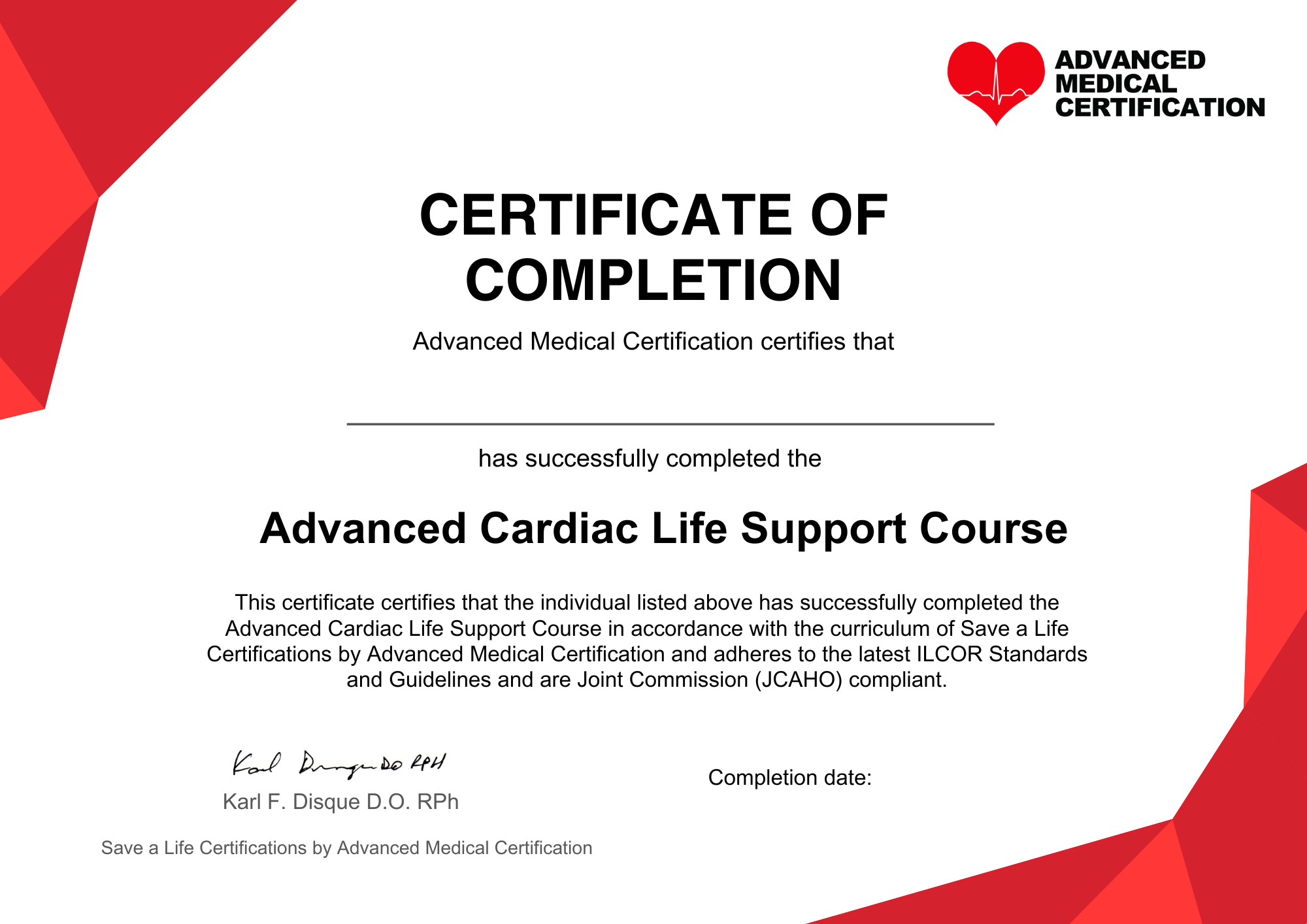
ACLS online certification refers to the digital delivery of Advanced Cardiovascular Life Support training, designed for healthcare providers who manage the urgent treatment of cardiac arrest, stroke, and other life-threatening cardiovascular emergencies. These programs typically consist of a self-paced cognitive curriculum completed through an online learning platform, followed by a mandatory hands-on skills assessment to verify clinical competency according to current resuscitation guidelines.
Understanding the ACLS Framework and Certification Requirements
Advanced Cardiovascular Life Support (ACLS) is a set of clinical algorithms for the urgent treatment of cardiac arrest, stroke, myocardial infarction, and other related cardiovascular emergencies. The certification is a mandatory credential for many medical personnel, including physicians, nurses, paramedics, and respiratory therapists.
In the modern clinical environment of 2026, the certification process is split into two distinct components: the cognitive portion and the psychomotor skills evaluation. The cognitive portion covers the pharmacological aspects of ACLS, high-quality CPR, electrical therapy (defibrillation and pacing), and the team dynamics required to lead a resuscitation effort. Because patient survival depends heavily on the physical application of these interventions, the American Heart Association (AHA) and other major certifying bodies emphasize that purely online-only courses—those lacking a practical skills verification—do not meet the standard of care requirements for clinical practice.
When researching certification options, you must ensure that the provider follows the most recent guidelines set forth by the International Liaison Committee on Resuscitation (ILCOR) and localized bodies like the AHA. A valid certification must be recognized by your employer and the licensing board in your jurisdiction.
The Two-Part Certification Model: Theory and Practice
To obtain a legitimate ACLS certification, you must successfully navigate a blended learning model. Relying solely on online video modules is insufficient for professional clinical practice.
Part 1: The Online Cognitive Module
The initial phase involves interactive, web-based modules. These cover:
- Systematic Approach: The evaluation of a patient using the Primary and Secondary Assessment models.
- Rhythm Recognition: Interpreting electrocardiogram (ECG) strips to identify shockable versus non-shockable rhythms.
- Pharmacology: Understanding the indications, dosages, and contraindications of drugs like epinephrine, amiodarone, and adenosine.
- Team Dynamics: Effective communication as a team lead during a high-stress code situation.
Part 2: Hands-On Skills Verification
Once the online portion is finished, you receive a completion certificate that serves as an admission ticket to a skills session. In 2026, many organizations offer these sessions via "Voice-Assisted Manikin" (VAM) technology or instructor-led sessions. During this phase, you must demonstrate proficiency in:
- Bag-mask ventilation techniques.
- Initiating chest compressions at the correct depth and rate.
- Safe and effective use of an Automated External Defibrillator (AED) or manual defibrillator.
- Managing a simulated patient through a complex cardiac arrest algorithm.
Selecting a Credible Provider
Not all online training platforms are created equal. Accreditation is the single most important factor when choosing a course. If the certification is not accepted by your hospital's credentialing office, it holds no professional value.
| Feature | Accredited Programs | Unaccredited/Generic Programs |
|---|---|---|
| Guidelines | Aligned with current ILCOR standards | Often outdated or proprietary algorithms |
| Skills Verification | Mandatory in-person or high-fidelity simulation | Often skipped or purely theoretical |
| Credential Recognition | Widely accepted by major health systems | Frequently rejected by HR and boards |
| Continuing Education | Provides valid CME/CEU credits | Credits may not count toward licensure |
When evaluating a provider, look for the official seal of the American Heart Association (AHA) or the American Red Cross. Verify that the provider specifically mentions their compliance with the most recent resuscitation science updates.
Prerequisites for Certification
Before enrolling in an ACLS course, most organizations mandate specific prerequisites to ensure students have the foundational knowledge necessary for advanced life support.
- Current BLS Certification: Basic Life Support (BLS) is the bedrock of ACLS. You generally must hold a current, valid BLS provider card from the same certifying organization (e.g., AHA) before you can be issued an ACLS credential.
- Clinical Proficiency: You are expected to have a working knowledge of basic ECG interpretation. While the course provides a review, it is not a remedial class for those who have never seen an ECG strip.
- Medical Training: ACLS is designed for healthcare professionals. If you are a student, ensure you are in a clinical program (nursing, medicine, respiratory therapy) that recognizes the need for this certification.
Steps to Completing Your Certification
- Select an Authorized Provider: Purchase the official course through an AHA-authorized training center or a reputable affiliate.
- Complete the Pre-Course Assessment: Most programs provide a pre-test. Do not skip this; it identifies knowledge gaps in pharmacology and rhythm identification that you must address before the final exam.
- Work Through Online Modules: Allocate sufficient time. These courses are comprehensive and often take several hours to complete. You can typically save your progress and return later.
- Schedule Skills Testing: Do not wait until your current card expires to schedule your skills session. In 2026, testing centers can have significant wait times.
- Pass the Final Examination: A written exam usually follows the online portion. Aim for a thorough understanding of the clinical algorithms rather than rote memorization, as clinical scenarios often evolve during the test.
Cost Considerations and Financial Planning
The cost of ACLS certification varies based on the provider, your location, and whether you are paying out-of-pocket or through an employer.
- Tuition Fees: Expect to pay between $150 and $300 for the combined online course and the skills assessment.
- Employer Reimbursement: Many hospitals offer "education budgets" for staff. Always check with your HR department or nursing educator before paying for the course yourself, as they may have a preferred training center that provides discounted or free sessions for employees.
- Hidden Costs: Some online programs charge additional fees for the digital access code to the manual. Ensure you clarify whether the course price includes the textbook (or eBook) and the skills testing fee.
Troubleshooting Common Issues
- Certificate Not Recognized: If your employer rejects your card, it is likely because the provider is not accredited. Always check the AHA or Red Cross website for a list of "Training Centers" in your zip code to guarantee legitimacy.
- Technical Glitches: Online platforms can encounter issues with browser compatibility or video playback. Use a desktop computer with a stable, high-speed internet connection rather than a mobile device for the final examination to minimize connection errors.
- Expiration Anxiety: If you are nearing the expiration date of your current card, you are considered "due for renewal." If you let your card expire, you may be required to take the full provider course rather than the shorter "Renewal" (or "Update") course.
Frequently Asked Questions
Does an online-only ACLS certificate count for hospital credentialing? Generally, no. Most hospitals require a certification that includes a documented psychomotor skills component. Always verify with your specific hospital’s credentialing department before purchasing an online-only course that lacks a physical testing requirement.
How long does an ACLS certification last? Under standard guidelines, an ACLS certification is valid for two years. You are encouraged to begin the renewal process 30 to 60 days before your expiration date to ensure continuous coverage.
What is the difference between an ACLS provider course and a renewal course? A provider course is for those who are certifying for the first time or whose previous card has already expired. A renewal course is a condensed version for those who currently hold a valid (non-expired) ACLS card.
Are the pharmacology and rhythm modules included in the online portion? Yes. High-quality ACLS online programs incorporate these as prerequisite sections or integrated modules because the ability to identify rhythms and manage medications is fundamental to the successful completion of the course algorithms.
Can I take the ACLS exam if I fail the pre-course assessment? You can usually retake the pre-course assessment as many times as necessary. However, it is a diagnostic tool; failing it indicates that you should review your ECG and pharmacology knowledge before attempting the final exam, which usually has a limited number of attempts.
Final Recommendation for Professionals
To ensure your ACLS certification is seamless and accepted by your institution, start by visiting the official American Heart Association "Find a Class" portal or the equivalent for your chosen organization. Verify that the course includes the mandatory hands-on skills session. By prioritizing accredited providers and completing your renewal well before your current card expires, you ensure that your credentials remain in good standing without professional disruption.