The three top life insurance options to build cash value are Participating Whole Life, Indexed Universal Life (IUL), and Variable Universal Life (VUL). These permanent policies accumulate a tax-deferred savings component alongside a death benefit, differing primarily in their growth mechanisms, risk exposure, and premium flexibility to meet specific financial goals.
The Mechanics of Cash Value Accumulation
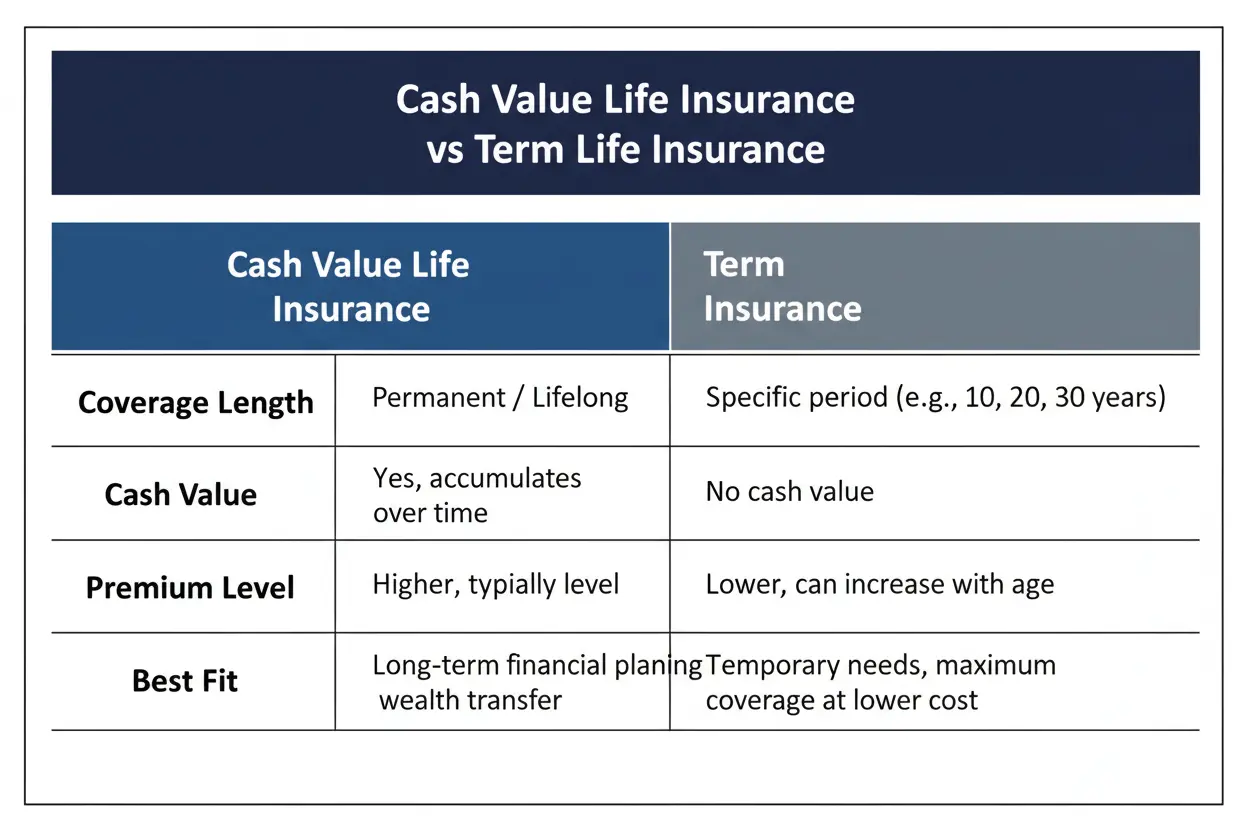
Cash value is the "living benefit" of permanent life insurance. Unlike term life insurance, which only pays a benefit upon the death of the insured, permanent policies allocate a portion of every premium payment into an internal savings account. In the early years of a policy, the premium payments are significantly higher than the actual cost of insurance (COI). This overpayment, combined with interest or investment earnings, builds equity within the policy.
As of 2026, the legislative landscape remains heavily influenced by the 2020 updates to Internal Revenue Code (IRC) Section 7702. These changes lowered the minimum interest rates used to test whether a policy qualifies as "life insurance" for tax purposes. This allows policyholders to pour more cash into their policies without triggering the Modified Endowment Contract (MEC) status, which would remove many of the tax advantages associated with life insurance.
The cash value grows on a tax-deferred basis, meaning you do not pay annual taxes on the gains. Furthermore, you can access this money through tax-free policy loans or withdrawals up to your "basis" (the total amount of premiums paid). Understanding which of the three main engines—Whole Life, IUL, or VUL—best suits your risk tolerance is the first step in effective wealth planning.
1. Participating Whole Life Insurance: The Conservative Powerhouse
Participating Whole Life insurance is often considered the foundation of a stable financial plan. It is characterized by three main guarantees: a guaranteed death benefit, a guaranteed level premium, and a guaranteed minimum rate of growth on the cash value.
The Role of Dividends
The "participating" aspect is what makes this a top option for cash value growth. While dividends are not legally guaranteed, many major mutual insurance companies have paid them every year for over a century. Dividends represent a return of "excess" premium to the policyholder when the insurance company performs better than expected (lower mortality rates, lower expenses, or higher investment returns).
In 2026, policyholders typically utilize dividends in one of four ways:
- Paid-Up Additions (PUAs): This is the most effective way to build cash value. Dividends are used to purchase additional "mini" policies that have their own cash value and death benefit, creating a compounding effect.
- Cash Payments: The company sends you a check annually.
- Premium Reduction: Dividends cover part of your scheduled premium.
- Accumulate at Interest: The dividends sit in a separate account and earn interest, though this interest is usually taxable.
Stability and Predictability
Whole Life is the least volatile option. Because the growth is based on the insurer's general account—which is largely comprised of high-grade corporate and government bonds—your cash value does not drop when the stock market crashes. For individuals looking for a "volatility buffer" in their retirement portfolio, the steady 3% to 5% internal rate of return (inclusive of dividends) offered by modern Whole Life policies provides a reliable floor.
2. Indexed Universal Life (IUL): The Balanced Growth Engine
Indexed Universal Life insurance has become one of the most popular vehicles for cash value accumulation because it offers a middle ground between conservative Whole Life and aggressive Variable Life.
How Index Crediting Works
In an IUL policy, the cash value growth is linked to the performance of a market index, such as the S&P 500 or the Nasdaq-100. However, you are not actually invested in the stock market. Instead, the insurance company uses the interest earned on its general account to purchase "options" on the index.
The key features of IUL crediting include:
- The Floor: Most IUL policies have a 0% floor. This means that even if the S&P 500 drops by 20% in a given year, your cash value remains stable (minus the internal cost of insurance and fees).
- The Cap: In exchange for the floor, the insurer sets a "cap" on your gains. If the cap is 9% and the index returns 15%, you receive 9%.
- Participation Rates: This determines what percentage of the index's gain you receive. If the participation rate is 120% and the index gains 5%, you might receive 6% (subject to the cap).
Premium Flexibility
Unlike Whole Life, IUL offers flexible premiums. As long as the cash value is sufficient to cover the monthly COI and administrative fees, you can increase, decrease, or even skip premium payments. This makes IUL a favorite for entrepreneurs or professionals with fluctuating incomes who still want to build significant tax-advantaged wealth.
In the current 2026 economic environment, IULs are often structured with "multi-index" options, allowing policyholders to diversify their crediting strategies across domestic, international, and volatility-controlled indices.
3. Variable Universal Life (VUL): The High-Reward Investment Vehicle
For those with a high risk tolerance and a long time horizon, Variable Universal Life (VUL) offers the greatest potential for cash value accumulation. VUL policies are considered "securities" and are regulated by both state insurance departments and the Securities and Exchange Commission (SEC).
Direct Market Exposure
Unlike Whole Life or IUL, the cash value in a VUL policy is directly invested in "sub-accounts" that function similarly to mutual funds. You can choose from a variety of asset classes, including aggressive growth stocks, international equities, and emerging markets.
Because the money is directly in the market, there is no floor (other than what may be offered by specific "protected" sub-accounts). If the underlying investments lose value, your cash value will decrease. Conversely, there is typically no cap on your gains. During a bull market, a VUL can significantly outperform Whole Life and IUL, leading to rapid cash value accumulation.
Maximum Flexibility and Oversight
VULs offer the same premium flexibility as IULs but require more active management. Policyholders must monitor their asset allocation to ensure the policy remains adequately funded. If the market performs poorly and the cash value drops too low, the policyholder may be required to inject more capital to prevent a lapse.
As of 2026, many VUL providers have introduced "Guaranteed Minimum Accumulation Benefits" (GMAB) riders, which provide a level of protection against market downturns for an additional fee, making VULs slightly more palatable for the moderately aggressive investor.
Comparative Analysis of Cash Value Options
The following table compares the primary characteristics of the three top life insurance options to build cash value based on current 2026 standards.
| Feature | Participating Whole Life | Indexed Universal Life (IUL) | Variable Universal Life (VUL) |
|---|---|---|---|
| Growth Basis | Fixed rate + Dividends | Market Index performance | Direct Sub-account (Mutual Funds) |
| Risk Level | Low | Moderate | High |
| Premium Structure | Fixed/Guaranteed | Flexible | Flexible |
| Downside Protection | Guaranteed growth floor | 0% Floor (typical) | None (can lose value) |
| Upside Potential | Moderate (3%–5% avg) | Capped (8%–12% avg cap) | Uncapped |
| Regulation | State Insurance Depts | State Insurance Depts | SEC, FINRA, & State Depts |
| Ideal Candidate | Risk-averse, needs guarantees | Wants growth with protection | Aggressive, long-term investor |
Strategic Considerations for Maximizing Growth
To truly build significant cash value, simply owning a policy is not enough. You must understand how to "engineer" the policy for maximum efficiency.
Overfunding and the MEC Limit
To maximize cash value, most experts recommend "overfunding" the policy. This means paying the maximum amount of premium allowed under IRC Section 7702 without turning it into a Modified Endowment Contract. By keeping the death benefit (the "Net Amount at Risk") as low as possible while maximizing the premium, you minimize the internal cost of insurance, allowing more of your money to go toward the cash value.
Policy Loans and "Infinite Banking"
One of the most powerful ways to use cash value in 2026 is through policy loans. Unlike a bank loan, you are not "borrowing" your own money; you are borrowing the insurance company's money and using your cash value as collateral.
There are two types of loan structures:
- Direct Recognition: The insurance company reduces the dividend or interest paid on the portion of the cash value used as collateral.
- Non-Direct Recognition: The insurance company continues to pay the full dividend or interest rate on your entire cash value, even the portion you have "borrowed" against. This can create a "positive spread" where you earn more on your cash value than you are paying in loan interest.
Surrender Charges and Early Liquidity
It is vital to note that cash value life insurance is a long-term play. Most policies have a "surrender charge" period lasting 10 to 15 years. If you cancel the policy in the first few years, you may receive little to no cash back. These charges cover the insurer's upfront costs, including commissions and underwriting.
Common Pitfalls and How to Avoid Them
Building cash value requires discipline and an understanding of policy expenses. Many people fail to see the results they expect due to the following common mistakes:
- Underfunding: If you only pay the "target" or minimum premium on a Universal Life policy, the rising cost of insurance as you age may eventually eat through the cash value, causing the policy to lapse later in life.
- Ignoring the Internal Costs: Every permanent policy has administrative fees and mortality charges. In a VUL, there are also investment management fees. It is essential to review your "annual statement" to ensure the growth is outpacing the costs.
- Taking Unstructured Withdrawals: Withdrawals are tax-free up to your basis, but they permanently reduce the death benefit. Loans are generally preferred because they keep the death benefit intact and the cash value compounding.
- Failing to Update the Policy: Financial goals change. In 2026, many policies offer "riders" for long-term care or chronic illness. Integrating these can provide additional value, but they also increase the cost of insurance.
Frequently Asked Questions
Can I lose money in a cash value life insurance policy?
In a Whole Life or IUL policy, your principal is generally protected from market losses. However, you can still "lose" money in the sense that the internal costs of insurance and administrative fees may exceed the interest credited in a given year, especially in the early years of the policy. In a VUL, you can absolutely lose principal due to direct market exposure in your sub-accounts.
Is the cash value paid out in addition to the death benefit?
In a standard "Level" death benefit (Option A) policy, the beneficiary receives only the face amount, which includes the cash value. If you want the beneficiaries to receive both the face amount and the accumulated cash value, you must select an "Increasing" death benefit (Option B). This option typically costs more in monthly premiums.
How long does it take for cash value to become significant?
Because of high upfront costs and surrender charges, most policies take between 7 and 12 years to reach a "break-even" point, where the cash value equals or exceeds the total premiums paid. After this point, the compounding effect accelerates significantly.
What happens if I stop paying premiums?
In a Whole Life policy, your policy may lapse unless it is "Reduced Paid-Up," which lowers the death benefit to a level that can be sustained without further premiums. In Universal Life (IUL/VUL), the policy will remain in force as long as the existing cash value is enough to cover the monthly internal costs. Once the cash value is exhausted, the policy lapses and the death benefit is lost.
Are policy loans really tax-free?
Yes, as long as the policy remains in force until the insured's death. If the policy lapses or is surrendered while there is an outstanding loan, the loan amount (to the extent it exceeds your basis) is treated as taxable income by the IRS. This is a "tax trap" that requires careful management of older policies.
Final Recommendation
Choosing the right life insurance for cash value accumulation depends on your specific financial profile. If you prioritize safety and want a "guaranteed" outcome for your legacy and savings, Participating Whole Life is the gold standard.
If you are looking for a tax-efficient way to participate in market gains while having a safety net against losses, Indexed Universal Life offers a compelling balance of flexibility and growth. For the sophisticated investor who views life insurance as a high-growth component of a broader portfolio and can stomach market volatility, Variable Universal Life provides the highest upside.
Before committing, request a "full illustration" from an insurance professional. This document will show you the projected growth of your cash value over 20, 30, and 40 years under both "guaranteed" and "non-guaranteed" scenarios. In 2026, with the availability of more transparent digital tools, you should also compare the "Internal Rate of Return" (IRR) on cash value across different carriers to ensure you are getting the most efficient contract for your dollar.