The 2-5-1 jazz chord progression is the foundational harmonic engine of Western jazz music, built on the second, fifth, and first degrees of a major or minor scale. It drives standard repertoire by creating a continuous cycle of musical tension and resolution that guides improvisation and harmonic reharmonization.
Introduction to Jazz Harmony and the 2-5-1 Progression
To understand jazz harmony, one must first master the absolute bedrock of the genre: the 2-5-1 jazz chord progression. Whether listening to a swing-era standard by Duke Ellington, a bebop exploration by Charlie Parker, or a modal composition by Miles Davis, your ears are almost certainly tracking a 2-5-1 sequence. In functional harmony, a chord progression represents a journey away from home, a period of heightened tension, and a satisfying return home. The 2-5-1 accomplishes this narrative arc with supreme elegance and efficiency.
In its simplest mathematical terms, a 2-5-1 progression takes three scale degrees from a major or minor scale—specifically the second scale degree (II), the fifth scale degree (V), and the first scale degree (I)—and turns them into seventh or extended chords. Because the intervals between the roots of these chords naturally move in descending fifths (or ascending fourths), the progression possesses a magnetic forward momentum. This article will break down the construction, theory, voice leading, and practical application of the 2-5-1 progression, giving musicians the tools necessary to analyze, play, and improvise over this ubiquitous harmonic structure.
The Theoretical Foundation: Scale Degrees and Roman Numerals
Before playing a single note on an instrument, a musician must understand how Roman numerals and scale degrees map out a key center. In music theory, capital Roman numerals represent major chords, while lowercase numerals (or numbers with specific suffixes) denote minor chords. Furthermore, jazz musicians rarely play simple triads; they deal almost exclusively in seventh chords (chords built by stacking thirds up to the seventh scale degree).
Consider the key of C Major. The scale consists of the notes C, D, E, F, G, A, and B. By building a seventh chord on each note of this scale using diatonic notes (notes residing strictly within the C major scale), we generate a specific chord quality for every scale degree:
- I (Cmaj7): C - E - G - B (Major 7th)
- II (Dm7): D - F - A - C (Minor 7th)
- III (Em7): E - G - B - D (Minor 7th)
- IV (Fmaj7): F - A - C - E (Major 7th)
- V (G7): G - B - D - F (Dominant 7th)
- VI (Am7): A - C - E - G (Minor 7th)
- VII (Bm7b5): B - D - F - A (Half-diminished 7th)
Taking the second degree (Dm7), the fifth degree (G7), and the first degree (Cmaj7), we form the classic major Dm7 – G7 – Cmaj7 progression.
The progression embodies the core functional harmony concepts of predominant, dominant, and tonic. The Dm7 chord initiates the movement by establishing a mild sense of departure from the home key. The G7 chord acts as the dominant powerhouse, packed with harmonic tension that begs for resolution. Finally, the Cmaj7 chord arrives as the tonic anchor, bringing total relaxation and completion to the phrase.
Anatomy of the Chords: Breaking Down Dm7, G7, and Cmaj7
To truly master the 2-5-1 progression, you must examine the internal architecture of each chord. Each chord plays a distinct psychological and physical role in the ear's journey from tension to release.
The II Chord (Minor 7th)
In a major key 2-5-1, the II chord is structurally a minor seventh chord. In C Major, this is Dm7. Composed of the notes D (root), F (minor third), A (fifth), and C (minor seventh), it acts as the setup. It introduces a slightly darker, introspective color compared to the bright major tonic, yet it is stable enough to sit comfortably without demanding immediate resolution.
The V Chord (Dominant 7th)
The V chord is the engine of the entire system. In C Major, this is G7, consisting of G (root), B (third), D (fifth), and F (minor seventh). The defining characteristic of any dominant seventh chord is the tritone interval hidden inside it. In G7, the interval between the third (B) and the seventh (F) is a diminished fifth (or augmented fourth), which spans precisely three whole tones. This interval is inherently unstable. The B wants to pull upward by a half step to C, while the F wants to pull downward by a half step to E. This microscopic voice-leading pressure is what makes dominant harmony so powerful.
The I Chord (Major 7th)
The I chord is the destination. In C Major, this is Cmaj7, consisting of C (root), E (third), G (fifth), and B (major seventh). When the B of the G7 chord resolves up to C, and the F resolves down to E, the tritone collapses into a stable major third (C and E). The tension evaporates, leaving the listener with a feeling of arrival and stability.
| Chord Symbol | Chord Quality | Notes (Key of C) | Harmonic Function |
|---|---|---|---|
| Dm7 | Minor 7th | D - F - A - C | Predominant (Setup) |
| G7 | Dominant 7th | G - B - D - F | Dominant (Tension) |
| Cmaj7 | Major 7th | C - E - G - B | Tonic (Resolution) |
The Minor Key 2-5-1 Progression
While the major 2-5-1 is essential, jazz music frequently utilizes the minor 2-5-1 progression. In a minor key, the harmonic landscape shifts because the underlying scale is derived from the natural, harmonic, or melodic minor scales.
Taking the key of C minor as our example, let us build the diatonic seventh chords:
- i (Cm7): C - Eb - G - Bb (Minor 7th)
- ii° (Dø7 or Dm7b5): D - F - Ab - C (Half-diminished 7th)
- V7 (G7alt or G7b9): G - B - D - F - (with altered extensions like Ab, Bb, Db, Eb)
- i (Cm(maj7) or Cm7): C - Eb - G - B (or Bb)
Consequently, the standard minor 2-5-1 progression becomes Dm7(b5) – G7alt – Cm7.
Examining the Minor Variant
- The Half-Diminished Chord (Dm7b5): Also written as $D^\varnothing7$, this chord contains a root, minor third, diminished fifth, and minor seventh (D - F - Ab - C). It provides a much darker, more dramatic predominant color than the standard minor seventh chord.
- The Altered Dominant Chord (G7alt): In minor keys, jazz musicians rarely play a plain, unadorned dominant seventh chord for the V. Instead, they utilize altered dominants packed with flat-ninths, sharp-ninths, flat-fifths, and sharp-fifths (e.g., G7b9, G7#5). These alterations maximize the tritone tension, making the eventual resolution to the minor tonic feel even more triumphant and dramatic.
- The Minor Tonic (Cm7): The final resting place is typically a minor seventh chord or a minor-major seventh chord, providing a moody, sophisticated conclusion to the phrase.
Voice Leading and Shell Voicings
Playing jazz requires smooth, efficient movement between chords. Pianists and guitarists rarely play full root-position chords with both hands; instead, they rely on shell voicings and voice leading. Voice leading is the art of moving individual notes from one chord to the next by the smallest possible physical distance.
The most famous concept in jazz voice leading involves the movement of the third and seventh intervals—often referred to as guide tones. These are the notes that define the quality of the chord and drive the resolution of the tritone.
Consider this classic left-hand piano voicing setup in C Major:
- On Dm7, play the root (D) with the pinky and the seventh/third (C and F) with your inner fingers.
- As you move to G7, the F can remain right where it is (or move smoothly), while the B (the third of G7) steps in neatly.
- As you move to Cmaj7, the B steps down to C, and the F steps down to E.
By keeping your hand anchored around the middle register of the keyboard, your fingers barely have to move. This economy of motion prevents your playing from sounding jumpy or disjointed, creating a smooth, professional jazz texture.
Common Substitutions and Advanced Variations
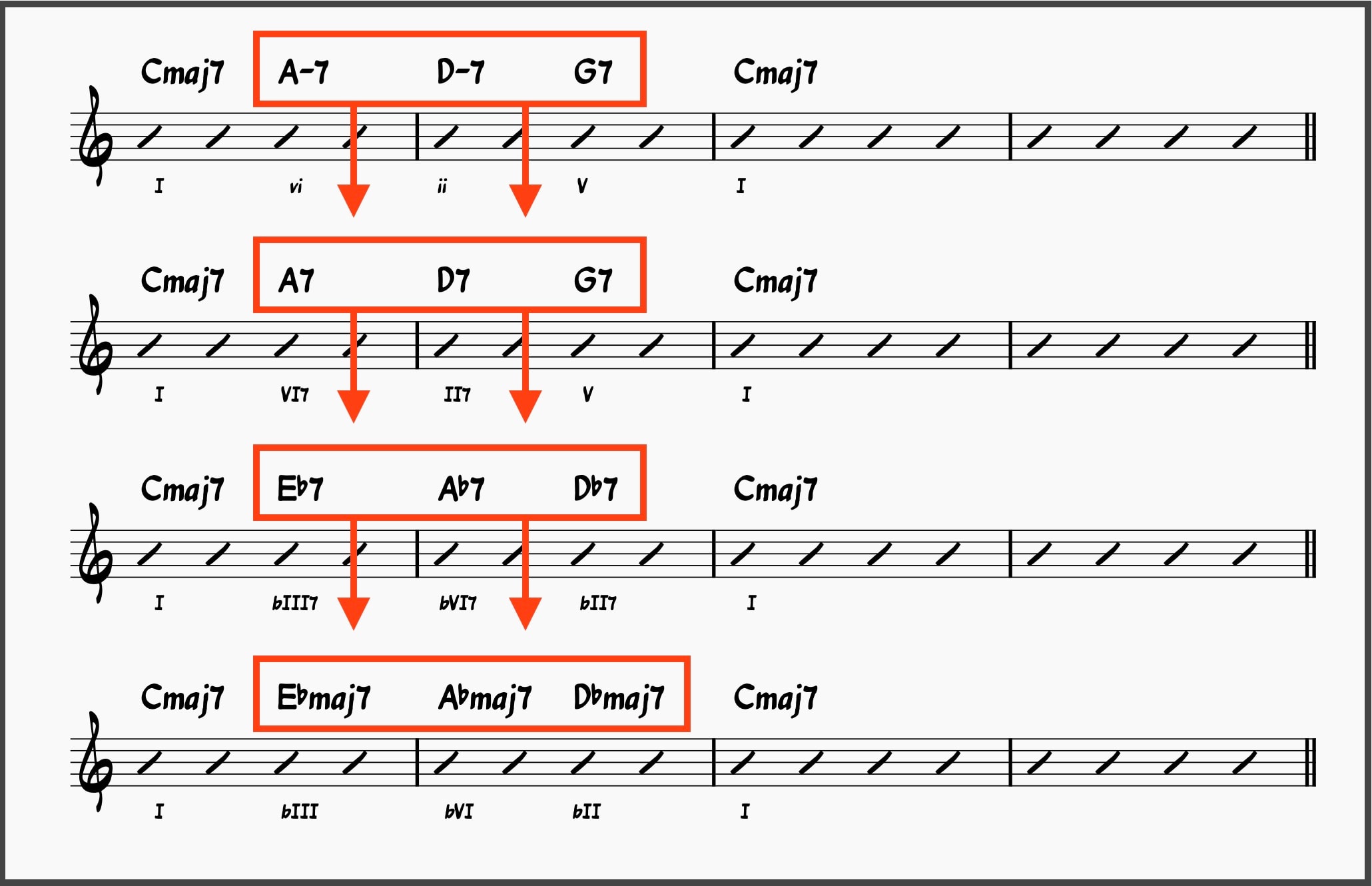
Once you understand the basic 2-5-1 framework, jazz harmony opens up into a playground of substitutions and embellishments. Composers and improvisers rarely leave a basic 2-5-1 untouched; they dress it up to create deeper emotional nuance.
1. Tritone Substitution
One of the most famous devices in jazz is the tritone substitution. Because the third and seventh intervals of a dominant chord define its function, any dominant chord that shares the exact same tritone can substitute for the original chord.
- In the key of C, the dominant chord is G7 (containing the tritone B and F).
- A Db7 chord contains the notes Db, F, Ab, and Cb (B). Notice that it shares the exact same tritone (F and B, spelled enharmonically as Cb), just with the roles of third and seventh reversed.
- Therefore, you can replace G7 with Db7, turning your 2-5-1 into Dm7 – Db7 – Cmaj7. This creates a gorgeous chromatic descending bassline (D down to Db down to C).
2. Secondary 2-5s
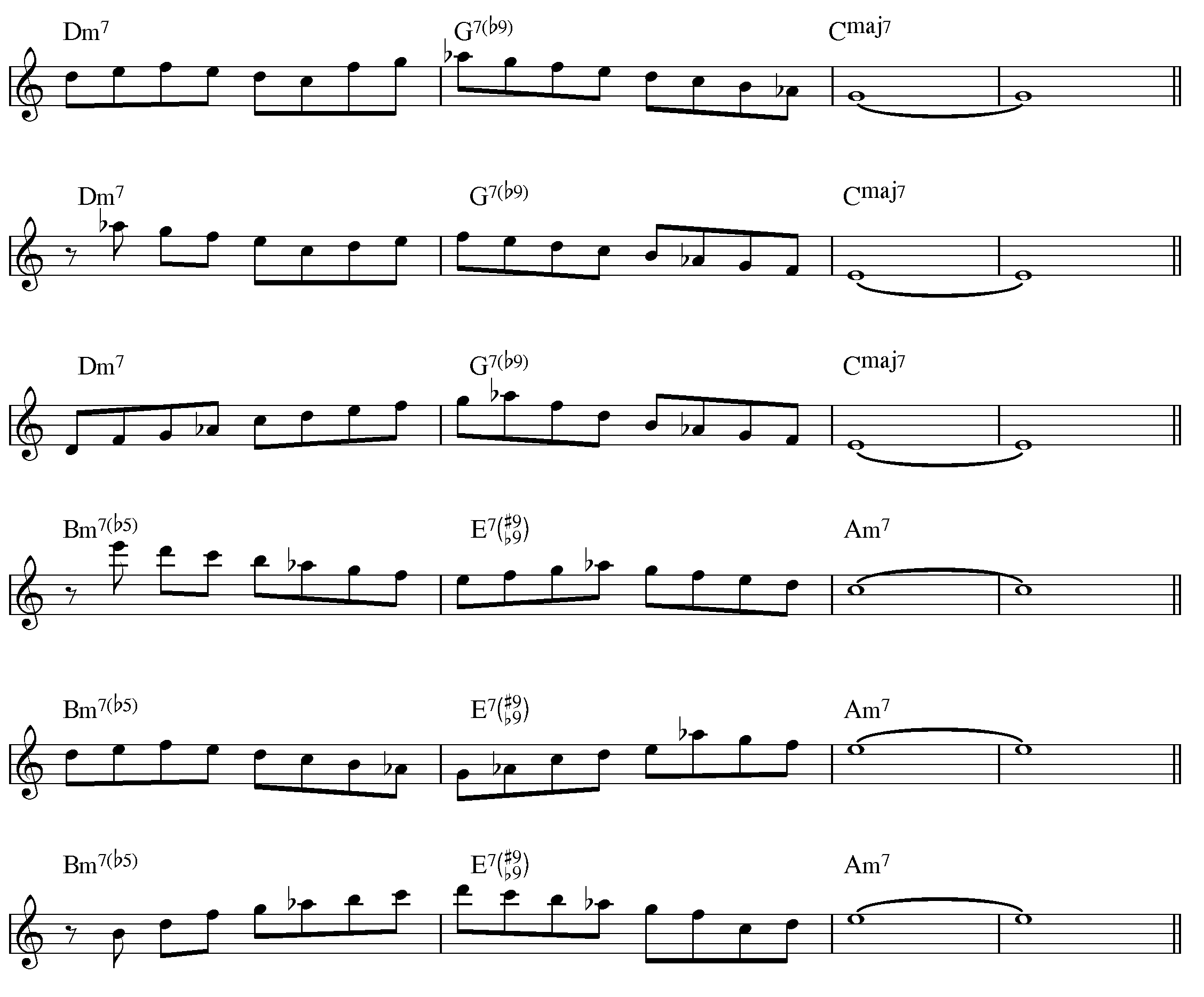
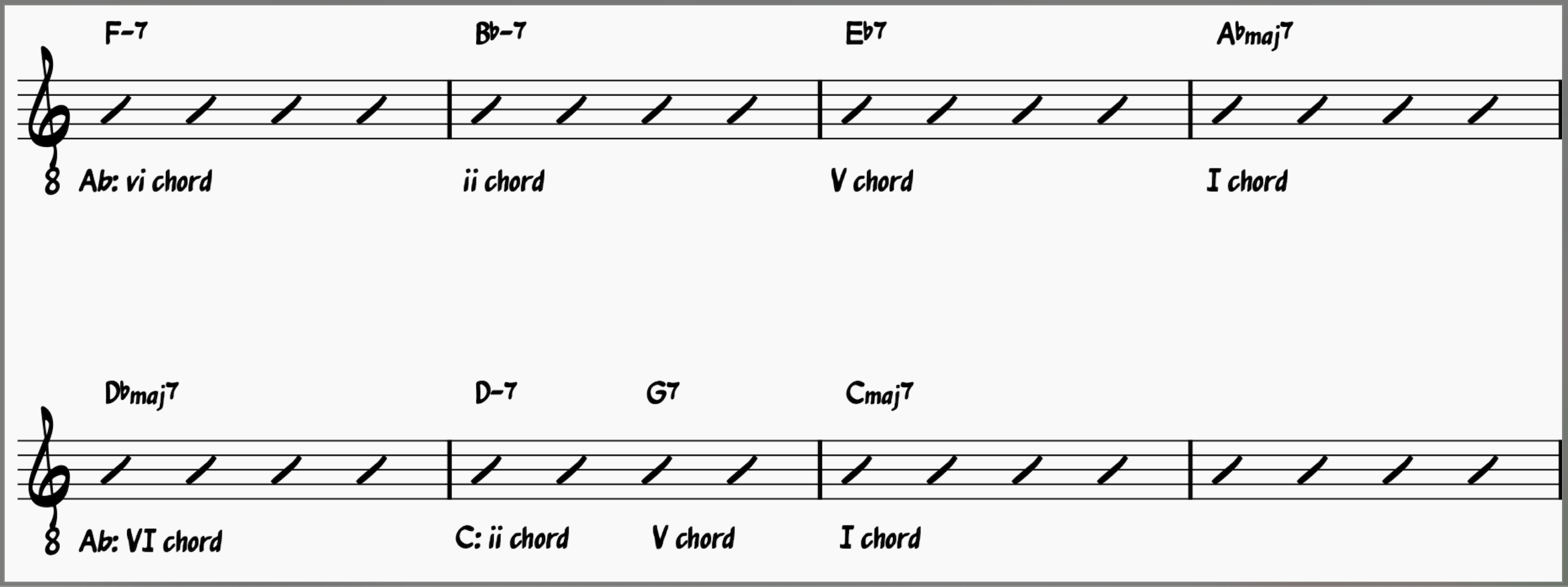
Jazz standards are notorious for modulating rapidly from one key center to another. Instead of waiting to hit a target chord, jazz composers insert secondary 2-5 progressions that point toward chords other than the tonic. For example, if a tune is in C Major and moves to an A minor chord (VI) on the fourth bar, a jazz player will often prepend a minor 2-5 specifically for A minor right before it hits (playing Bm7b5 – E7 leading into Am7).
3. Extended 2-5s
You can also chain multiple 2-5 progressions together in a sequence of descending fifths. Instead of playing just Dm7 - G7 - Cmaj7, a composer might write an extended chain: Am7 – D7 – Dm7 – G7 – Cmaj7. Each pair acts as a temporary 2-5 resolving into the next root down the line.
Application in Improvisation: Scales and Arpeggios
For horn players, guitarists, and single-note improvisers, the 2-5-1 progression provides a roadmap for soloing. Rather than treating each chord as an isolated island, improvisers look for the underlying tonal family.
- Arpeggio Outlines: The absolute safest and most musical way to begin soloing over a 2-5-1 is to outline the chord arpeggios. Play the root, third, fifth, and seventh of Dm7, transition smoothly into the arpeggio of G7, and land gracefully on the arpeggio of Cmaj7.
- Scale Choices:
- Over Dm7, you can play the D Dorian mode (the second mode of C major).
- Over G7, you can play the G Mixolydian mode (the fifth mode of C major), or if you want an altered sound, the G Altered scale (derived from the melodic minor system).
- Over Cmaj7, you can play the C Ionian mode (standard major scale) or the C Lydian mode (with a sharp 4th, which avoids clashing with the major seventh interval).
Common Mistakes and Troubleshooting
Students approaching the 2-5-1 progression often encounter specific hurdles. Recognizing these pitfalls can drastically accelerate your learning curve.
- Relying Solely on Root-Position Triads: Playing big, blocky root-position chords with both hands sounds heavy and unidiomatic. Always practice rootless voicings and guide-tone lines to achieve a lighter, professional jazz feel.
- Rushing the Resolution: The magic of the 2-5-1 lies in the tension of the V chord resolving to the I. Beginners often rush through the G7 chord without letting the tritone tension do its job. Give the dominant chord room to breathe before bringing relief on the tonic.
- Ignoring Left-Hand and Right-Hand Independence: On keyboard or guitar, ensure your accompaniment does not clash with the melodic lines you are trying to sing or play over the top. Keep your comping rhythms syncopated and sparse rather than mechanically locked to a steady quarter-note pulse.
Summary and Next Steps
The 2-5-1 jazz chord progression is far more than a simple music theory exercise; it is the fundamental grammar of jazz. By understanding its scale degrees, mastering its internal tritone tension, practicing smooth voice leading, and exploring harmonic substitutions like tritone subs, you unlock the ability to navigate thousands of jazz standards with confidence.
To take your practice to the next level, select a standard from the Real Book—such as "Autumn Leaves," "All the Things You Are," or "Tune Up"—and highlight every 2-5-1 progression hidden within the chart. Practice playing the chord voicings in all twelve keys, and improvise single-note lines over backing tracks. Consistent, daily navigation of this foundational progression will permanently transform your musical ear and improvisational fluency.