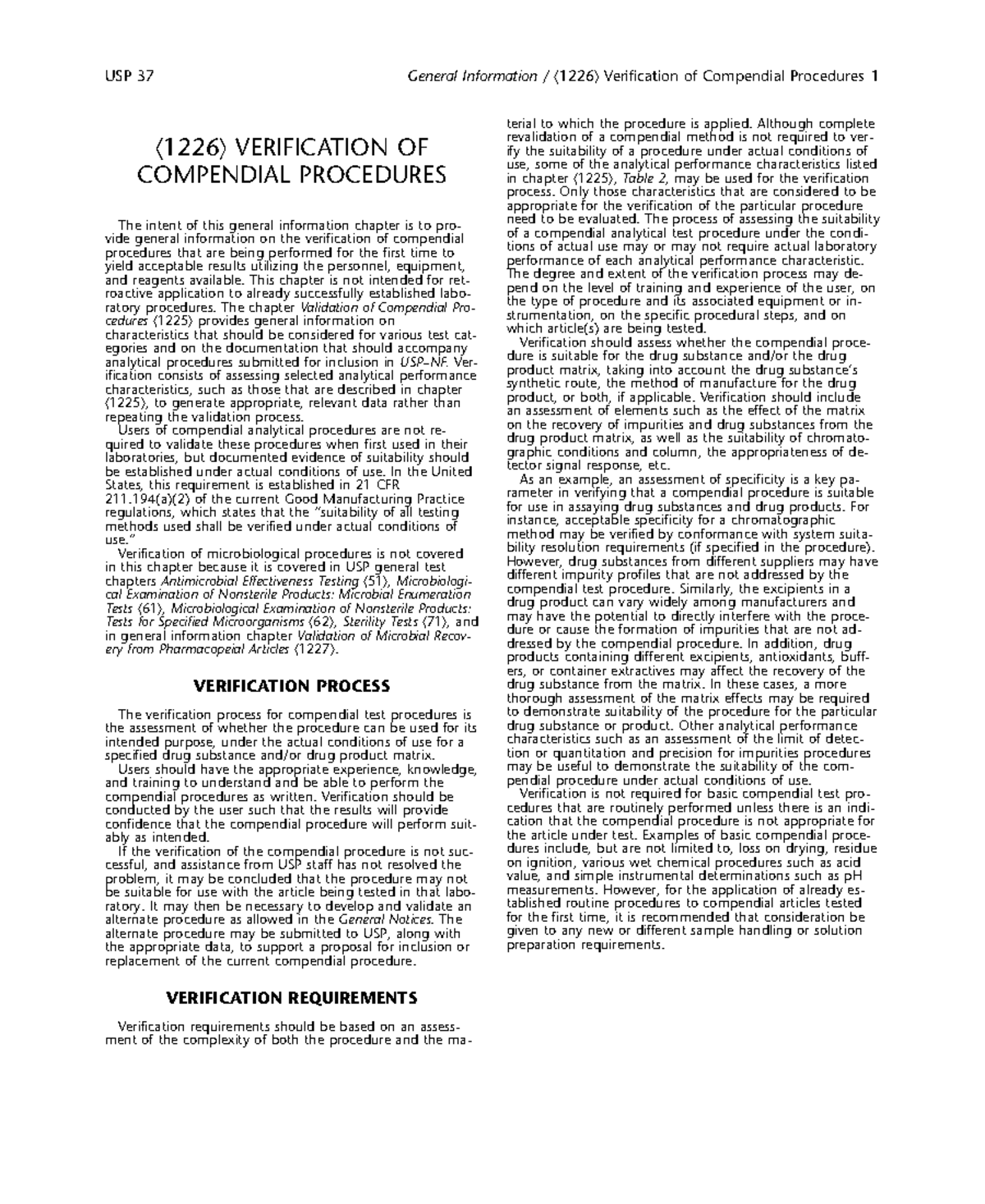
United States Pharmacopeia (USP) General Chapter <1226> Verification of Compendial Procedures provides laboratories with systematic guidelines to demonstrate that an established, pharmacopeial analytical procedure can be successfully executed under actual facility and instrumentation conditions. While compendial methods published in the USP–National Formulary (NF) are considered validated by the standards-setting body, individual testing laboratories must verify their capability to perform these assays accurately and reliably using their own personnel, equipment, and reagents.
Understanding the Scope and Purpose of USP <1226>
The Role of Compendial Procedures in Quality Control
Compendial procedures are analytical methods published in official pharmacopeias like the USP–NF to ensure the identity, strength, quality, and purity of drug substances, excipients, and drug products. When a manufacturer or testing laboratory adopts a compendial method, the regulatory assumption is that the method is scientifically sound. However, unlike non-compendial methods that require rigorous, full validation under frameworks such as International Council for Harmonisation (ICH) Q2(R1) or Q2(R2), compendial procedures require verification rather than re-validation.
The primary purpose of USP <1226> is to bridge the gap between published compendial standards and laboratory-specific execution. A method that performs exceptionally well in a reference laboratory may encounter matrix interferences, subtle equipment differences, or regional reagent variations in a commercial quality control (QC) environment. Verification ensures that these variables do not compromise data integrity or analytical accuracy.
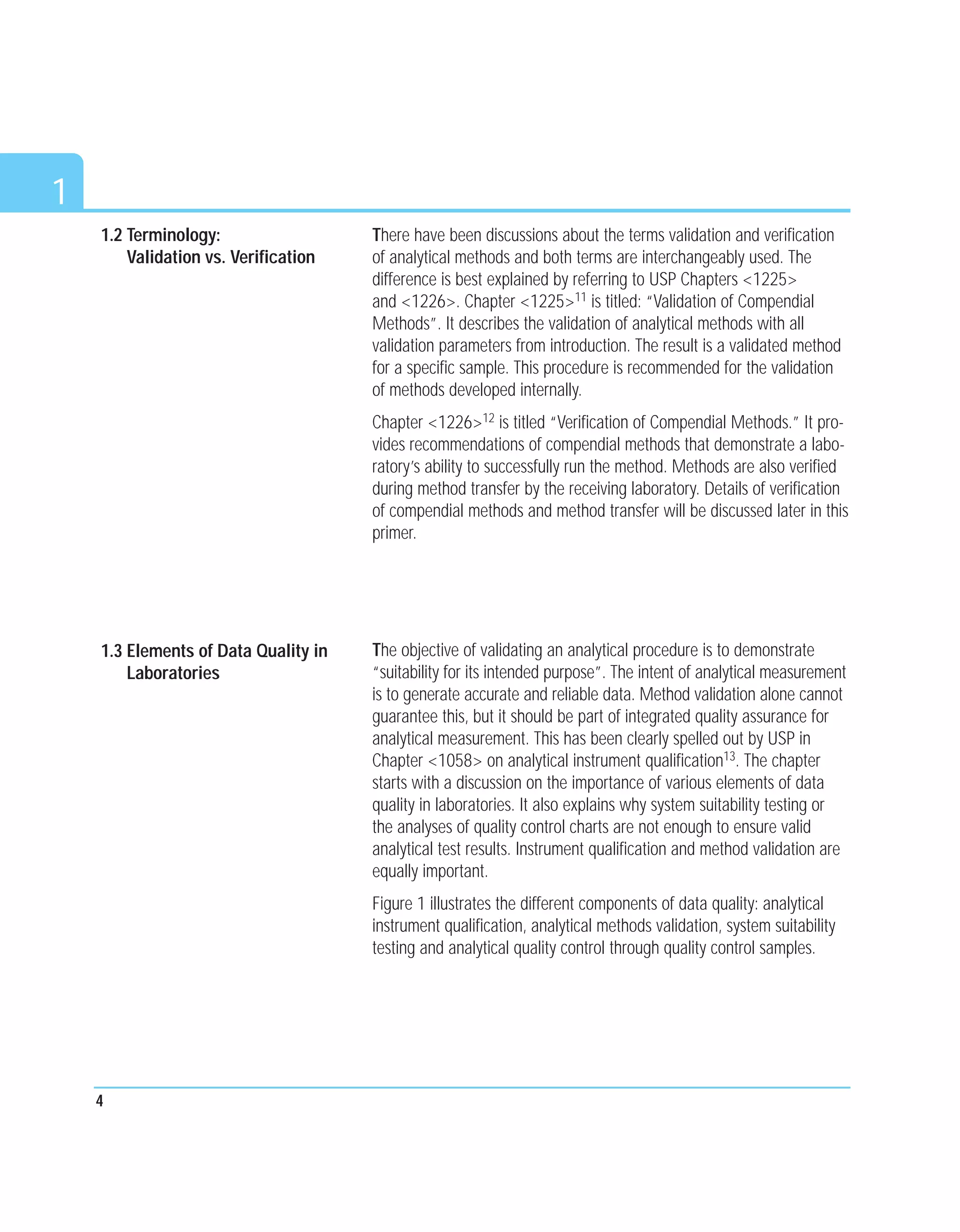
Verification Versus Validation: Clarifying the Distinctions
A common source of confusion in pharmaceutical quality assurance is the boundary between method validation and method verification.
- Validation (ICH Q2): Establishes documented evidence that an analytical procedure is suitable for its intended purpose through extensive testing of parameters such as linearity, range, accuracy, precision, specificity, detection limit, and quantitation limit. This is typically required for novel, non-compendial, or phase-appropriate customized methods.
- Verification (USP <1226>): Confirms that the laboratory can properly operate a compendial procedure to yield acceptable results using its own staff, instruments, and environmental conditions. It does not require re-testing every single validation parameter from scratch.
By focusing verification on parameters relevant to the specific product and test sample, laboratories save time and resources while maintaining uncompromising compliance with current Good Manufacturing Practices (cGMP).
Regulatory Context and Applicability
FDA and Global Regulatory Expectations
Regulatory bodies such as the U.S. Food and Drug Administration (FDA), European Medicines Agency (EMA), and other global health authorities strictly enforce the principle that laboratories must demonstrate competency with official methods. Under 21 CFR 211.165 (Testing and release for distribution) and 21.194 (Laboratory records), firms must establish and document the reliability of all analytical testing methods.
USP <1226> aligns directly with these cGMP expectations. When an inspector reviews a drug application or conducts a routine facility audit, they expect to see documented verification protocols and reports for every compendial method brought into routine use, especially when testing finished pharmaceuticals or active pharmaceutical ingredients (APIs).
When Is Verification Required Under USP <1226>?
Not every compendial change triggers a full verification cycle. USP <1226> outlines specific scenarios where verification is mandatory:
- First-Time Adoption: When a laboratory introduces an established USP-NF procedure for the first time.
- Method Revisions: When the USP revises an existing compendial procedure, and the changes are significant enough to impact performance (minor editorial corrections typically do not require re-verification).
- Major Instrument Changes: When transitioning an assay from one analytical technology platform to another (e.g., moving from traditional HPLC to UHPLC, or changing detection principles).
- New Product Matrix: When testing a new drug product or raw material formulation using an existing compendial method where excipients or active ingredients could create novel interferences.
Core Elements of a USP <1226> Verification Protocol
Designing a successful verification study requires a structured, phase-appropriate protocol that reflects the complexity of the analytical procedure and the criticality of the quality attribute being measured.
- USP <1226> Verification Lifecycle
- Protocol Development & Risk Assessment
- Define scope, acceptance criteria, and critical parameters
- Execution of Experimental Work
- Specificity, precision, accuracy, and range evaluations
- Data Analysis & Documentation
- Compare results against predefined acceptance criteria
- Routine Implementation & Lifecycle Management
- Periodic review, system suitability, and ongoing trending
- Protocol Development & Risk Assessment
Risk-Based Approach and Analytical Parameters
USP <1226> advocates for a risk-based approach to determine which validation characteristics must be evaluated during verification. The extent of testing depends on the type of test:
- Identification Tests: Generally require evaluation of specificity to ensure the method can unambiguously distinguish the target analyte from potential interferents, related substances, or excipients.
- Impurity and Limit Tests: Require evaluation of specificity, detection limits (if quantitative limits are applied), and precision at the specification threshold.
- Assay and Quantitative Procedures: Typically require a balanced assessment of accuracy, precision, range, and specificity.
Predefined Acceptance Criteria
Before executing any laboratory work, scientists must draft a formal protocol containing unambiguous, quantitative acceptance criteria. If a method requires a recovery rate between 95.0% and 105.0%, or a relative standard deviation (RSD) of less than 2.0% for repeatability, these limits must be locked down before sample analysis begins. Relying on post-hoc justification violates data integrity standards and invalidates the verification exercise.
Step-by-Step Execution of Verification Procedures
Executing a USP <1226> verification plan involves careful coordination between analytical chemists, quality assurance specialists, and instrumentation engineers.
Step 1: Document Review and Feasibility Assessment
Begin by reviewing the current USP monograph and any associated general chapters (such as USP <621> Chromatography or USP <85> Bacterial Endotoxins Tests). Verify that the laboratory possesses the required instrumentation, columns, certified reference standards, and high-purity reagents specified in the procedure. If the compendial method calls for proprietary columns or discontinued hardware configurations, consult local change-control procedures to establish justified equivalency under allowable adjustments.
Step 2: Protocol Authoring and Approval
Draft a comprehensive verification protocol that details:
- The exact title and monograph citation of the compendial procedure.
- The purpose and scope of the testing.
- Specific instrument IDs, column part numbers, and reagent lot numbers.
- Detailed experimental designs, including sample preparations, injection sequences, and replication counts.
- Pre-established acceptance criteria.
- Sign-off lines for analytical staff and QA approval.
Step 3: Laboratory Testing and Data Generation
Perform the analytical runs in accordance with the protocol. Ensure that system suitability criteria outlined in the compendial procedure are met prior to running analytical samples. Maintain contemporaneous electronic and hardcopy records, capturing chromatograms, spectra, raw weights, and calculation spreadsheets.
Step 4: Report Generation and Quality Sign-Off
Compile the analytical data into a formal verification report. Compare the observed performance metrics against the criteria established in the protocol. If all parameters meet expectations, Quality Assurance approves the report, and the method is cleared for routine cGMP testing.
| Analytical Test Type | Recommended Verification Parameters | Typical Acceptance Criteria Focus |
|---|---|---|
| Identification | Specificity | No false positives/negatives; positive identification against reference standard. |
| Assay (Active Ingredient) | Accuracy, Precision, Specificity, Range | Recovery within 98.0–102.0%; RSD < 1.0%; no excipient interference. |
| Impurity/Degradation | Specificity, Quantitation Limit, Precision | Quantitation down to reporting threshold; precision within specified RSD limits. |
| Limit Tests (Cata/Heavy Metals) | Specificity, Limit of Detection | Visual or instrumental clarity at specified limit concentration. |
Common Challenges and Troubleshooting in Verification
Even when following established compendial methods, laboratories frequently encounter technical hurdles during the verification phase. Anticipating these issues prevents costly project delays.
Column and Stationary Phase Variations
Many older USP monographs list specific column brands and packings that may be obsolete or difficult to source. While USP <621> permits certain adjustments to particle size, column length, and inner diameter, changing stationary phase chemistry (e.g., moving from L1 to L10) can radically alter selectivity. If a designated column is unavailable, laboratories must perform comparative testing using equivalent phases and document the justification in accordance with change control guidelines.
Matrix Interferences in Complex Formulations
Compendial assays are often developed using pure active pharmaceutical ingredients or simple model formulations. When applied to complex finished products containing multiple excipients, binders, or coating agents, peaks can co-elute. If specificity fails due to matrix interference, laboratories must investigate chromatographic resolution parameters, modify gradient conditions within allowable USP <621> adjustments, or conduct forced degradation studies to prove peak purity.
Reagent Grade and Environmental Sensitivities
Subtle differences in water purity, buffer pH preparation, or ambient laboratory temperature can destabilize sensitive analytical methods—particularly titrimetric assays, high-sensitivity chromatographic separations, and microbiological tests. Establishing robust preparation logs and strictly controlling environmental parameters helps isolate whether a failing verification run stems from a flawed method interpretation or a local laboratory artifact.
Best Practices for Maintaining Verified Methods
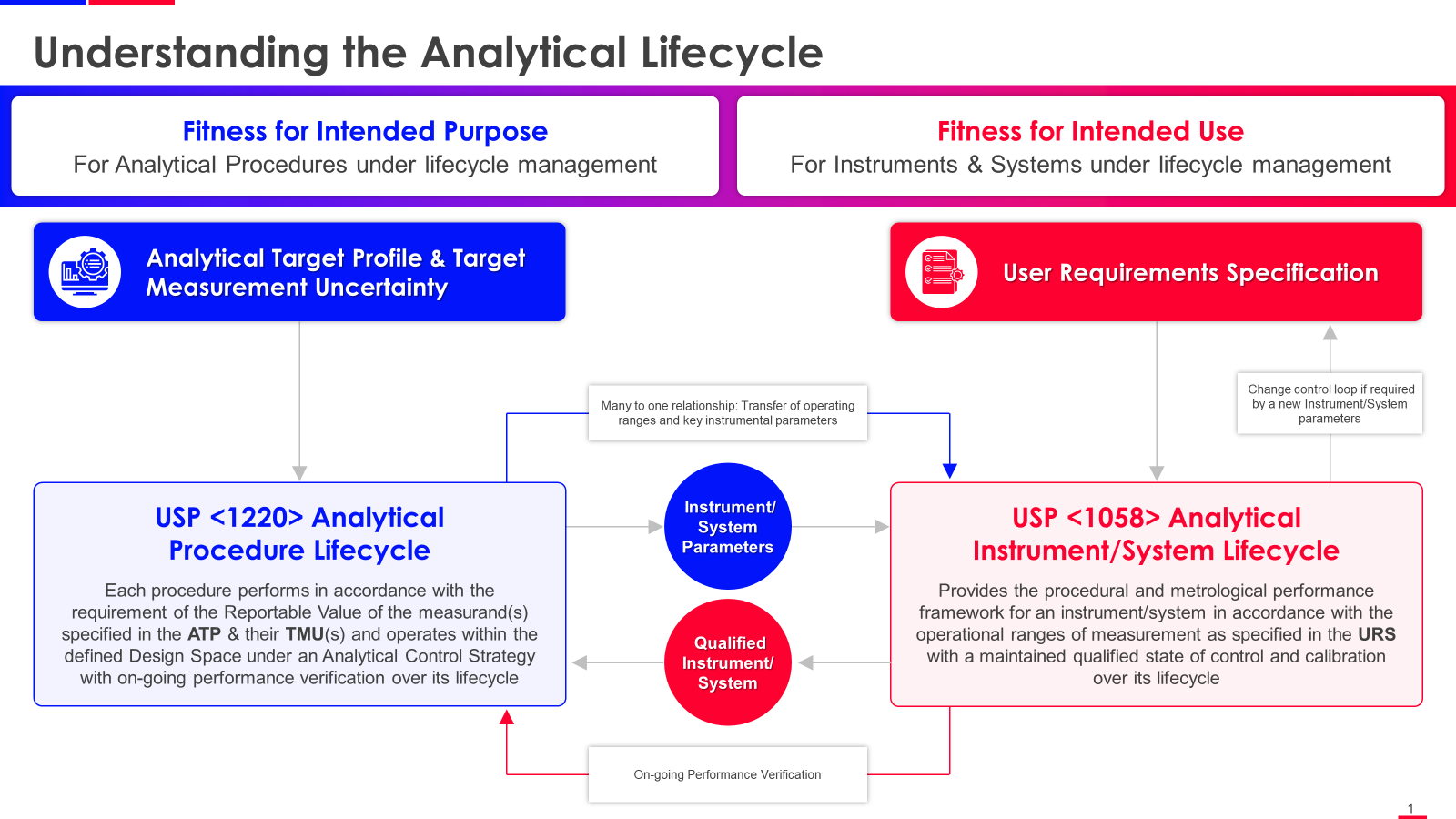
Verification is not a one-time static event; it forms part of the ongoing analytical lifecycle. Maintaining compliance requires active oversight after initial implementation.
Periodic Review and Continuous Monitoring
Quality control laboratories should periodically review the performance of compendial procedures through annual product quality reviews (APQR) and system suitability trending. If a method exhibits a progressive drift in retention times, declining column efficiency, or increasing variability over time, investigations should determine whether re-verification or procedural optimization is warranted.
Tracking Compendial Revisions
The USP–NF is updated continuously through new editions, supplements, and online revisions. Laboratories must implement a rigorous change-control system to monitor Pharmacopeial Forum (PF) proposals and official USP-NF updates. When the USP updates a monograph, a designated regulatory affairs or quality professional must evaluate the changes to determine if re-verification is required under USP <1226>.
Training and Competency Assessments
Ensure that all analysts performing compendial procedures are formally trained and qualified. Analytical competency should be verified independently of the primary method validation, ensuring that multiple operators can achieve comparable precision and accuracy when executing the verified procedure.
Frequently Asked Questions
Is USP <1226> verification required for all pharmacopeial methods?
Yes, USP <1226> applies to all compendial procedures adopted by a laboratory. However, the extent of verification required is risk-based and depends entirely on the nature of the test (e.g., identification versus complex multi-component assay) and whether the method is being applied to an established or novel product matrix.
Can a laboratory perform a reduced verification study?
Yes. Because compendial procedures are already validated by the USP, laboratories do not need to repeat full ICH validation studies. A reduced, targeted verification protocol focusing on site-specific parameters like precision, accuracy, and specificity under local operating conditions is standard practice.
What happens if a compendial method fails verification?
If a method fails to meet pre-established acceptance criteria during verification, the laboratory must initiate a formal laboratory investigation (OOS/OOT framework). The investigation should determine whether the failure resulted from operator error, instrumentation issues, reagent quality, or a genuine flaw or limitation in the published compendial procedure itself.
How does USP <621> interact with USP <1226>?
USP <621> governs allowable adjustments to chromatographic systems (such as column dimensions, flow rates, and injection volumes), whereas USP <1226> governs the broader verification of compendial procedures. When making chromatographic adjustments under USP <621>, laboratories must ensure that system suitability requirements are met, which often forms a key component of the USP <1226> verification package.
Do compendial microbial enumeration tests require USP <1226> verification?
Yes. Microbiological methods published in chapters such as USP <61> and USP <62> must be verified to demonstrate that the laboratory's testing environment, media lots, and sample preparation techniques do not inhibit recovery or invalidate microbial enumeration and test for specified microorganisms.
Conclusion and Next Actions
Implementing USP <1226> Verification of Compendial Procedures ensures that analytical data generated in quality control laboratories remains scientifically sound, legally defensible, and fully compliant with cGMP requirements. By establishing robust, risk-based protocols, pre-defining clear acceptance criteria, and rigorously documenting local instrumentation and analyst performance, laboratories can confidently bridge pharmacopeial standards with routine operational execution.
To initiate or improve your laboratory's verification program, review your current inventory of compendial methods against active USP-NF monographs, identify any gaps in historical verification documentation, and draft a standardized standard operating procedure (SOP) governing the lifecycle management of all compendial testing.