The longest word appearing in major English dictionaries is pneumonoultramicroscopicsilicovolcanoconiosis, a 45-letter term referring to a specific lung disease caused by inhaling very fine silicate or quartz dust. While technical chemical names like "titin" can reach 189,819 letters, they are generally excluded from standard lexical records because they represent formulas rather than functional language.
Defining the "Longest" Word: Why Context and Criteria Matter
In 2026, the quest for the longest word in English remains a fascination for linguists and casual learners alike. However, defining what qualifies as a "word" is the first hurdle in this exploration. Linguists typically categorize long words into several distinct groups: those found in standard dictionaries, technical or scientific nomenclature, coined literary terms, and agglutinative constructions.
The Dictionary Standard: Merriam-Webster and Oxford
For a word to enter the Oxford English Dictionary (OED) or Merriam-Webster, it must demonstrate sustained use in a variety of sources over time. Dictionaries generally exclude specialized chemical names or words created solely to be long. Therefore, the "official" longest word is often much shorter than the longest "theoretical" word. The criteria for inclusion involve frequency of use, widespread recognition, and the word’s utility in describing a specific concept that other words cannot easily capture.
Technical and Chemical Nomenclature
The most significant outliers are found in organic chemistry. International Union of Pure and Applied Chemistry (IUPAC) naming conventions allow for the construction of names that describe every single amino acid or atom in a structure. The protein known as titin, for instance, has a full chemical name that would take over three hours to recite. In the eyes of most lexicographers, these are not words but rather verbal representations of chemical formulas. They do not appear in dictionaries because they do not function as lexical units in standard communication.
The Reigning Champion: Pneumonoultramicroscopicsilicovolcanoconiosis
Clocking in at 45 letters, pneumonoultramicroscopicsilicovolcanoconiosis is the undisputed heavyweight of the dictionary world. Despite its intimidating length, the word is remarkably logical when broken down into its Greek and Latin roots.
- Pneumono-: Relating to the lungs (Greek pneumon).
- ultra-: Beyond or extreme (Latin).
- microscopic-: Extremely small (Greek mikros and skopos).
- silico-: Relating to silicon or silica.
- volcano-: Relating to volcanic activity.
- coni-: Dust (Greek konis).
- -osis: A suffix indicating a diseased condition.
Historically, this word was not born out of a medical necessity. It was coined in 1935 by Everett M. Kunkel, then president of the National Puzzlers' League. Kunkel intended to create a word that would mimic the structure of medical terminology to serve as the longest word in the language. Despite its somewhat artificial origin, the word was eventually adopted into the OED and other major dictionaries, though medical professionals typically prefer the much shorter term "silicosis" to describe the actual condition.
The Political Classic: Antidisestablishmentarianism
For decades, antidisestablishmentarianism (28 letters) was the word most children learned when asked for the longest word in English. Unlike the medical "hoax" of the 45-letter champion, this word has a legitimate history in political science and church history.
The term refers to a political position in 19th-century Britain. To understand it, one must work backward through its layers:
- Establishment: Refers to the Church of England’s status as the official state church.
- Disestablishment: The movement to remove that official status.
- Antidisestablishment: Opposition to the movement to remove that status.
- Antidisestablishmentarian: A person who opposes the movement.
- Antidisestablishmentarianism: The philosophy or movement of those who oppose the removal of the church's state status.
While the specific 19th-century context has faded, the word remains a prime example of how English uses prefixes and suffixes to build complex, specific meanings.
The Linguistic Curiosity: Floccinaucinihilipilification
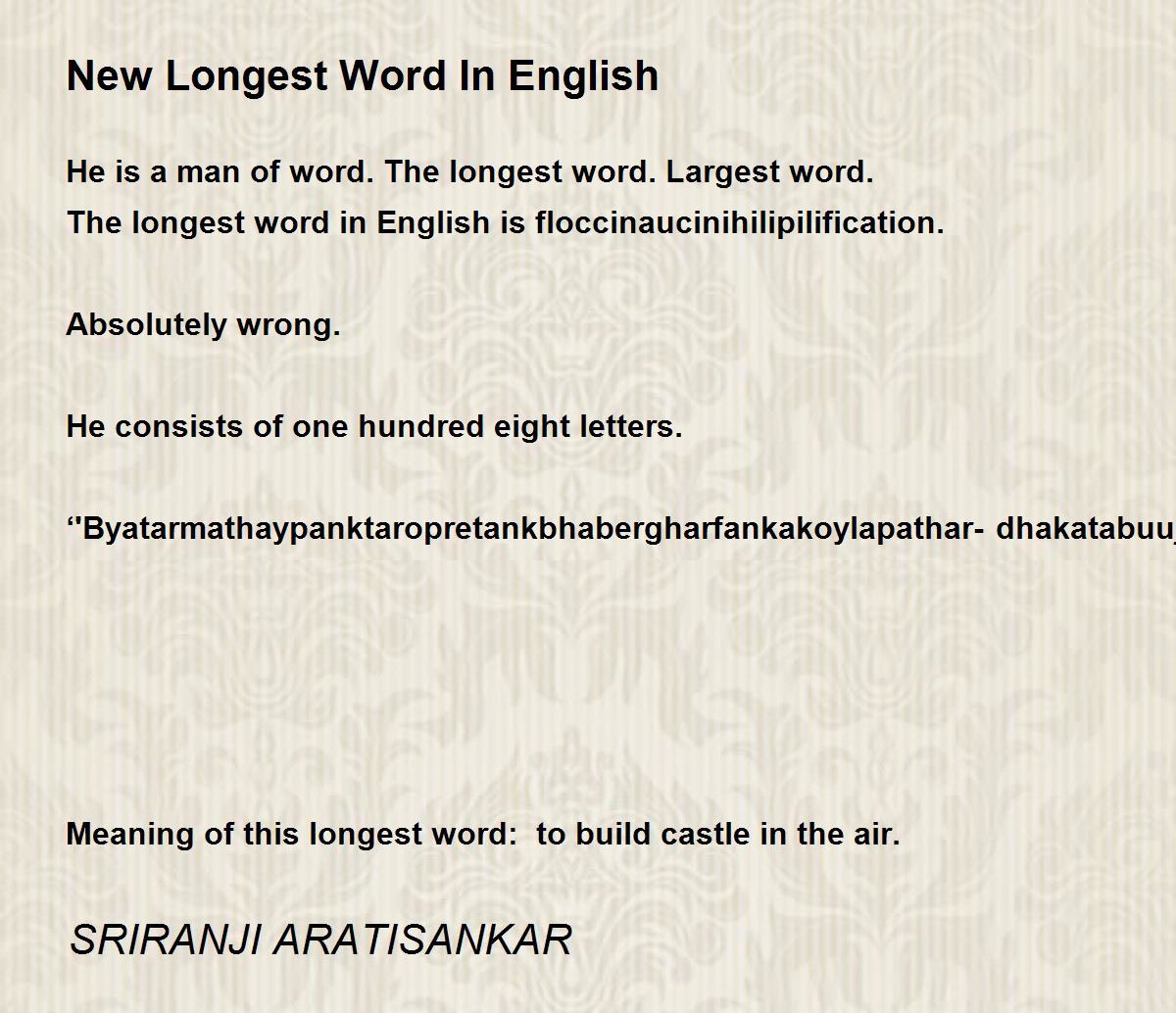
Coming in at 29 letters, floccinaucinihilipilification is often cited as the longest non-technical, non-medical word in the English language. It is defined as the act or habit of estimating something as worthless.
The word’s history is rooted in the 18th-century classroom. Students at Eton College reportedly combined four Latin words that all meant "of little value" or "nothing" to create a humorous, overly complicated term for "worthlessness."
- Flocci: A tuft of wool (something of little value).
- Nauci: A trifle.
- Nihili: Nothing.
- Pili: A hair.
The addition of the suffix "-fication" turns these roots into the act of making something nothing. It is a favorite of sesquipedalians (people who enjoy using long words) and has been used in various literary works and even in political speeches to describe the dismissal of an opponent’s ideas.
The Technical Extreme: The Story of Titin
As of 2026, the full name of the protein titin remains the most extreme example of length in the English language. This protein, which plays a vital role in muscle elasticity, has a systematic name that begins with "Methionyl..." and ends with "...isoleucine."
The reason for its 189,819-letter length is that the systematic name lists every single amino acid residue in the protein. Since titin is the largest known protein in the human body, its list is correspondingly massive. Because this name is essentially a data dump of a molecular sequence, it is not considered a true "word" for the purposes of general-purpose dictionaries. For those interested in the scientific context of such structures, resources like The National Center for Biotechnology Information (NCBI) provide the necessary biochemical background on titin's role in human physiology.
Literary Inventions: From Shakespeare to Mary Poppins
Authors have long experimented with "long-wordism" to add flavor, humor, or rhythm to their work.
- Supercalifragilisticexpialidocious (34 letters): Popularized by the 1964 film Mary Poppins, this word was coined to represent something "extraordinarily good." While it appears in several modern dictionaries, it is categorized as a "coined word" or "nonsense word."
- Honorificabilitudinitatibus (27 letters): This is the longest word used by William Shakespeare. It appears in Love's Labour's Lost and is the dative plural of a Latin word meaning "the state of being able to achieve honors." It is often cited as the longest word in English that alternates consonants and vowels.
- Lopadotemachoselachogaleokranioleipsanodrimhypotrimmatosilphioparaomelitokatakechymenokichlepikossyphophattoperisteralektryonoptekephalliokigklopeleiolagoiosiraiobaphetraganopterygon: This 183-letter monstrosity is a transliteration of a Greek word used by the playwright Aristophanes in his comedy Assemblywomen. It refers to a fictional dish made of various leftover meats, fish, and sauces.
Comparing the Contenders
The following table compares the most prominent long words in English based on their category and source.
| Word | Letters | Category | Primary Definition |
|---|---|---|---|
| Pneumonoultramicroscopicsilicovolcanoconiosis | 45 | Medical (Dictionary) | A lung disease caused by inhaling silica dust. |
| Hippopotomonstrosesquippedaliophobia | 36 | Psychological (Social) | The ironic name for the fear of long words. |
| Supercalifragilisticexpialidocious | 34 | Literary (Coined) | Something exceptionally wonderful or great. |
| Pseudopseudohypoparathyroidism | 30 | Medical (Clinical) | An inherited disorder mimicking a thyroid condition. |
| Floccinaucinihilipilification | 29 | Linguistic (Academic) | The act of describing something as worthless. |
| Antidisestablishmentarianism | 28 | Political (Historical) | Opposition to the withdrawal of state support for a church. |
| Honorificabilitudinitatibus | 27 | Literary (Classical) | The state of being able to achieve honors. |
| Incomprehensibilities | 21 | General (Common) | Things that are impossible to understand. |
Linguistic Mechanics: How English Constructs Length
English is not naturally an agglutinative language like Turkish or Finnish, where words are built by stringing together many morphemes. Instead, English is largely analytic, using separate words to express relationships. However, its heavy reliance on Latin and Greek roots allows it to function agglutinatively in scientific and academic contexts.
Most of the longest words in English are created through affixation—the process of adding prefixes and suffixes to a root word. For example, "comprehend" (root) becomes "in-comprehend-s-ibil-ities" (long word). In technical fields, this allows for extreme precision. In the medical field, a word like pseudopseudohypoparathyroidism is necessary because it describes a condition that looks like ("pseudo-") another condition ("pseudohypoparathyroidism"), which in itself looks like hypoparathyroidism.
The Practical Side: Managing Sesquipedalianism
While knowing these words is a fun trivia exercise, using them in daily communication is often discouraged. This practice, known as sesquipedalianism (from the Latin sesquipedalis, meaning "a foot and a half long"), can hinder clarity.
Modern technical writing and SEO guidelines generally favor simpler alternatives. In professional environments, the goal is to reduce cognitive load for the reader. Using "worthless" instead of "floccinaucinihilipilification" ensures that the message is accessible to a wider audience. However, the existence of these words serves as a testament to the flexibility and historical depth of the English language. They provide a window into the specific moments in history—whether political upheaval or scientific discovery—that required the creation of such massive linguistic structures.
Frequently Asked Questions
What is the longest word in the Oxford English Dictionary?
As of 2026, pneumonoultramicroscopicsilicovolcanoconiosis is officially recognized as the longest word in the OED. While the dictionary contains many long technical terms, this 45-letter word holds the title for the longest entry that isn't a purely chemical systematic name.
Is there a word for the fear of long words?
Yes, the word is hippopotomonstrosesquippedaliophobia. It is a 36-letter word that is often criticized for being intentionally cruel, as it requires the person suffering from the phobia to use or see a very long word to describe their condition. The root "sesquipedalian" refers to long words, while "hippo" and "monstro" were added to make the word sound larger and more intimidating.
Why aren't chemical names in the dictionary?
Dictionaries focus on words used in general or professional discourse. Because chemical names (like the 189,819-letter name for titin) follow a formulaic structure and can theoretically be infinite in length depending on the molecule, they are considered scientific data rather than lexical items. Including them would make dictionaries unmanageable and serve little purpose for the average user.
What is the longest "short" word?
This is often a riddle. The word smiles is frequently cited because "there is a mile between the two S's." In terms of actual linguistics, the word strengths (9 letters) is often cited as one of the longest one-syllable words in the English language.
Are there longer words in other languages?
Yes. Languages like German and Finnish are much more prone to creating long words because they are agglutinative or use compound nouns more freely. For example, the German word Rindfleischetikettierungsüberwachungsaufgabenübertragungsgesetz (63 letters) was a real law concerning the delegation of duties for cattle labeling. English tends to break such concepts into separate words.
Recommendation for Language Enthusiasts
If you are interested in the evolution of English vocabulary, the best next step is to explore etymological databases. Websites like the Online Etymology Dictionary or the Oxford English Dictionary offer deep dives into how small roots from Latin and Greek have branched out into the complex terms we see today. Understanding the roots of these long words makes them much easier to spell and use, turning a daunting 45-letter string into a manageable set of meaningful segments.