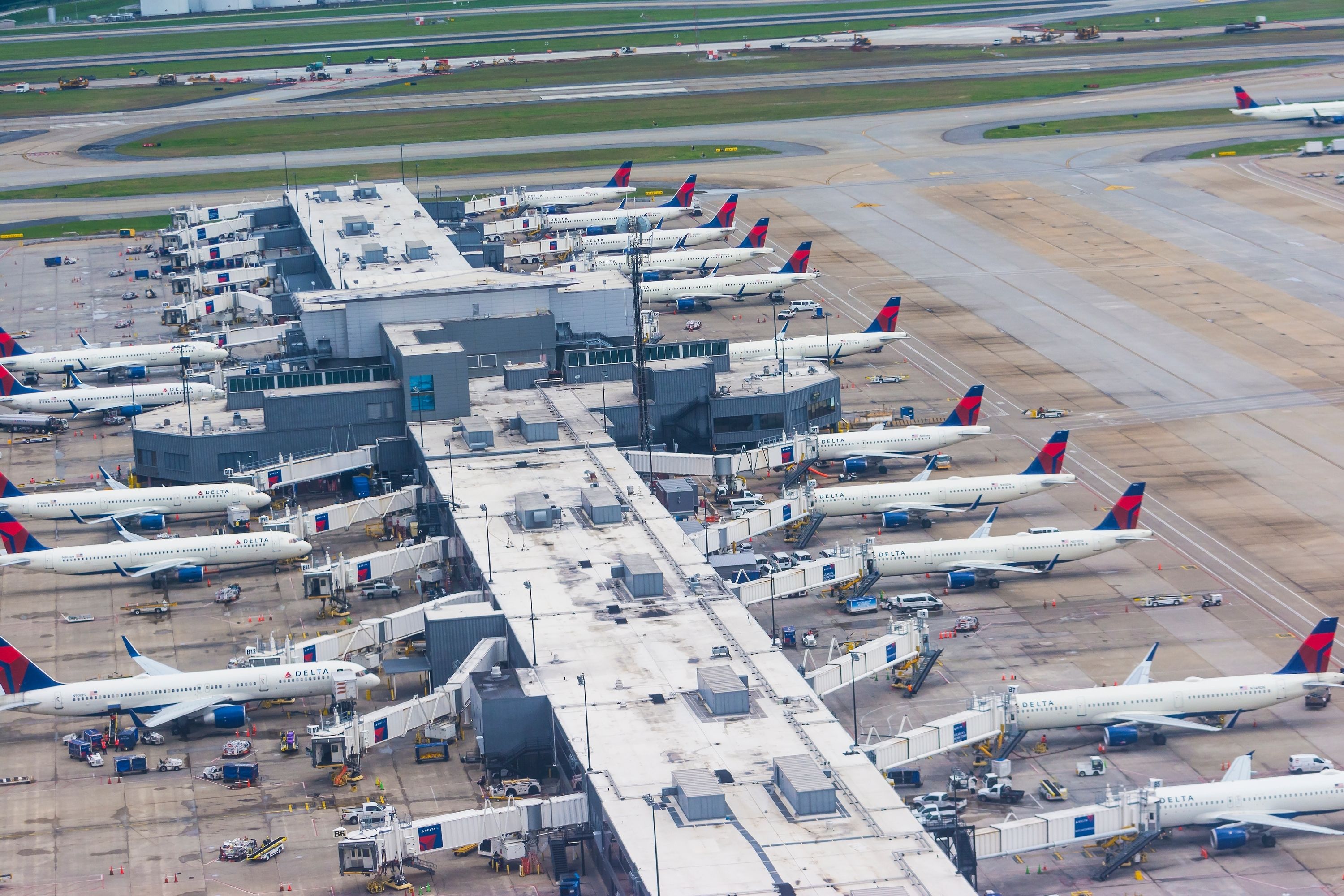
Hartsfield-Jackson Atlanta International Airport (ATL) currently operates five parallel runways. All five runways are oriented in an east-west direction, a strategic configuration that allows the airport to manage simultaneous takeoffs and landings with extraordinary efficiency, maintaining its status as one of the world's most critical aviation hubs in 2026.
As of 2026, the airfield layout at Hartsfield-Jackson remains a masterclass in civil engineering and logistical planning. While many global mega-hubs struggle with intersecting runways that create "bottlenecks," Atlanta’s parallel system allows for a streamlined flow of traffic that can handle more than 100 arrivals and departures per hour under optimal conditions. Understanding the complexity of these five runways requires looking beyond their numbers and into their specific roles, technical specifications, and the massive infrastructure that supports them.
The Evolution of Atlanta’s Five-Runway System
The transition from a regional airfield to a five-runway international powerhouse did not happen overnight. The current configuration is the result of decades of incremental expansion driven by the growth of Delta Air Lines and the increasing demand for a centralized North American connecting point.
For much of the late 20th century, Atlanta operated with four runways. However, as air traffic increased in the late 1990s, the "quad" configuration began to reach its saturation point. This led to one of the most expensive and complex construction projects in Georgia’s history: the construction of the fifth runway (10/28). Completed in 2006, this runway was essential for reducing delays, as it provided a dedicated space for shorter-haul domestic flights, freeing up the longer "outer" runways for heavy international aircraft.
In 2026, the five-runway system is more than just pavement; it is a synchronized environment where GPS-based NextGen flight procedures and ground-based radar work together to maximize every square inch of the 4,700-acre site.
Detailed Specifications of the Five Runways
The five runways are divided into two clusters: the North Complex (two runways) and the South Complex (three runways). They are separated by the massive terminal complex, which includes the domestic and international halls and the seven concourses (T, A, B, C, D, E, and F).
The North Complex: 8L/26R and 8R/26L
The north side of the airport consists of two primary runways. These are often the first runways passengers see when arriving from northern or eastern destinations.
- Runway 8L/26R: This is the northernmost runway. It is primarily used for departures due to its proximity to the terminal gates, reducing taxi times for aircraft headed north or west. It measures 9,000 feet in length.
- Runway 8R/26L: Situated just south of 8L, this runway is 9,999 feet long. It is a workhorse for arrivals, frequently handling a mix of domestic narrow-body aircraft and regional jets.
The South Complex: 9L/27R, 9R/27L, and 10/28
The south side of the airport is more expansive and houses the longest runway on the property, making it the primary zone for heavy international traffic.
- Runway 9L/27R: Measuring 12,390 feet, this is the longest runway at Hartsfield-Jackson. Its length is critical for fully loaded wide-body aircraft—such as the Airbus A350 or Boeing 777—that require more distance for takeoff, especially during the hot Georgia summers when "thin air" reduces lift.
- Runway 9R/27L: This runway is 9,000 feet long and sits between the longest runway and the fifth runway. It serves as a flexible asset, often handling arrivals to balance the flow during peak "pushes."
- Runway 10/28 (The Fifth Runway): Located the furthest south, this 9,000-foot runway is unique because it was built on a massive man-made embankment that bridges over Interstate 285. It is used primarily for arrivals, allowing aircraft to land without interfering with the departure flows of the other south-complex runways.
| Runway Designation | Length (Feet) | Length (Meters) | Primary Purpose |
|---|---|---|---|
| 8L/26R | 9,000 | 2,743 | Departures (North) |
| 8R/26L | 9,999 | 3,048 | Arrivals (North) |
| 9L/27R | 12,390 | 3,776 | Heavy/International Takeoffs |
| 9R/27L | 9,000 | 2,743 | Mixed Arrival/Departure |
| 10/28 | 9,000 | 2,743 | Arrivals (South) |
The Engineering Marvel of the Fifth Runway (10/28)
The "Fifth Runway" is a focal point of discussion for aviation enthusiasts and engineers alike. Before its construction, Hartsfield-Jackson faced significant "interdependence" issues. If a heavy aircraft was taking off on the south side, it often blocked the arrival path of another.
To solve this, the city of Atlanta invested $1.28 billion to build Runway 10/28. The challenge was geographic: there was no land left. The solution was to build the runway over Interstate 285. This required a massive bridge structure capable of supporting the weight of a 600,000-pound aircraft landing at 150 miles per hour.
In 2026, this runway remains vital. By providing a "tripled" or even "quadrupled" arrival stream, the fifth runway allows ATL to maintain operations even during inclement weather. It is equipped with Category III Instrument Landing Systems (ILS), which permit aircraft to land in near-zero visibility—a common occurrence during Georgia’s foggy autumn mornings.
Air Traffic Management: East Flow vs. West Flow
The five runways at ATL are used in one of two configurations based on wind direction, as aircraft must take off and land into the wind to maintain airspeed and safety.
- West Flow: Aircraft arrive from the east and depart toward the west. This is the most common configuration. In this setup, the runways are identified as 26R, 26L, 27R, 27L, and 28.
- East Flow: When the wind shifts, the airport flips its operation. Aircraft arrive from the west and depart toward the east. The runways are then identified as 8L, 8R, 9L, 9R, and 10.
The coordination required to "flip" the world's busiest airport is immense. The Federal Aviation Administration (FAA) controllers in the ATL tower—which stands at 398 feet, making it the tallest in North America—must coordinate with the Atlanta TRACON (Terminal Radar Approach Control) to re-sequence hundreds of planes in mid-air. This transition is usually completed in under 20 minutes, a testament to the efficiency of the parallel runway design.
Ground Safety and the "Victor Loop" Taxiways
One of the greatest risks at any multi-runway airport is a "runway incursion," where an aircraft accidentally crosses an active runway. Because Atlanta has five parallel runways, planes landing on the outer runways (the ones furthest from the terminals) historically had to cross the inner runways to get to their gates.
To mitigate this, ATL pioneered the use of "End-Around Taxiways," specifically the Victor Loop on the north side and similar structures on the south. These are taxiways that wrap around the end of the runway, allowing landed aircraft to bypass the departure threshold entirely.
By 2026, these loops have significantly increased safety and decreased the "pilot workload." Instead of waiting for a gap in departing traffic to cross a runway, pilots simply follow the loop, keeping the flow of departures constant and reducing the chance of a ground-based collision.
Maintenance and Pavement Technology in 2026
Maintaining five runways that facilitate nearly 900,000 flight movements per year is a relentless task. In 2026, the City of Atlanta Department of Aviation utilizes advanced predictive maintenance. Sensors embedded within the concrete of Runway 9L/27R monitor stress, temperature, and moisture levels, alerting crews to potential cracks before they become safety hazards.
The concrete used at ATL is specialized. It is high-performance Portland cement designed to withstand the immense "shear" forces exerted by landing gear. Periodically, the airport performs "deep slab replacement," where entire sections of a runway are replaced overnight. These projects are carefully choreographed to ensure that at least four runways remain operational, preventing a total shutdown of the hub.
Comparison: Why Five Runways?
When comparing Atlanta to other major hubs, the number of runways tells a story of geographic and operational philosophy:
- Chicago O’Hare (ORD): Has eight runways, but many intersect, which can complicate operations during high winds.
- Dallas/Fort Worth (DFW): Has seven runways, but they are spread across a much larger landmass (nearly 17,000 acres compared to Atlanta’s 4,700).
- London Heathrow (LHR): Only has two runways. While LHR is incredibly efficient for its size, it lacks the "redundancy" of Atlanta. If one runway at LHR closes, the airport loses 50% of its capacity. If one at ATL closes, it still has 80% capacity.
Atlanta’s five parallel runways represent the "sweet spot" of being able to handle massive volume within a relatively compact footprint. This layout minimizes the distance between the runway and the gate, which saves airlines millions of dollars in fuel costs every year.
The Future: Will There Be a Sixth Runway?
As we look toward the latter half of the 2020s, the question of a sixth runway often arises. The Atlanta Airport Master Plan (2035) has historically evaluated the possibility of a sixth runway located further south of Runway 10/28.
However, as of 2026, the focus has shifted toward efficiency over expansion. With the rise of larger, more efficient aircraft and the implementation of satellite-based navigation that allows planes to fly closer together safely, the current five-runway system is expected to meet demand for the foreseeable future. The environmental and residential impact of a sixth runway would be significant, requiring the acquisition of substantial land in neighboring communities. Instead, the airport is investing in "smart" taxiways and terminal expansions to handle the increased passenger loads.
Frequently Asked Questions
Which runway at Atlanta Airport is the longest?
The longest runway is 9L/27R, located on the south side of the airfield. It measures 12,390 feet (3,776 meters). This extra length is necessary for long-haul international flights departing for Asia, Africa, or Europe, which carry heavy fuel loads and require higher takeoff speeds.
Can all five runways be used at the same time?
Yes, Hartsfield-Jackson is designed for simultaneous operations. Under typical conditions, the airport uses a "triple" or "quadruple" approach where three or four runways are used for arrivals while the others are used for departures. The FAA manages these flows to ensure horizontal and vertical separation between all aircraft.
Does the fifth runway really go over a highway?
Yes, Runway 10/28 was built on a bridge structure that spans Interstate 285 (the Perimeter) on the south side of the city. It was a landmark engineering project that allowed the airport to expand within its existing geographic constraints without relocating the interstate.
How many runways are used for international flights?
Technically, any of the five runways can accommodate an international flight. However, Runway 9L/27R and 8L/26R are most commonly used for international takeoffs because they are closest to the International Terminal (Concourse F) and offer the necessary length for "heavy" aircraft.
Why are all the runways parallel at ATL?
The parallel design is intended to maximize efficiency and safety. Intersecting runways, common at older airports like Boston Logan or New York JFK, require complex timing to ensure planes don't collide at the intersection. Parallel runways allow for independent operations, which is the primary reason Atlanta can handle more flights than almost any other airport.
Final Recommendation for Travelers and Spotters
If you are a traveler or aviation enthusiast looking to experience the scale of these five runways, the best view is from the Maynard H. Jackson Jr. International Terminal (Concourse F). The floor-to-ceiling windows offer an unobstructed view of the South Complex runways (9L, 9R, and 10), where you can witness the engineering feat of the I-285 bridge and the precision of the world's most sophisticated air traffic management system in action. For those tracking flights, remember that wind direction determines the "Flow"; check local weather to see if the airport is in "East" or "West" operation to know which side of the terminal will have the best takeoff views.