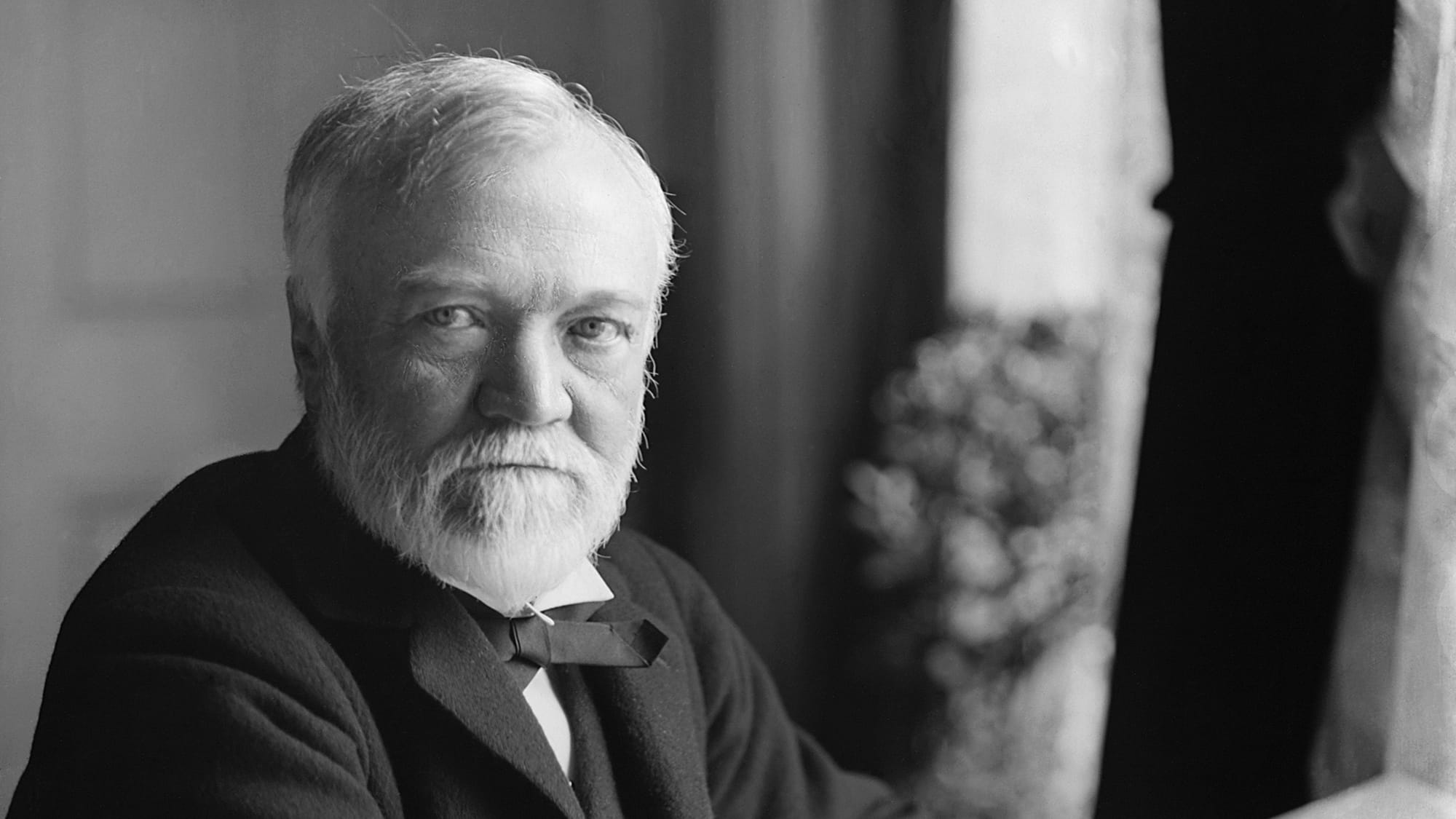
Andrew Carnegie redefined modern philanthropy by donating approximately $350 million—roughly 90% of his massive fortune—to causes focused on education, world peace, and scientific research. His approach, famously articulated in "The Gospel of Wealth," prioritized providing the public with the "ladders" to improve themselves rather than offering direct, short-term relief.
The Philosophy of the "Gospel of Wealth"
Andrew Carnegie’s transition from a ruthless steel magnate to the world’s foremost philanthropist was not a sudden whim but the execution of a deeply held philosophy. In 1889, he published an essay titled "Wealth" (later known as "The Gospel of Wealth"), which established the moral framework for his later years. In this document, Carnegie argued that the concentration of wealth in the hands of a few was a positive result of capitalism, but it came with a heavy social responsibility.
He proposed that a wealthy man had three options for his estate: he could leave it to his family, leave it for public purposes after his death, or administer it for the public good during his lifetime. Carnegie vehemently rejected the first two. He believed that large inheritances often "spoiled" children and that waiting until death to give money away was a sign of a lack of true conviction. His most famous dictate from the essay—"The man who dies thus rich dies disgraced"—became the mantra for his final decades.
Carnegie’s brand of giving is often called Scientific Philanthropy. Unlike traditional charity, which might provide food or clothing to the poor, scientific philanthropy sought to address the root causes of poverty by providing resources for self-improvement. He famously stated that neither the individual nor the race was improved by "almsgiving," and that the best way to help the community was to place within its reach the ladders upon which the aspiring could rise.
The Library Movement: A Global Legacy
The most visible manifestation of Carnegie's philanthropy is the global network of libraries he funded. Between 1883 and 1929, Carnegie provided funds for the construction of 2,508 libraries across the world, with 1,689 of those located in the United States. To Carnegie, the library was the ultimate tool for democracy and self-education. Having immigrated from Scotland as a "poor boy" and gaining access to a private library in Pittsburgh, he viewed books as the primary vehicle for social mobility.
The Carnegie Formula
Carnegie did not simply hand over checks for buildings. He implemented the "Carnegie Formula," a set of requirements that ensured the community was invested in the library's long-term success. For a municipality to receive a grant, it had to:
- Demonstrate the need for a public library.
- Provide the site for the building.
- Commit to annual maintenance, pledging 10% of the original grant amount annually to support the library’s operations and staff through local tax revenue.
This model transformed the library from a private, elite institution into a public service. As of 2026, many of these "Carnegie Libraries" remain the architectural and social hearts of their communities, though some have been repurposed as museums, community centers, or offices.
Architectural Standards
While Carnegie did not mandate a specific architectural style, his secretary, James Bertram, eventually issued "Notes on the Erection of Library Buildings." These guidelines encouraged functional, efficient layouts over ornate, wasteful designs. Most Carnegie libraries feature a prominent entrance, often with a staircase symbolizing the "climb" toward knowledge, and open stacks that allowed patrons to browse books freely—a revolutionary concept at a time when most libraries kept books behind a counter.
Educational Institutions and the "Carnegie Unit"
Carnegie’s influence on education extended far beyond the walls of libraries. He founded the Carnegie Institute of Technology in 1900, which later merged with the Mellon Institute of Industrial Research to become Carnegie Mellon University (CMU). His goal was to provide technical and vocational training to the children of the working class in Pittsburgh, ensuring they had the skills necessary for the industrial age.
The Advancement of Teaching
In 1905, he established the Carnegie Foundation for the Advancement of Teaching (CFAT). Carnegie was appalled by the low pay and lack of security for college professors. The foundation initially focused on providing pensions for retiring teachers. To determine which colleges were eligible for these pensions, the foundation had to standardize what constituted a "college" and a "student."
This led to the creation of the Carnegie Unit, a measure of the amount of time a student spends in a subject. One unit represents 120 hours of contact time. This standard transformed the American educational landscape, providing a universal currency for academic credit that is still utilized in high schools and universities in 2026.
Support for Minority Education
Carnegie was also a significant benefactor of Booker T. Washington’s Tuskegee Institute. Recognizing the systemic barriers facing African Americans in the post-Civil War era, Carnegie provided large sums to support vocational education and the construction of libraries at historically black colleges and universities (HBCUs).
Global Peace and the Carnegie Endowment
Perhaps the most ambitious—and arguably the most challenging—of Carnegie’s philanthropic goals was the pursuit of international peace. In 1910, he established the Carnegie Endowment for International Peace (CEIP) with a $10 million gift. He tasked the trustees with "hastening the abolition of international war, the foulest blot upon our civilization."
Carnegie was a fervent believer that international disputes could be settled through arbitration rather than conflict. He funded the construction of the Peace Palace in The Hague, which today serves as the seat of the International Court of Justice. Despite the outbreak of World War I, which deeply saddened Carnegie in his final years, the Endowment survived and remains one of the world's leading non-partisan foreign policy think tanks.
| Institution | Founded | Primary Mission |
|---|---|---|
| Carnegie Corporation of New York | 1911 | The "holding company" for his remaining wealth; focuses on education and international peace. |
| Carnegie Institution for Science | 1902 | Supports high-risk, high-reward scientific research without the constraints of commercial application. |
| Carnegie Hero Fund Commission | 1904 | Recognizes and financially supports "heroes of civilization" who risk their lives for others. |
| Carnegie Foundation (CFAT) | 1905 | Focuses on educational standards, teacher pensions, and instructional improvement. |
| Carnegie Endowment for International Peace | 1910 | Dedicated to advancing cooperation between nations and preventing global conflict. |
The Carnegie Hero Funds
Carnegie had a unique fascination with individual acts of bravery. After a 1904 mining disaster in Harwick, Pennsylvania, where two men died trying to rescue others, Carnegie established the Carnegie Hero Fund. He believed that the "heroes of civilization"—those who risked their lives to save others in peaceful pursuits—deserved as much recognition as the "heroes of war."
The fund provides medals and financial assistance to people who have been injured while performing heroic acts, or to the families of those who died during such acts. Between 1904 and 2026, the Hero Fund has recognized over 10,000 individuals, distributing millions of dollars in grants, scholarships, and pensions to those who demonstrated "extraordinary civilian heroism."
Scientific Research and the Carnegie Institution
In 1902, Carnegie founded the Carnegie Institution for Science in Washington, D.C. Unlike universities, which focus on teaching, this institution was designed for pure research. Carnegie wanted to support "the exceptional man" in his quest for knowledge, regardless of immediate practical application.
This institution has been the site of monumental discoveries. It was here that Edwin Hubble performed the research that proved the existence of galaxies beyond the Milky Way and that the universe is expanding. In the modern era, the institution continues to lead in fields such as plant biology, embryology, and global ecology.
Complexity and Critiques of His Philanthropy
It is impossible to analyze Andrew Carnegie as a philanthropist without acknowledging the source of his wealth. The massive fortune that funded thousands of libraries was built through the exploitation of labor and the suppression of unions.
The most notable blemish on his record is the Homestead Strike of 1892. While Carnegie was in Scotland, his business partner Henry Clay Frick used Pinkerton guards to break a strike at the Homestead Steel Works, resulting in a violent battle that left several workers dead. While Carnegie later expressed regret for the loss of life, he did not intervene at the time and continued to benefit from the increased profits that followed the destruction of the union.
Critics of his time, and historians since, have argued that Carnegie’s philanthropy was a form of "reputation laundering" or a way to exert control over society. However, Carnegie's proponents argue that his commitment to giving was established long before the Homestead Strike and that his systematic distribution of wealth remains the gold standard for institutional giving.
The 2026 Perspective: Long-term Institutional Impact
As we look at Carnegie’s legacy in 2026, his impact is characterized by the permanence of his institutions. Unlike many wealthy individuals whose names fade after their deaths, Carnegie’s foundations were designed to be "perpetual."
The Carnegie Corporation of New York, which received the bulk of his remaining fortune ($135 million) in 1911, continues to be a major player in global affairs. In the 21st century, it has pivoted to focus on challenges like nuclear non-proliferation, democratic participation, and the integration of immigrants—issues that Carnegie himself likely would have recognized as vital to a "civilized" society.
Furthermore, his influence is seen in the "Giving Pledge" established by Bill Gates and Warren Buffett. The idea that the extremely wealthy have a social obligation to give back the majority of their wealth during their lifetime is a direct descendant of the "Gospel of Wealth."
Frequently Asked Questions
How much money did Andrew Carnegie give away in today’s dollars?
While Carnegie gave away $350 million in his lifetime, adjusting this for inflation is complex. In terms of purchasing power in 2026, it is roughly equivalent to $6 billion to $10 billion. However, if measured as a percentage of the total U.S. GDP at the time, his wealth and subsequent giving were even more significant than those of most modern billionaires.
Did Carnegie give libraries to every city that asked?
Not necessarily. While he was prolific, a city had to meet the "Carnegie Formula." If a municipality refused to provide a site or could not guarantee the 10% annual maintenance fund, Carnegie would deny the grant. He believed that giving a library to a community that would not support it was "harmful" rather than helpful.
What was the first Carnegie library?
The first library Carnegie funded was in his birthplace of Dunfermline, Scotland, in 1883. The first Carnegie library in the United States was built in Braddock, Pennsylvania, in 1889, for the benefit of the workers at his Edgar Thomson Steel Works.
Why did Carnegie focus so much on libraries?
Carnegie famously said, "A library outranks any other one thing a community can do to benefit its people. It is a never-failing spring in the desert." He credited his own success to the access he had to a personal library as a young immigrant and believed libraries were the best way to help those who were willing to help themselves.
Is Carnegie Mellon University still funded by the Carnegie estate?
While the university carries his name and received its founding endowment from him, it is now an independent research university. It relies on its own endowment, tuition, and research grants, though it maintains strong historical ties to the various Carnegie foundations.
Practical Recommendation for Further Study
To truly understand the depth of Carnegie's philanthropic impact, one should visit a local Carnegie library or examine the digital archives of the Carnegie Corporation of New York. For those interested in the ethics of wealth, reading the original 1889 essay "The Gospel of Wealth" remains essential, as it provides the primary source evidence for the motivations behind one of history's most significant transfers of private wealth to the public.