Deciding how much life insurance to own requires balancing your current financial obligations, future income needs, and existing assets to ensure your dependents are fully protected if you pass away. While simple rules of thumb like multiplying your income by ten offer a quick starting point, a comprehensive calculation considers debts, future expenses, and inflation to establish a precise coverage amount.
Calculating the correct amount of life insurance to own is one of the most consequential financial decisions you can make for your family. A policy that is too small leaves surviving dependents vulnerable to financial hardship, mounting debt, and unfulfilled long-term goals like college education. Conversely, a policy that is excessively large results in paying unnecessarily high premiums that strain your household budget during your lifetime. Because life stages, income levels, and family structures shift over time, understanding the mechanics of coverage calculation ensures you purchase a policy that fits your exact circumstances.
The Core Philosophy of Life Insurance Protection
Life insurance is fundamentally a risk-management tool designed to replace the economic value of an insured individual. When an earner passes away, their future earning potential disappears instantly, but the family's financial obligations—mortgages, utility bills, food, and childcare—remain. The primary purpose of life insurance is to bridge this gap, providing surviving family members with the financial resources necessary to maintain their standard of living, eliminate crippling debts, and achieve long-term objectives without immediate economic panic.
When evaluating the amount of life insurance to own, you must shift your perspective away from morbid considerations and focus strictly on mathematics and liability management. Insurance companies do not look at your worth as a human being; rather, they evaluate your financial footprint. If you contribute significantly to your household income, provide uncompensated domestic labor (such as stay-at-home parenting), or carry substantial shared debt, your financial absence creates a measurable deficit. The correct coverage amount neutralizes that deficit.
Traditional Estimation Methods vs. Detailed Analysis
Financial planners utilize several different methodologies to calculate coverage needs. Understanding these methods helps you evaluate whether a quick quote matches your actual requirements or if a deeper financial audit is necessary.
The Multiple-of-Income Rule
The most common shortcut used in the insurance industry is the multiple-of-income method. Historically, this meant multiplying your annual salary by 10, though modern variations suggest multipliers between 10 and 15 depending on current interest rates and inflation expectations.
- How it works: If you earn $70,000 per year, you purchase $700,000 to $1,000,000 in coverage.
- Advantages: It is exceptionally easy to calculate and provides a fast baseline estimate.
- Limitations: It ignores individual variables. It does not account for existing savings, current debt levels, number of dependents, or specific future expenses like college tuition. A person with $500,000 in debt needs a very different policy than a person with zero debt, even if they earn the exact same salary.
The Human Life Value Approach
The human life value approach calculates the total economic value of your earnings from your current age until your planned retirement age. This method projects your future salary increases, subtracts estimated personal consumption costs, and discounts the total to present value using an appropriate interest rate. While more mathematically rigorous, it is primarily used in commercial settings or high-net-worth estate planning rather than everyday family protection.
The Needs-Based Approach (The Gold Standard)
Insurance experts widely agree that the needs-based approach is the most accurate and reliable method for determining the amount of life insurance to own. This approach itemizes every financial obligation your family would face immediately upon your death, medium-term expenses, and long-term goals, then subtracts your existing liquid assets.
Step-by-Step Breakdown of the Needs-Based Calculation
To execute a proper needs-based calculation, break your financial life down into distinct categories, often referred to by the acronym DIME (Debt, Income, Mortgage, Education) or expanded frameworks.
| Expense Category | Description | Typical Consideration |
|---|---|---|
| Immediate Expenses | Final medical bills, funeral costs, and probate fees. | Usually ranges from $10,000 to $20,000. |
| Debt Elimination | Outstanding credit cards, auto loans, and personal loans. | Pay off all non-mortgage debt to free up monthly cash flow. |
| Mortgage Payoff | Remaining balance on your home loan. | Eliminates housing costs for survivors, or provides funds to downsize. |
| Income Replacement | Replacing your salary for a designated number of years. | Multiplied by the number of years dependents need support. |
| Future Education | College tuition funds for children. | Estimated costs for public or private university tuition per child. |
1. Immediate Final Expenses
No family should scramble to cover funeral and burial costs while grieving. The average cost of a funeral with a viewing and burial frequently exceeds $7,000 to $10,000, excluding cemetery plots, headstones, and flowers. Furthermore, unexpected medical bills from a final illness can accumulate quickly. Allocating a baseline of $15,000 to $25,000 for immediate cash needs ensures these bills do not draw from your family's daily living funds.
2. Debt Elimination
Carrying debt is stressful under normal circumstances; carrying debt on a single income after the loss of a partner can be devastating. When calculating your life insurance amount, include the total payoff balances for:
- Auto loans
- Student loans (unless federal loans that discharge upon death)
- Credit card balances
- Personal loans or business guarantees
By clearing these obligations, surviving family members retain full ownership of assets like vehicles without worrying about monthly payments.
3. Mortgage and Housing Costs
Housing is typically a family's largest monthly expense. You must decide whether your life insurance policy should pay off the mortgage entirely or simply provide enough cash flow to cover mortgage payments for a transitional period. Paying off the mortgage guarantees housing security, but it requires a much larger policy face value. Alternatively, you can calculate the monthly payment multiplied by the number of years until the loan matures.
4. Income Replacement Duration
How many years would your family need your financial support if you were gone?
- If you have young children: You may need income replacement until your youngest child graduates from college or turns 18 (e.g., 18 to 22 years of support).
- If you have no children: You may only need income replacement for a few years while your spouse adjusts, retrains, or transitions into a full-time career.
To calculate this, multiply your annual take-home contribution by the number of years required. Keep in mind that survivors will not need 100% of your current income, as your personal expenses (commuting, lunches, clothing) will no longer exist. Most planners recommend budgeting for 70% to 80% of your current gross income.
5. Education Funding
If funding your children's higher education is a priority, estimate the future cost of tuition, room, and board. According to data tracked by the College Board, average annual tuition and fees vary widely between public and private institutions, often ranging from $11,000 to over $40,000 per year. Multiply your target per-child amount by four years of undergraduate education.
Factoring in Existing Assets and Offsets
Once you calculate the gross total of your family's financial needs, you must subtract existing assets that would immediately become available to your survivors. Failing to subtract these items results in over-insuring.
- Savings and Investments: Balances in checking, savings, brokerage accounts, and retirement accounts (like 401k or IRA plans) reduce the need for life insurance. However, keep in mind the tax implications of withdrawing from traditional retirement accounts.
- Existing Group Life Insurance: Many employers provide group life insurance policies, typically valued at one or two times your salary. While helpful, remember that these policies are rarely portable if you leave your job, and they may be insufficient on their own.
- Spousal Income: If your surviving spouse earns a stable income, factor their ongoing earnings into the household's long-term survival budget.
- Government Benefits: Surviving children and spouses may qualify for Social Security survivor benefits. You can review your estimated Social Security statements online to see what monthly stipend your family would receive, which reduces the raw income-replacement burden on your private insurance policy.
Term Life vs. Permanent Life Insurance and Coverage Amounts
The type of life insurance you choose impacts how much coverage you can realistically afford to own.
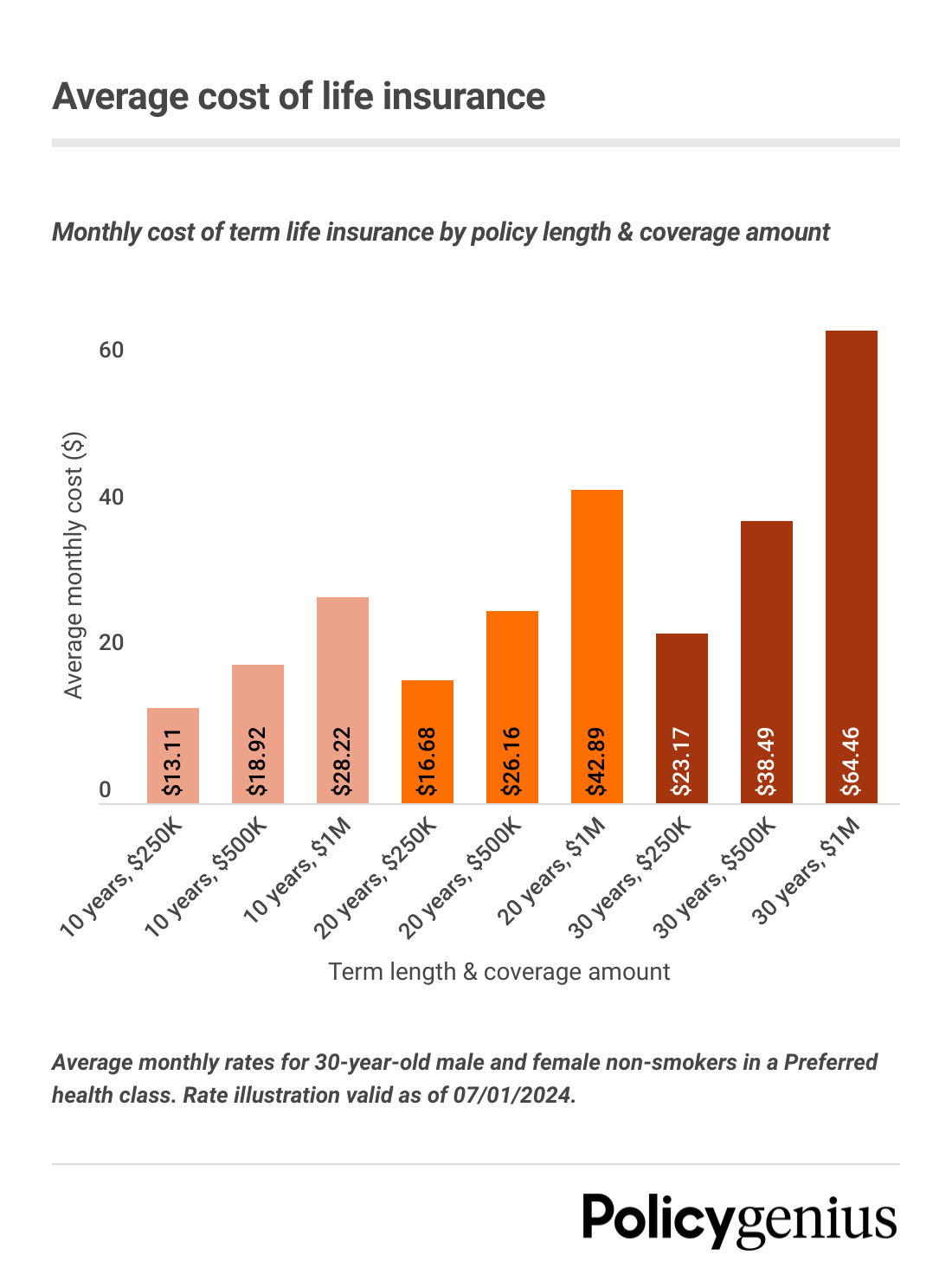
- Term Life Insurance: Provides coverage for a specific period (e.g., 10, 20, or 30 years). Because it is pure protection without an investment component, term life insurance is inexpensive, allowing most families to purchase the high face values ($500,000 to $2,000,000+) required by a proper needs-based calculation.
- Permanent Life Insurance: Includes whole life, universal life, and variable life policies that build cash value and last for your entire lifetime. Because premiums are significantly higher (often 5 to 10 times more expensive than term insurance for the same death benefit), individuals often purchase smaller face amounts than they actually need because larger policies become cost-prohibitive.
For the vast majority of income earners and parents, term life insurance is the most efficient vehicle for securing the adequate amount of life insurance to own during peak liability years.
Common Mistakes When Determining Coverage
When evaluating life insurance needs, individuals frequently fall into common psychological and mathematical traps that leave their families underprotected.
Insuring Only the Primary Earner
A common oversight is purchasing a large policy on the primary breadwinner while buying little to no coverage for a stay-at-home parent. Stay-at-home parents provide critical labor—childcare, transportation, cooking, cleaning, and home management. If a stay-at-home parent passes away, the surviving spouse often has to hire outside help for daycare, housekeeping, and after-school care. Replacing these services carries a significant market cost, meaning stay-at-home parents require substantial life insurance coverage as well.
Forgetting Inflation
Long-term income replacement calculations must account for inflation. A dollar today will not purchase the same basket of goods or pay the same tuition rate in fifteen years. While calculating exact inflation rates is difficult, building a small buffer into your income replacement multiplier protects your family's purchasing power over time.
Assuming Coverage Needs Remain Static
Your life insurance needs fluctuate throughout your lifetime. A newly married couple with no children has different needs than a family with three school-aged children and a large mortgage. As you pay down your mortgage, build retirement savings, and watch your children grow into independent adults, your need for life insurance gradually decreases. This is why purchasing a laddered portfolio of term policies or periodic re-evaluations is often recommended over locking into a single, permanent lifetime assumption.
Frequently Asked Questions
How much life insurance do I need if I have no dependents and no debt?
If you have zero dependents and zero debt, your life insurance needs are minimal. You likely only need enough coverage to pay for final arrangements, burial expenses, and any outstanding medical bills. Many single individuals without dependents choose to forgo life insurance entirely, relying instead on personal savings or workplace coverage if available.
Does my employer-provided life insurance count toward my total needs?
Yes, employer-provided group life insurance contributes to your total safety net, but you should rarely rely on it exclusively. These policies usually terminate if you leave your job, lose employment, or retire. Furthermore, employer-provided coverage is frequently capped at one or two times your salary, which is rarely enough for a family with a mortgage and young children.
How often should I recalculate my life insurance coverage amount?
You should review your life insurance coverage whenever you experience major life milestones. Key triggers include getting married, having or adopting a child, purchasing a home, starting a business, receiving a significant salary increase or decrease, or going through a divorce. As a general rule of thumb, review your coverage every three to five years.
Is it better to have one large policy or multiple smaller policies?
Having multiple policies—a strategy sometimes called "laddering"—can be an effective financial strategy. For example, you might buy a 30-year term policy to cover your mortgage and long-term income needs, and a separate 15-year term policy to cover the intensive years of child-rearing and college tuition. This allows you to drop the smaller policy when those specific expenses disappear, lowering your overall premium costs over time.
Does my health status affect how much insurance I can buy?
Your health status impacts how much insurance you can afford, but insurance companies also enforce financial underwriting limits on how much total coverage you can own. Insurers will look at your income, net worth, and existing policies to ensure you do not purchase an unreasonable amount of coverage that exceeds your economic human life value.
Next Steps and Action Plan
To determine your exact coverage requirement today, gather your recent financial statements, loan balances, and monthly household budget. Itemize your immediate funeral costs, wipe out your non-housing debt totals, decide whether you want your mortgage paid in full, and multiply your required annual income replacement by the number of years your dependents will need support. Subtract your existing savings and group policies from that gross total, and you will arrive at the precise amount of life insurance you need to own to secure your family's financial future.