In chemistry, alpha ($\alpha$), beta ($\beta$), and gamma ($\gamma$) primarily refer to types of radioactive decay in nuclear chemistry and positional labels for carbon atoms in organic chemistry. Radioactive decay involves the emission of particles or energy from unstable nuclei, while organic notation identifies the distance of atoms from a specific functional group.
The Dual Identity of Alpha, Beta, and Gamma in Chemistry
To understand "alpha beta gamma chemistry," one must distinguish between the two disparate fields where these Greek letters serve as fundamental descriptors: nuclear chemistry and organic chemistry. While they share the same nomenclature, their applications involve entirely different scales and forces.
In nuclear chemistry, these terms describe the primary modes of radioactive decay. This branch of science focuses on changes within the nucleus of an atom, where unstable isotopes release energy or matter to reach a more stable state. The study of these emissions is critical for everything from carbon dating and medical imaging to nuclear power generation.
In organic chemistry, alpha, beta, and gamma refer to the relative positions of carbon atoms and their attached substituents within a molecule. This notation system is essential for predicting how a molecule will react, identifying the acidity of specific protons, and understanding the mechanism of complex biochemical pathways. As of 2026, these labeling conventions remain the universal standard for IUPAC (International Union of Pure and Applied Chemistry) nomenclature and laboratory synthesis.
Nuclear Chemistry: The Three Pillars of Radioactive Decay
Radioactivity is the spontaneous disintegration of atomic nuclei. This process is governed by the weak and strong nuclear forces. Understanding the specific properties of alpha, beta, and gamma radiation is vital for safety, medical applications, and industrial processes.
Alpha Decay ($\alpha$)
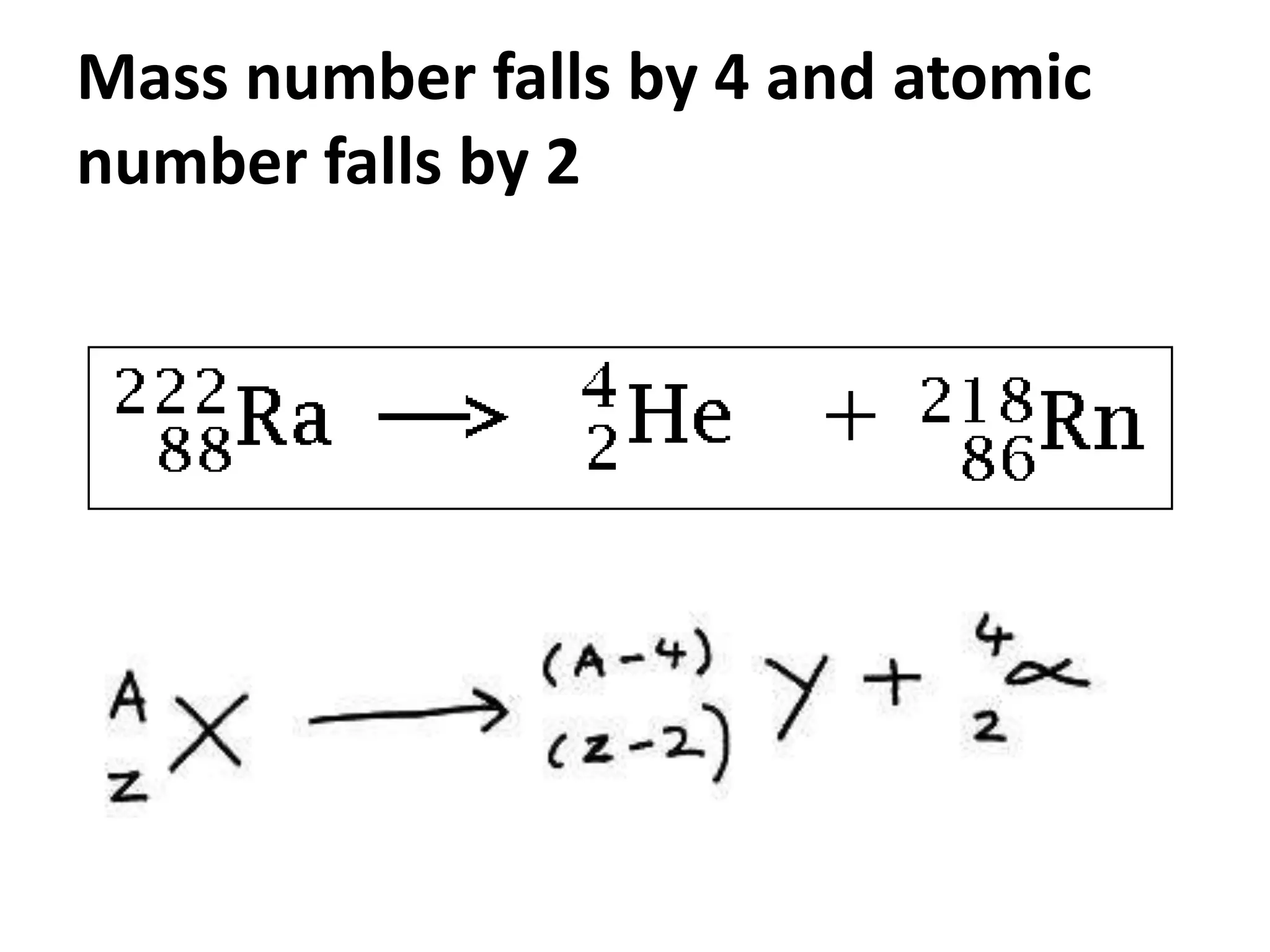
Alpha decay occurs when an unstable nucleus emits an alpha particle, which consists of two protons and two neutrons. Essentially, an alpha particle is a helium-4 nucleus ($^4_2\text{He}^{2+}$). This type of decay is most common in heavy elements like uranium, thorium, and radium.
Because an alpha particle contains two protons, the parent atom's atomic number decreases by two, and its mass number decreases by four, effectively transforming the atom into a different element. For example, Uranium-238 undergoes alpha decay to become Thorium-234.
From a chemical perspective, alpha particles are highly ionizing but have low penetrative power. They are large and carry a $+2$ charge, meaning they interact strongly with surrounding matter, stripping electrons from nearby atoms. However, they can be stopped by a single sheet of paper or the dead layer of human skin. The primary danger of alpha emitters arises if they are ingested or inhaled, where they can cause significant localized cellular damage.
Beta Decay ($\beta$)
Beta decay is more complex than alpha decay and occurs in two forms: $\beta^-$ (electron emission) and $\beta^+$ (positron emission).
- Beta-Minus Decay: This occurs when a nucleus has too many neutrons. A neutron is converted into a proton, and an electron (the beta particle) and an antineutrino are ejected. The atomic number increases by one, but the mass number remains the same. Carbon-14 decaying into Nitrogen-14 is the most famous example used in radiocarbon dating.
- Beta-Plus Decay (Positron Emission): This occurs when a nucleus has too many protons. A proton is converted into a neutron, emitting a positron (the antimatter equivalent of an electron) and a neutrino. This is the fundamental principle behind Positron Emission Tomography (PET) scans used in modern oncology.
Beta particles are much smaller and lighter than alpha particles. They have a $-1$ or $+1$ charge and can penetrate deeper into materials, requiring a few millimeters of aluminum or plastic to be effectively shielded.
Gamma Radiation ($\gamma$)
Unlike alpha and beta, gamma radiation is not a particle with mass; it is high-energy electromagnetic radiation (photons). Gamma decay often follows alpha or beta decay when the "daughter" nucleus is left in an excited state. To reach its ground state, the nucleus releases the excess energy as a gamma-ray photon.
Because gamma rays have no mass and no charge, they do not change the element's identity or its mass. However, they possess extreme penetrative power. They can pass through the human body and require thick layers of lead or several feet of concrete for shielding. In 2026, gamma radiation remains a primary tool for sterilizing medical equipment and treating deep-seated tumors via gamma-knife surgery.
Comparison Table: Properties of Radiation Types
| Property | Alpha ($\alpha$) | Beta ($\beta$) | Gamma ($\gamma$) |
|---|---|---|---|
| Identity | Helium Nucleus ($^4_2\text{He}$) | Electron or Positron ($e^-$ or $e^+$) | High-energy Photon |
| Mass (amu) | ~4.00 | ~1/1836 | 0 |
| Charge | $+2$ | $-1$ (or $+1$) | 0 |
| Ionizing Power | Very High | Moderate | Low |
| Penetration | Very Low (Paper/Skin) | Moderate (Aluminum/Plastic) | Very High (Lead/Concrete) |
| Typical Source | Heavy elements (U, Th) | N-rich or P-rich isotopes | Excited nuclei |
Organic Chemistry: Positional Notation and Reactivity
In the realm of molecular chemistry, alpha, beta, and gamma describe the location of carbon atoms relative to a "principal" functional group, such as a carbonyl (C=O), a hydroxyl (-OH), or a halogen. This shorthand is indispensable for discussing reaction mechanisms.
The Alpha Carbon ($\alpha$-Carbon)
The carbon atom directly attached to the functional group of interest is designated as the alpha carbon. This position is arguably the most important in organic synthesis because of the unique properties it confers on the atoms attached to it.
For instance, in a carbonyl compound (like an aldehyde or ketone), the hydrogen atoms attached to the $\alpha$-carbon are surprisingly acidic. This is due to the resonance stabilization of the resulting enolate ion. This acidity allows for the "Alpha-Substitution" reaction, where a hydrogen is replaced by an electrophile. Many biological processes, including the metabolism of amino acids, center on the chemistry of the $\alpha$-carbon. In an amino acid, the $\alpha$-carbon is the central atom to which the amino group, the carboxyl group, and the side chain are all attached.
The Beta Carbon ($\beta$-Carbon)
The carbon atom one step further away from the functional group is the beta carbon. The chemistry at this position is most frequently discussed in the context of Beta-Elimination reactions (E1 and E2 mechanisms).
In a $\beta$-elimination, a base removes a hydrogen atom from the $\beta$-carbon, and a leaving group (like a bromide or chloride ion) departs from the $\alpha$-carbon. This results in the formation of a double bond (an alkene) between the $\alpha$ and $\beta$ positions. This is a fundamental method for synthesizing unsaturated hydrocarbons. Furthermore, "Beta-Oxidation" is the metabolic pathway by which fatty acids are broken down in the mitochondria to produce energy.
Gamma ($\gamma$) and Beyond
The gamma carbon is the third carbon in the chain relative to the functional group. While generally less reactive than the $\alpha$ or $\beta$ positions, $\gamma$-substitution is critical in the formation of cyclic compounds. For example, $\gamma$-hydroxy acids can undergo internal esterification to form five-membered rings known as gamma-lactones. Similarly, the neurotransmitter GABA (Gamma-Aminobutyric Acid) derives its name from the fact that the amino group is attached to the third carbon away from the carboxylic acid group.
Practical Applications in 2026
The principles of alpha, beta, and gamma chemistry are not merely theoretical; they drive the most advanced technologies of 2026.
Targeted Alpha Therapy (TAT)
In the medical sector, targeted alpha therapy has become a frontier in treating metastatic cancers. By attaching alpha-emitting isotopes (like Actinium-225) to monoclonal antibodies, physicians can deliver highly ionizing radiation directly to cancer cells. Because alpha particles have such a short range, they destroy the tumor cell's DNA without damaging the surrounding healthy tissue.
Carbon-14 and Isotopic Labeling
The beta decay of Carbon-14 remains the gold standard for dating organic remains up to 50,000 years old. In 2026, isotopic labeling using $\beta$-emitters is also used in environmental chemistry to trace the movement of pollutants through groundwater systems. By replacing a standard atom in a molecule with a radioactive $\beta$-emitting isotope, scientists can track the "path" of a chemical through complex biological or geological systems.
Advanced Polymer Synthesis
In organic chemistry, the specific manipulation of $\alpha$ and $\beta$ positions allows for the creation of "smart" polymers. By controlling the substitution at these sites, chemists can engineer materials that change shape or conductivity in response to pH or temperature, which are increasingly used in 2026 for wearable medical sensors and soft robotics.
Safety and Detection in the Laboratory
Handling "alpha beta gamma chemistry" requires specialized equipment and rigorous protocols. Detection is the first line of defense.
- Geiger-Müller Counters: These are effective for detecting alpha and beta particles. The radiation ionizes gas inside a tube, creating an electrical pulse.
- Scintillation Counters: Often used for gamma detection, these devices use crystals that emit light when struck by high-energy photons.
- Film Badges and TLDs: Personnel working with radiation wear these to monitor cumulative exposure over time.
For organic chemists, "safety" involves understanding the reactivity of these positions. For example, $\alpha$-halo carbonyls are potent lacrimators (tear-inducing agents), and proper fume hood use is essential when synthesizing them to prevent accidental inhalation or skin exposure.
Frequently Asked Questions
What is the main difference between alpha particles and gamma rays?
The primary difference is mass and charge. An alpha particle is a physical cluster of protons and neutrons with a $+2$ charge and significant mass. A gamma ray is a packet of electromagnetic energy (a photon) with no mass and no charge. This results in alpha particles being highly ionizing but easily blocked, while gamma rays are deeply penetrating but less likely to ionize matter upon immediate contact.
Why are alpha hydrogens in carbonyls acidic?
Alpha hydrogens are acidic because the oxygen in the carbonyl group is highly electronegative and exerts an inductive effect, pulling electron density away from the C-H bond. More importantly, when the proton is removed, the resulting negative charge is resonance-stabilized by the carbonyl oxygen, forming an enolate. This stability makes the removal of the proton much more energetically favorable than in a standard alkane.
Can beta decay change the element's identity?
Yes. In beta-minus decay, a neutron turns into a proton, increasing the atomic number by one, which shifts the atom one position to the right on the periodic table. In beta-plus decay, a proton turns into a neutron, decreasing the atomic number by one and shifting the atom one position to the left.
How is gamma radiation used in 2026 for food safety?
Gamma radiation is used in a process called food irradiation. High-energy gamma rays from sources like Cobalt-60 are passed through food products to kill bacteria, parasites, and insects. This extends shelf life and reduces the risk of foodborne illnesses without making the food itself radioactive.
What is an alpha-amino acid?
An alpha-amino acid is an organic molecule where both the amino group ($-NH_2$) and the carboxyl group ($-COOH$) are attached to the same central carbon atom (the alpha carbon). Most of the amino acids that make up human proteins are alpha-amino acids.
Conclusion and Next Actions
Understanding alpha, beta, and gamma chemistry is a prerequisite for any advanced study in the physical sciences. Whether you are analyzing the decay of an isotope or the mechanism of a nucleophilic substitution, these terms provide the necessary framework for spatial and energetic classification.
For those looking to apply this knowledge, the next steps include:
- For Nuclear Chemistry: Study the Belt of Stability to predict which type of decay an isotope is likely to undergo based on its neutron-to-proton ratio.
- For Organic Chemistry: Practice drawing enolate resonance structures to better understand why the alpha position is so reactive in synthetic pathways.
- Safety Review: If working in a lab environment in 2026, ensure you are familiar with the specific shielding requirements for the isotopes or reactive intermediates you are handling.