California almond orchards require approximately 3.5 to 4 acre-feet of water per acre annually, consuming roughly 10% to 12% of the state’s developed agricultural water supply. While individual almond kernels take about 1.1 to 3 gallons of water to produce, modern micro-irrigation, deficit strategies, and strict groundwater regulations have significantly enhanced crop water productivity across the Central Valley.
The Scale of Almond Water Consumption in California
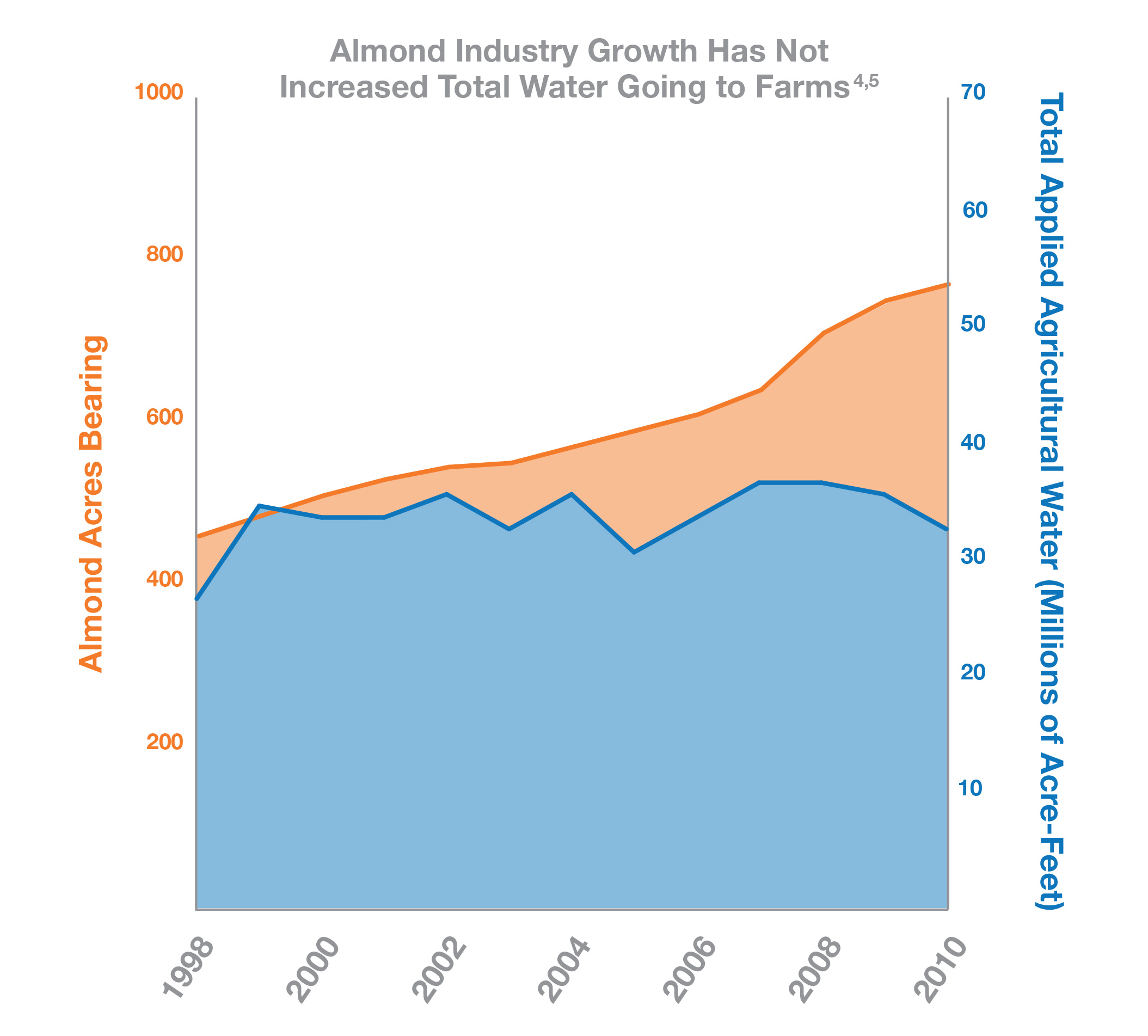
California produces approximately 80% of the world's commercial almond supply, driven by the Mediterranean climate of the Central Valley. This region features hot, dry summers and mild winters—ideal growing conditions for nut trees, provided sufficient water is available during the dry months. Over the past several decades, the acreage dedicated to almond orchards expanded significantly, growing from roughly 500,000 bearing acres in the late 1990s to over 1.3 million bearing acres.
To evaluate almond water use accurately, agricultural scientists distinguish between applied water and crop evapotranspiration ($ET_c$):
- Applied Water: The total depth of irrigation water delivered to the field by pump or canal system, measured in acre-feet per acre ($AF/A$). One acre-foot equals 325,851 gallons, covering one acre of land to a depth of one foot.
- Crop Evapotranspiration ($ET_c$): The total amount of water that actually evaporates from the soil surface and transpires through the tree leaves to sustain plant health and crop growth.
On average, mature almond trees require an applied water volume ranging between 3.0 and 4.0 acre-feet per acre per year (approximately 975,000 to 1,300,000 gallons per acre). This requirement varies based on local microclimates (lower in the northern Sacramento Valley, higher in the southern San Joaquin Valley), soil salinity, irrigation system efficiency, and annual weather fluctuations.
Total Applied Water = Irrigation Volume (AF/Acre)
- Transpiration (Water drawn by roots, lost through leaf stomata)
- Evaporation (Water evaporated directly from soil surfaces)
- Beneficial Runoff/Recharge (Unused applied water returning to aquifers or drainage)
Deconstructing the "One Gallon Per Almond" Metric
Public discussions often cite the statistic that it takes "one gallon of water to grow a single almond." While mathematically close when dividing total evapotranspiration by kernel yield, this metric often oversimplifies agricultural water dynamics:
- Biomass Allocation: An almond tree produces more than just the edible nut kernel. The growing process creates tree wood, leaves, an outer green hull, and an inner shell.
- Co-Product Utilization: Hulls are harvested and sold as nutrient-dense feed for dairy cows, reducing the need to cultivate dedicated forage crops like alfalfa elsewhere. Shells are utilized for livestock bedding, bioenergy generation, and soil amendments.
- Kernel Weight Variations: Almond varieties (such as Nonpareil, Monterey, or Carmel) yield different kernel weights. Taking into account the entire harvested biomass, water productivity has improved by over 30% over the last two decades according to research published by the UC Agricultural and Natural Resources (UC ANR).
California Water Infrastructure and Agricultural Footprint
California’s managed water infrastructure redistributes water from the rain-heavy northern region and snowpack-rich Sierra Nevada mountains to the arid agricultural centers of the Central Valley and urban centers in the south.
Total California Water Budget (Average Year)
- Environmental Flows: ~50% (Wild rivers, delta outflows, protected wetlands)
- Managed Agriculture: ~40% (Crop irrigation across ~9 million acres)
- Urban / Industrial: ~10% (Residential, commercial, municipal use)
Within the ~40% allocated to agriculture across approximately 9 million irrigated acres, almonds account for roughly 10% to 12% of total agricultural water use.
Permanent Crops vs. Annual Crops in Drought Cycles
A major challenge regarding almond water use is the physiological nature of tree crops. Almond trees are perennial permanent crops with an economic lifespan of 25 to 30 years.
Unlike annual crops (such as processing tomatoes, cotton, or lettuce) which farmers can choose not to plant during severe drought years to conserve water, almond orchards cannot be fallowed without sacrificing significant capital investment. If an almond tree experiences complete water deprivation during summer months, it suffers severe dieback or death, resulting in hundreds of thousands of dollars in lost long-term capital per orchard. Consequently, during dry years, growers must secure water through ground pumping or spot-market water transfers to preserve their mature rootstocks.
Comparative Analysis: Almonds vs. Other California Major Crops
To understand where almonds fit in California's agricultural landscape, it is useful to compare their water requirements, acreage, crop type, and primary irrigation methods against other leading commodities in the state.
| Crop Category | Average Applied Water (AF/Acre) | Typical Crop Type | Primary Irrigation Method | Relative Economic Value / Acre | Main Byproducts / End Uses |
|---|---|---|---|---|---|
| Almonds | 3.5 – 4.0 | Perennial (Tree) | Micro-drip / Micro-sprinkler | High | Edible kernels, dairy hull feed, shell bedding |
| Pistachios | 3.0 – 3.8 | Perennial (Tree) | Micro-drip / Drip | High | Edible nuts, shell bio-fuel |
| Walnuts | 3.5 – 4.2 | Perennial (Tree) | Micro-sprinkler / Flood | Moderate-High | Edible nuts, industrial abrasive shells |
| Alfalfa (Hay) | 4.0 – 6.0 | Perennial (Forage) | Flood / Pivot Overhead | Moderate | Livestock and dairy feed |
| Wine Grapes | 1.2 – 2.0 | Perennial (Vine) | Drip | High | Wine production, pomace fertilizer |
| Processing Tomatoes | 2.2 – 2.8 | Annual | Subsurface Drip | Moderate | Sauces, pastes, food products |
| Rice | 4.0 – 5.0 | Annual | Managed Basin (Flood) | Moderate | Human consumption, waterfowl habitat |
Note: Water application rates vary based on soil type, regional evapotranspiration rates, and annual climatic conditions across California's hydrologic regions.
Regulatory Framework: SGMA and Groundwater Restrictions
The historic 2012–2016 California drought exposed deep vulnerabilities in the state's groundwater reserves. As surface water deliveries from the California State Water Project and Central Valley Project dropped to zero or single-digit percentages for many agricultural districts, farmers increasingly drilled deeper wells to pump groundwater.
In response, California enacted the Sustainable Groundwater Management Act (SGMA) in 2014. SGMA requires local agencies to form Groundwater Sustainability Agencies (GSAs) and develop Groundwater Sustainability Plans (GSPs) to bring critically overdrafted groundwater basins into balanced extraction and recharge by 2040.
SGMA Implementation Timeline & Mechanics
- 2014: SGMA Enacted into California Law
- 2020–2022: GSA Plans Submitted for Critically Overdrafted Basins
- 2026+: Active Enforcement of Pumping Allocations & Volumetric Caps
- 2040: Statutory Requirement to Achieve Basin Sustainability (Zero Net Overdraft)
Impact of SGMA Enforcement
SGMA implementation directly impacts almond acreage dynamics across California:
- Pumping Caps and Extraction Fees: GSAs are instituting strict volumetric allocations per acre. Pumping beyond an assigned cap results in steep financial penalties.
- Land Fallowing: Research from institutions like the Public Policy Institute of California (PPIC) estimates that SGMA compliance may require fallowing 500,000 to 900,000 acres of Central Valley farmland over the coming decades, primarily affecting lower-margin annual crops and older, less productive permanent orchards.
- Water Markets and Trading: Local groundwater markets allow growers to trade water allocations within sub-basins, directing water toward higher-value crops like almonds and pistachios while compensating growers who fallow land.
Precision Agriculture and Technical Innovation in Almond Irrigation
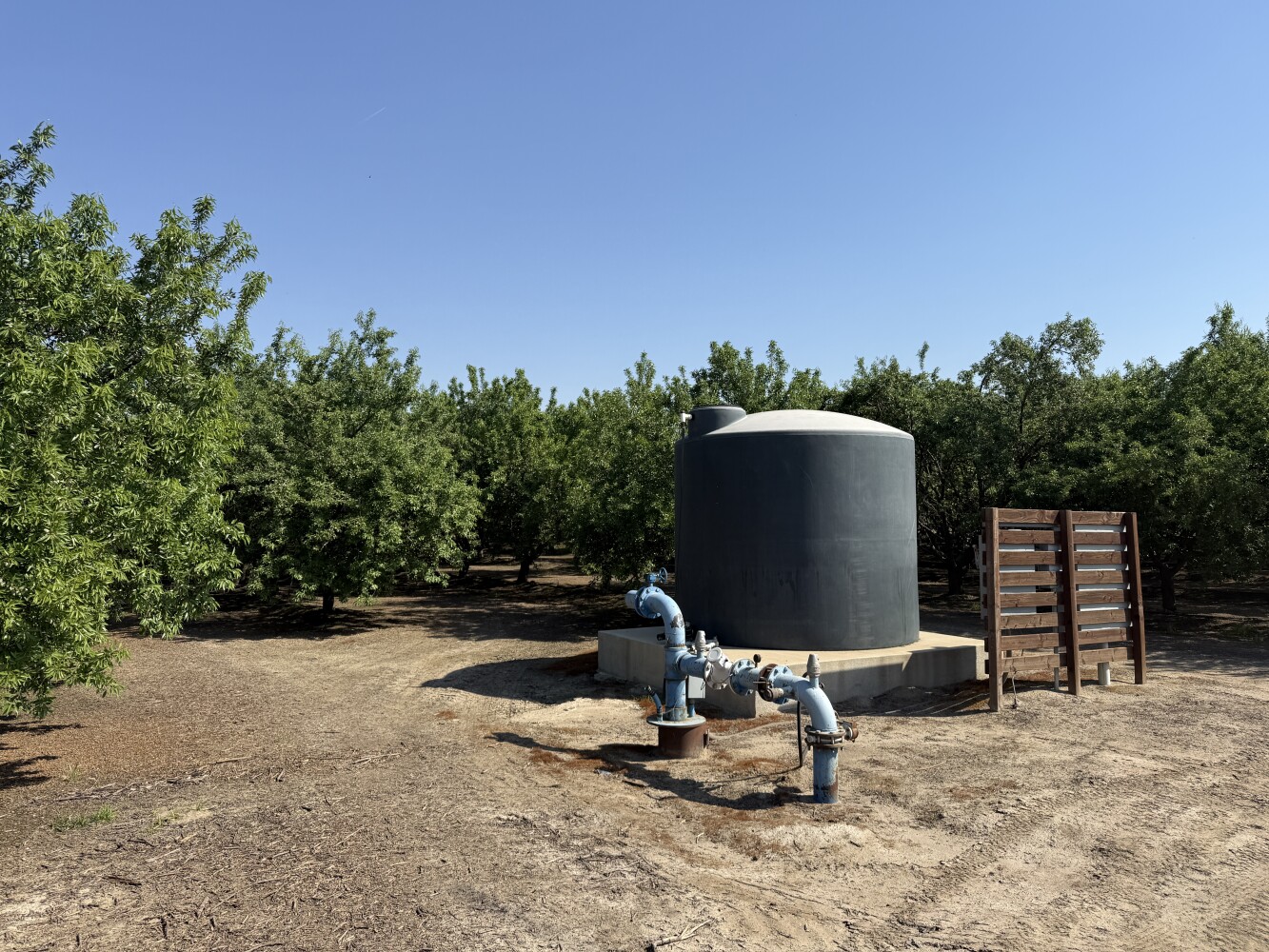
To maintain productivity under tightening water allocations, California almond growers have adopted advanced water management technologies. Over 85% of California almond orchards now utilize micro-irrigation systems, far exceeding the adoption rate for general broadacre agriculture worldwide.
Modern Orchard Water Management Stack
- Delivery: Subsurface Drip (SDI) & Low-Volume Micro-Sprinklers
- Soil Sensing: Continuous TDR & Capacity Soil Moisture Probes
- Plant Sensing: Pressure Chambers (Stem Water Potential) & Sap Flow Sensors
- Regional Data: OpenET Satellite Evapotranspiration Monitoring Systems
High-Efficiency Irrigation Infrastructure
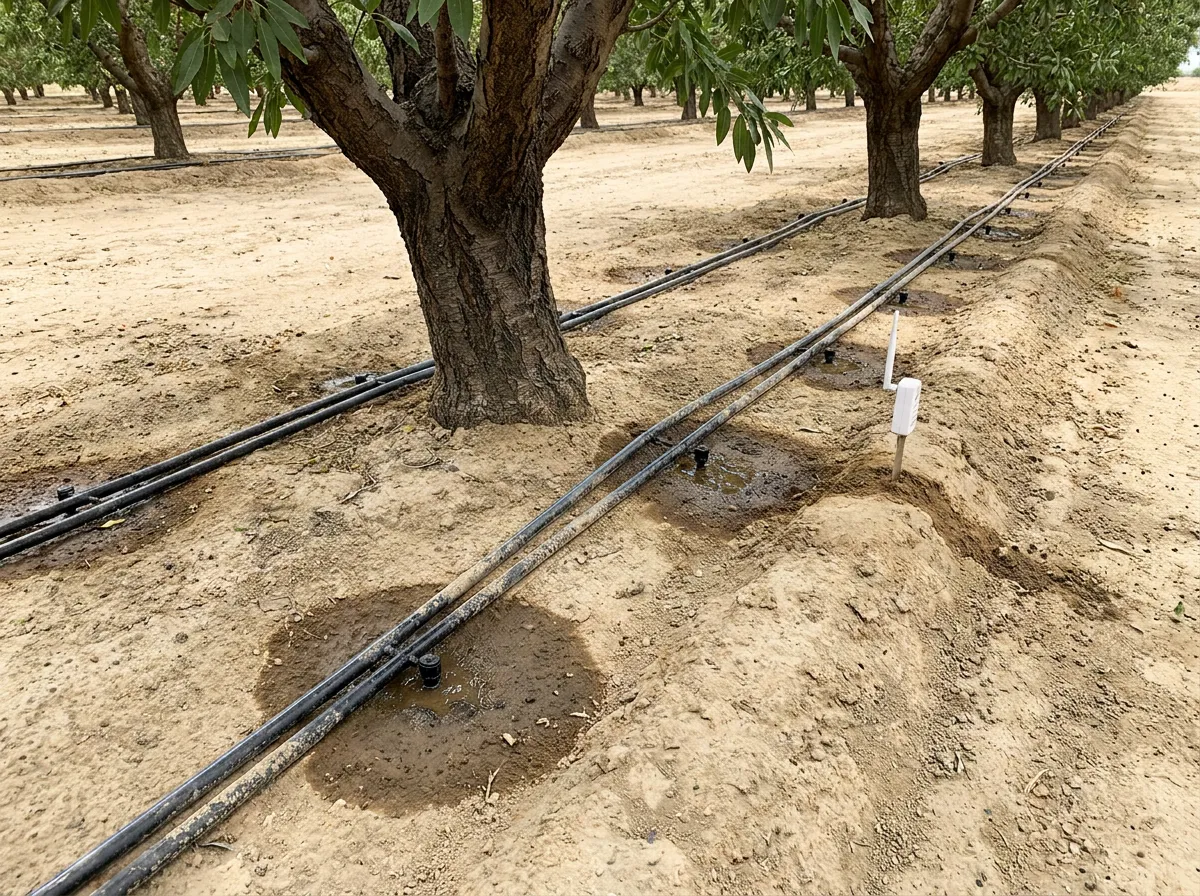
- Subsurface Drip Irrigation (SDI): Drip lines are buried 12 to 18 inches below the soil surface, delivering water directly to the root zone. SDI minimizes surface evaporation, eliminates wind drift loss, and reduces weed germination between tree rows.
- Micro-Sprinklers: Low-volume sprinklers deliver targeted water to the root zone while preserving a slightly wider soil-moisture footprint than single drip emitters, encouraging healthier root architecture without the high evaporative losses of traditional flood irrigation.
Sensor-Driven Scheduling and Evapotranspiration Tracking
Instead of irrigating on a fixed calendar schedule, growers use real-time data integration:
- Pressure Chambers (Midday Stem Water Potential): Farmers measure water tension within leaf petioles using a pressure chamber (often called a "pressure bomb"). This reveals the exact level of physiological water stress the tree is experiencing, preventing both over-irrigation and under-irrigation.
- Soil Moisture Sensors: Capacitance probes placed at various soil depths (e.g., 12, 24, 36, and 48 inches) provide continuous readings of moisture penetration, ensuring water does not percolate past the active root zone where it would be wasted.
- OpenET and Remote Sensing: Satellite-based monitoring platforms leverage thermal infrared imagery to map actual crop evapotranspiration at field scales, allowing precise water application tailored to specific block requirements.
Regulated Deficit Irrigation (RDI)
Regulated Deficit Irrigation is a practice where water application is deliberately reduced below full crop requirement at specific, non-critical growth stages.
During hull split (typically late July through August), applying mild, controlled water stress yields dual benefits:
- Accelerates Uniform Ripening: Mild stress encourages the hull to split evenly, speeding up harvest readiness.
- Disease Reduction: Lower humidity within the orchard canopy reduces the risk of fungal infections such as hull rot (Monilinia fructicola and Rhizopus stolonifer), while conserving up to 10% to 15% of summer irrigation water.
Economic Returns Per Unit of Water
When evaluating agricultural water use, economists analyze the economic yield generated per acre-foot of applied water. Almonds generate higher revenue per unit of water than many alternative traditional crops, making them an economically efficient user of scarce water resources.
Economic Yield Metric = Net Crop Revenue ($) / Total Applied Water (AF)
- High Capital Value: Almonds generate substantial revenue per acre, supporting local agricultural economies, processing infrastructure, packing houses, and farm labor employment throughout the Central Valley.
- Export Value: As one of California's top agricultural exports by value, almonds contribute billions of dollars to the state's international trade balance, with major markets in Europe, East Asia, and South Asia.
- Resource Trade-Offs: Opponents argue that exporting water-intensive nuts amounts to "exporting California's water." Proponents highlight that importing foreign capital in exchange for high-value agricultural commodities strengthens the state's rural economy far more efficiently than lower-value crops.
Practical Action Steps for Landowners, Managers, and Consumers
For stakeholders navigating California’s evolving water landscape, concrete steps exist to balance agricultural production with regional sustainability.
For Agricultural Managers and Landowners
- Audit Irrigation Distribution Uniformity (DU): Conduct annual pressure and flow tests across orchard blocks. A DU rating above 85–90% ensures water is applied evenly without over-watering section ends.
- Integrate Pressure Chamber SWP Readings: Base irrigation triggers on plant-based stem water potential (SWP) thresholds rather than soil moisture alone, targeting -10 to -14 bars of tension during non-critical phases.
- Adopt Whole-Orchard Recycling (WOR): When pulling out old orchards, grind whole trees and incorporate the woodchips into the topsoil prior to replanting. Studies by UC Cooperative Extension demonstrate WOR increases soil organic matter, improves soil water-holding capacity by up to 10%, and boosts cumulative crop yields over the subsequent orchard lifecycle.
- Engage in Local GSA Governance: Participate actively in local Groundwater Sustainability Agency meetings to secure clear historical pumping records and understand local credit-trading rules.
For Consumers and Policy Observers
- Contextualize Food Water Footprints: Recognize that almost all protein- and nutrient-dense foods (including livestock products, nuts, and oilseeds) require substantial water inputs compared to simple leafy greens.
- Support Co-Product Utilization: Support supply chains that utilize almond hulls and shells fully, ensuring the crop's complete carbon and water investment contributes to the broader agricultural circular economy.
Frequently Asked Questions
How many gallons of water does it take to grow a single almond?
It takes approximately 1.1 to 3.0 gallons of water to grow a single almond kernel, depending on orchard location, weather conditions, and irrigation efficiency. However, this calculation encompasses the entire tree biomass and co-products generated during the process, such as cattle feed hulls and shells.
What percentage of California's water is used by almonds?
Almonds consume approximately 10% to 12% of California’s developed (managed) agricultural water supply. Looking at California's total managed water budget—which includes environmental flows dedicated to wild rivers—almonds account for roughly 4% to 5% of overall state water allocations.
Can almond trees be fallowed during a drought?
Unlike annual crops like corn or tomatoes, permanent tree crops like almonds cannot be fallowed for a season without killing the trees. Depriving an almond orchard of water for a year causes severe canopy loss or tree death, destroying an investment that takes 3 to 5 years to reach commercial maturity.
How is the Sustainable Groundwater Management Act (SGMA) changing almond farming?
SGMA places strict caps on groundwater pumping to prevent aquifer depletion. As these limits take full effect across California, growers face reduced water allocations, driving the fallowing of less productive farmland, incentivizing precision irrigation technology, and shifting acreage toward higher-efficiency management practices.
Why don't farmers replace almonds with less water-intensive crops?
Almonds provide high economic returns per acre and per unit of water used compared to many low-margin field crops. Additionally, almond trees represent long-term capital investments lasting 25 to 30 years, supported by specialized harvesting equipment, processing facilities, and established global export markets.
Summary Recommendation
To navigate tightening water supplies and regulatory constraints, California almond producers must transition from traditional volume-based irrigation to data-driven precision application. Incorporating whole-orchard recycling, micro-irrigation infrastructure, continuous canopy stress monitoring, and local GSA groundwater trading structures offers the clearest pathway to maintaining yield profitability while remaining compliant with California's 2040 groundwater sustainability mandates.