Nikola Tesla held nearly 300 patents globally, covering a vast range of electrical and mechanical technologies. His most significant inventions include the Alternating Current (AC) system, the induction motor, the Tesla coil, wireless radio transmission, and remote control. These innovations fundamentally shaped the 20th century and continue to drive modern electrical infrastructure and wireless communication in 2026.
Nikola Tesla is often remembered as the "man who invented the 20th century." His work was not merely a collection of gadgets but a systemic reimagining of how energy and information could be transmitted across the globe. While he is most famous for the "War of Currents" against Thomas Edison, his intellectual output spanned everything from early X-ray imaging to vertical take-off aircraft. Understanding the full scope of Tesla’s inventions requires looking past the myths to the specific patents and prototypes that changed the physical world.
The Alternating Current (AC) System and Polyphase Power
The most consequential entry on any list of Nikola Tesla inventions is the polyphase system of alternating current. Before Tesla’s work in the late 1880s, the world relied primarily on Direct Current (DC), championed by Thomas Edison. DC was limited by its inability to be transmitted efficiently over long distances due to significant power loss in the wires.
Tesla’s breakthrough was the development of the polyphase system, which used multiple alternating currents with different phases to create a rotating magnetic field. This allowed for the use of transformers to "step up" voltages for long-distance transmission and "step down" voltages for safe home use.
In 1888, George Westinghouse purchased Tesla’s AC patents, leading to the construction of the first large-scale power plant at Niagara Falls. By 1896, this plant was sending power to Buffalo, New York, proving that AC was the superior method for grid-scale electrification. Even in 2026, the global electrical grid operates almost entirely on the principles established by Tesla’s original AC patents.
The Induction Motor: The Workhorse of Industry
While the AC system provided the power, the induction motor provided the means to use it efficiently. Tesla’s induction motor, patented in 1888, was revolutionary because it did not require commutators or brushes—parts that frequently wore out or caused sparks in DC motors.
The induction motor operates using a rotating magnetic field generated by the stator (the stationary part of the motor). This field induces a current in the rotor, causing it to spin without any physical electrical connection between the two parts. This "brushless" design made motors more durable, efficient, and easier to maintain. Today, induction motors are used in everything from household appliances and industrial fans to the propulsion systems of modern electric vehicles.
The Tesla Coil and High-Frequency Electricity
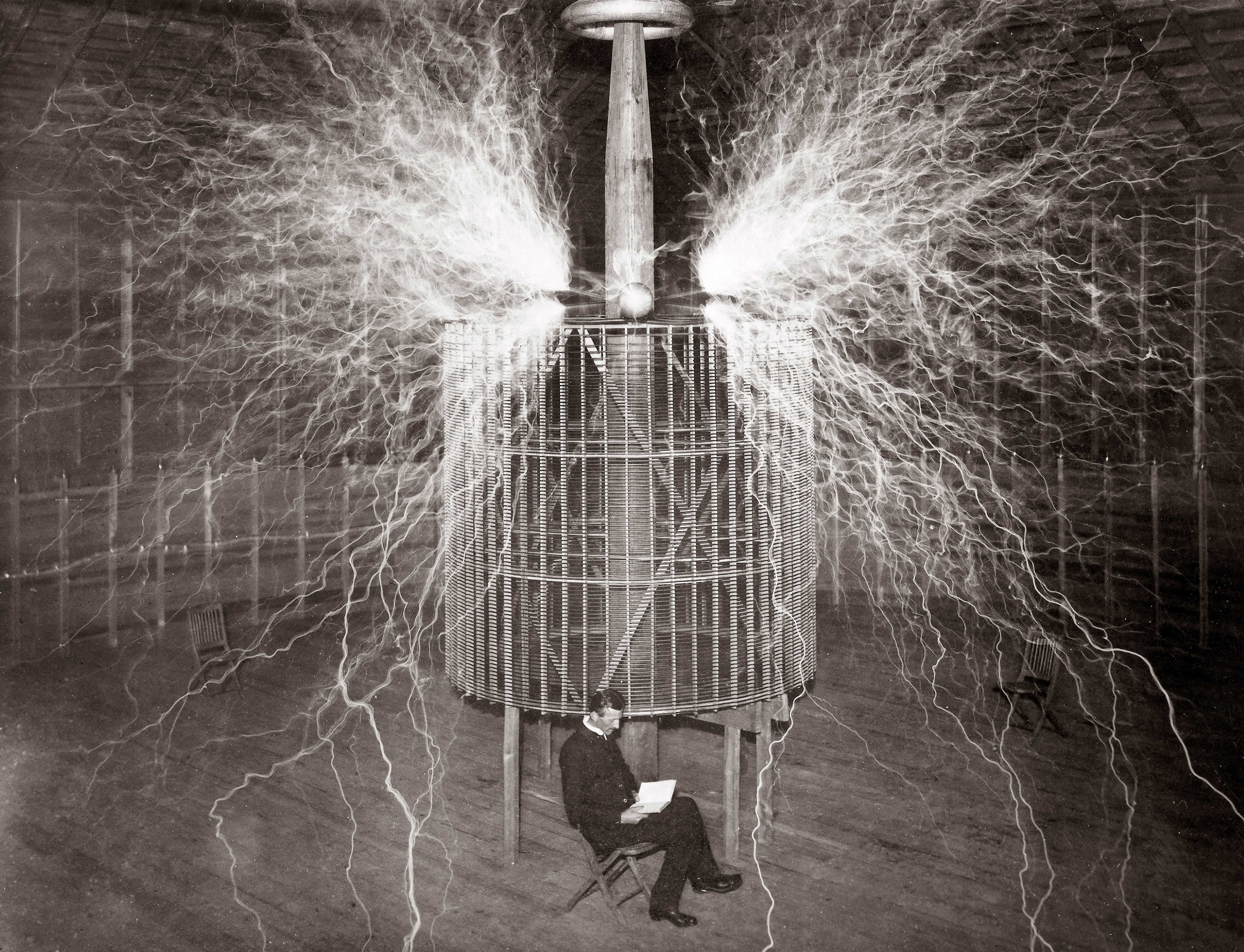
Patented in 1891, the Tesla Coil is perhaps his most visually iconic invention. It is an air-core resonant transformer circuit used to produce high-voltage, low-current, high-frequency alternating-current electricity.
Technically, the Tesla Coil works by using two circuits (a primary and a secondary) that are tuned to the same resonant frequency. When the primary circuit discharges into the secondary, the voltage is amplified to millions of volts, creating the famous electrical arcs associated with Tesla's laboratory.
While the Tesla Coil is often used today for educational demonstrations and entertainment, its historical importance lies in its role in early radio and wireless research. It allowed Tesla to explore the behavior of high-frequency currents, leading to his discoveries in wireless lighting, phosphorescence, and the transmission of electromagnetic energy without wires.
Radio Transmission and the Four-Tuned Circuit
A common historical misconception is that Guglielmo Marconi alone invented the radio. However, Tesla’s work predated Marconi’s and provided the fundamental technology required for wireless communication. In 1893, Tesla demonstrated a wireless radio transmitter in St. Louis, Missouri, years before Marconi’s first successful long-distance transmission.
The core of Tesla’s radio invention was the "four-tuned circuit." This system used two tuned circuits on the transmitter side and two on the receiver side, ensuring that the signals were sent and received at specific frequencies. This prevented interference and allowed for the selection of different "channels."
In 1943, the United States Supreme Court overturned Marconi’s radio patents, citing Tesla’s earlier work as the primary invention. Tesla’s vision for radio was not just for audio communication but for the wireless transmission of data and power—a precursor to the interconnected wireless world of 2026.
The Teleautomaton: The First Remote Control
In 1898, at Madison Square Garden, Tesla demonstrated what he called a "teleautomaton." This was a radio-controlled boat that he could maneuver from a distance using a wireless remote. The audience was so shocked that some believed it was magic, or that Tesla had a trained monkey hidden inside the vessel.
This invention was the birth of remote control, robotics, and drone technology. Tesla envisioned "teleautomatic" machines performing dangerous tasks or serving as weapons of war to deter conflict. His patent for the "Method of and Apparatus for Controlling Mechanism of Moving Vessels or Vehicles" established the logic gates and wireless signals that govern modern robotics and autonomous systems.
Lighting: Neon and Fluorescent Principles
Tesla was a pioneer in high-frequency lighting. Long before the widespread use of modern fluorescent or neon lights, Tesla was experimenting with "cold" light. He developed vacuum tubes that were coated with phosphors and energized by high-frequency currents from a Tesla Coil.
He demonstrated these lights at the 1893 World’s Columbian Exposition in Chicago. Unlike Edison’s incandescent bulbs, which produced light through heat (making them inefficient), Tesla’s tubes remained cool and used much less energy. While he did not commercialize neon signs himself, his research into gas-discharge lamps provided the technical foundation for the neon and fluorescent lighting industries that dominated the 20th century.
The Tesla Turbine and Valveless Pulsejet
In the later stages of his career, Tesla moved into mechanical engineering. He patented the Tesla Turbine in 1913, which is a unique bladeless turbine. Instead of using traditional blades to catch steam or air, the Tesla Turbine uses a series of closely spaced parallel disks.
When a fluid (such as steam or water) is injected at the edges of the disks, it follows a spiral path toward the center, turning the disks through the "boundary layer effect" and fluid friction. Tesla claimed this turbine could achieve over 90% efficiency. Although it was difficult to manufacture with the materials available in his time, modern engineers in 2026 continue to study the Tesla Turbine for use in specialized pumps and micro-turbines.
Summary Table of Key Tesla Inventions
The following table summarizes the most influential inventions and concepts attributed to Nikola Tesla.
| Invention | Approximate Year | Primary Function | Modern Impact/Legacy |
|---|---|---|---|
| Polyphase AC System | 1887–1888 | Universal power distribution | The standard for the global power grid. |
| Induction Motor | 1888 | Converts electrical energy to mechanical | Essential for EVs and industrial automation. |
| Tesla Coil | 1891 | High-voltage resonant transformer | Used in radio, TV, and medical electronics. |
| Wireless Radio | 1893 | Long-distance signal transmission | The foundation of all wireless communication. |
| Teleautomaton | 1898 | Remote-controlled movement | The precursor to robotics and drones. |
| Tesla Turbine | 1913 | Fluid-driven power generation | Specialized high-efficiency pumps and turbines. |
| Shadowgraphs | 1895 | Early X-ray imaging | Contributed to the development of radiology. |
| Magnifying Transmitter | 1900 | Massive scale wireless power | Prototype for global energy distribution. |
Wardenclyffe and the Vision of Wireless Power
No list of Tesla’s inventions is complete without mentioning the Wardenclyffe Tower project. Built in Shoreham, New York, between 1901 and 1905, Wardenclyffe was intended to be the first "World Wireless System."
Tesla’s goal was to transmit both information and electrical power through the Earth’s atmosphere and the ground itself. He believed the Earth could act as a giant conductor, allowing anyone with a simple antenna to "tap into" free, clean energy. The project was never completed due to a lack of funding and the withdrawal of his primary investor, J.P. Morgan. While the physics of long-distance wireless power transmission remains a challenge in 2026, Tesla’s work at Wardenclyffe anticipated the modern concepts of wireless data networks (Wi-Fi) and the "Internet of Things."
Secondary and Theoretical Inventions
Beyond the major categories, Tesla's patent record includes several unique and often overlooked devices:
- Tesla’s Egg of Columbus: A device used to demonstrate the principles of the rotating magnetic field and the induction motor by making a copper egg stand on end.
- Ozone Generators: Tesla patented several machines to produce ozone for medical and air purification purposes, a technology still used in high-end filtration systems.
- Vertical Take-Off and Landing (VTOL) Aircraft: In 1928, Tesla received his last patent for a "Flivver" plane that could take off vertically like a helicopter and then tilt its wings to fly like a conventional airplane.
- The Valvular Conduit: A one-way valve with no moving parts. This "Tesla Valve" uses a complex internal geometry to allow fluid to flow in one direction while significantly resisting it in the other. It is increasingly used in 2026 for microfluidic applications.
Frequently Asked Questions
Did Nikola Tesla invent the light bulb?
No, Nikola Tesla did not invent the light bulb; that credit primarily goes to Thomas Edison and Joseph Swan. However, Tesla invented more efficient forms of lighting, such as high-frequency discharge lamps and neon/fluorescent lighting precursors. He focused on using alternating current to power lighting systems, which eventually became the standard.
How many patents did Nikola Tesla actually have?
Tesla held approximately 300 patents worldwide. This number varies depending on whether you count original patents, reissues, or foreign filings of the same invention. In the United States alone, he held 112 patents. Many of his ideas were never formally patented or were kept in his private journals and notes.
Did Tesla invent the "Death Ray"?
Tesla proposed a "Teleforce" weapon in the 1930s, which the press dubbed a "Death Ray." It was designed to be a particle-beam weapon that could accelerate pellets of mercury or other materials to high speeds. While Tesla claimed to have developed the theory and some components, there is no evidence a functional full-scale model was ever built or tested.
Why did Tesla die poor if he invented so much?
Despite his brilliant inventions, Tesla was a poor businessman. He frequently signed away his royalties to ensure his projects continued. For instance, he tore up his royalty contract with George Westinghouse to save Westinghouse's company from bankruptcy. Additionally, he invested most of his own money into the Wardenclyffe project, which ultimately failed financially.
Was Tesla's wireless power ever proven to work?
Tesla successfully demonstrated short-range wireless power, lighting lamps from across a room using his resonant coils. However, his vision for global wireless power (the Wardenclyffe project) was never proven at scale. Modern physics suggests that while power can be transmitted wirelessly (e.g., inductive charging), doing so over massive distances with high efficiency remains extremely difficult.
Recommendations for Further Research
For those interested in the technical specifics of "all nikola tesla inventions listed," the most reliable method is to examine the original patent filings. The U.S. Patent and Trademark Office (USPTO) maintains digital archives of all Tesla's U.S. patents. Researchers should look for patent numbers ranging from his early work in 1885 (U.S. Patent 334,823) to his final VTOL aircraft patent in 1928 (U.S. Patent 1,655,113). Additionally, the Nikola Tesla Museum in Belgrade holds the largest collection of his original documents, models, and personal effects, providing a definitive look at the inventions that didn't make it to the patent office.