As of 2026, Albert Bandura’s estimated net worth at the time of his passing in 2021 is valued between $3 million and $7 million. This valuation is derived from his long-standing tenure as a top-tier professor at Stanford University, decades of high-volume textbook royalties, significant academic awards, and the substantial appreciation of real estate holdings in the Silicon Valley area.
Albert Bandura was not a traditional "celebrity" in the sense of Hollywood or professional sports, yet his influence on the field of psychology was so profound that he often shared the stage with the world's most influential thinkers. For someone whose career spanned over six decades at one of the world's most prestigious institutions, his financial profile represents the pinnacle of academic and intellectual achievement. To understand the "net worth" of a man like Bandura, one must look beyond a simple bank balance and examine the compounding value of intellectual property, institutional tenure, and the specialized economy of high-level academia.
The Pillars of Academic Wealth: The Stanford Tenure
The primary driver of Albert Bandura’s financial stability was his nearly 70-year association with Stanford University. Joining the faculty in 1953, Bandura reached the rank of David Starr Jordan Professor of Social Science in Psychology. In the hierarchy of academic compensation, endowed professorships at Ivy League or top-tier private research universities represent the highest possible salary brackets for educators.
Salary Trajectory and Endowed Chairs
In the latter decades of his career, a professor of Bandura’s stature would have commanded an annual salary ranging from $250,000 to $450,000. While these figures are high, the true "wealth" in these positions comes from the benefits and retirement packages associated with tenured faculty at Stanford.
Stanford University provides robust retirement contributions, often matching a significant percentage of a professor's salary. Over 60 years of continuous service, the compounding interest on these retirement funds (likely managed through TIAA or similar institutional investment vehicles) would have grown into a multi-million dollar portfolio. Furthermore, the university often provides housing assistance or subsidized on-campus housing to its elite faculty, which brings us to a major component of his net worth: real estate.
The Silicon Valley Real Estate Factor
Albert Bandura lived in the Palo Alto area, specifically on or near the Stanford campus, during a period of unprecedented real estate growth. A home purchased in the 1950s or 1960s in Palo Alto for a modest academic's salary would be worth several million dollars by 2026 standards. Even accounting for university land-lease agreements (common at Stanford), the equity built in a residence in one of the most expensive zip codes in the world constitutes a massive portion of an academic’s estate.
Intellectual Property and Textbook Royalties
In the world of psychology, few names carry as much weight as Bandura. This name recognition translates directly into book sales. Unlike "pop psychology" authors who may have a single bestseller, Bandura wrote foundational texts that have been required reading for hundreds of thousands of students globally for over half a century.
Seminal Works and Long-Term Revenue
Bandura’s revenue from intellectual property can be categorized into three main streams:
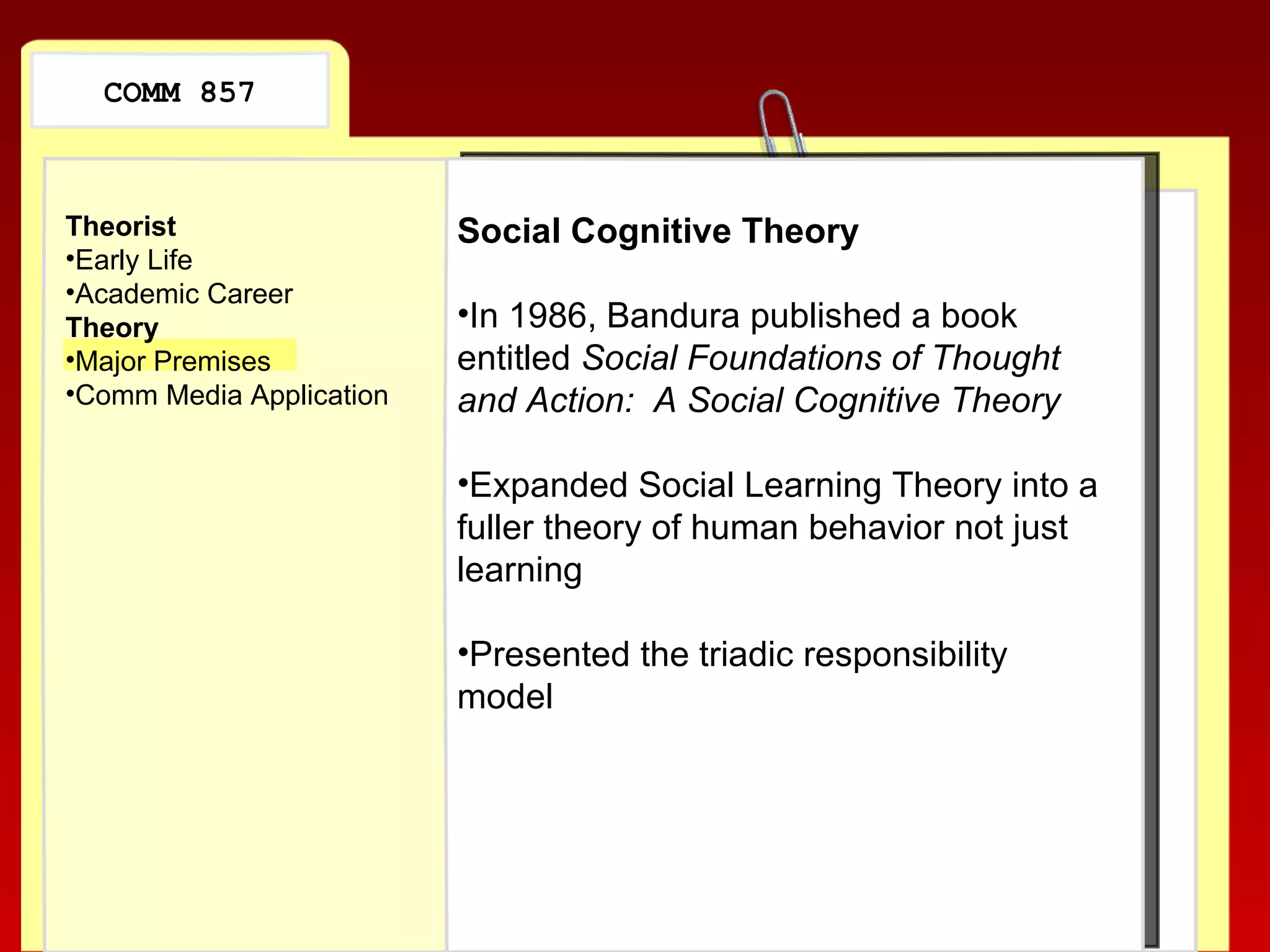
- Core Textbooks: Books such as Social Foundations of Thought and Action: A Social Cognitive Theory (1986) are considered "bibles" in the field. These books are expensive and have high sell-through rates in university bookstores.
- Specialized Monographs: Self-Efficacy: The Exercise of Control (1997) remains a definitive text. As "Self-Efficacy" became a buzzword in corporate training and self-help, the citations and sales of his original research provided a steady stream of passive income.
- Translations and International Rights: His work has been translated into dozens of languages, ensuring that he received royalties from global markets across Europe, Asia, and South America.
While the "royalty check" for an academic author rarely matches that of a Stephen King, a steady flow of five-to-six-figure annual royalties over four decades creates a significant capital base.
Monetary Awards and Professional Recognition
Throughout his life, Bandura was the recipient of numerous prestigious awards that included cash prizes. While these are often donated to research or charity, they reflect the "market value" of his expertise.
| Award Name | Year | Estimated Monetary Value (Approx.) | Significance |
|---|---|---|---|
| Grawemeyer Award | 2008 | $200,000 | Awarded for ideas improving world order. |
| National Medal of Science | 2016 | Prestige / Grant-Linked | The highest honor for a US scientist. |
| APA Lifetime Achievement | 2004 | Variable | Gold Medal Award for Life Work. |
| NAS Award | 1999 | $25,000 | For Scientific Reviewing. |
The Grawemeyer Award is particularly notable as it is one of the few academic awards with a substantial, direct cash prize. While $200,000 may not seem like a fortune to a tech mogul, in the context of an academic estate, it is a significant injection of liquid capital.
The Economic Impact of the "Bobo Doll" Experiments
While Albert Bandura did not "monetize" the Bobo Doll experiments in a commercial sense, the fame generated by this research allowed him to command high fees for speaking engagements and consulting. In the 1980s, 1990s, and 2000s, a keynote address from Bandura at a major international conference could command an honorarium in the range of $10,000 to $30,000 plus expenses.
Given his prolific travel and speaking schedule, these supplementary earnings, when reinvested, contributed heavily to his overall net worth. His theories on Social Learning also made him a valuable consultant for educational media, including organizations like the Children’s Television Workshop (the creators of Sesame Street), though much of this work was done out of professional dedication rather than a desire for profit.
Self-Efficacy and the Corporate Training Market
One of the most overlooked aspects of Bandura's financial context is the industry built around his concept of Self-Efficacy. In the late 20th and early 21st centuries, corporate America became obsessed with "Growth Mindsets" and "Employee Efficacy."
While Bandura himself did not launch a coaching firm, his work provided the scientific scaffolding for a multi-billion dollar coaching and corporate training industry. This indirectly bolstered his net worth by:
- Increasing the demand for his books.
- Raising the value of his consulting time.
- Ensuring his research remained at the forefront of "paid" academic databases, which generate revenue for the authors and their institutions.
Charitable Contributions and the "Net Value" of the Estate
When discussing the net worth of an academic titan like Bandura, it is important to note that a significant portion of his wealth was likely earmarked for philanthropic and educational causes. Leading academics often set up trusts to fund scholarships, research labs, or chairs at their home institutions.
Upon his death in 2021, the distribution of his estate likely prioritized the continuation of social cognitive research. Therefore, his "net worth" should be viewed as a "living fund" that continues to support the Psychology Department at Stanford and various psychological associations.
Frequently Asked Questions
Was Albert Bandura a millionaire?
Yes. Based on his career length, his position at Stanford, his Palo Alto real estate, and his book royalties, Albert Bandura was a multi-millionaire. His wealth was not "extravagant" by billionaire standards, but it was substantial for the academic world.
What was Albert Bandura's highest-earning book?
His most financially successful book was likely Social Foundations of Thought and Action or Self-Efficacy: The Exercise of Control. These books were widely adopted as graduate-level textbooks, which have higher price points and more consistent sales cycles than general interest books.
How does Bandura's net worth compare to other psychologists?
Bandura’s wealth was likely higher than contemporaries like B.F. Skinner or Carl Rogers, largely due to his longevity and his location in the hyper-appreciating real estate market of Silicon Valley. However, modern "psychologist-influencers" or "pop psych" authors like Jordan Peterson or Brené Brown likely have higher liquid net worths due to media deals and massive public speaking platforms.
Did Bandura make money from the "Bobo Doll" videos?
He did not make direct "royalties" from the videos of the experiments in the way a filmmaker would. However, the fame of those experiments made his textbooks essential and his presence at conferences highly valuable, which indirectly led to his financial success.
Where did Albert Bandura's money go after he died?
While private estate details are not public, it is standard for high-profile Stanford professors to leave a portion of their estate to the university, their family, and various psychological research foundations to ensure their work continues to be taught and expanded.
Practical Lessons from Bandura’s Financial Journey
Albert Bandura’s financial life offers a masterclass in the "Slow and Steady" approach to wealth. He did not chase trends; he built a foundation of expertise that became more valuable every year.
Next Actions for Those Inspired by Bandura’s Success:
- Invest in Intellectual Property: If you are an expert in your field, focus on writing the "definitive" guide or textbook. The longevity of royalties from a foundational text far outweighs the quick burst from a trendy publication.
- Value Institutional Stability: Bandura’s 60+ years at Stanford highlight the power of institutional benefits and the long-term growth of retirement portfolios within a stable organization.
- Real Estate Timing: While we cannot all buy Palo Alto real estate in the 1950s, the lesson remains: living near the "hubs of innovation" (like major research universities) often leads to higher-than-average property appreciation.
Albert Bandura’s true net worth was, of course, his contribution to the human understanding of behavior, but the millions he accumulated throughout his life stand as a testament to the fact that profound scientific contribution and financial security can indeed go hand-in-hand.