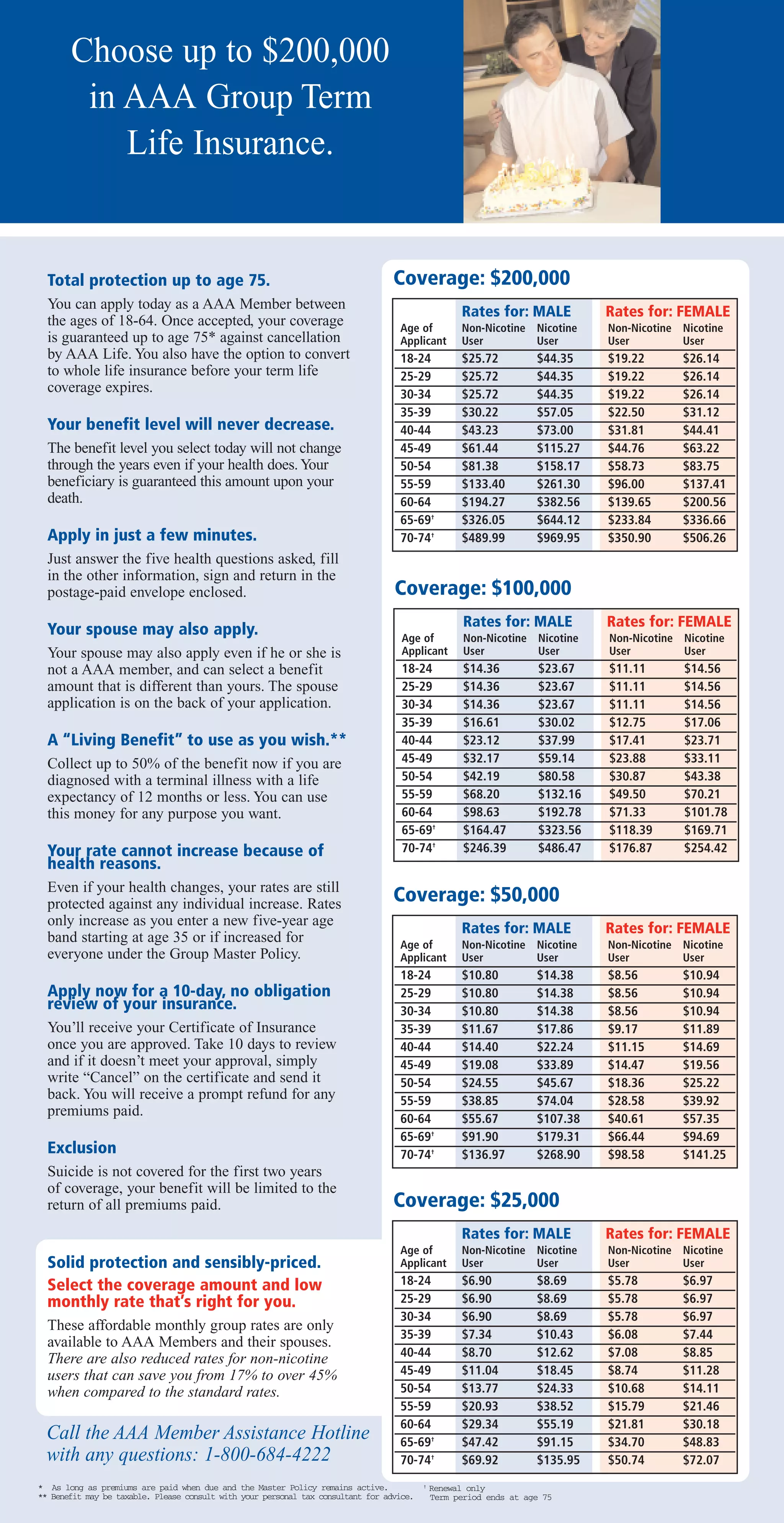
AAA term life insurance costs are primarily determined by your age, health classification, coverage amount, and membership status. As of 2026, a healthy 35-year-old non-smoker can typically secure a 20-year traditional term policy for approximately $20 to $30 per month. AAA members often benefit from exclusive premium discounts and waived administrative fees.
Choosing the right life insurance policy requires a clear understanding of how premiums are calculated and which product tier aligns with your financial goals. While AAA is widely recognized for roadside assistance, the AAA Life Insurance Company operates as a distinct entity offering robust financial products. In 2026, the company continues to focus on two primary term products: Traditional Term and ExpressTerm. This guide clarifies the costs, underwriting requirements, and value propositions of these offerings to help you make an informed decision.
The Structure of AAA Life Insurance in 2026
It is a common misconception that AAA life insurance is a single, monolithic product provided by your local auto club. In reality, AAA Life Insurance Company is a specialized insurer headquartered in Livonia, Michigan. While it leverages the brand trust of the American Automobile Association, its pricing models are independent and regulated by state insurance commissioners.
The cost of your policy is heavily influenced by the specific "club" or region you belong to, as some regional AAA clubs offer enhanced subsidies or bundled discounts for their members. In 2026, the integration between the auto club membership and the insurance arm has become even more streamlined, often allowing members to apply their "AAA Dollars" or reward points directly toward their life insurance premiums.
Traditional Term Life vs. ExpressTerm Costs
The most significant factor in clarifying AAA term life insurance costs is identifying which of the two main term products you are applying for. The pricing structures for these two products serve very different consumer needs.
Traditional Term Life Insurance
Traditional term life insurance is designed for individuals seeking high coverage amounts—often ranging from $100,000 to $5 million or more. Because this product requires a full medical underwriting process, including a paramedical exam (blood draw, blood pressure check, and medical history review), it offers the most competitive rates for healthy individuals.
In 2026, the cost advantage of traditional term life remains significant. By allowing the insurer to assess the exact risk level through medical data, the "Preferred Plus" and "Preferred" health tiers become accessible. For a 40-year-old male in excellent health, a $500,000 policy for a 20-year term might cost significantly less than a smaller "no-exam" policy because the insurer has higher certainty regarding the applicant's longevity.
ExpressTerm Life Insurance
ExpressTerm is a simplified issue product. It is designed for speed and convenience, often providing an automated decision within minutes. In 2026, AAA has refined its algorithmic underwriting, allowing applicants to skip the medical exam entirely for coverage amounts up to $500,000.
However, convenience comes at a price. ExpressTerm premiums are generally higher than traditional term premiums for the same amount of coverage. This is because the insurer assumes a higher level of "aggregate risk" since they do not have the detailed blood work used in traditional underwriting. If you are in peak physical condition, you might be "overpaying" for the convenience of ExpressTerm compared to what you would qualify for under a fully underwritten policy.
Primary Factors Influencing AAA Premiums
To clarify the costs effectively, one must look at the specific variables that the AAA Life Insurance Company uses to set rates in 2026.
Age and Mortality Curves
Life insurance is a game of mathematical probability. In 2026, AAA utilizes updated mortality tables that reflect current life expectancy trends. Premiums increase almost linearly in your 20s and 30s but begin to climb exponentially once you pass age 50. This is why "locking in" a 30-year term at age 30 is significantly more cost-effective than buying a 10-year term at age 50.
Health Classifications
AAA typically uses four to five health tiers:
- Preferred Plus: Excellent health, ideal height/weight ratio, no family history of early cardiovascular disease.
- Preferred: Great health, perhaps minor issues like well-controlled cholesterol.
- Standard Plus: Above-average health but with one or two minor complications.
- Standard: Average health, including those with slightly higher BMI or managed hypertension.
- Substandard (Rated): Individuals with chronic conditions (e.g., Type 2 Diabetes or history of cancer).
The jump from "Preferred Plus" to "Standard" can result in a 50% to 100% increase in the monthly premium.
Nicotine and Tobacco Use
Tobacco use remains the single most impactful lifestyle factor on cost. In 2026, AAA distinguishes between cigarette smokers and occasional cigar or nicotine replacement users (vaping/patches). However, cigarette smokers can still expect to pay 200% to 300% more than non-smokers. If you have quit smoking for at least 12 to 24 months, AAA may allow you to apply for non-smoker rates, which is one of the most effective ways to lower your costs.
2026 Sample Premium Estimates
The following table provides estimated monthly premiums for a $250,000 Traditional Term Life Insurance policy with a 20-year term for non-smokers in the "Preferred" health category.
Note: These are estimates for 2026 and vary by state and individual underwriting.
| Issue Age | Monthly Premium (Male) | Monthly Premium (Female) |
|---|---|---|
| 25 | $14.50 | $12.75 |
| 30 | $16.20 | $14.10 |
| 35 | $19.80 | $17.50 |
| 40 | $28.40 | $23.20 |
| 45 | $42.10 | $34.60 |
| 50 | $64.70 | $51.30 |
| 55 | $98.50 | $74.20 |
As shown, the price difference between a 30-year-old and a 50-year-old is substantial. For males, the premium nearly quadruples over that twenty-year span. This highlights the importance of early enrollment to maximize the value of a term policy.
The Impact of AAA Membership on Pricing
One of the primary reasons consumers look toward AAA for life insurance is the promised member discount. In 2026, AAA continues to offer a 10% premium discount for active members in most states.
Furthermore, AAA often waives the "policy fee" (an annual administrative charge typically ranging from $50 to $100) for members. While a 10% discount might seem modest, over a 30-year term policy, this can result in thousands of dollars in savings. It is important to verify if your specific regional club participates in these discount programs, as the AAA Life Insurance Company works with various regional motor clubs (such as ACG, AAA Northeast, or Auto Club of Southern California) which may have varying benefit structures.
Understanding Policy Riders and Their Costs
The "base" premium of a term life policy can be modified by adding "riders"—optional features that provide extra benefits under specific circumstances. Clarifying these costs is essential, as they are often the source of "price creep" during the application process.
- Waiver of Premium Rider: If you become totally disabled and cannot work, AAA will pay your life insurance premiums for you. This typically adds about 5% to 10% to your monthly cost.
- Child Term Rider: This allows you to add life insurance coverage for all your children under one rider. In 2026, this is often a flat fee (e.g., $5 to $10 per month) regardless of the number of children.
- Accidental Death Benefit Rider: This pays an additional sum if your death is the result of an accident. While it provides "double indemnity," it is often considered less essential than the base coverage and adds a moderate cost based on your occupation's risk level.
- Return of Premium (ROP): Some AAA term products offer a version where you receive all your paid premiums back at the end of the term if you outlive the policy. This rider is expensive, often doubling or tripling the base premium. In 2026, most financial advisors suggest that purchasing a standard term policy and investing the difference is more mathematically sound than an ROP rider.
Conversion Options: A Hidden Value Factor
When evaluating the "cost" of AAA term life insurance, you must consider the value of the Conversion Privilege. Most AAA term policies allow you to convert your term coverage into a permanent (Whole Life or Universal Life) policy without undergoing a new medical exam.
In 2026, this feature is critical. If you develop a health condition during your 20-year term that would make you uninsurable elsewhere, you can convert your AAA policy to a permanent one at the standard rates for your original health class. While the premiums for the permanent policy will be higher than the term premiums, the ability to maintain coverage regardless of new health issues is a massive financial safeguard.
Comparing AAA to Industry Competitors
To truly clarify if AAA's costs are competitive, we must look at how they stack up against industry giants like State Farm, Prudential, or digital-first insurers like Ladder or Haven Life.
AAA is rarely the "absolute cheapest" on the market for non-members. Digital-first insurers often beat AAA on raw price for the healthiest individuals due to lower overhead. However, for the "average" individual—someone who might have a slightly elevated BMI or take a common blood pressure medication—AAA's underwriting is often more "common sense" and forgiving than the ultra-strict digital algorithms.
For existing AAA members, the 10% discount usually brings the price within a few dollars of the market leaders, making the convenience of having all insurance (auto, home, and life) under one ecosystem very attractive.
Common Mistakes That Inflate AAA Insurance Costs
Many applicants inadvertently pay more for their coverage than necessary. To keep your AAA term life insurance costs clarified and minimized, avoid these common pitfalls:
- Over-insuring with ExpressTerm: If you need $500,000 in coverage and you are healthy, don't choose ExpressTerm just to avoid a needle. The 15-minute medical exam for a Traditional Term policy could save you $200 a year for the next 20 years ($4,000 total).
- Ignoring the Annual Payment Option: AAA, like most insurers, charges a "fractional fee" for monthly payments. Paying your premium annually instead of monthly can often save you 5% to 8% off the total annual cost.
- Failing to Update Health Status: If you bought a policy as a smoker and have since quit for over two years, or if you have lost a significant amount of weight and maintained it, you can request a "re-rating." AAA may allow you to undergo a new medical exam to move into a cheaper health bracket.
- Waiting for "The Right Time": Because age is the primary driver of cost, every year you wait to buy life insurance increases your permanent base rate by roughly 5% to 10%.
Frequently Asked Questions
Does AAA term life insurance require a medical exam in 2026?
It depends on the product. The ExpressTerm product typically does not require a medical exam for qualified applicants under age 65 and for coverage amounts up to $500,000. However, the Traditional Term product, which offers higher coverage limits and lower premiums for healthy individuals, generally requires a standard paramedical exam.
How much is the AAA member discount on life insurance?
In most jurisdictions, active AAA members receive a 10% discount on their life insurance premiums. Additionally, members may have certain administrative fees waived. This discount usually remains active as long as you maintain your AAA motor club membership.
Can I cancel my AAA term life insurance at any time?
Yes, you can cancel your term life insurance policy at any time without penalty. Since term life insurance does not build cash value, you will not receive any money back upon cancellation unless you have a specific "Return of Premium" rider. You simply stop paying the premiums, and the coverage ceases at the end of the current paid period.
What happens to my AAA term policy when the term ends?
When the term (e.g., 10, 15, 20, or 30 years) expires, your coverage ends unless the policy includes a renewal or conversion clause. Most AAA policies allow for guaranteed renewal on an annual basis after the term ends, but the premiums will increase significantly each year based on your attained age. Alternatively, you can convert the policy to a permanent life insurance plan before the term expires.
Is AAA life insurance available to non-members?
Yes, non-members can apply for AAA life insurance. However, they will not be eligible for the 10% member discount or other membership-related perks. In many cases, if you are not a AAA member and do not plan to become one, it may be beneficial to compare AAA's rates against other commercial insurers to ensure you are getting the most competitive price.
Does AAA offer a "no-lapse" guarantee?
AAA term policies are guaranteed to remain in force as long as premiums are paid on time. Unlike some Universal Life policies that can "implode" if interest rates shift, a term policy has a fixed premium for the duration of the term, providing a straightforward guarantee of coverage.
Final Recommendation for 2026
To optimize your AAA term life insurance cost, start by determining your actual coverage needs using a DIME (Debt, Income, Mortgage, Education) calculation. If you are a AAA member and require $500,000 or less in coverage with a need for speed, ExpressTerm is a high-value, convenient option. However, if you are in good health and want the lowest possible long-term rate, the Traditional Term policy remains the superior choice, especially when the 10% member discount is applied. Always request a quote for both an annual and monthly payment schedule to see the total cost of the "fractional fees" associated with monthly billing.