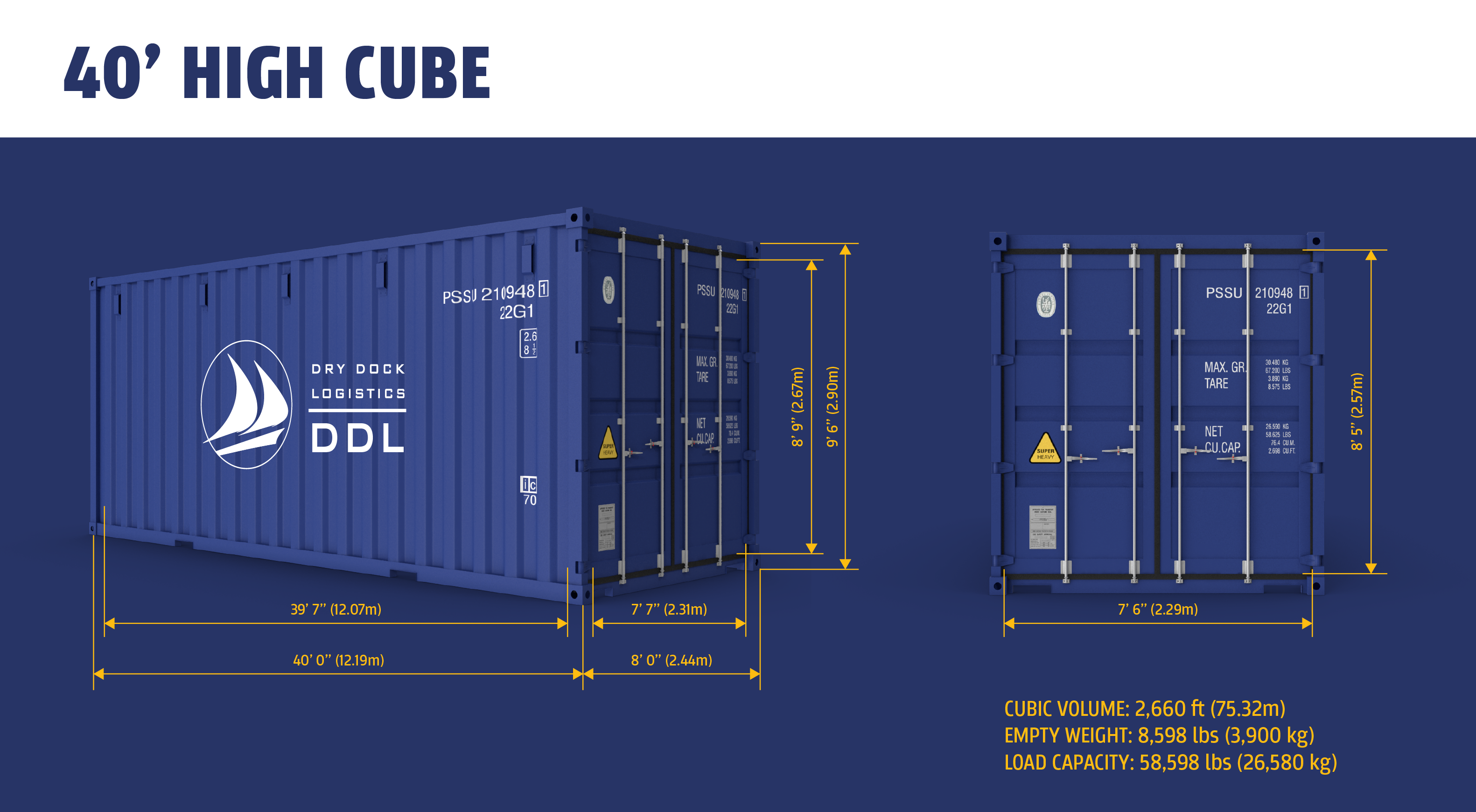
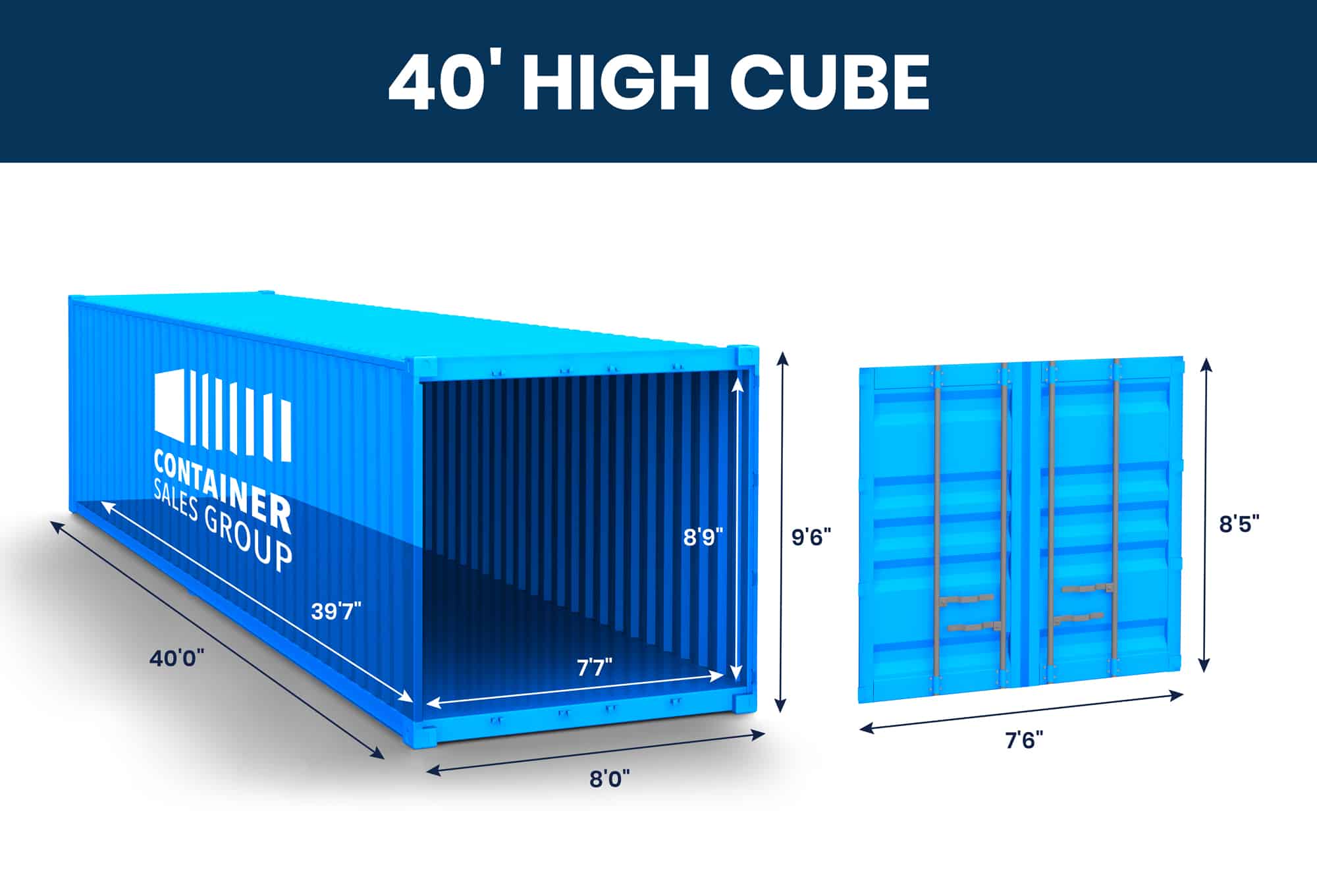
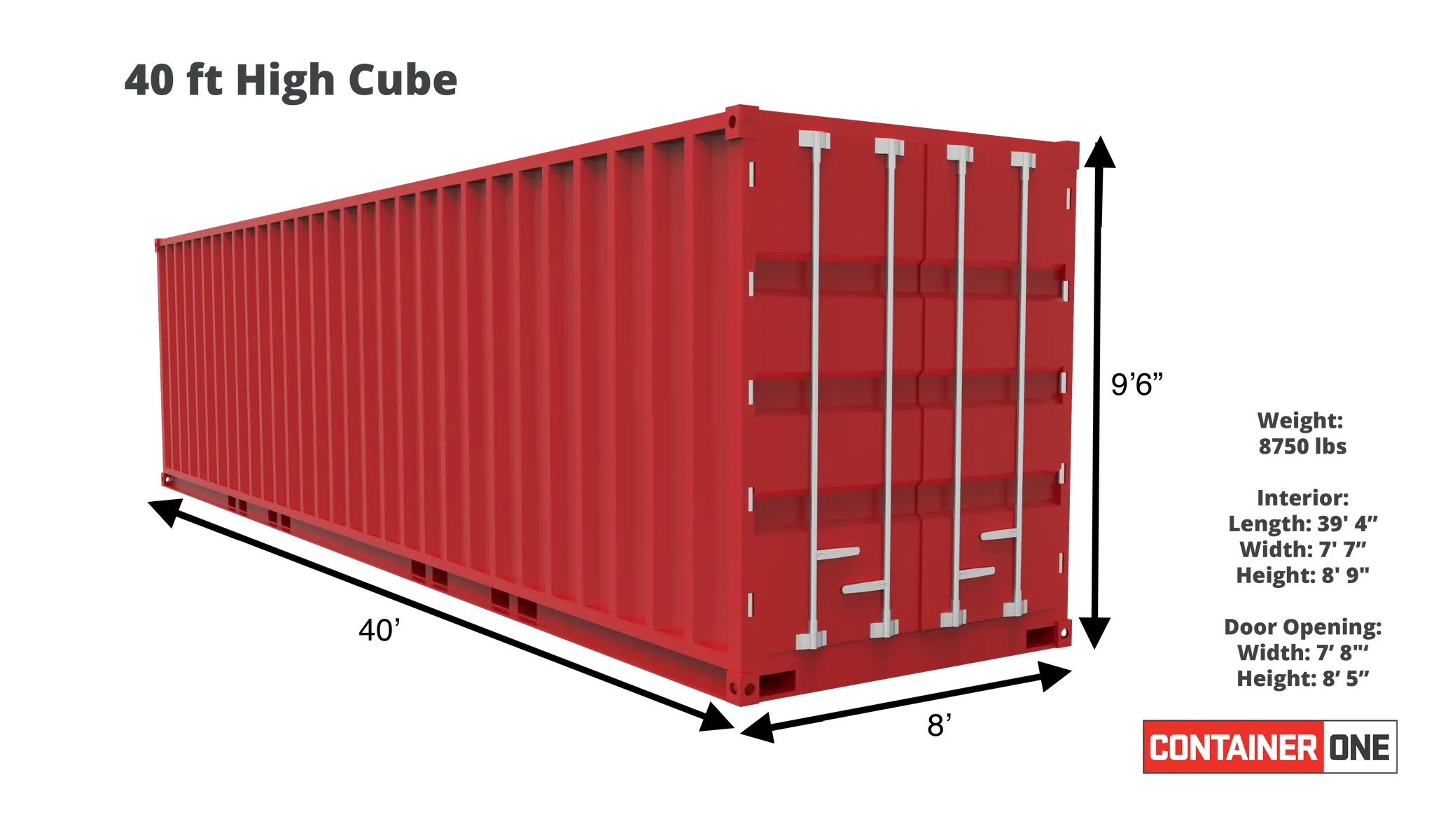
A standard 40-foot high cube (HC) shipping container has exterior dimensions of 40 feet in length, 8 feet in width, and 9 feet 6 inches in height. Internally, it provides approximately 39 feet 5 inches of length, 7 feet 8 inches of width, and 8 feet 10 inches of height, offering a total volume of 2,694–2,700 cubic feet.
The 40-foot high cube container is the backbone of modern international logistics and a preferred choice for modular architectural projects. While it shares the same length and width as a standard 40-foot container, its additional foot of vertical clearance makes it indispensable for transporting light, voluminous cargo or for creating habitable spaces where insulation and ceiling fixtures are required. As of 2026, these units remain the most sought-after specialized container type due to their versatility and favorable volume-to-cost ratio.
The Physical Anatomy of a 40-Foot High Cube Container
To understand the dimensions of a high cube container, one must first look at its physical construction and why these specific measurements were standardized by the International Organization for Standardization (ISO).
Exterior Dimensions: The Standard Footprint
The exterior measurements of a 40ft HC are strictly regulated to ensure they fit within the global infrastructure of cranes, ships, trucks, and railcars.
- Length: 40 feet (12.192 meters)
- Width: 8 feet (2.438 meters)
- Height: 9 feet 6 inches (2.896 meters)
The "High Cube" designation refers specifically to that 9'6" height. For comparison, a "Standard" container is exactly one foot shorter at 8'6". This extra 12 inches may seem minor, but it increases the total internal volume by approximately 10-12%, which is a massive advantage for high-volume, low-weight goods like electronics, clothing, or furniture.
Interior Dimensions: Usable Space
The interior dimensions are slightly smaller than the exterior due to the thickness of the Corten steel corrugated walls and the heavy-duty flooring.
- Internal Length: 39 feet 5 inches (12.032 meters)
- Internal Width: 7 feet 8 inches (2.352 meters)
- Internal Height: 8 feet 10 inches (2.698 meters)
The internal height is the most critical measurement for those using containers for storage or housing. In a standard container, the internal height is only 7'10". When you factor in the installation of flooring and a ceiling in a container home conversion, a standard unit can feel claustrophobic. The high cube’s 8'10" internal clearance allows for a standard 8-foot ceiling even after heavy insulation and HVAC ducting are installed.
Weight Capacity and Structural Ratings
Understanding dimensions is only half the battle; one must also understand what those dimensions can hold in terms of mass. In 2026, the shipping industry continues to adhere to the Maximum Gross Mass (MGM) ratings established for safety.
Tare Weight
The "Tare Weight" is the weight of the container when it is completely empty. For a 40-foot high cube, this typically ranges from 8,500 lbs to 9,000 lbs (3,855 kg to 4,082 kg). High cubes are slightly heavier than standard units because of the additional steel required for the extra foot of height.
Payload Capacity
The payload is the maximum weight of the cargo you can safely load into the container. Most 40ft HC containers are rated for a payload of approximately 58,000 lbs to 60,000 lbs (26,300 kg to 27,200 kg).
Maximum Gross Weight
This is the combined weight of the container and its cargo. Most ISO 40ft units are rated for a maximum gross weight of 67,200 lbs (30,480 kg), though some reinforced units are rated for more. It is important to note that while the container can hold this weight, road weight limits for trucks often restrict the total weight to a lower threshold depending on the jurisdiction and the type of chassis used for transport.
Door Opening Dimensions: The Logistics Bottleneck
One of the most frequent mistakes in logistics planning is measuring the internal space but forgetting the door opening. The door frame is slightly smaller than the internal dimensions of the container because of the heavy steel corner posts and the header beam.
- Door Opening Width: 7 feet 8 inches (2.340 meters)
- Door Opening Height: 8 feet 5 inches (2.585 meters)
If you are loading a single piece of machinery or a pre-fabricated structure that is exactly 8'8" tall, it will fit inside the 40ft HC, but it will not fit through the door. In such cases, an Open Top container or a Flat Rack would be required. The high cube's door height of 8'5" is a significant upgrade over the standard container's 7'5" door, allowing for taller forklifts and larger palletized stacks to enter the unit without stripping the top layer of goods.
Comprehensive 40ft High Cube Specification Table
The following table provides a side-by-side comparison of Imperial and Metric measurements for the 40ft High Cube container, based on 2026 industry standards.
| Specification | Imperial (ft/in/lbs) | Metric (m/kg) |
|---|---|---|
| Exterior Length | 40' 0" | 12.192 m |
| Exterior Width | 8' 0" | 2.438 m |
| Exterior Height | 9' 6" | 2.896 m |
| Interior Length | 39' 5" | 12.032 m |
| Interior Width | 7' 8" | 2.352 m |
| Interior Height | 8' 10" | 2.698 m |
| Door Opening Width | 7' 8" | 2.340 m |
| Door Opening Height | 8' 5" | 2.585 m |
| Internal Volume | 2,694 cu ft | 76.3 m³ |
| Tare Weight | ~8,775 lbs | ~3,980 kg |
| Max Payload | ~58,425 lbs | ~26,500 kg |
| Max Gross Weight | 67,200 lbs | 30,480 kg |
The "Gooseneck Tunnel" Feature
A technical detail often overlooked by non-professionals is the "gooseneck tunnel." Most 40-foot containers (both standard and high cube) feature a recess in the floor at the front end. This tunnel is designed to allow the container to sit lower on a specialized trailer chassis known as a gooseneck chassis.
Because high cube containers are 9'6" tall, they run a higher risk of hitting overpasses or low-hanging power lines when mounted on a standard flatbed trailer. The gooseneck tunnel allows the unit to "straddle" the trailer frame, lowering the overall transport height. This is a critical consideration for 2026 transport permits, as over-height loads can lead to significant fines and logistical delays.
Volume Comparison: How Much Can It Actually Hold?
To visualize the capacity of a 40ft HC container, it is helpful to translate cubic feet into common shipping units:
- Euro Pallets (1.2m x 0.8m): You can typically fit 23 to 25 Euro pallets in a single tier, depending on how they are oriented.
- Standard US Pallets (48" x 40"): A 40ft HC can accommodate approximately 20 to 21 standard pallets in a single tier.
- Household Goods: A 40ft HC is generally large enough to hold the contents of a 3- to 4-bedroom family home, including large appliances, furniture, and boxed personal items.
- CBM (Cubic Meters): While the mathematical volume is 76.3 m³, the "usable" volume for rigid cargo is usually calculated at 68–70 m³ to account for gaps and loading tolerances.
Advantages of High Cube Units for Modifications
In the realm of container architecture—a field that has matured significantly by 2026—the 40ft high cube is the gold standard.
Vertical Space for Utilities
When converting a container into a living or office space, you must install a subfloor (often containing plumbing or radiant heating) and a ceiling (containing lighting and electrical runs). In a standard 8'6" container, these additions can leave the occupant with a ceiling height of less than 7'6", which often violates local building codes for "habitable space." The high cube provides the necessary buffer to maintain a standard 8-foot ceiling.
Improved Airflow
The extra foot of height significantly improves passive ventilation. In storage applications, this extra headspace allows heat to rise further away from the stored goods and provides more "air gap" for moisture to dissipate, reducing the risk of "container rain" (condensation dripping from the ceiling).
Transport and Handling Considerations
Because of their dimensions, 40ft HC containers require specific handling equipment.
- Stacking: High cubes can be stacked on top of each other, and they can also be stacked on top of standard 40ft containers. However, you cannot easily stack a standard 40ft container on top of a high cube if the crane's twist-lock reach is not configured for the height difference, though this is rarely an issue at modern 2026 port terminals.
- Clearance: When planning a delivery, you need a minimum vertical clearance of 14 feet to 15 feet to account for the truck, the trailer, and the container height. If the delivery site has low tree branches or arched gates, a high cube may not be able to reach the destination.
- Tilt-Bed Delivery: If the container is being delivered via a tilt-bed truck (where the trailer tilts and the container slides off the back), the height of the container during the "tip" can reach nearly 20 feet. Site surveys are essential for high cube deliveries.
Frequently Asked Questions
Is a 40ft high cube container wider than a standard 40ft container?
No. All standard ISO shipping containers, whether 20-foot, 40-foot, or high cube, share the same exterior width of 8 feet. This uniformity ensures they can all be locked together on ships and trucks using standardized twist-lock mechanisms.
Can I transport a 40ft high cube on a standard flatbed trailer?
While it is physically possible, it is often legally problematic. A 9'6" high cube sitting on a standard 4-foot high flatbed results in a total height of 13'6". In many regions, the legal height limit is 13'6", leaving zero margin for error. Using a "drop-deck" or "low-boy" chassis is the standard and safer practice for high cube transport.
How can I identify a high cube container from a distance?
High cube containers are required by ISO standards to have black and yellow striped tape (resembling a hazard pattern) on the corner posts at the top of the unit. Additionally, the "High Cube" designation is usually printed clearly on the door next to the weight specifications.
Are 40ft high cube containers more expensive than standard 40s?
Generally, yes. In the 2026 market, a high cube container typically carries a price premium of 10% to 15% over a standard 40ft unit in similar condition. This price reflects both the higher material cost (more steel) and the higher demand in the secondary market for storage and housing.
What is the life expectancy of a 40ft HC container?
When used for international shipping, they typically have a service life of 12 to 15 years. However, once retired from sea service and used for storage or as a building structure, a 40ft HC made of Corten steel can last 25 to 50 years or more, provided it is properly painted and kept off direct contact with damp soil.
Final Recommendation
If you are planning to ship dense, heavy materials like stone or metal ingots, the 40-foot high cube is likely unnecessary; a standard 40ft or even a 20ft container would suffice. However, if your goal is to maximize storage volume, ship light but bulky retail goods, or convert the unit into a habitable structure, the 40-foot high cube is the superior choice. Its dimensions offer the best balance of structural integrity and usable volume available in the global shipping market today. Always verify your local delivery route for height clearances before finalizing a purchase or lease.