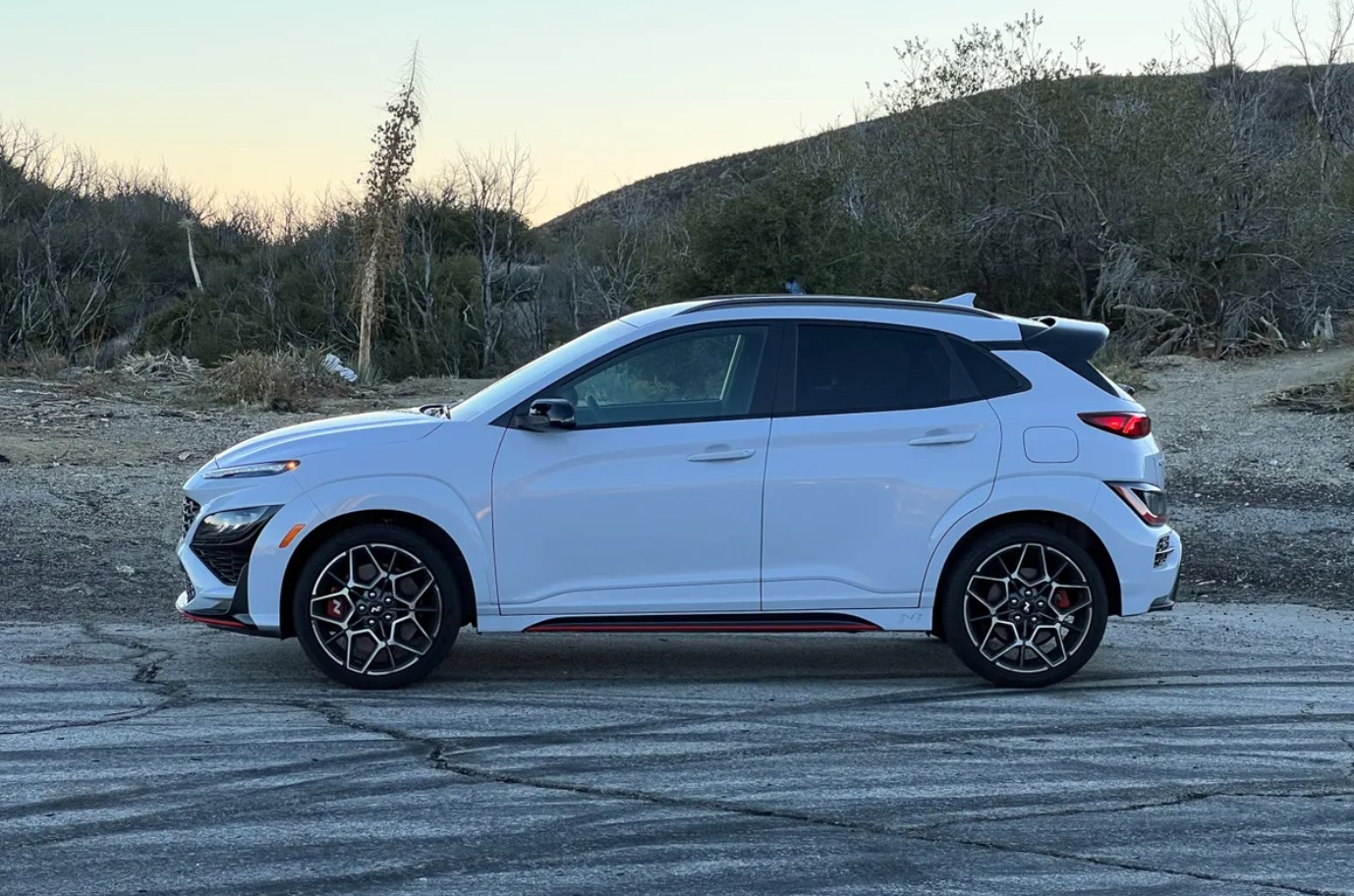
The 2023 Hyundai Kona N delivers a 0-60 mph time of 4.8 to 5.2 seconds when utilizing its N Grin Shift (NGS) and Launch Control systems. While Hyundai officially estimates a 5.5-second sprint, real-world testing consistently reveals faster results, solidifying its position as one of the quickest front-wheel-drive performance crossovers ever produced.
The 2023 Kona N represents the pinnacle of Hyundai’s internal combustion N-division efforts for its first-generation subcompact crossover. Now that we are in 2026, the 2023 model has transitioned from a showroom floor firebrand to a highly sought-after performance vehicle on the secondary market. To understand what the 0-60 mph numbers truly reveal, one must look beyond the stopwatch and into the engineering choices that allowed a front-wheel-drive (FWD) SUV to compete with established all-wheel-drive (AWD) rivals.
The Heart of the Performance: The 2.0L Turbocharged Engine
At the center of the 2023 Kona N’s performance is its 2.0-liter turbocharged GDI four-cylinder engine. This powerplant is characterized by its "flat power" tuning, a strategy designed to provide consistent torque across a wider RPM range. The engine produces 276 horsepower and 289 lb-ft of torque in its standard state. However, the numbers reveal a temporary peak of 286 horsepower when the N Grin Shift (NGS) button is engaged.
The "flat power" approach is crucial for the 0-60 mph sprint because it prevents the power drop-off often felt in smaller turbocharged engines as they approach the redline. By maintaining peak torque from approximately 2,100 to 4,700 RPM, the Kona N ensures that every gear change lands the engine back into the meat of its power band. In 2026, this engine remains respected for its durability and tuning potential, though stock figures are what established its legendary status among "hot" crossovers.
Deciphering the 0-60 mph Variance
The discrepancy between Hyundai’s official 5.5-second 0-60 mph claim and the 4.8-second times recorded by independent journalists is a result of several factors: environmental conditions, tire temperature, and the use of the N-specific electronic aids.
The Role of N Grin Shift (NGS)
Engaging the NGS button on the steering wheel provides an additional 10 horsepower for 20 seconds. More importantly, it alters the transmission’s shifting logic to the most aggressive setting possible. In a 0-60 mph test, this allows the turbocharger to maximize boost pressure instantly. The numbers reveal that without NGS, the Kona N typically settles into the 5.2 to 5.4-second range, showcasing how much the electronic "overboost" contributes to the vehicle’s peak performance.
Launch Control and Traction Management
For a front-wheel-drive vehicle, the first 60 feet of a sprint are the most challenging. The 2023 Kona N utilizes a sophisticated Launch Control system that allows the driver to set the launch RPM between 2,000 and 3,500. Finding the "sweet spot" is essential; too many revs result in excessive wheel spin and "wheel hop," while too few cause the engine to bog down.
The numbers reveal that the Kona N’s Electronic Limited Slip Differential (e-LSD), which Hyundai calls the "N Corner Carving Differential," is the unsung hero of the 0-60 run. It manages torque distribution between the front wheels to minimize slip, ensuring that power is converted into forward motion rather than tire smoke.
Transmission Dynamics: The 8-Speed N-DCT
The 2023 Kona N was equipped exclusively with an 8-speed "Wet" Dual-Clutch Transmission (N-DCT). Unlike "dry" DCTs used in more economy-focused vehicles, the wet DCT uses oil to improve cooling and lubrication, allowing it to handle the high-torque demands of aggressive launches.
The transmission includes three specific performance functions that impact acceleration numbers:
- N Power Shift (NPS): Engages when the accelerator is pushed past 90%, mitigating any reduction in torque during upshifts. This keeps the momentum moving forward without the momentary "dip" found in traditional automatics.
- N Track Sense Shift (NTS): While more relevant for circuit driving, it ensures the car is always in the optimal gear for immediate acceleration.
- Manual Mode Paddle Shifters: Though the N-DCT is excellent in automatic mode, many drivers find that shifting manually just before the redline can shave a fraction of a second off the 0-60 time by avoiding the electronic limiter.
2023 Kona N Technical Specifications and Performance Data
The following table summarizes the technical data that defines the Kona N’s performance profile as verified through factory specifications and independent testing.
| Specification | Detail |
|---|---|
| Engine Type | 2.0L Turbocharged Inline-4 |
| Horsepower | 276 hp (286 hp with NGS) |
| Torque | 289 lb-ft |
| Transmission | 8-Speed Wet Dual-Clutch (DCT) |
| Drivetrain | Front-Wheel Drive (FWD) |
| 0-60 mph (Official) | 5.5 Seconds |
| 0-60 mph (Tested) | 4.8 - 5.1 Seconds |
| Quarter Mile | 13.4 Seconds @ 105 mph |
| Top Speed | 149 mph |
| Curb Weight | 3,340 lbs |
| Braking (60-0 mph) | 106 feet |
Aerodynamics and Weight: The Physics of the Sprint
Performance numbers are not just a product of the engine; they are heavily influenced by the vehicle’s physical footprint. The 2023 Kona N features a distinct aerodynamic package, including a double-wing roof spoiler and a front lip spoiler. These elements are designed to increase downforce, which, while more critical at high speeds, helps stabilize the car during the high-speed portion of a 0-60 mph run.
At a curb weight of approximately 3,340 pounds, the Kona N is relatively light for a modern performance crossover. Its power-to-weight ratio allows it to overcome the inherent traction disadvantages of a FWD setup once it clears the initial launch phase. From 30 mph to 60 mph, the Kona N is exceptionally rapid, often pulling harder than AWD competitors that carry the extra weight of a rear differential and driveshafts.
Comparative Performance: How the Numbers Stack Up
To understand what the Kona N’s numbers reveal, we must compare it to its peers from the same era. In 2023, its primary competitors included the Volkswagen Golf GTI, the Volkswagen Golf R, and its stablemate, the Hyundai Elantra N.
- vs. Volkswagen Golf GTI: The GTI traditionally recorded 0-60 mph times in the 5.4 to 5.8-second range. The Kona N consistently outperformed the GTI in raw acceleration, thanks to its higher torque output and more aggressive DCT tuning.
- vs. Volkswagen Golf R: The Golf R, with its AWD system, could hit 0-60 mph in under 4 seconds. The Kona N’s numbers reveal its limitation as an FWD vehicle in this specific comparison; however, the Kona N was significantly more affordable, offering roughly 80% of the performance for a lower price point.
- vs. Hyundai Elantra N: The Elantra N shared the same powertrain but sat lower to the ground and had a slightly different weight distribution. The Elantra N was often a tenth of a second faster to 60 mph due to its superior aerodynamics and lower center of gravity, but the Kona N offered the utility of a hatchback/SUV body style.
The Practical Side of Performance: Tires and Surface
What the numbers often fail to reveal is the sensitivity of the 2023 Kona N to its environment. The vehicle came factory-equipped with Pirelli P Zero summer tires specifically tuned for the "N" brand (marked with an "HN" on the sidewall).
On a cold morning or a damp road, a FWD vehicle with nearly 300 lb-ft of torque will struggle. In such conditions, the 0-60 mph time can easily balloon to over 6 seconds as the traction control system fights to keep the wheels from spinning. Conversely, on a prepped drag strip or warm asphalt, the Pirelli tires provide the grip necessary to achieve those sub-5-second runs. Owners in 2026 often find that switching to high-performance all-season tires for daily driving slightly degrades these peak numbers but provides more consistent "real-world" acceleration across different seasons.
Longevity and Maintenance of Performance
By 2026, the 2023 Kona N has entered the "used" market, and the performance numbers reveal the importance of maintenance. To maintain sub-5-second 0-60 capabilities, specific components require attention:
- Turbocharger Health: Regular oil changes with high-quality synthetic oil are vital to prevent boost leaks or bearing wear.
- DCT Fluid: While Hyundai often labeled the DCT fluid as "lifetime" for normal driving, performance enthusiasts know that frequent use of Launch Control necessitates more regular fluid intervals to maintain the crispness of the shifts.
- Bushing Integrity: The front suspension takes a beating during hard launches. Worn bushings can lead to increased wheel hop, which ruins 0-60 mph attempts.
Troubleshooting Common Performance Issues
If a 2023 Kona N is not hitting its expected performance targets, the numbers usually reveal one of three common culprits:
- Heat Soak: After several consecutive 0-60 mph runs, the intercooler may struggle to shed heat. Hotter intake air is less dense, leading the ECU to pull timing and reduce boost, which increases acceleration times.
- Fuel Quality: The Kona N is designed to run on premium unleaded fuel. Using lower octane fuel causes the knock sensors to trigger a more conservative engine map, noticeably dulling the 0-60 mph sprint.
- Tire Wear: Given the FWD layout and the aggressive e-LSD, the front tires on a Kona N wear significantly faster than the rears. Reduced tread depth leads to less "bite" during a launch.
FAQs About 2023 Kona N Performance
Is the 2023 Kona N faster than the Elantra N?
Generally, no. While they share the same engine and transmission, the Elantra N is slightly more aerodynamic and has a lower center of gravity. In most tests, the Elantra N is about 0.1 to 0.2 seconds faster to 60 mph than the Kona N. However, the Kona N's higher seating position and shorter wheelbase offer a different driving sensation that many prefer.
Can you get a manual transmission in the 2023 Kona N?
No. Unlike the Veloster N or Elantra N, the Kona N was only produced with the 8-speed N-DCT. This was a strategic choice by Hyundai, as the DCT allowed for the quickest possible acceleration and better suited the "performance SUV" persona of the vehicle.
What is the 1/4 mile time for the 2023 Kona N?
The 2023 Kona N typically completes the quarter-mile in approximately 13.4 seconds at a trap speed of 105 mph. These numbers reveal that once the car is moving, its power-to-weight ratio allows it to keep pace with many more expensive sports cars.
Does the 2023 Kona N have All-Wheel Drive?
No, the Kona N is strictly Front-Wheel Drive. While many crossovers in its class offer AWD, Hyundai opted for FWD to keep the weight down and maintain the "playful" handling characteristics the N division is known for. The electronic Limited Slip Differential (e-LSD) is used to mitigate the traction issues inherent in a high-power FWD setup.
How many times can you use N Grin Shift (NGS)?
In the 2023 model, NGS can be used for 20 seconds at a time. After use, there is a mandatory cool-down period of 40 seconds before it can be engaged again. This is to protect the turbocharger and transmission from excessive heat and stress.
Final Recommendation for Enthusiasts
The numbers for the 2023 Kona N reveal a vehicle that punches well above its weight class. If you are looking for a performance vehicle in 2026 that balances sub-5-second 0-60 mph capability with the utility of a crossover, the 2023 Kona N remains a premier choice. To maximize this performance, ensure the vehicle is equipped with high-quality summer tires and that the NGS system is used strategically. While FWD presents a learning curve for the perfect launch, the rewards are a visceral, engaging driving experience that few modern SUVs can replicate.