Navigating tax reporting requirements for independent workers involves understanding the 1099 subcontractor form framework, determining whether you are classified as an independent contractor or employee, tracking business income accurately, and correctly filing the appropriate information returns with the Internal Revenue Service.
For businesses and independent workers alike, the tax landscape can often feel like a moving target. Among the most critical yet frequently misunderstood documents in this landscape is the 1099 form series. When companies hire independent professionals—often referred to as 1099 subcontractors, freelancers, or independent contractors—they enter a different administrative territory than they do with traditional W-2 employees. There are no payroll tax withholdings, no unemployment insurance contributions, and no company-provided benefits. Instead, the administrative and financial burden shifts to the individual worker, while the hiring business assumes specific reporting responsibilities.
Understanding these requirements is essential for avoiding costly penalties, interest charges, and compliance audits by tax authorities. Whether you are a business owner trying to figure out when to issue information returns or an independent contractor trying to reconcile your gross receipts at year-end, mastering the nuances of the 1099 subcontractor form process is a non-negotiable aspect of modern commerce.
Understanding Worker Classification: W-2 vs. 1099 Subcontractor
Before diving into the mechanics of reporting forms, it is necessary to establish the boundary between a traditional employee and a 1099 subcontractor. Worker classification is not a matter of choice or mutual agreement; it is determined by the legal reality of the working relationship. Misclassifying workers—whether intentionally or accidentally—carries severe financial and legal repercussions.
The Internal Revenue Service (IRS) examines three primary categories of behavior and control to determine worker classification:
- Behavioral Control: Does the company control or have the right to control what the worker does and how the worker does the job? If a company provides comprehensive training, dictates specific hours, requires detailed step-by-step procedures, or mandates where the work must be performed, the worker leans toward employee status. Conversely, a 1099 subcontractor typically decides how the work gets completed, uses their own methods, and often chooses their own schedule.
- Financial Control: Are the business aspects of the worker’s job controlled by the payer? Significant factors include whether the worker has unreimbursed business expenses, invests in their own tools and equipment, makes their services available to the general market, and has the opportunity for profit or loss. Independent contractors operate as distinct business entities that bear financial risk.
- Type of Relationship: Are there written contracts or employee-type benefits? The expectation of permanence, the provision of employee-like benefits (such as pension plans, insurance, or paid vacation), and whether the work performed is a key aspect of the core business all point toward an employer-employee relationship.
When a hiring entity correctly identifies a worker as an independent contractor, the relationship shifts from a payroll framework to a business-to-business transaction. This transition is what necessitates the use of information returns rather than standard wage statements.
The Foundation: Form W-9 and Collecting Taxpayer Data
The compliance lifecycle for a 1099 subcontractor does not begin at tax time in January; it begins before the worker performs a single hour of service. The cornerstone of this upfront compliance is IRS Form W-9 (Request for Taxpayer Identification Number and Certification).
Before issuing any payments to a new subcontractor, a business should require the worker to complete and sign a Form W-9. This document serves multiple critical functions:
- Verifies Identity: It collects the legal name of the individual or business entity.
- Confirms Tax Classification: It indicates whether the entity is a sole proprietorship, single-member LLC, partnership, C corporation, S corporation, or another tax structure.
- Obtains the Taxpayer Identification Number (TIN): For individuals and sole proprietors, this is typically a Social Security Number (SSN). For registered businesses, it is an Employer Identification Number (EIN).
- Certifies Backup Withholding Exemption: The signer certifies under penalties of perjury that they are not subject to backup withholding.
Failing to collect a Form W-9 can leave a business vulnerable to IRS penalties if the information reported on subsequent 1099 forms proves incorrect or untraceable. Furthermore, if a subcontractor refuses to provide a W-9 or provides an obviously invalid TIN, the hiring business may be legally mandated to implement backup withholding, withholding a flat percentage (currently 24%) of all future payments and remitting it directly to the IRS.
The Evolution of 1099 Forms: NEC vs. MISC
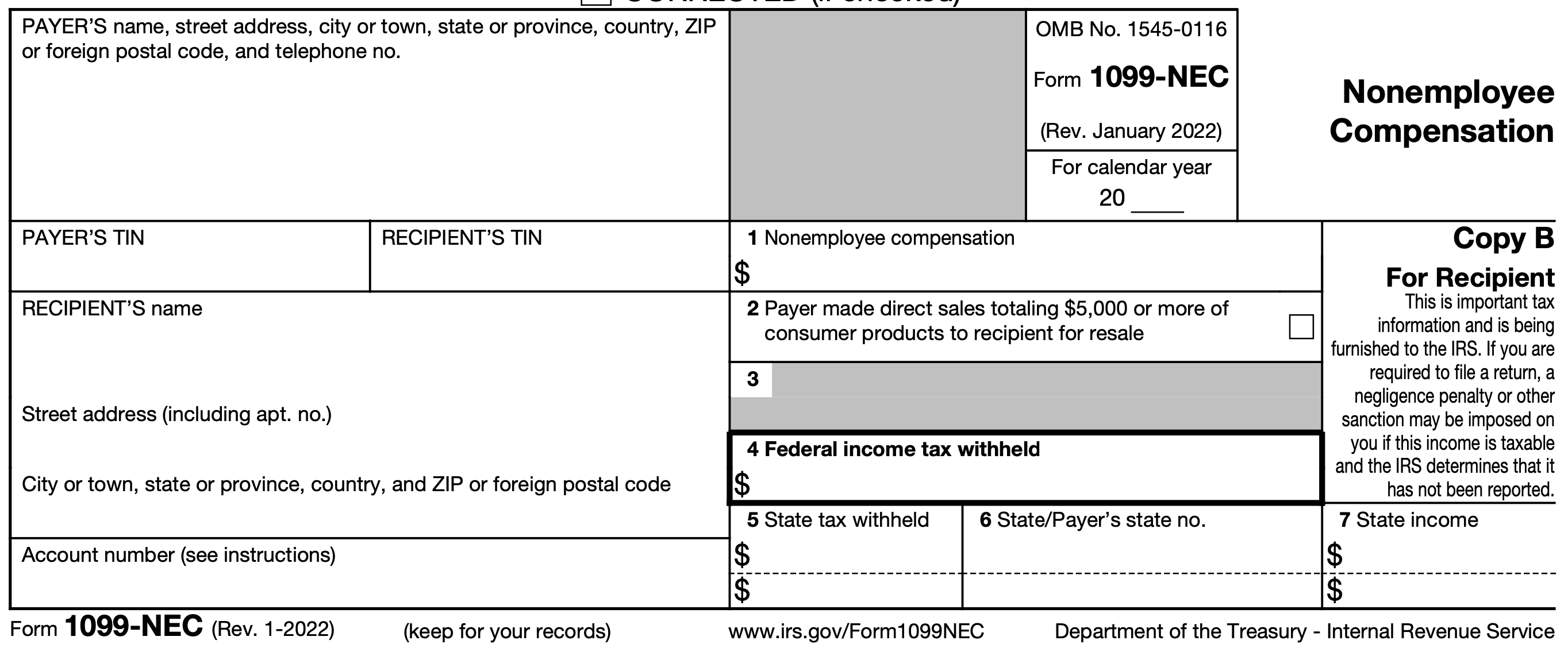
For many years, payers used Form 1099-MISC (Miscellaneous Information) to report payments made to independent contractors. However, regulatory changes altered this workflow. To streamline processing and reduce fraud, the IRS reintroduced Form 1099-NEC (Nonemployee Compensation) as the dedicated vehicle for reporting payments to independent workers.
Understanding which form to use, when to use it, and what monetary thresholds trigger filing obligations is essential for accurate compliance.
Form 1099-NEC: Nonemployee Compensation
Form 1099-NEC is used exclusively to report payments made to non-employees. If you paid an independent contractor, freelancer, or subcontractor for services rendered in the course of your trade or business during the tax year, this is the form you will likely need to file.
Key criteria for filing Form 1099-NEC include:
- The Threshold: You must file a 1099-NEC if you paid the independent contractor $600 or more in total during the calendar year.
- The Payer: The payment must be made in the course of a trade or business. Personal payments (such as hiring a landscaper for your personal residence) do not trigger 1099 reporting requirements.
- The Payee: Payments made to individuals, sole proprietors, partnerships, and LLCs treated as disregarded entities generally require a 1099-NEC. Payments to corporations (both C and S corps) are generally exempt, with specific exceptions such as payments for legal services.
Form 1099-MISC: Other Financial Transactions
While nonemployee compensation moved to the 1099-NEC, Form 1099-MISC remains active for reporting other types of business payments. These include:
- Rents (office space, equipment, land).
- Prizes and awards.
- Other income payments.
- Medical and healthcare payments.
- Gross proceeds paid to an attorney (independent of legal services fees, which are reported on 1099-NEC).
The threshold for Form 1099-MISC is also generally $600, though certain categories, such as royalties, have a $10 threshold.
| Form Name | Primary Use Case | Minimum Payment Threshold | Typical Payee Entity Types |
|---|---|---|---|
| Form 1099-NEC | Nonemployee compensation for services | $600 | Sole proprietors, individuals, partnerships, LLCs |
| Form 1099-MISC | Rents, prizes, medical payments, miscellaneous income | $600 (varies by category) | Individuals, partnerships, corporations (depending on context) |
| Form W-9 | Pre-filing collection of TIN and certification | N/A (Requested before payment) | All independent contractors and subcontractors |
| Form 1096 | Annual summary and transmittal of paper 1099s | N/A | Businesses filing paper returns |
Critical Deadlines and Electronic Filing Mandates
Timing is everything in tax reporting. Missing deadlines or failing to adhere to formatting and filing mandates can result in escalating financial penalties from the IRS.
Filing Deadlines
Historically, information returns had staggered due dates, but current tax regulations enforce strict timelines for Form 1099-NEC:
- To the IRS and to the Contractor: Both copies must typically be furnished to the recipient and filed with the IRS by January 31 following the close of the calendar year. This early deadline gives independent contractors the financial documentation they need to prepare their own tax returns in a timely manner.
- Form 1099-MISC: Deadlines for MISC forms vary slightly; sending them to recipients is typically due by January 31, while paper filing with the IRS is due by February 28, and electronic filing is due by March 31.
Electronic Filing Thresholds
For years, businesses could file dozens of information returns on paper. However, regulatory updates have dramatically lowered the threshold for mandatory electronic filing. Under current IRS guidelines, if you file a total of 10 or more information returns (combining all types of 1099s, W-2s, and other returns), you must file electronically.
Failing to file electronically when required can lead to severe per-form penalties. Businesses utilize the IRS's IRIS (Information Returns Intake System) platform or authorized third-party tax software to submit electronic returns securely.
Special Situations and Common Reporting Exceptions
Navigating 1099 subcontractor compliance often involves edge cases where standard rules do not neatly apply. Understanding these nuances prevents both under-reporting and unnecessary filing.
The Corporate Exemption Rule
As noted, payments made to corporations (C corps and S corps) generally do not require a Form 1099-NEC. However, a major exception exists for legal services. Even if an attorney or law firm operates as a professional corporation (PC) or LLC taxed as a corporation, you must report payments of $600 or more for legal services on Form 1099-NEC.
Credit Card and Third-Party Network Payments
If you pay a subcontractor via a third-party payment network (such as PayPal, Stripe, or Venmo) or via commercial credit card, do not include these payments on your Form 1099-NEC.
Under Internal Revenue Code Section 6050W, payment settlement entities (PSEs) are responsible for issuing Form 1099-K to the worker if payment thresholds are met. Reporting these same payments on a 1099-NEC creates a duplicate reporting scenario, which can trigger automated IRS mismatch notices for the contractor. You are only responsible for issuing a 1099-NEC for payments made directly via cash, check, direct bank transfer (ACH), or non-card electronic transfers.
International Subcontractors
If you hire a non-U.S. resident subcontractor who performs all of their work outside the United States, U.S. tax reporting rules generally do not apply. To protect your business in the event of an audit, you should collect Form W-8BEN (for individuals) or Form W-8BEN-E (for entities) instead of a Form W-9. This documentation certifies the worker's foreign status and exempts the payment from U.S. information reporting.
Best Practices for Businesses: Building an Audit-Proof Workflow
To minimize administrative chaos at year-end, organizations should implement a standardized subcontractor onboarding and tracking workflow:
- Onboard Before Payment: Implement a strict policy that no purchase order is issued, and no invoice is paid, until a valid, signed Form W-9 is on file in your accounting or human resources system.
- Audit Entity Types Regularly: Review W-9 forms to catch corporations versus sole proprietors. Do not assume that an LLC is a corporation; many LLCs are single-member entities that must receive a 1099-NEC.
- Track Payments Continuously: Use accounting software configured to track vendor payments against the $600 threshold automatically throughout the year, rather than scrambling to pull raw expense reports in January.
- Reconcile Early: Perform a mid-year check of your contractor payments around June or July to verify that W-9 data matches your payment ledger, resolving discrepancies long before tax season arrives.
Perspectives for Independent Workers: Receiving and Managing 1099s
For the independent worker, navigating the 1099 ecosystem requires a proactive approach to income verification and tax planning.
- Tracking Income Independent of Forms: Do not wait until you receive 1099 forms in the mail to calculate your annual gross receipts. Payers sometimes make mistakes, miss thresholds, or fail to issue forms altogether. You are legally required to report all self-employment income on your Schedule C (Form 1040), regardless of whether you received a 1099 form.
- Managing Estimated Taxes: Because no federal or state income taxes, Social Security, or Medicare are withheld from 1099 payments, independent workers must calculate and pay quarterly estimated taxes (using IRS Form 1040-ES) to avoid underpayment penalties.
- Deducting Business Expenses: Operating as a 1099 subcontractor means you can deduct ordinary and necessary business expenses—such as home office use, software subscriptions, professional development, equipment, and travel—directly against your self-employment income, lowering your overall tax liability.
Frequently Asked Questions
What happens if I file a 1099 subcontractor form late or miss the deadline?
The IRS assesses tiered penalties for late filing based on how late the return is submitted. Penalties increase the longer the delay persists, and intentional disregard of filing requirements carries substantially higher fines. Filing electronically through approved portals before the January 31 deadline is the best way to ensure compliance and avoid these penalties.
Do I need to issue a 1099 to an LLC?
It depends on how the LLC is classified for tax purposes. If the LLC is a single-member LLC treated as a disregarded entity (or a multi-member LLC treated as a partnership), you generally must issue a 1099-NEC if payments meet or exceed $600. If the LLC has elected to be taxed as a C corporation or an S corporation, you are generally exempt from issuing a 1099 (except for legal services). Always verify the tax classification section on the contractor's Form W-9.
Are payments made through Venmo or PayPal reported on a 1099-NEC?
No. Payments made through third-party settlement organizations, credit cards, or debit cards are excluded from Form 1099-NEC reporting. These transactions are tracked and reported by the payment platform via Form 1099-K if they exceed statutory thresholds. Reporting these payments yourself on a 1099-NEC can result in double-reporting discrepancies for the worker.
What should I do if a subcontractor refuses to provide a W-9?
If a subcontractor refuses or fails to provide a valid Taxpayer Identification Number via Form W-9, the hiring business is legally required to implement backup withholding. This means you must withhold 24% of all subsequent gross payments made to that contractor and remit those funds directly to the IRS using Form 945.
Can I file paper 1099 forms with the IRS?
While paper filing is technically permitted for businesses filing fewer than 10 total information returns across all categories, electronic filing is strongly encouraged and becomes mandatory once the 10-return threshold is met. Electronic filing offers faster processing, immediate confirmation of receipt, and a lower margin for clerical error compared to manual paper submissions.
Conclusion
Navigating the 1099 subcontractor form framework requires diligence, organization, and a clear understanding of federal tax guidelines. By establishing rigorous upfront onboarding procedures via Form W-9, accurately distinguishing between 1099-NEC and 1099-MISC reporting triggers, and adhering strictly to electronic filing mandates and January deadlines, businesses can maintain full compliance. At the same time, independent workers who maintain meticulous financial records and understand their tax obligations can navigate self-employment with confidence. As tax regulations continue to evolve, staying informed remains the single most effective strategy for mitigating risk and ensuring financial accuracy.
Disclaimer: Tax laws and reporting thresholds are subject to legislative change and can vary based on state-specific jurisdictions. Businesses and independent workers should consult with a qualified certified public accountant (CPA) or tax professional to address specific compliance scenarios.