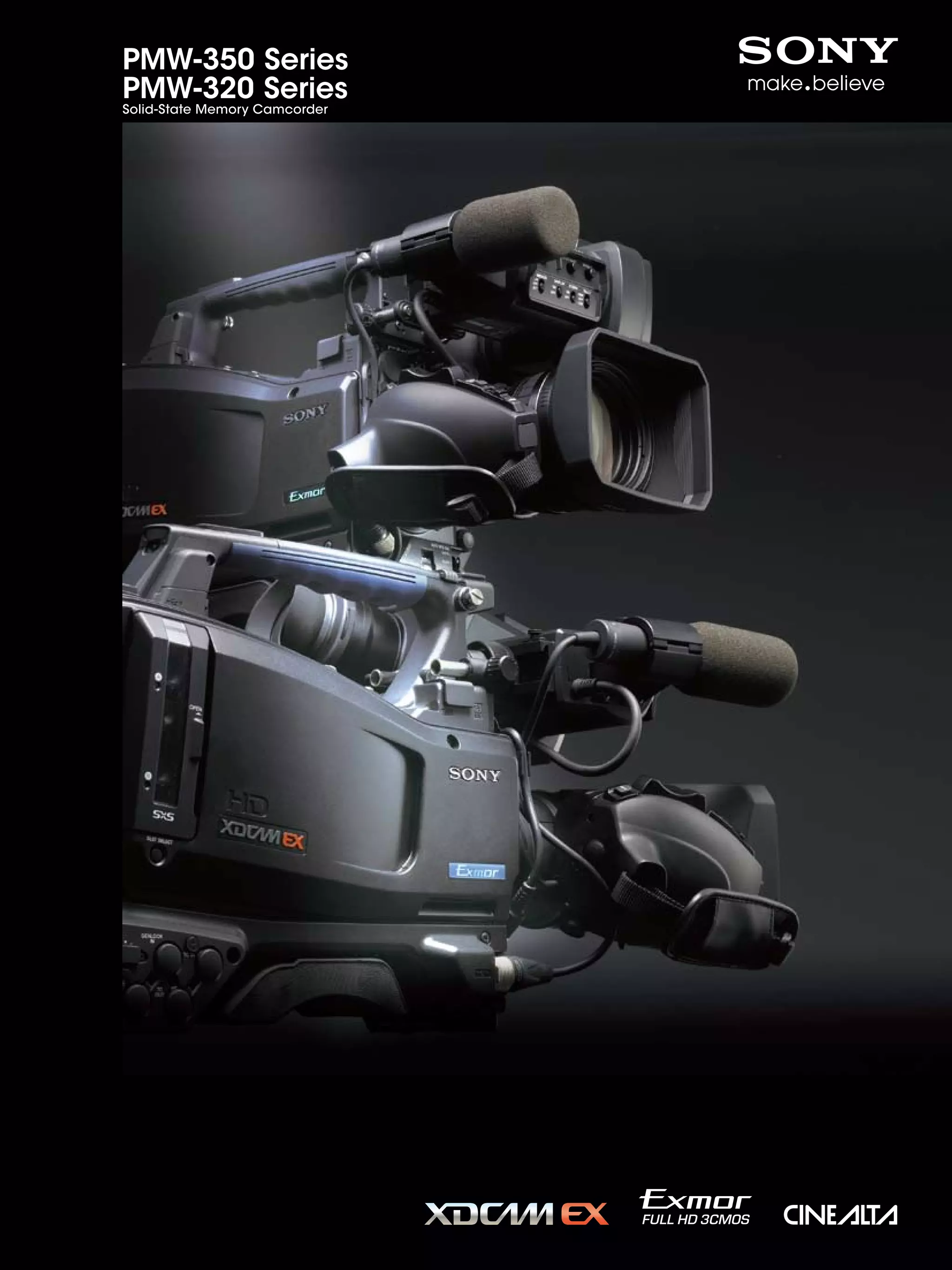
The Sony PMW-300K1 XDCAM camcorder remains a significant milestone in the evolution of professional video production, bridging the gap between handheld ergonomics and full-shoulder broadcast capabilities. Even in 2026, it serves as a reliable high-definition solution for live streaming, corporate videography, and educational environments that prioritize robust physical controls and proven 1/2-inch sensor performance over 4K resolution.
The Evolution of a Legend: From EX3 to PMW-300
To understand the Sony PMW-300, one must first look at its predecessor, the PMW-EX3. Released during the height of the transition from tape to solid-state recording, the EX3 was a revolutionary tool that introduced the "semi-shoulder" form factor. When Sony announced the PMW-300, the industry viewed it as the ultimate refinement of that design. It addressed the ergonomic complaints of the EX3 while significantly boosting the internal processing capabilities to meet the then-emerging European Broadcasting Union (EBU) standards for long-form broadcast production.
By the time the PMW-300 reached maturity, it was clear that Sony had created a "Swiss Army knife" for videographers. It wasn't just a camera; it was a flexible acquisition platform. In 2026, while 4K and 8K acquisition have become the standard for cinema and high-end commercials, a massive volume of global content—including local news, house of worship broadcasts, and government meetings—still operates comfortably in the 1080i or 1080p domain. The PMW-300 continues to thrive in these niches due to its exceptional build quality and the specific aesthetic of its three 1/2-inch Exmor CMOS sensors.
Technical Specifications and Sensor Performance
The heart of the PMW-300 is its triple 1/2-inch type Exmor Full HD CMOS sensor array. In an era where large-format sensors (Super 35mm and Full Frame) dominate the narrative, the 1/2-inch sensor remains technically superior for specific broadcast tasks. The primary advantage is the depth of field; for news gathering and live events, having a slightly deeper focus range makes it far easier for a solo operator to keep a moving subject in sharp focus compared to a large-sensor camera.
Sensor Sensitivity and Image Quality
The Exmor technology utilized in these sensors provides a remarkable signal-to-noise ratio. With a sensitivity of F11 at 2000 lux and a noise level of -60dB, the PMW-300 delivers clean images even in challenging lighting conditions. This is particularly noticeable in the skin tones and the graduation of highlights, which remain natural and professional. While modern 2026 sensors have higher dynamic range, the PMW-300’s output requires very little post-production "grading" to look "broadcast-ready," which is a major time-saver for fast-turnaround environments.
The Power of XAVC and MPEG HD422
At launch, the PMW-300 was praised for its support of the MPEG HD422 codec at 50 Mbps, which was the "gold standard" for HD broadcast delivery. However, its longevity was secured through firmware updates that enabled XAVC Intra and Long GOP recording.
- MPEG HD422 (50 Mbps): This format is highly efficient and compatible with almost every legacy non-linear editing (NLE) system. It provides 4:2:2 color sampling, which is essential for minimizing "chroma crawling" on green screens and ensuring color accuracy.
- XAVC Intra/Long GOP: By moving to XAVC, the PMW-300 allowed for 10-bit recording. This jump from 8-bit to 10-bit is massive for professionals who need to perform color correction or work in environments with high-contrast lighting.
Ergonomics and Physical Build
The PMW-300 is often categorized as a "semi-shoulder" camera. It features an extendable chest pad that allows the operator to brace the camera against their body, distributing the weight more effectively than a standard handheld camcorder but without the bulk of a full-size ENG (Electronic News Gathering) camera.
Viewfinder and Monitoring
Sony equipped the PMW-300 with a 3.5-inch color LCD viewfinder offering 960 x 540 pixels. For 2026 standards, this resolution might seem modest, but the optical loupe provided with the camera transforms this screen into a highly effective electronic viewfinder (EVF). The focus magnification and peaking tools are tactile and responsive, allowing for precision even when shooting in bright sunlight.
Physical Controls
One of the primary reasons professionals still seek out the PMW-300 is its "button-per-function" philosophy. Unlike modern mirrorless cameras that bury essential settings in digital menus, the PMW-300 features dedicated physical switches for:
- Gain (L, M, H): Instant sensitivity adjustments.
- White Balance (A, B, Preset): Essential for moving between indoor and outdoor environments.
- ND Filters: A physical wheel with four positions (Clear, 1/4, 1/16, 1/64), allowing for exposure control without affecting depth of field or shutter angle.
- Audio Levels: Independent physical dials for Channel 1 and Channel 2, located conveniently for thumb-adjustment while shooting.
The Versatility of the Interchangeable Lens System
The PMW-300 uses the Sony EX mount, and the K1 kit typically includes a 14x Fujinon zoom lens. This lens is a "hot-shoe" style lens, meaning it draws power and communicates with the camera through the mount.
The true value for professionals, however, lies in the ability to adapt other lenses. With an optional ACM-21 adapter, the PMW-300 can mount standard 2/3-inch B4 broadcast lenses. This capability is almost unheard of in this price bracket today. It allows a production house to use high-end Canon or Fujinon glass from their older full-size cameras on a more compact body. For sports or wildlife videography, the 1/2-inch sensor provides a "crop factor" that effectively increases the reach of these lenses, turning a standard zoom into a powerful telephoto tool.
Connectivity and Workflow Integration
In a professional studio or field environment, a camera is only as good as its outputs. The PMW-300 excels here, providing a suite of connections that many modern cameras omit to save space.
| Feature | Specification | Practical Use in 2026 |
|---|---|---|
| HD-SDI Output | Dual Link (BNC) | Reliable connection for long cable runs to switchers or external recorders. |
| HDMI Output | Type A | Standard connection for monitors or low-cost streaming encoders. |
| Timecode I/O | BNC In/Out | Essential for multi-camera synchronization in professional shoots. |
| Genlock In | BNC | Crucial for multi-cam live switching to prevent frame "jumps." |
| Audio Input | Dual 3-pin XLR | Balanced professional audio for mics and line-level mixers. |
| Storage | Dual SxS Slots | High-speed, professional-grade media with redundancy options. |
The dual SxS card slots are a hallmark of the Sony professional line. These cards are built for the rigors of field use, featuring high read/write speeds and data recovery capabilities. While SxS media remains expensive, the PMW-300 supports the use of SDHC and SDXC cards via the MEAD-SD02 adapter, providing a cost-effective alternative for less demanding projects.
Performance Evaluation: Pros and Cons
To provide a balanced review, we must look at how the PMW-300 stands up against the technological landscape of 2026.
Advantages
- Reliability: These cameras were built to withstand years of daily use. Their cooling systems are robust, and they rarely overheat, even during long-form event recording.
- Professional Audio: The built-in preamps are significantly better than those found in consumer or "prosumer" mirrorless cameras, providing clean, low-noise audio.
- Remote Control: Via the 8-pin remote connector, the PMW-300 can be controlled by Sony RCP (Remote Control Panel) units, making it an excellent choice for a budget-friendly "studio" camera setup.
- Power Efficiency: Using the standard BP-U series batteries, the PMW-300 can run for hours on a single charge, which is a significant advantage over power-hungry 4K cinema rigs.
Limitations
- Resolution Ceiling: The PMW-300 is strictly an HD camera. If your client requires 4K or 6K deliverables, this camera cannot meet that requirement internally.
- Weight: At approximately 3.9kg (with lens and battery), it is much heavier than modern handhelds. Using it without a tripod for extended periods requires physical stamina.
- Media Costs: Genuine SxS cards are still high-priced compared to CFexpress or SD cards.
- Aging Sensors: While the image is clean, the dynamic range (approximately 11-12 stops) is noticeably lower than the 14-15 stops found in newer Sony FX-series cameras.
Ideal Use Cases in 2026
Who is still buying or using the Sony PMW-300 today? The market has shifted, but three primary groups remain:
1. Educational Institutions and Journalism Schools
For teaching the fundamentals of broadcast journalism, the PMW-300 is perfect. It introduces students to the same physical controls and workflows they will encounter on high-end Sony, Grass Valley, or Panasonic broadcast cameras. Its durability makes it "student-proof" compared to fragile mirrorless setups.
2. House of Worship and Community Television
Many churches and local TV stations operate on a fixed HD infrastructure. The PMW-300 provides a "big-camera" look and feel with professional SDI outputs for their switchers, without the prohibitive cost of upgrading the entire signal chain to 4K.
3. Corporate and Legal Videography
For filming depositions, conferences, or internal training, 4K is often an unnecessary burden on storage and processing. The PMW-300’s ability to record for hours on end, combined with its professional XLR audio inputs, makes it a reliable tool for these "bread and butter" video jobs.
Frequently Asked Questions
Can the Sony PMW-300 record 4K?
No, the Sony PMW-300 is a dedicated Full HD (1920x1080) camcorder. It cannot record 4K internally or output a 4K signal. Its hardware was designed specifically for high-quality HD broadcast standards.
Does the PMW-300 support SD cards?
Yes, but not natively in the SxS slots. You must use a Sony MEAD-SD02 adapter. It is important to note that when using SD cards, some high-speed recording modes or specific XAVC bitrates may be restricted depending on the speed class of the SD card.
Is the lens on the PMW-300 interchangeable?
Yes. The PMW-300 features the Sony EX mount. You can remove the standard 14x Fujinon lens and mount other EX-mount lenses or use adapters to mount 2/3-inch B4 lenses or even SLR lenses, though the latter is less common for this type of camera.
How does the PMW-300 handle low light compared to modern cameras?
While it has professional-grade sensitivity (F11 at 2000 lux), it cannot compete with modern Full Frame sensors (like the Sony FX3 or A7S III) in extreme low light. However, within a controlled professional environment or well-lit outdoor setting, it produces a very clean, noise-free image that is superior to many older 1/3-inch sensor cameras.
What is the difference between the PMW-300K1 and K2?
The primary difference is the lens included in the kit. The K1 typically came with a 14x zoom lens, while the K2 (released later) featured a 16x zoom lens with improved focus and zoom rings. The camera body itself is identical.
Final Recommendation: Should You Buy a PMW-300 in 2026?
The decision to acquire a Sony PMW-300 in 2026 depends entirely on your delivery requirements. If your business model revolves around 4K cinematography, social media content in vertical formats, or high-end color grading, this camera will feel like a relic.
However, if you are a professional who needs a reliable, broadcast-standard HD camcorder for live events, long-form recording, or educational purposes, the PMW-300 is an incredible value on the secondary market. It offers a level of physical control and connectivity that is hard to find in modern cameras at the same price point. For those who prioritize the stability of HD-SDI, the convenience of physical ND filters, and the "set-it-and-forget-it" reliability of the XDCAM ecosystem, the PMW-300 remains a formidable and respected tool in the video professional's arsenal.