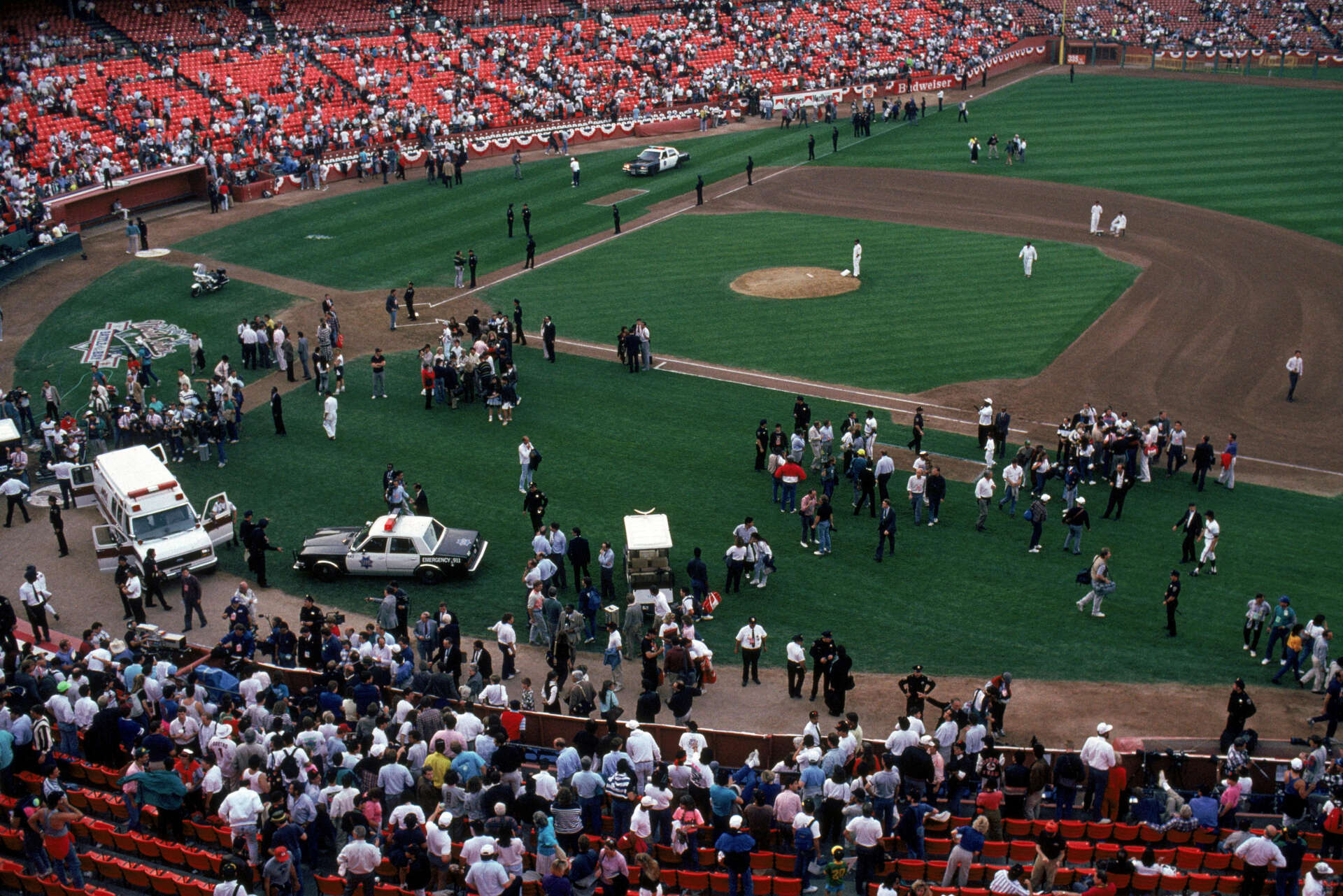
On October 17, 1989, at 5:04 p.m. PDT, a major 6.9 magnitude earthquake struck Northern California just minutes before Game 3 of the World Series at Candlestick Park. The catastrophe, known as the Loma Prieta earthquake, caused severe devastation across Oakland and San Francisco, suspended the championship series for 12 days, and fundamentally transformed seismic engineering standards across the United States.
The 1989 "Battle of the Bay" Context
The 1989 Fall Classic featured an unprecedented local matchup: the Oakland Athletics facing off against their cross-bay rivals, the San Francisco Giants. Dubbed the "Bay Bridge Series" or "Battle of the Bay," the event generated immense excitement throughout the San Francisco Bay Area.
The Oakland Athletics, led by manager Tony La Russa and powered by stars like Mark McGwire, Jose Canseco, Dennis Eckersley, and Series MVP Dave Stewart, had dominated the American League with 99 regular-season wins. Across the bay, the San Francisco Giants, managed by Roger Craig and led by Will Clark, Kevin Mitchell, and Matt Williams, had captured the National League pennant.
Oakland took a commanding 2–0 series lead after winning the first two games at the Oakland-Alameda County Coliseum. As the series shifted to San Francisco's Candlestick Park for Game 3 on Tuesday, October 17, over 62,000 fans filled the stadium, while millions tuned into the live television broadcast on ABC.
1989 World Series Game 3 Schedule (Original): Location: Candlestick Park, San Francisco, CA Scheduled First Pitch: 5:35 p.m. PDT Matchup: Oakland Athletics (2) vs. San Francisco Giants (0) Status at 5:04 p.m.: Teams taking field / Pre-game broadcast live on ABC
Moment of Impact: October 17, 1989, at 5:04 PM
At precisely 5:04:15 p.m. PDT, a rupture along the San Andreas Fault near Loma Prieta Peak in the Santa Cruz Mountains triggered a magnitude 6.9 earthquake. The shockwaves traveled northward at miles per second, striking the densely populated Bay Area during peak evening commute hours.
Inside Candlestick Park, players were completing pre-game warmups and fans were settling into their seats. As the ground began to shake, the concrete stadium structure swayed, and electrical power cut out completely. On the live ABC broadcast, announcer Al Michaels was analyzing pre-game footage alongside analyst Tim McCarver when the signal distorted. Michaels famously declared: "I'll tell you what, we're having an earth—" before the feed went dead.
When power was briefly restored via generators, Michaels returned to the airwaves to inform the national audience that an earthquake had struck the region. Despite the violent shaking, Candlestick Park’s reinforced concrete design held firm, preventing major structural collapse or massive crowds from panicking. Fans and players remained on the field for hours while emergency authorities assessed the damage across the metropolitan region.
Loma Prieta Earthquake Technical Summary: • Date & Time: October 17, 1989 | 5:04:15 p.m. PDT • Moment Magnitude (Mw): 6.9 • Epicenter: Forest of Nisene Marks State Park (Santa Cruz County) • Focal Depth: 11.8 miles (19 km) • Duration: Approximately 15 seconds of main shaking • Peak Ground Acceleration (PGA): 0.64g recorded near epicenter
Detailed geological assessments from the U.S. Geological Survey (USGS) confirmed that the earthquake originated deep within the earth along a oblique slip-fault section of the San Andreas system.
Structural Devastation in Oakland and the East Bay
While Candlestick Park escaped catastrophic damage, Oakland and the East Bay suffered the deadliest structural failures of the entire disaster. The unique regional geology—specifically deep layers of soft, water-saturated mud and artificial fill—amplified seismic waves far beyond what was felt on solid bedrock.
The Cypress Street Viaduct Collapse (Interstate 880)
The most severe disaster occurred on the Cypress Street Viaduct, a two-level reinforced concrete highway segment of Interstate 880 in West Oakland. Constructed in the 1950s under non-ductile design standards, the upper deck's support columns sheared off under intense lateral shaking.
The top deck of I-880 collapsed directly onto the lower deck for a stretch of nearly 1.5 miles. Of the 63 total fatalities caused by the Loma Prieta earthquake, 42 occurred on the Cypress Viaduct. Emergency personnel, local residents, and volunteer community members worked around the clock for days, using heavy machinery, jackhammers, and physical labor to extract trapped drivers.
Cypress Viaduct Structural Failure Mechanics:
- UPPER DECK (Collapsed downwards under lateral force)
- LOWER DECK (Crushed beneath falling upper level)
Primary Cause: Shear failure of unreinforced concrete joints and lack of continuous vertical rebar tying upper/lower frames.
The San Francisco–Oakland Bay Bridge
The earthquake severely impacted the San Francisco–Oakland Bay Bridge (Interstate 80), the principal transportation artery connecting Oakland to San Francisco. A 50-foot section of the upper deck on the eastern cantilever span sheared off its bolts and dropped onto the lower deck at Pier E9. The collapse forced the complete closure of the Bay Bridge for a month, severing direct highway transit across the bay and forcing commuters onto expanded BART (Bay Area Rapid Transit) train networks.
The "Baseball Miracle": How Game 3 Saved Lives
Transportation analysts and emergency responders later identified a striking paradox: despite occurring during the height of Tuesday evening rush hour (5:04 p.m.), overall highway casualties were significantly lower than standard predictive models estimated.
Because the Oakland Athletics and San Francisco Giants were playing in a historic local World Series, thousands of commuters had left work early, stayed at local venues, or remained at home to watch the televised broadcast. As a result, normally congested arteries like Interstate 880, the Bay Bridge, and the San Francisco highway network carried a fraction of their typical traffic volume.
Had the highway collapse occurred on a non-game day during normal bumper-to-bumper rush hour, experts estimated that hundreds of vehicles would have been trapped beneath the Cypress Structure. The coincidence of the local sports championship undoubtedly spared dozens, if not hundreds, of additional lives.
Series Postponement and Resumption
Following the earthquake, Major League Baseball Commissioner Fay Vincent took immediate action, suspending the World Series indefinitely to ensure public safety resources were directed entirely to rescue, recovery, and infrastructure assessment.
For 12 days, baseball took a backseat as Oakland, San Francisco, and surrounding communities focused on search-and-rescue operations, restoring utility grids, fighting fires in San Francisco's Marina District, and clearing collapsed roadway debris.
1989 World Series Timeline Adjustment: • Oct 14: Game 1 (Oakland 5, San Francisco 0) - Oakland • Oct 15: Game 2 (Oakland 5, San Francisco 1) - Oakland • Oct 17: Game 3 postponed at 5:04 p.m. due to earthquake • Oct 27: Game 3 resumes (Oakland 13, San Francisco 7) - San Francisco • Oct 28: Game 4 (Oakland 9, San Francisco 6) - Oakland sweeps 4–0
When the series resumed on October 27, 1989, at Candlestick Park, the mood was solemn yet resilient. Emergency first responders and civic leaders were honored on the field before first pitch. The Oakland Athletics went on to win Game 3 by a score of 13–7 and wrapped up the championship the following day with a 9–6 victory in Game 4, completing a four-game sweep.
Infrastructure Transformation and Engineering Legacy
The 1989 earthquake served as a dramatic turning point for structural engineering, transportation planning, and seismic safety guidelines across California and nationwide. The failure of double-deck concrete highways exposed deep vulnerabilities in mid-20th-century civil infrastructure.
Reconstruction and Retrofitting Initiatives
- Replacement of the Cypress Viaduct: Rather than rebuilding the elevated highway through West Oakland neighborhoods, the California Department of Transportation (Caltrans) rerouted Interstate 880 around the perimeter of the area (the Mandela Parkway boulevard now stands where the old viaduct collapsed).
- The New Eastern Span of the Bay Bridge: Civil engineers determined that retrofitting the historic cantilever eastern span was cost-prohibitive. Caltrans designed and built a self-anchored suspension bridge replacement, which opened in 2013 engineered to withstand the maximum credible earthquake expected over a 1,500-year return period.
- Statewide Bridge Retrofit Program: California launched comprehensive retrofitting projects to wrap bridge columns in steel casings, add expansion joint restraints, and install seismic isolation bearings across thousands of overpasses.
- Building Code Overhauls: Structural codes were updated to eliminate soft-story building configurations and require continuous steel reinforcement in concrete columns.
Seismic Engineering Legacy Comparison:
| Pre-1989 Standards | Post-1989 Reforms |
|---|---|
| Unreinforced masonry permitted | Strict retrofitting mandates |
| Brittle concrete column joints | Steel-jacketed ductile columns |
| Single-path highway corridors | Redundant transportation links |
| Localized emergency response | Integrated regional inter-agency network |
Federal disaster management and regional planning agencies like the Federal Emergency Management Agency (FEMA) incorporated the operational lessons of Loma Prieta into modern response protocols, multi-agency communication networks, and early-warning systems like ShakeAlert.
Comparative Data: Loma Prieta Impact Analysis
The following table synthesizes the critical historical, engineering, and sports statistics surrounding the 1989 Oakland/San Francisco earthquake event:
| Metric / Aspect | Historical Event Details |
|---|---|
| Date & Time | October 17, 1989 at 5:04:15 p.m. PDT |
| Magnitude & Depth | 6.9 $M_w$; 11.8 miles (19 km) depth |
| Primary Epicenter | Santa Cruz Mountains (Loma Prieta Peak) |
| Total Casualties | 63 fatalities; 3,757 reported injuries |
| Oakland Fatalities | 42 fatalities (Cypress Street Viaduct collapse) |
| Economic Damage | Approx. $6 billion to $10 billion (1989 USD) |
| World Series Teams | Oakland Athletics vs. San Francisco Giants |
| Series Delay | 12 days (Resumed Oct 27, completed Oct 28) |
| World Series Outcome | Oakland Athletics won 4–0 (Sweep) |
| Major Infrastructure Impact | I-880 Cypress Viaduct collapse; Bay Bridge upper deck failure |
| Key Engineering Output | Modern bridge steel-jacketing; new Bay Bridge Eastern Span |
Frequently Asked Questions
Why is the 1989 earthquake called the Loma Prieta earthquake?
The earthquake was named after Loma Prieta Peak in the Santa Cruz Mountains, located near the epicenter in Forest of Nisene Marks State Park. "Loma Prieta" translates from Spanish to "Dark Hill," which is the highest point in the Santa Cruz Mountain range.
How many people died during the 1989 Oakland earthquake?
A total of 63 deaths were directly attributed to the Loma Prieta earthquake across Northern California. The majority of these fatalities—42 people—occurred in Oakland when the upper level of the double-deck Cypress Street Viaduct on Interstate 880 collapsed onto the lower deck.
What was Al Michaels doing when the earthquake hit?
Al Michaels was co-anchoring the live ABC pre-game broadcast for Game 3 of the World Series alongside Tim McCarver. As the shaking started at 5:04 p.m., the audio and video feeds glitched, and Michaels famously began stating, "I'll tell you what, we're having an earth..." before transmission went down. When power returned via generators, he anchored coverage of the disaster live from Candlestick Park.
Why did Candlestick Park sustain so little structural damage?
Candlestick Park was constructed on solid bedrock at Candlestick Point, whereas areas that suffered severe structural failures—such as Oakland's Cypress Viaduct and San Francisco's Marina District—were built on uncompacted soil, mud, or artificial fill that suffered from soil liquefaction and wave amplification. Additionally, Candlestick Park’s pre-cast concrete design performed well under lateral displacement.
Who won the 1989 World Series after play resumed?
The Oakland Athletics won the 1989 World Series, sweeping the San Francisco Giants in four straight games. After Game 3 was delayed on October 17, play resumed on October 27. Oakland won Game 3 by a score of 13–7 and Game 4 on October 28 by a score of 9–6.
Practical Resources and Historical Research
For researchers, historians, and structural engineers analyzing the legacy of the 1989 Loma Prieta earthquake and its impact on Northern California, the following steps provide authoritative avenues for further exploration:
- Review USGS Technical Reports: Access original seismological data and ground movement acceleration studies compiled by the U.S. Geological Survey (USGS).
- Examine Caltrans Retrofit Documentation: Explore structural engineering archives at Caltrans detailing the design evolution from the Cypress Viaduct failure to the construction of the new Bay Bridge Eastern Span.
- Consult Baseball Historical Archives: Review historical broadsheets, broadcast transcripts, and retrospective analysis archived by Major League Baseball and local news outlets covering the 12-day suspension of the 1989 Fall Classic.
- Implement Modern Earthquake Preparedness: Homeowners and structural designers in seismic hazard zones should consult current California Seismic Safety Commission guidelines to ensure structures adhere to modern earthquake retrofitting standards.