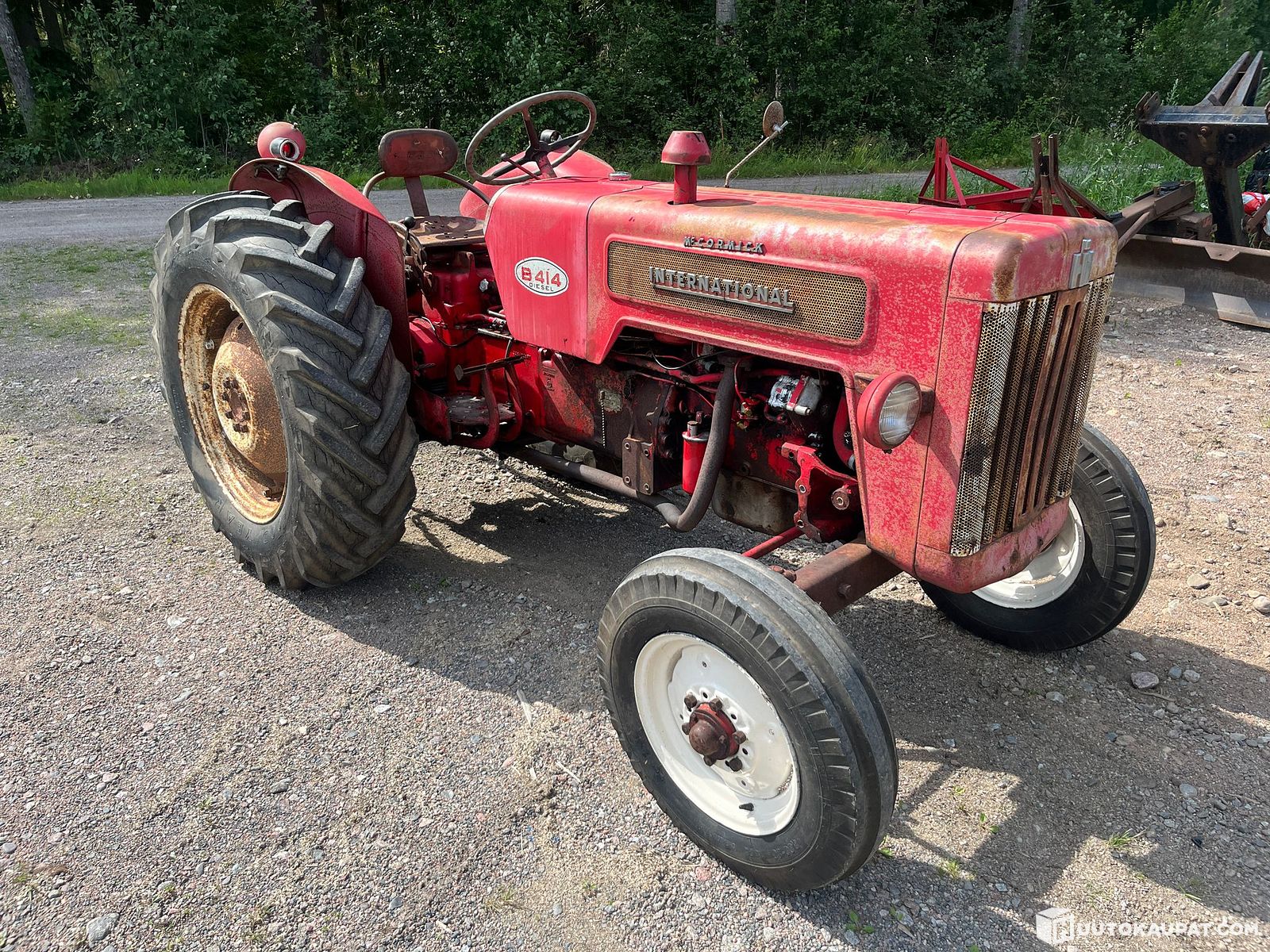
The International Harvester B414 is a versatile 40-horsepower utility tractor produced between 1961 and 1966. Manufactured primarily at the IH Bradford Works in Great Britain, it features the legendary BD-154 diesel engine, an 8-speed transmission, and advanced "Vary-Touch" hydraulics. It remains a favorite for small-scale farming and vintage restoration in 2026.
The Historical Significance of the IH B414
The International Harvester (IH) B414 represents a pivotal era in mid-century agricultural engineering. Introduced in 1961 as the successor to the popular B275, the B414 was designed to bridge the gap between small chore tractors and larger field machines. While IH was an American titan, the "B" prefix denotes its British origins, specifically the Bradford factory in Yorkshire, England.
During the early 1960s, the global agricultural market demanded tractors that were not only powerful but also maneuverable and technically sophisticated enough to handle the burgeoning array of hydraulic implements. The B414 was IH’s answer to the Massey Ferguson 35 and 135 series. It was an "export hero," shipped in massive quantities to North America, Australia, and across Europe. In 2026, the B414 is celebrated not just as a museum piece, but as a "working classic" that continues to perform light duties on hobby farms and orchards due to its robust mechanical simplicity.
Technical Specifications: The Heart of the Machine
The B414's longevity is largely attributed to its over-engineered powertrain. To understand why this tractor is still relevant over six decades after its launch, one must look at the specific components that defined its performance.
Engine Options: BD-154 and BC-144
The most common variant of the B414 is powered by the BD-154 diesel engine. This is a 4-cylinder, naturally aspirated, indirect-injection engine with a displacement of 154 cubic inches (2.5 liters). In the 1960s, it was rated at approximately 43.5 engine horsepower and 36.7 horsepower at the PTO (Power Take-Off).
The BD-154 is famous for its "Glow Plug" starting system. Unlike modern direct-injection diesels that might start instantly in cold weather, the B414 requires a deliberate heating cycle. As of 2026, many owners have upgraded these to fast-glow systems to improve reliability.
For markets where gasoline was more economical, IH offered the BC-144 petrol engine. This 4-cylinder unit shared many structural similarities with the diesel block but operated with a traditional carburetor and ignition system. While smoother and quieter, the petrol version is significantly rarer today than the diesel counterpart.
Transmission and Gearing
The B414 utilizes a sliding gear transmission providing 8 forward and 2 reverse speeds. This is achieved through a 4-speed main gearbox coupled with a high/low range selector. This "ten-speed" total configuration (including reverse) allowed farmers to select the precise ground speed needed for tasks ranging from slow-speed transplanting to high-speed road transport (reaching roughly 15 mph).
The inclusion of a differential lock was a standout feature for a tractor of this size in the 1960s. Operated by a foot pedal, it locked the rear wheels together to prevent slippage in muddy or uneven terrain—a feature that remains a critical safety and performance requirement for modern utility tractors.
Vary-Touch Hydraulic System and Linkage
One of the B414's primary selling points was its "Vary-Touch" hydraulic system. Before the widespread standardization of hydraulic controls, IH developed this system to provide both "Draft Control" and "Position Control."
- Draft Control: This automatically adjusts the depth of an implement (like a plow) based on the resistance it encounters in the soil. If the plow hits a patch of heavy clay, the hydraulics slightly lift the hitch to maintain engine RPM and prevent stalling.
- Position Control: This allows the operator to set the hitch at a specific height and keep it there, which is essential for mowers, sprayers, and blades.
The B414 is equipped with a Category 1 three-point hitch, which is the universal standard for small implements. This compatibility is a major reason why the tractor is still sought after in 2026; you can go to any modern farm supply store and buy a brand-new bush hog or box blade, and it will bolt directly onto a 1963 B414 without modification.
Operational Ergonomics and Design
The B414 features a "swept-back" front axle design. This wasn't just for aesthetics; it allowed for a remarkably tight turning radius, making it ideal for working in tight barnyards or between rows of trees in an orchard.
The Operator's Station
By 2026 standards, the B414's cockpit is minimalist. The seat is typically a steel "pan" style, often mounted on a leaf spring for rudimentary shock absorption. The controls are laid out logically:
- Left Side: The clutch pedal and the high/low range selector.
- Right Side: The individual turning brakes (which can be locked together for road use), the throttle lever, and the hydraulic control levers.
- Center: The main gear shift and the starter button/glow plug switch.
One quirk of the British-built B414 is the offset seating and steering position, which provides a better view of the furrow when plowing but can feel slightly unusual to those accustomed to perfectly centered modern tractors.
Comparison of IH B414 Key Specifications
The following table summarizes the core technical data for the standard diesel model of the B414.
| Feature | Specification | Details |
|---|---|---|
| Engine | IH BD-154 Diesel | 4-Cylinder, Indirect Injection |
| Horsepower (PTO) | 36.7 hp | Tested at rated RPM |
| Horsepower (Engine) | 43.5 hp | Gross manufacturer rating |
| Displacement | 154 cu in (2.5L) | Bore/Stroke: 3.5 x 4.0 inches |
| Transmission | 8 Forward / 2 Reverse | Sliding Gear with High/Low Range |
| Brakes | Mechanical Dry Disc | Independent or Synchronized |
| Hydraulics | Vary-Touch System | 6.5 GPM pump flow |
| Lift Capacity | 2,600 lbs | At the lower link ends |
| Wheelbase | 76.5 inches | Provides high stability for its size |
| Fuel Capacity | 12.6 Gallons | Sufficient for a full day of light work |
Maintenance and Parts Availability in 2026
For a machine that is sixty years old, the International Harvester B414 remains surprisingly easy to maintain. This is due to the sheer volume of units produced and the commonality of parts with other IH models like the B275, 434, and 444.
Common Maintenance Tasks
- Fuel System: The CAV injection pump is a robust unit but sensitive to water contamination. In 2026, with modern biofuels, it is highly recommended to use a fuel stabilizer and high-quality water separators to prevent internal corrosion.
- Glow Plugs: The original "series-wired" glow plugs are a common failure point. If one fails, the whole circuit breaks. Most modern owners convert these to 12V "parallel-wired" plugs, which heat up in seconds rather than minutes.
- Braking System: The B414 uses dry disc brakes. Over time, dust and moisture can cause the "actuators" to stick. Periodic cleaning and adjustment of the brake rods are necessary to ensure the tractor can stop safely, especially when trailering.
Parts Sourcing
Replacement parts—from engine overhaul kits to hydraulic seals—are widely available through specialized vintage tractor suppliers. Because the BD-154 engine was used in skid steers, compressors, and marine applications, engine components remain in active production by several aftermarket manufacturers.
The B414 in the 2026 Market: Value and Suitability
Whether you are a collector or a smallholder, the B414 represents a specific value proposition. As of 2026, prices for a well-maintained B414 vary based on condition and regional demand, but they generally fall into the "affordable" category compared to modern sub-compact tractors.
Why Buy a B414 Today?
- Simplicity: There are no computers, no DEF (Diesel Exhaust Fluid) requirements, and no complex sensors. Repairs can usually be performed with a standard set of wrenches and a shop manual.
- Versatility: It is heavy enough (approx. 3,500 to 4,000 lbs depending on ballast) to provide real traction for ground-engaging work like plowing or discing, which modern lightweight tractors struggle with.
- Heritage: It is a piece of agricultural history. Participating in "plow days" or vintage tractor pulls is a popular hobby, and the B414 is a competitive entry in its weight class.
Potential Drawbacks
- Safety Features: Original B414s did not come with ROPS (Roll-Over Protective Structures). For modern use, it is strongly advised to retrofit a certified ROPS and seatbelt.
- Live PTO: While some B414s were equipped with a dual-stage clutch for "Live PTO" (allowing the tractor to stop moving while the implement keeps spinning), many basic models were not. This makes tasks like heavy bush-hogging slightly more cumbersome.
Frequently Asked Questions
Is the IH B414 a good tractor for a first-time owner?
Yes, the B414 is often considered an ideal entry-point into vintage tractor ownership. Its mechanical systems are straightforward, and its size makes it manageable for those with limited space. However, prospective owners should be prepared to perform basic maintenance and understand the nuances of 1960s diesel engine operation.
How can I tell if a B414 has a "Live PTO"?
A B414 with a Live PTO will have a dual-stage clutch. You can test this by depressing the clutch pedal halfway; the tractor should stop moving, but the PTO shaft should continue to turn. Depressing the pedal the rest of the way to the floor will then stop the PTO. This is a highly desirable feature for mowing.
What are the main differences between the B275 and the B414?
The B414 is essentially an upgraded version of the B275. The most significant differences are the increased engine displacement (the B275 used the BD-144, while the B414 uses the BD-154), improved hydraulic controls (Vary-Touch), and updated styling, including a more modern grille and hood design.
Can the B414 run on modern ultra-low sulfur diesel (ULSD)?
Yes, but since the BD-154 engine was designed for higher-sulfur fuels which provided better lubrication for the injection pump, many owners in 2026 add a lubricity additive or a small amount of bio-diesel to the tank to protect the fuel system from premature wear.
Where is the serial number located on an IH B414?
The serial number plate is typically located on the right-hand side of the transmission housing, near the gear levers or on the front axle support. This number is essential for identifying the exact year of manufacture and for ordering correct engine parts.
Next Steps for Prospective Owners
If you are considering acquiring an International Harvester B414 in 2026, your first action should be to verify the mechanical health of the engine and the hydraulic pump. Check for "blow-by" (smoke coming from the oil breather) and ensure the three-point hitch can lift a heavy load without shuddering.
For those interested in the technical history and preservation of these machines, the Wisconsin Historical Society houses the official International Harvester Archives, providing access to original design blueprints and production records. Additionally, joining a local vintage tractor club can provide invaluable peer support for troubleshooting and sourcing rare original components.