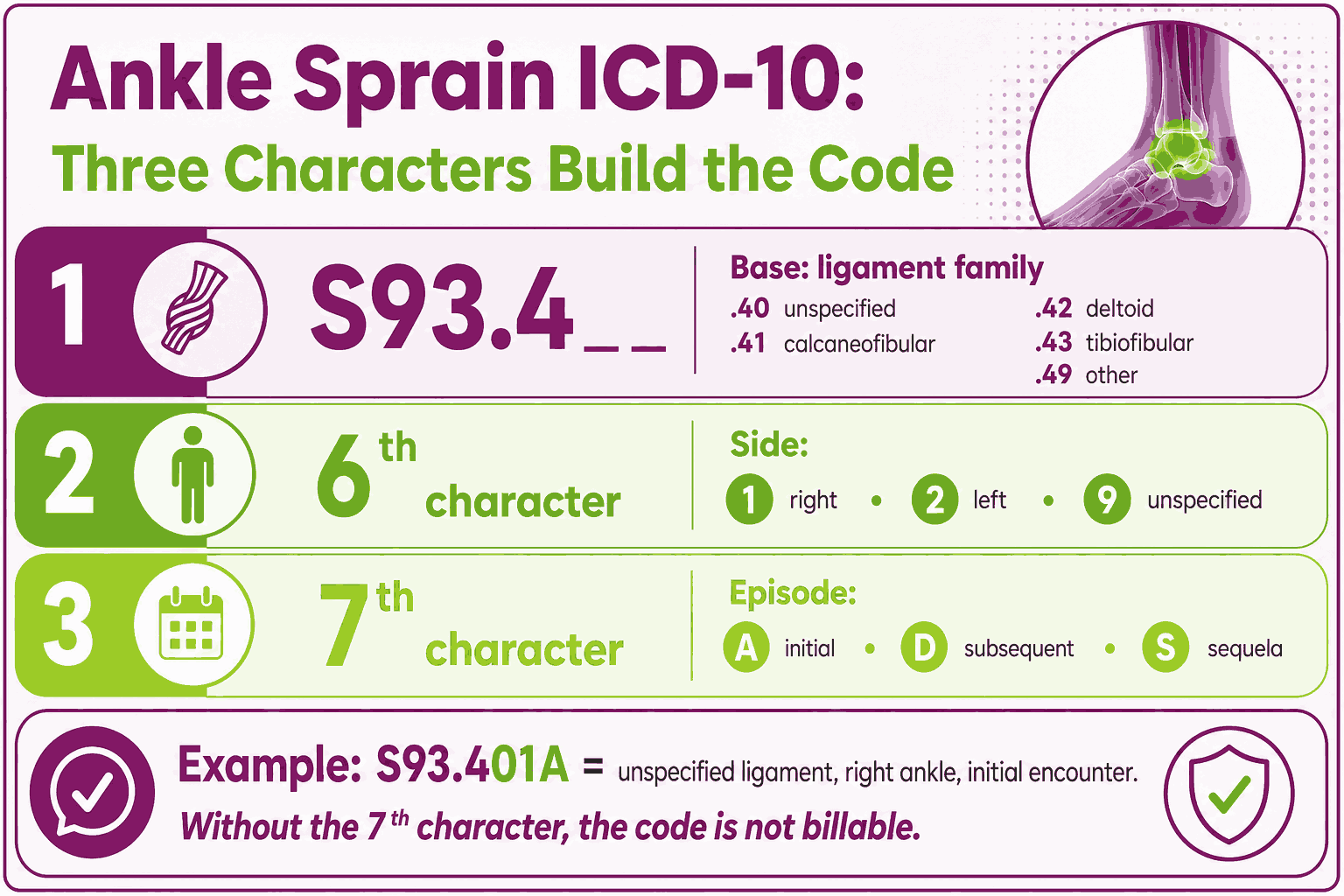
The primary ICD-10-CM code for an unspecified ankle sprain is S93.40. However, this code is not complete for billing purposes. In 2026, clinical coding requirements demand additional characters to specify laterality—S93.401 (right), S93.402 (left), or S93.409 (unspecified side)—and a mandatory seventh character (A, D, or S) to indicate the encounter type.
Ankle injuries remain one of the most common reasons for emergency department visits and primary care consultations. In the complex ecosystem of medical billing and clinical documentation, the transition to the International Classification of Diseases, 10th Revision, Clinical Modification (ICD-10-CM) has necessitated a high level of precision. While "unspecified" codes exist, their utility is increasingly scrutinized by payers in 2026. Understanding the nuances of the S93.40 family is essential for healthcare providers, medical coders, and insurance adjusters to ensure accurate records and timely reimbursement.
The Structural Breakdown of ICD-10 Code S93.40
To understand why S93.40 is used for an unspecified ankle sprain, one must look at the hierarchical structure of the ICD-10-CM system. The code is built through a series of specific identifiers that narrow down the diagnosis from a general injury to a specific anatomical site and injury type.
- S Section: The letter "S" designates the category for "Injuries, poisoning, and certain other consequences of external causes related to single body regions."
- 93 Category: This numerical group refers specifically to "Dislocation and sprain of joints and ligaments at ankle, foot and toe level."
- The 4th Character (4): This specifies that the injury is a "Sprain of joints and ligaments of ankle."
- The 5th Character (0): This is the placeholder for "Unspecified ligament." While other codes like S93.41 refer to the calcaneofibular ligament, the "0" indicates that the specific ligament involved (such as the anterior talofibular or deltoid ligament) has not been identified in the clinical documentation.
By the time you reach S93.40, you have identified the injury as a sprain of an unknown ligament in the ankle. However, a code ending at the fifth character is considered "invalid" for claim submission in 2026.
The Necessity of Laterality: Right, Left, or Unspecified?
In 2026, the specificity of laterality is a non-negotiable requirement for the majority of insurance carriers, including Medicare and major private payers. Laterality identifies which side of the body is affected. For an unspecified ankle sprain, the code must be expanded to six characters:
- S93.401: Sprain of unspecified ligament of the right ankle.
- S93.402: Sprain of unspecified ligament of the left ankle.
- S93.409: Sprain of unspecified ligament of an unspecified ankle.
The use of S93.409 (unspecified side) is generally discouraged. In a clinical setting, it is rare that a provider would not know which ankle is injured. Use of the "unspecified side" code often triggers a "medical necessity" review or an automated denial from the payer, as it suggests incomplete documentation.
The Seventh Character: Defining the Episode of Care
The most critical addition to the S93.40 code family is the seventh character. This character is required for all codes within the S93 category to identify the phase of treatment the patient is currently receiving.
A – Initial Encounter
The seventh character "A" is used while the patient is receiving active treatment for the injury. This is not limited to the very first visit. As long as the patient is undergoing active care—such as emergency department evaluation, diagnostic imaging, or even surgical intervention—the "A" extension is appropriate. For example, S93.401A represents the initial treatment for an unspecified ligament sprain of the right ankle.
D – Subsequent Encounter
The seventh character "D" is utilized for encounters after the patient has completed active treatment and is now receiving routine care during the recovery phase. This typically includes follow-up visits to a primary care physician or orthopedist to monitor healing, or the removal of a cast or brace. For instance, a patient returning three weeks after the initial injury for a progress check would be coded with S93.401D.
S – Sequela
The seventh character "S" is reserved for complications or conditions that arise as a direct result of the original injury. When using the "S" extension, it is often necessary to code both the injury (the sequela) and the manifestation (the current problem, such as chronic joint instability or post-traumatic osteoarthritis). The "S" identifies that the current issue is a "late effect" of the original unspecified ankle sprain.
Clinical Documentation Requirements for Ankle Sprains
To support the use of S93.40—or better yet, a more specific code—clinicians must provide detailed notes. In the 2026 regulatory environment, "Ankle Sprain" written on a chart is often insufficient. Documentation should ideally include:
- Mechanism of Injury: How did the sprain occur? (e.g., inversion, eversion, or rotation).
- Specific Anatomical Location: Which ligaments show tenderness? (e.g., Anterior Talofibular Ligament (ATFL), Calcaneofibular Ligament (CFL), or Deltoid Ligament).
- Laterality: Clearly state right or left.
- Severity/Grade: Grade I (stretching), Grade II (partial tear), or Grade III (full rupture).
- Associated Findings: Is there significant edema, ecchymosis, or an inability to bear weight?
If the physician documents a sprain of the ATFL, the coder should bypass S93.40 and move to S93.41, which is the specific code for the calcaneofibular ligament, or S93.42 for the deltoid ligament. S93.40 is strictly a "fallback" code when the specific ligament cannot be or was not determined.
Comparison of Specified vs. Unspecified Ankle Sprain Codes
The following table illustrates the differences in coding based on the level of detail provided in the medical record.
| Diagnosis Detail | Laterality | Encounter Type | Correct ICD-10 Code (2026) |
|---|---|---|---|
| Unspecified Ankle Sprain | Right | Initial | S93.401A |
| Unspecified Ankle Sprain | Left | Subsequent | S93.402D |
| Calcaneofibular Ligament Sprain | Right | Initial | S93.411A |
| Deltoid Ligament Sprain | Left | Initial | S93.422A |
| Anterior Talofibular Ligament Sprain | Right | Sequela | S93.491S |
| Unspecified Ankle Sprain | Unspecified | Initial | S93.409A |
Financial and Administrative Implications of "Unspecified" Coding
In 2026, the healthcare industry continues to move toward value-based care and high-specificity billing. Using "unspecified" codes like S93.409A carries several risks:
- Claim Denials: Many insurance algorithms are programmed to flag "unspecified" codes for review. If the documentation is available but the code used is unspecified, the claim may be rejected as "not coded to the highest level of specificity."
- Delayed Reimbursement: Manual reviews of "unspecified" claims take time, often extending the accounts receivable (AR) cycle by 30 to 60 days.
- Audit Vulnerability: Frequent use of unspecified codes can make a practice an outlier in data analysis performed by the Centers for Medicare & Medicaid Services (CMS) or private auditors, potentially leading to more frequent audits.
- Inaccurate Patient Profiles: For researchers and public health officials, unspecified codes mask the true prevalence of specific types of injuries, making it harder to develop targeted prevention strategies for sports or workplace safety.
Related Coding Considerations: Excludes Notes
When using the S93.40 series, it is important to be aware of "Excludes" notes found in the official ICD-10-CM guidelines.
- Excludes1: This note indicates that the code should never be used at the same time as the code listed. For ankle sprains, this often includes specific injuries like a "dislocation of the ankle joint" (S93.0-) or "fracture of the ankle" (S82.-). If a fracture is present, it takes precedence over a sprain.
- Excludes2: This note indicates that the condition excluded is not part of the condition represented by the code, but a patient may have both conditions at the same time. An example would be an injury to the Achilles tendon (S86.0-), which can occur simultaneously with an ankle sprain but is coded separately.
For more information on these guidelines, practitioners should consult the official CMS ICD-10-CM resources.
Practical Expert Guidance: How to Avoid S93.40
While S93.40 is the correct answer for an "unspecified" sprain, the goal of a high-performing billing department is to minimize its use. Here are three practical steps for providers in 2026:
- Standardize Templates: Electronic Health Record (EHR) templates should force the selection of "Left" or "Right" before a diagnosis can be finalized.
- Education on Anatomy: Ensure that clinical staff are aware that identifying a specific ligament (like the ATFL) leads to a "cleaner" claim than a generic "ankle sprain."
- Review "Unspecified" Reports: Billing managers should run a monthly report of all "unspecified" codes used. If S93.409 shows up frequently, it is an indicator that provider documentation training is required.
FAQs
What is the difference between S93.40 and S93.49?
S93.40 is for a sprain of an unspecified ligament. S93.41, S93.42, and S93.43 cover specific ligaments like the calcaneofibular, deltoid, and tibiofibular ligaments. S93.49 is used for "Sprain of other ligament of ankle," which is used when the specific ligament is known (e.g., the posterior talofibular ligament) but there isn't a dedicated code for it.
Can I use S93.401A for a chronic ankle sprain?
No. Ankle sprains are by definition acute injuries. If a patient has chronic instability or a "old" sprain that never healed properly, you should look at codes in the M category (Diseases of the musculoskeletal system and connective tissue), specifically M24.27 (Disorder of ligament, ankle and foot).
Is a 7th character always required for S93.40?
Yes. In the ICD-10-CM system, any code in the S93 category that does not have a 7th character is considered truncated and will be rejected by clearinghouses and payers. It must end in A, D, or S.
Does S93.401A cover a "high ankle sprain"?
No. A "high ankle sprain" involves the syndesmotic ligaments (the tibiofibular ligaments). The specific code for this is S93.43- (Sprain of tibiofibular ligament). Using S93.40 for a high ankle sprain is technically an under-coding of the condition’s severity.
Can S93.40 be used for an injury involving both the ankle and the foot?
If both are injured, you should code for both sites unless a combination code exists. For an unspecified sprain of both the ankle and the foot, you would use S93.40- for the ankle and likely S93.60- for the unspecified sprain of the foot.
Recommendation for Next Actions
If you are a medical provider or coder dealing with an "unspecified ankle sprain," your first step should be to review the clinical notes for any mention of laterality (Right vs. Left) and the specific phase of care (Initial vs. Subsequent). Ensure the final code contains seven characters—for example, S93.401A for a right ankle sprain in the initial treatment phase. Moving forward, refine documentation practices to identify specific ligaments whenever possible, as this reduces the risk of claim denials and improves the quality of the patient's medical record. For the most up-to-date coding manuals, refer to the CDC's ICD-10-CM browser.