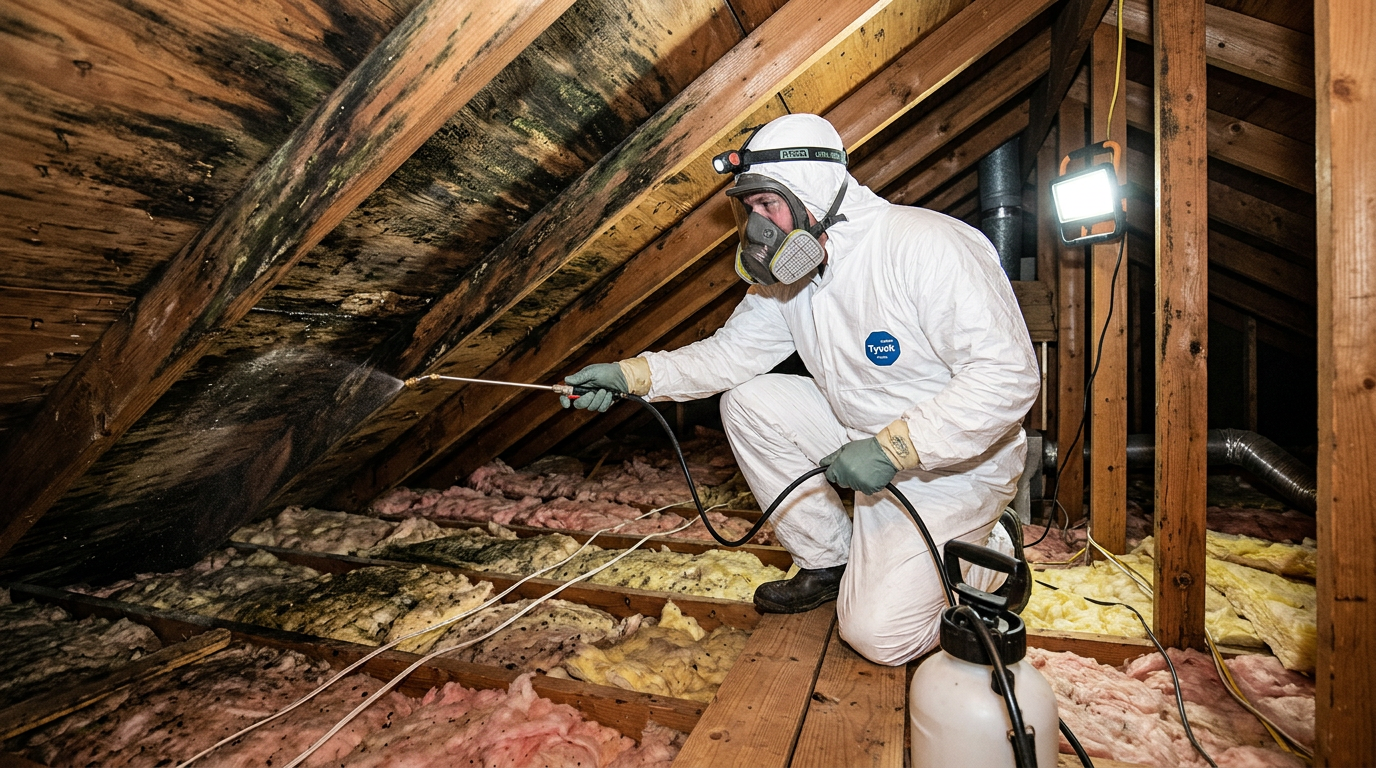
Attic mold remediation in Columbus, Ohio involves containing fungal growth, eliminating active colonies from roof sheathing and framing using antimicrobial treatments or media blasting, and fixing underlying moisture problems. Due to Central Ohio's humid summers and freezing winters, resolving improper ventilation, unsealed attic bypasses, or bathroom exhaust leaks is essential to prevent permanent structural damage and indoor air contamination.
Why Columbus Attics Are Prone to Mold Growth
Central Ohio’s humid continental climate creates an ideal environment for attic mold. Columbus experiences wide seasonal temperature swings, ranging from hot, humid summer days to sub-freezing winter nights. These fluctuating exterior conditions interact directly with indoor air leakage and roof architecture, creating chronic condensation issues within residential attics.
During winter, warm, moisture-laden air generated from cooking, showers, and human respiration rises through living spaces due to the stack effect. If the attic floor is not air-sealed, this buoyant air bypasses drywall penetrations, recessed lights, and drop soffits, entering the unconditioned attic space. When warm, humid air hits cold roof decking chilled by freezing exterior temperatures, the air temperature drops below its dew point. Moisture then condenses on structural lumber, OSB (oriented strand board), or plywood sheathing.
Warm, Moist House Air ---> Unsealed Ceiling Penetrations ---> Attic Space | v Hits Freezing Roof Sheathing (Dew Point) | v Condensation & Wood Rot / Mold
In addition to winter condensation, late spring and summer in Columbus bring elevated outdoor relative humidity, often exceeding 75%. If an attic lacks adequate intake and exhaust airflow, moisture becomes trapped inside the roof cavity. Over time, wood framing absorbs this ambient moisture. Mold spores, which exist naturally in outdoor and indoor air, settle on damp wooden surfaces. When the moisture content of structural lumber exceeds 19%, fungal species such as Cladosporium, Penicillium, Aspergillus, and occasionally Stachybotrys chartarum begin to colonize rapidly.
Central Ohio’s housing stock also plays a significant role. Older homes in neighborhoods like Clintonville, Grandview Heights, and German Village often feature antiquated roof venting, compromised flashing, or layers of settling cellulose insulation that block soffit vents. Conversely, newer suburban developments in Dublin, Westerville, and New Albany frequently suffer from improper installation of continuous ridge vents, blocked baffles, or bathroom vent fans that exhaust directly into the attic instead of ducting through the roof or gable wall.
Warning Signs of Attic Mold
Because homeowners rarely enter their attics, microbial growth can develop undetected for months or years. Homeowners should watch for several warning signs:
Visual Discoloration on Decking and Rafters
Active mold colonies typically appear as black, white, gray, or greenish-brown spotting or streaking across the undersides of roof sheathing and rafters. In Columbus homes, mold is commonly concentrated on the north-facing slope of the roof, which receives the least direct sunlight and stays colder for longer periods during winter.
Rusty Roofing Nails
When moist air continually condenses on the underside of roof decking, the exposed shingle nails protruding through the wood begin to corrode. Streaks of rust running down plywood or black circular staining around roof nails indicate chronic moisture and elevated relative humidity.
Darkened, Clumped, or Wet Insulation
Fiberglass batt or blown-in cellulose insulation that has absorbed condensation often looks dark, compacted, or matted. While mold requires organic material to feed on—meaning it rarely grows directly on synthetic fiberglass itself—accumulated dust, paper backings, and cellulose provide ample nutrients when damp.
Persistent Musty Odors on Upper Floors
Air does not remain stationary in an attic. Under certain wind patterns or when running an HVAC system with ductwork located in the attic, air from the roof cavity can be drawn down into second-story bedrooms and hallways. A pervasive, earthy, or musty smell on upper floors often points to hidden attic contamination.
Frost or Ice Accumulation on Framing
During cold snaps in Central Ohio, extreme moisture loading can cause visible frost or icicles to form on exposed nail heads and the underside of the roof deck. Once the outdoor temperature rises above freezing, this frost melts, saturating the framing below.
The Professional Attic Mold Remediation Process
Professional mold remediation is not merely spraying chemical bleach on affected surfaces. In fact, common chlorine bleach is primarily water-based and cannot penetrate porous wood surfaces; the chlorine evaporates while the residual water feeds the fungal hyphae deeper inside the wood. Professional remediation relies on the standards established by the Institute of Inspection, Cleaning and Restoration Certification, specifically the IICRC S520 Standard for Professional Mold Remediation.
1. Initial Assessment and Moisture Mapping
Before remediation starts, an inspector conducts a visual assessment and uses professional diagnostic tools. Technicians measure the moisture content of structural members with pin-type wood moisture meters and use thermal imaging cameras to locate hidden air leaks, missing insulation, and roof penetrations.
2. Negative Air Pressure and Containment
To prevent mold spores and mycotoxins from migrating down into living spaces during the cleanup, remediators seal off attic access hatches, drop-down stairs, and HVAC registers with 6-mil polyethylene sheeting. Commercial HEPA-filtered air scrubbers (High-Efficiency Particulate Air) are ducted out of attic dormers or gable vents, creating continuous negative air pressure inside the workspace.
3. Source Correction
Remediation is pointless if the moisture source remains active. Technicians identify and resolve the root cause, which may involve:
- Rerouting flexible exhaust ducts directly through roof caps.
- Installing rafter vents (baffles) to restore airflow from soffits.
- Coordinating with a roofing contractor to repair damaged flashing or missing shingles.
4. Physical Mold Removal
Mold must be physically removed from porous and semi-porous surfaces. Common physical removal methods include:
- HEPA Vacuuming: Vacuuming all framing, decking, and ceiling joists using commercial HEPA-rated vacuums that trap particles down to 0.3 microns.
- Abrasive Cleaning / Blasting: For deep-rooted fungal growth, contractors frequently use dry-ice blasting or baking soda (sodium bicarbonate) blasting. Dry-ice blasting sublimates upon contact, leaving no secondary abrasive waste, effectively stripping mold mycelium from wood grain without damaging framing.
- Manual Sanding and Wire Brushing: In tight eave spaces where blasting equipment cannot maneuver, technicians manually abrade surfaces using mechanical sanders with vacuum attachments.
5. Antimicrobial Treatment and Encapsulation
Once physical removal is complete, remaining surfaces are treated with an EPA-registered biocide or antifungal solution to neutralize any microscopic spore traces. After the wood dries to acceptable moisture levels (typically below 15%), contractors apply a fungicidal coating or encapsulant. These specialized sealers seal the wood pores and incorporate antimicrobial agents that prevent mold colonies from re-establishing if minor humidity occurs in the future.
6. Post-Remediation Verification (Clearance Testing)
For verified projects, an independent third-party Indoor Environmental Professional (IEP) conducts a clearance inspection. This involves taking post-remediation air and surface samples inside the attic and living areas to verify that spore counts are equal to or lower than typical outdoor baseline levels.
Correcting Structural Root Causes in Central Ohio Homes
Remediating mold addresses the symptom; correcting building defects eliminates the problem. Most attic mold in the Columbus area stems from a failure in three interdependent systems: ventilation, insulation, and air barrier integrity.
Balanced Attic Airflow [ Ridge Vent ] <--- Warm, moist air exhausts / \ / \ / \ [ Soffit ] ---> [ Baffle ] ---> Continuous airflow washes under deck
Attic Ventilation Balance
Attic ventilation requires a balanced system of intake and exhaust governed by the building code standard of Net Free Ventilating Area (NFVA). Most building codes require a 1:150 or 1:300 ratio of ventilation area to attic floor square footage.
- Intake Deficits: In many Columbus homes, intake at the soffit or eave is blocked by blown-in insulation, or soffit vents were never cut open under perforated vinyl siding. Without intake at the bottom, roof-mounted ridge vents, box vents, or wind turbines cannot draw air properly, causing stagnant, moist air to collect at the peak.
- Rafter Baffles: Installing rigid plastic or foam baffles between every rafter bay ensures clear airflow channels from the soffit vents over the insulation layer up to the ridge.
Bathroom Fan Exhaust Routing
One of the most frequent defects found during Columbus attic inspections is a bathroom exhaust fan duct dumping moist, hot air directly into the attic, or terminated loosely under a passive soffit vent. When a bathroom exhaust terminates near a soffit vent, the attic intake simply pulls the wet exhaust right back inside.
- All exhaust lines must use smooth, rigid, or semi-rigid insulated ductwork.
- Ducts must vent directly through an exterior roof cap fitted with a backdraft damper or out through an exterior gable wall.
Air Sealing Ceiling Bypasses
Simply adding more insulation on top of an attic floor does not stop moisture transfer. Warm air moves through small air leaks around:
- Electrical wire penetrations
- Plumbing vent stacks
- Chimney chases
- Recessed lighting fixtures (can lights)
- Attic access panels
Sealing these penetrations using expanding polyurethane foam, fire-rated caulking, and rigid foam insulation sheets prevents warm household air from reaching the unconditioned roof space.
Cost of Attic Mold Remediation in Columbus, Ohio
The cost of attic mold remediation varies based on square footage, the severity of the colonization, accessibility, and whether contaminated insulation must be extracted and replaced.
In Central Ohio, professional remediation projects typically range between $1,800 and $7,500. When full insulation removal, attic floor air sealing, and insulation reinstallation to current energy standards are required, total costs can exceed $10,000.
| Remediation Scope | Description & Included Work | Typical Central Ohio Price Range |
|---|---|---|
| Minor / Localized Remediation | Small areas of mold (under 100 sq. ft.) caused by a localized roof leak or isolated disconnected exhaust hose. Involves HEPA vacuuming, biocide cleaning, and sealing. | $1,500 – $2,500 |
| Moderate Attic Remediation | Widespread surface mold across roof sheathing (1,000–1,800 sq. ft. attic). Includes negative air setup, biocide application, light abrading, and full roof deck encapsulation. Insulation left intact if unaffected. | $2,500 – $4,500 |
| Extensive Remediation (Blasting Required) | Severe, deep-rooted mold across rafters, trusses, and OSB/plywood. Requires full dry-ice or soda blasting, advanced chemical encapsulation, and full negative air containment. | $4,500 – $7,500 |
| Comprehensive Restoration (Remediation + Full Retrofit) | Complete mold removal via blasting/encapsulation, removal of moisture-damaged insulation, air-sealing attic floor bypasses, installing baffles, and blowing in new cellulose/fiberglass to R-49/R-60 standards. | $7,500 – $13,000+ |
Key Factors Influencing Costs
- Roof Pitch and Working Clearance: Low-slope or shallow roofs offer restricted working space, increasing labor hours compared to high-pitch attics with standing room.
- Type of Wood Substrate: Plywood and OSB absorb moisture differently. OSB is more susceptible to moisture swelling, making thorough cleaning more labor-intensive than traditional tongue-and-groove plank sheathing found in historic Columbus homes.
- Contaminated Insulation: If mold spores or roof leaks have settled heavily into blown-in insulation, the material must be extracted using high-powered commercial vacuum trucks parked outside, increasing project disposal and labor fees.
Does Homeowners Insurance Cover Attic Mold in Ohio?
Whether homeowners insurance covers mold remediation in Ohio depends strictly on the proximate cause of the moisture. Insurance policies generally differentiate between sudden, accidental perils and ongoing maintenance neglect.
When It May Be Covered
- Sudden and Accidental Water Damage: If a severe Central Ohio wind or hail storm rips shingles off the roof, causing water to pour into the attic and rapidly generate mold, the remediation costs are typically covered under the storm damage claim.
- Burst Pipes: If an attic-routed plumbing line or fire sprinkler pipe ruptures suddenly, mold resulting from that specific event is often covered, subject to policy limits.
When Coverage Is Typically Denied
- Condensation and Lack of Ventilation: Insurers view poor roof ventilation, blocked soffits, and lack of air sealing as deferred maintenance or design flaws. Mold caused by slow, continuous condensation is almost universally excluded.
- Gradual Roof Leaks: If a roof leak has been slowly rotting wood for months or years, insurance adjusters classify this as ongoing wear and tear.
Homeowners should review their policy documents carefully. Many standard policies in Ohio have explicit mold sub-limits, which cap mold remediation payouts at $5,000 or $10,000, even if the root water damage event is covered up to structural limits. Additional mold riders can sometimes be purchased to expand this coverage.
Choosing a Remediation Contractor in Columbus
Attic mold remediation requires specialized building science knowledge. Columbus homeowners should carefully vet prospective remediation companies by asking specific operational and credentialing questions:
Contractor Evaluation Checklist [ ] Holds active IICRC certification (AMRT - Applied Microbial Remediation Technician) [ ] Provides proof of environmental/pollution liability insurance (not just general liability) [ ] Uses commercial HEPA filtration and negative air containment [ ] Identifies and addresses ventilation or air-leakage root causes [ ] Provides clear, written scope of work and independent clearance testing options
Essential Qualifications
- IICRC Certification: Ensure the contractor or on-site supervisor holds the Applied Microbial Remediation Technician (AMRT) certification from the IICRC.
- Dedicated Pollution Liability Insurance: Standard contractor general liability insurance often contains broad mold and microbial exclusions. A qualified remediation company must carry dedicated Contractor’s Pollution Liability (CPL) coverage to protect your home against accidental cross-contamination.
- Clearance Guarantees: Reputable firms stand behind their work with written warranties (commonly 1 to 5 years), contingent upon correcting the underlying ventilation and moisture sources.
- Separation of Assessment and Remediation: Avoid companies that insist on performing both the initial testing, the remediation, and the post-remediation clearance internally without offering third-party verification options. Independent testing ensures unbiased results.
Long-Term Mold Prevention in Central Ohio Climates
After eliminating existing mold colonies, homeowners must maintain a stable attic environment. In Columbus, keeping attic relative humidity below 60% year-round is the primary objective.
1. Maintain Proper Insulation R-Values
According to current energy guidelines for Climate Zone 5, which includes Columbus and the rest of Central Ohio, attics should have an insulation depth between R-49 and R-60. This equates to roughly 16 to 20 inches of blown-in cellulose or fiberglass. Adequate insulation keeps conditioned indoor heat from warming the attic air and coming into contact with cold roof decking.
2. Verify Clear Soffit Intake
Periodically check attic eaves to verify that insulation installers or settling materials have not covered rafter baffles. From inside a dark attic during daylight hours, you should see light entering evenly through the soffit intake vents along the eaves.
3. Conduct Annual Seasonal Inspections
Inspect the attic at least twice per year:
- Late Winter (February): Look for signs of condensation, wet nail heads, or frost accumulation during freezing weather.
- Late Summer (August): Check for roof leaks, excessive heat buildup, or sour, musty odors after heavy seasonal thunderstorms.
4. Upgrade Bathroom and Kitchen Vent Ducts
Replace uninsulated flexible vinyl accordion ducting with insulated, rigid metal ductwork. Insulated ducts prevent moisture from condensing inside the pipe and running back down into the fan motor or pooling above ceiling drywall.
Frequently Asked Questions
Can I clean attic mold myself using bleach?
No, using household chlorine bleach to clean attic mold on structural wood is not recommended. Bleach does not eliminate fungal roots within porous materials like plywood, OSB, and framing lumber. Because bleach is mostly water, its active chemical evaporates quickly, leaving residual moisture behind that encourages deeper fungal growth. Effective DIY efforts for minor, non-toxic surface areas require an EPA-registered fungicidal disinfectant, personal protective equipment (N95 or P100 respirator, eye protection, and protective suit), and complete air containment. Extensive mold growth should always be handled by certified professionals.
Can attic mold make my family sick?
Attic mold has the potential to cause health symptoms, particularly for individuals with respiratory conditions, asthma, or mold allergies. Although the attic is separated from living spaces by ceiling drywall, homes operate under the stack effect, and pressure changes caused by HVAC systems, exhaust fans, and wind can draw air from the attic down through ceiling cracks, recessed lighting fixtures, and wall cavities into living areas. Exposure can trigger coughing, sneezing, skin irritation, eye inflammation, and chronic sinus infections.
Does attic mold always mean I need a new roof?
No, attic mold rarely requires a full roof replacement unless the wood sheathing has suffered extensive structural rot or chronic water penetration has ruined the structural integrity of the roof decking. In most cases, the existing mold can be removed via abrasive blasting or chemical treatment, followed by encapsulation. The roof covering itself only needs replacement if damaged shingles, failing underlayment, or degraded flashing caused the initial moisture intrusion.
How long does the attic mold remediation process take?
A standard residential attic mold remediation in Columbus typically takes between one to three days. Localized treatments may take only a single day, whereas large homes requiring total dry-ice blasting, contaminated insulation extraction, structural framing remediation, and new insulation blowing can take three to four working days.
What causes attic mold in the summer versus the winter?
In winter, attic mold is caused primarily by warm, moist indoor air leaking into the freezing attic and condensing against the cold underside of the roof sheathing. In the summer, mold is caused by high exterior relative humidity and ambient heat trapped within an under-ventilated attic, combined with roof leaks or uninsulated air conditioning ductwork running through the attic space that sweats when cooling.
Practical Next Steps for Central Ohio Homeowners
If you suspect mold in your attic, prioritize a methodical evaluation before committing to costly repairs.
Begin by scheduling a dedicated attic inspection with an IICRC-certified mold professional or an independent home energy auditor. Have the inspector check the moisture content of the roof framing, confirm the continuity of all bathroom exhaust ducting, and verify that soffit vents are uninhibited by insulation. If fungal growth is confirmed, obtain a comprehensive, written remediation estimate detailing the negative air containment protocols, abrasive cleaning methods, and fungicidal encapsulants the contractor plans to deploy.
Simultaneously, consult a qualified roofing or insulation professional to address the root building failures—whether that entails balancing your attic's Net Free Ventilating Area, sealing ceiling air leaks, or properly ducting ventilation fans to exterior wall or roof caps.