Obtaining an Assurant conversion form for life insurance is the first critical step in transitioning from a group life insurance policy to an individual permanent policy. This process, legally mandated in most jurisdictions, allows individuals who have lost their employer-sponsored coverage—whether due to retirement, resignation, or termination—to maintain their death benefit protections without undergoing a new medical examination or providing evidence of insurability.
Because Assurant sold its employee benefits business, including its group life insurance segment, to Sun Life Financial in 2016, most "Assurant" conversion forms are now processed through Sun Life or specific successor entities. This guide provides the technical details, eligibility criteria, and procedural steps necessary to navigate the conversion of these legacy policies as of 2026.
Understanding Life Insurance Conversion Rights
The "Right to Convert" is a standard contractual provision in group life insurance certificates. When an employee’s coverage ends under a group plan, the insurance company is generally required to offer an individual policy in its place. The primary benefit of this conversion is the waiver of medical underwriting. If you have developed health conditions that would make you uninsurable on the open market, the conversion form is your guaranteed path to continued coverage.
In the context of Assurant legacy policies, these conversion rights are typically governed by the laws of the state where the group policy was issued. While the entity managing the claim or the conversion might have changed since the policy’s inception, the underlying contractual obligation to allow conversion remains intact.
The 31-Day Conversion Window
The most critical technical aspect of the Assurant conversion form is the timeline. Standard group life policies provide a 31-day grace period following the termination of employment or the loss of eligibility. During this window:
- Your life insurance coverage remains active under the group terms.
- You must request, complete, and submit the conversion application.
- You must pay the first premium for the new individual policy.
Failure to submit the form within this window usually results in a permanent loss of the right to convert without medical evidence. In some states, if the employer fails to notify the employee of their conversion rights, this window may be extended, but relying on such extensions is risky.
Navigating the Transition: Assurant and Sun Life
To correctly locate the conversion form, it is essential to understand the corporate history. In 2016, Assurant, Inc. completed the sale of its Employee Benefits business to Sun Life Financial. Consequently, if your group life coverage was originally branded as Assurant Employee Benefits, the administrative responsibility for conversion now rests with Sun Life.
When searching for the conversion form, you should look for the "Sun Life Group Life Conversion" documents, specifically mentioning the legacy Assurant group policy number. If the policy was a "Preneed" or "Final Expense" policy rather than an employee group plan, it may be serviced by CNO Financial Group or Liberty National, depending on the specific block of business.
Eligibility and Prerequisites for Conversion
Before requesting the conversion form, you must meet specific eligibility requirements. These are defined in the Summary Plan Description (SPD) of your original Assurant group coverage.
Grounds for Eligibility
- Termination of Employment: Voluntary or involuntary departure from the company.
- Reduction in Hours: Moving from full-time to part-time status where life insurance is no longer a benefit.
- Loss of Class Membership: If the employer eliminates life insurance for a specific group of employees (e.g., all managers or all hourly workers).
- Retirement: Transitioning out of the active workforce.
- Termination of the Master Policy: If the employer cancels the entire life insurance contract with the carrier and does not replace it.
Required Documentation
To complete the conversion successfully, you will need the following information, which should be provided by your former employer’s Human Resources department:
- Notice of Right to Convert: A formal document stating your coverage end date and the amount of insurance eligible for conversion.
- Group Policy Number: The identification number for the employer’s master contract.
- Amount of Coverage: Usually, you can convert any amount up to the total face value of your group policy, though minimums (often $2,000 to $10,000) may apply.
Step-by-Step Guide to Completing the Conversion Form
The conversion process is a sequence of administrative tasks that must be executed with precision to avoid a gap in coverage.
Step 1: Request the Notice of Right to Convert
Your employer is legally obligated to provide you with a notice regarding your conversion rights. If they do not provide this within five days of your termination, contact the HR department immediately. This notice contains the specific data required to fill out the insurance carrier’s application.
Step 2: Obtain the Correct Form
Since Assurant policies are now largely managed by Sun Life, you should visit the Sun Life Financial Forms Center or contact their customer service specifically for the "Legacy Assurant Conversion Package." Ensure the form is the current 2026 version to avoid processing delays.
Step 3: Calculate the New Premium
Unlike group coverage, which is often subsidized by an employer, converted policies are individual whole life policies. The premiums are based on your attained age (your age at the time of conversion) and are significantly higher than the group rates you previously paid. The conversion form will often include a rate table to help you calculate the quarterly or annual premium required with the application.
Step 4: Submit the Application and Initial Premium
The application, the Notice of Right to Convert, and a check for the first premium must be mailed to the address specified on the form. It is highly recommended to use a trackable shipping method (e.g., USPS Certified Mail or FedEx) to prove the application was submitted within the 31-day window.
Comparing Conversion, Portability, and New Individual Policies
Choosing to convert is not always the most cost-effective move. It is a strategic choice often reserved for those who cannot qualify for a standard policy due to health issues.
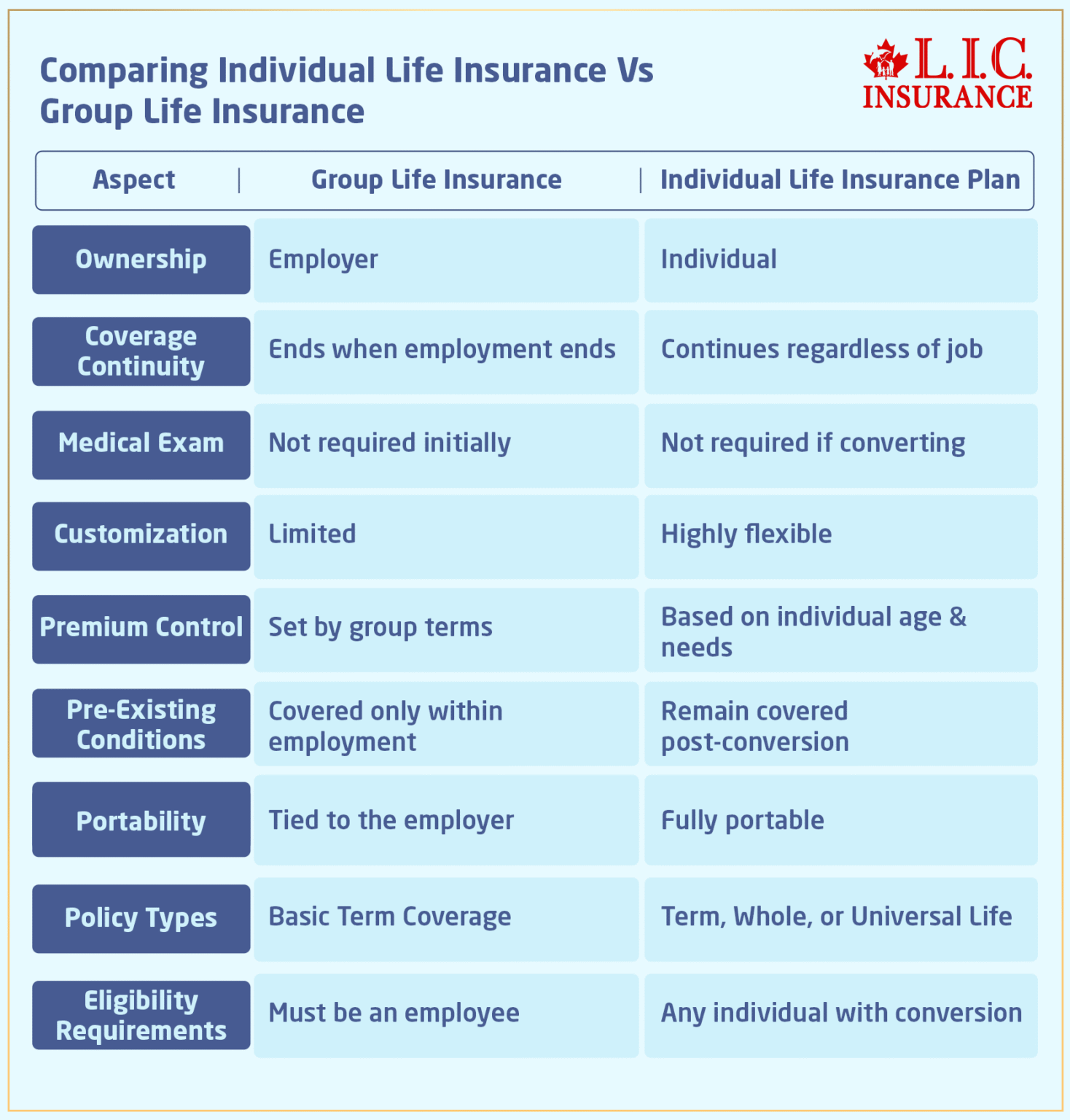
| Feature | Life Insurance Conversion | Life Insurance Portability | New Individual Policy |
|---|---|---|---|
| Evidence of Insurability | Not Required (Guaranteed) | Often Not Required | Required (Medical Exam) |
| Policy Type | Permanent (Whole Life) | Term Life | Term or Permanent |
| Cost | High (Attained Age) | Moderate | Lowest (if healthy) |
| Coverage Limits | Up to the group limit | Often capped or reduced | Based on income/need |
| Cash Value | Yes (Builds over time) | No | Optional |
| Timeline | 31-day strict window | 31-day strict window | Anytime |
When to Choose Conversion
Conversion is the best option if you have a chronic illness, a history of major medical events (like a heart attack or cancer), or are of an advanced age where new term life insurance would be prohibitively expensive or unavailable. Because it is a whole life policy, it will provide coverage for the remainder of your life as long as premiums are paid, and it will eventually build cash value.
When to Choose Portability
Some legacy Assurant plans offer "Portability." This allows you to take your term insurance with you at a group-like rate. However, portability often has "evidence of insurability" requirements if you are over a certain age or have specific health conditions. Furthermore, ported policies usually terminate at age 70 or 75, whereas converted policies are permanent.
Technical Specifications of the Converted Policy
Once the Assurant conversion form is processed, the resulting policy has specific characteristics that differ from the group coverage you previously held.
- Attained Age Rating: Your premium is calculated based on how old you are on the effective date of the new policy. It does not "grandfather in" the rates you had when you first joined the group plan.
- Permanent Nature: The policy is typically a Whole Life contract. This means the premium is level (it will not increase as you get older) and the policy remains in force until death, provided premiums are paid.
- Ownership: You are the sole owner of the policy. You can change beneficiaries, take out policy loans against the cash value, or surrender the policy for its cash value at any time.
- No Suicide or Incontestability Reset: In many states, if you have already cleared the two-year suicide and incontestability clauses under the group plan, those periods do not "reset" when you convert. This provides an extra layer of security for your beneficiaries.
Common Pitfalls in the Conversion Process
Errors in the conversion process can lead to a permanent loss of coverage. Senior benefits administrators frequently highlight the following mistakes:
- Missing the Deadline: The 31-day window is absolute in most contracts. Even being one day late can disqualify the application.
- Incorrect Premium Payment: If you send the form without the initial premium, or with an incorrect amount, the carrier may return the application. If the 31-day window expires while the form is in the mail, you may lose your rights.
- Incomplete Forms: Missing signatures from the employer (on the Notice of Right to Convert) or the applicant (on the Conversion Application) are leading causes of delay.
- Assuming Portability and Conversion are Identical: Many employees believe they are "porting" their cheap term insurance when they are actually "converting" to expensive whole life. Always clarify which form you are signing.
Alternatives to the Assurant Conversion Form
If you are in good health, the conversion of a legacy Assurant policy is likely the most expensive way to secure life insurance. Healthy individuals should explore:
- Private Term Life Insurance: For the same premium as a $50,000 converted whole life policy, a healthy 45-year-old might be able to secure $500,000 or more in private term coverage.
- Association Plans: Professional organizations or alumni associations often offer group-rate term insurance that may be cheaper than a converted individual policy.
- Spousal Coverage: If your spouse has a group plan at their workplace, you may be able to be added as a dependent during their open enrollment period.
Frequently Asked Questions
Can I convert only a portion of my Assurant life insurance?
Yes. You are generally permitted to convert any amount up to the full face value of your group coverage. For example, if you had $200,000 in group life, you could choose to convert only $50,000 to keep the premiums affordable. However, you cannot convert more than the amount you had under the group plan.
What happens if I die during the 31-day conversion window?
If an individual dies during the 31-day period following the termination of their group coverage, the death benefit is typically paid out to the beneficiaries as if the coverage were still in force, regardless of whether a conversion application was submitted. This is a standard protection in group life contracts.
Who do I contact if my former employer has gone out of business?
If the employer no longer exists, you must contact the insurance carrier directly. For most Assurant legacy policies, this is Sun Life Financial. You will need to provide your Social Security number and the name of the defunct company to help them locate the master policy and determine your eligibility.
Does the converted policy include Accidental Death and Dismemberment (AD&D)?
Generally, no. Conversion rights apply to the "Basic Life" or "Supplemental Life" portions of a policy. AD&D is usually considered a separate rider or benefit that does not carry over into a permanent individual whole life policy.
Is a medical exam ever required for conversion?
By definition, a true "conversion" does not require a medical exam. If a carrier asks for a medical exam, you are likely applying for a "new" policy or "porting" coverage that requires evidence of insurability, rather than exercising your contractual right to convert.
Practical Recommendation
If you are facing the loss of Assurant group life insurance in 2026, your first action should be to request the Notice of Right to Convert from your HR department. Review the cost of the conversion policy immediately. If you have significant health issues, complete the Sun Life/Assurant conversion form and submit it with the required premium well before the 31-day deadline. If you are in good health, use that same 31-day window to quickly shop for private term life insurance; if you are approved for a private policy, you can bypass the more expensive conversion option.