The Artemis II mission is currently scheduled to conclude its historic crewed flight around the Moon with a splashdown in the Pacific Ocean on April 10, 2026. This landing marks the first time humans have returned from deep space in over five decades, signifying a critical milestone in NASA’s goal of establishing a long-term presence on the lunar surface.
As of early 2026, the Artemis II mission represents the culmination of years of rigorous testing, engineering refinements, and international cooperation. This mission is the first crewed flight of the Space Launch System (SLS) rocket and the Orion spacecraft, carrying four astronauts on a high-stakes journey that loops around the Moon before returning to Earth. The April 10 touchdown is not merely a logistical end-point; it is the final validation of the life-support systems, heat shield integrity, and recovery procedures required for the subsequent Artemis III lunar landing mission.
The Mission Architecture: From Launch to Lunar Flyby
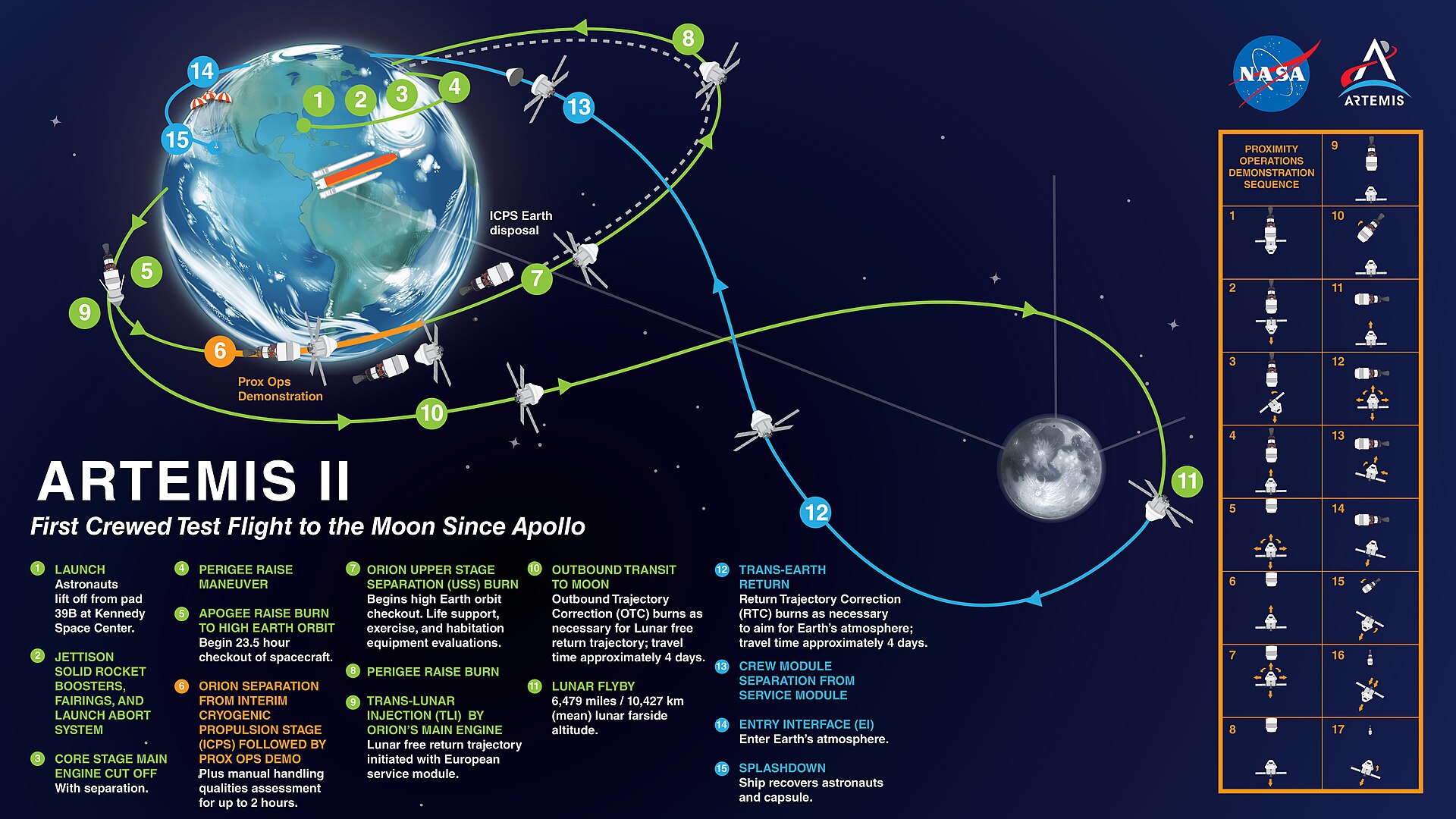
The Artemis II mission profile is a 10-day flight designed to test the Orion spacecraft's performance with a human crew on board. Unlike the uncrewed Artemis I mission, which lasted 25 days, Artemis II follows a "hybrid free-return trajectory." This specific orbital path ensures that the spacecraft can return to Earth using natural gravity if the primary propulsion system fails after the initial Trans-Lunar Injection (TLI) burn.
High Earth Orbit and System Checks
Before committing to the lunar flyby, the Orion spacecraft spends the first 24 hours in a High Earth Orbit (HEO). This phase is critical for the crew—Commander Reid Wiseman, Pilot Victor Glover, and Mission Specialists Christina Koch and Jeremy Hansen—to verify that the Environmental Control and Life Support System (ECLSS) is functioning perfectly. In 2026, the data from these checks is monitored in real-time by teams at Johnson Space Center.
During HEO, the crew performs proximity operations using the spent Interim Cryogenic Propulsion Stage (ICPS). This manual handling test demonstrates Orion’s handling qualities, which will be essential for future missions involving docking with the Lunar Gateway or the Human Landing System (HLS).
The Lunar Flyby and Return Trajectory
Once the systems are cleared, Orion performs the TLI burn, propelling the crew toward the Moon. The spacecraft reaches a distance of approximately 4,600 miles (7,400 kilometers) beyond the lunar far side. At this point, the crew experiences a perspective of the Earth and Moon that no human has seen since the Apollo 17 mission in 1972. The return journey is powered by the European Service Module (ESM), provided by the European Space Agency (ESA), which manages propulsion, power, and thermal control.
Technical Specifications: The Orion Spacecraft and Heat Shield Performance
The most harrowing phase of the Artemis II mission occurs during the final hours leading up to the April 10, 2026 touchdown. As Orion approaches Earth, it must shed a massive amount of kinetic energy. The spacecraft enters the atmosphere at approximately 24,500 mph (39,400 kph), or Mach 32.
The Skip Entry Maneuver
A defining technical feature of the Artemis II return is the "skip entry" maneuver. Orion hits the upper atmosphere, "skips" back out briefly like a stone across a pond to bleed off speed and heat, and then re-enters for the final descent. This technique allows NASA to more precisely target the splashdown location and reduces the G-loads experienced by the astronauts. It also limits the peak heating on the thermal protection system (TPS).
Thermal Protection and the Avcoat Shield
The Orion heat shield is 16.5 feet in diameter, making it the largest of its kind ever built. It is covered in Avcoat, an ablative material that wears away during re-entry to carry heat away from the capsule. During the descent on April 10, temperatures on the exterior of the shield will reach nearly 5,000 degrees Fahrenheit (2,760 degrees Celsius)—about half the temperature of the surface of the sun. The successful performance of this shield is the single most important factor for crew safety during the touchdown phase.
The Artemis II Crew: Pioneers of the Modern Lunar Era
The four individuals tasked with this mission represent a diverse range of experience and expertise. Their safe return on April 10, 2026, is a testament to the international partnerships that define the Artemis program.
- Reid Wiseman (Commander, NASA): A veteran of the International Space Station (ISS), Wiseman provides the leadership necessary for the first deep-space mission of the 21st century.
- Victor Glover (Pilot, NASA): As the first person of color to participate in a lunar mission, Glover’s role as pilot involves managing the complex flight systems of the Orion capsule.
- Christina Koch (Mission Specialist, NASA): Holding the record for the longest single spaceflight by a woman, Koch’s extensive experience with long-duration EVAs and station maintenance is vital for troubleshooting Orion’s systems.
- Jeremy Hansen (Mission Specialist, CSA): Representing the Canadian Space Agency, Hansen is the first non-American to travel to the vicinity of the Moon, highlighting the global nature of the mission.
Recovery Operations: The April 10 Splashdown Logistics
The touchdown on April 10, 2026, is a choreographed effort between NASA and the United States Navy. The primary recovery zone is located in the Pacific Ocean, typically off the coast of San Diego or Baja California, depending on prevailing weather patterns and sea states.
The Role of the USS Portland
The recovery is led by a San Antonio-class amphibious transport dock ship, such as the USS Portland. This vessel is equipped with a well deck that can be flooded, allowing the Orion capsule to be towed directly into the ship rather than being hoisted by a crane. This method is safer for the crew and protects the spacecraft from the corrosive effects of seawater during the extraction process.
Post-Splashdown Procedures
Upon splashdown, the Orion’s uprighting system—a series of five large orange balloons—inflates to ensure the capsule remains vertical in the swells. The crew remains inside the capsule until the recovery divers and Navy personnel secure the craft. Open-water egress is a high-risk activity; therefore, the crew is typically retrieved via a "front porch" platform or directly through the well deck of the recovery ship once the capsule is stabilized.
| Phase of Recovery | Duration/Metric | Key Action |
|---|---|---|
| Drogue Parachute Deployment | 25,000 ft altitude | Stabilization of the capsule's descent |
| Main Parachute Deployment | 9,500 ft altitude | Slowing velocity to ~20 mph for splashdown |
| Splashdown (Touchdown) | April 10, 2026 | Impact in the Pacific Ocean recovery zone |
| Capsule Uprighting | Immediate | Inflation of five CMUS (Crew Module Uprighting System) bags |
| Crew Extraction | ~60-90 minutes | Movement of astronauts from Orion to the recovery ship |
| Capsule Recovery | ~4-6 hours | Towing Orion into the flooded well deck of the USS Navy ship |
Critical Challenges and Safety Protocols
The successful touchdown of Artemis II depends on the resolution of several technical challenges identified during the uncrewed Artemis I mission. In 2026, NASA engineers have focused on three primary areas to ensure crew safety during the April 10 return.
Heat Shield Charring and Erosion
During Artemis I, engineers observed unexpected charring and "spalling" (the loss of small pieces of the heat shield) during re-entry. For the April 10 mission, the Avcoat application process was modified to ensure a more uniform thermal response. The Artemis II heat shield has undergone rigorous non-destructive evaluation to ensure no internal voids or weaknesses exist before the crew's return.
Communication Blackout Periods
As Orion enters the atmosphere, the friction of the air creates a sheath of ionized plasma around the spacecraft. This plasma blocks radio waves, resulting in a communication blackout period that typically lasts about seven minutes. During the April 10 landing, Mission Control in Houston will rely on automated telemetry and wait for the "skip" phase to re-establish contact before the final descent.
Side Hatch Integrity
Artemis II is the first Orion to fly with a fully functional side hatch designed for crew ingress and egress. Unlike the simplified hatch on Artemis I, this version must maintain a perfect seal against the vacuum of space for ten days and withstand the extreme pressures of re-entry. The structural integrity of this hatch is a primary focus for the pre-landing safety brief.
Significance for the Future: Beyond Artemis II
The splashdown on April 10, 2026, serves as the final "green light" for the Artemis III mission, which aims to land the first woman and first person of color on the lunar south pole. Every gallon of fuel consumed and every parachute line deployed during Artemis II provides data that reduces the risk for future lunar landings.
By verifying that a crew can survive the radiation environment of deep space and the extreme forces of a 25,000-mph re-entry, Artemis II transitions the program from the experimental phase to the operational phase. The mission also tests the Deep Space Network (DSN), ensuring that continuous communication can be maintained with astronauts who are thousands of miles from Earth.
NASA Artemis Program Official Site European Space Agency: Orion ESM Canadian Space Agency: Artemis II Crew
Frequently Asked Questions
Why is the Artemis II mission not landing on the Moon?
The primary goal of Artemis II is to test the spacecraft's life-support systems and the safety of the crew in a deep-space environment. Landing on the Moon requires a separate vehicle called the Human Landing System (HLS). By orbiting the Moon first, NASA can verify that the Orion capsule is safe for human transport before attempting the much more complex landing and ascent maneuvers scheduled for Artemis III.
How long will the astronauts be in the water after touchdown?
NASA aims to have the crew out of the capsule and on the recovery ship within 60 to 90 minutes of splashdown. However, the astronauts are trained to remain in the capsule for up to 24 hours if sea conditions are too rough for a safe transfer. The Orion capsule is stocked with emergency supplies and climate control systems to maintain a habitable environment during this waiting period.
What happens to the Orion capsule after it is recovered on April 10?
Once the USS Navy ship returns to port, the Orion capsule is transported back to the Kennedy Space Center in Florida. Engineers perform a "post-flight autopsy" of the craft, analyzing the heat shield's erosion patterns, the performance of the avionics, and the interior radiation levels. Data gathered from the April 10 landing will be used to finalize the flight software and hardware configurations for Artemis III.
Can the splashdown date change?
Yes. While April 10, 2026, is the target date, the actual touchdown depends on the launch window and orbital dynamics. NASA also monitors weather conditions in the Pacific recovery zone up to the final hours before re-entry. If there are high winds, lightning, or excessive wave heights, the mission can be extended by several days while the spacecraft remains in a stable orbit, waiting for a safe landing window.
What kind of training did the crew undergo for the splashdown?
The crew practiced egress procedures in the Neutral Buoyancy Laboratory (NBL) in Houston, a massive pool containing a mockup of the Orion capsule. They also participated in "Underway Recovery Tests" (URT) with the U.S. Navy, practicing how to exit the capsule in open water and how to be hoisted into helicopters or transferred to small inflatable boats.
Final Recommendation for Observers
For those following the Artemis II mission, the April 10, 2026 touchdown will be broadcast live via NASA TV and various international space agencies. The most critical moments to watch are the parachute deployment sequences starting at approximately 25,000 feet and the final splashdown. Following the landing, NASA will release a detailed mission report within several weeks, providing the definitive technical analysis required to clear the way for the next phase of human lunar exploration.