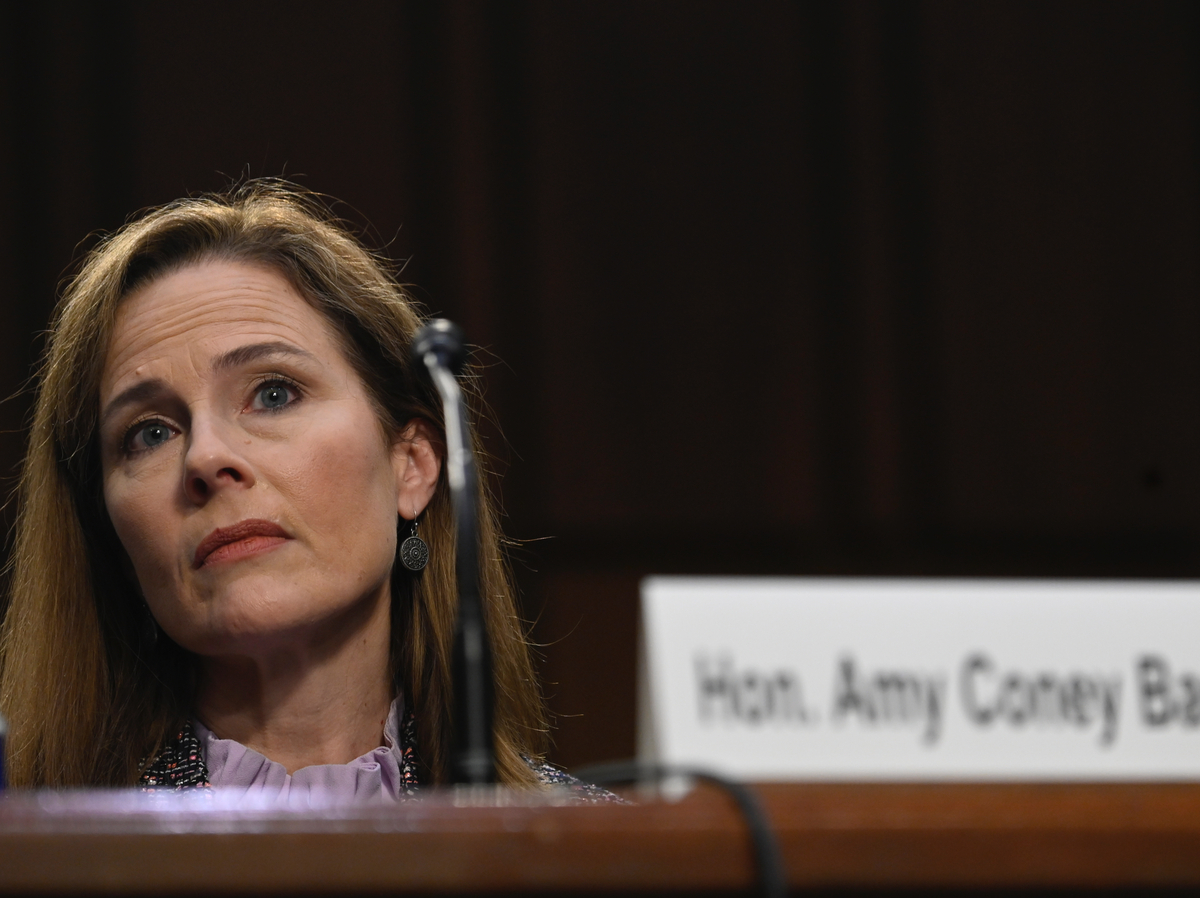
Amy Coney Barrett’s ideology is defined by two central pillars: originalism and textualism. As an Associate Justice of the U.S. Supreme Court, she interprets the Constitution based on its original public meaning at the time of enactment and statutes by their literal text, seeking to limit judicial discretion and adhere strictly to the written law.
Since her appointment to the Supreme Court in late 2020, Amy Coney Barrett has emerged as a cornerstone of the conservative judicial majority. By 2026, her impact on American jurisprudence has become increasingly clear through a series of landmark rulings and detailed opinions. To understand her ideology is to understand a specific methodology of legal interpretation that prioritizes the "four corners" of a document over evolving social norms or legislative intent. This philosophy seeks to separate the personal preferences of a judge from the objective meaning of the law, a distinction Barrett has emphasized throughout her career as both a scholar and a jurist.
The Foundations of Originalism
At the heart of Amy Coney Barrett’s constitutional ideology is originalism. This theory posits that the provisions of the U.S. Constitution should be interpreted according to the meaning they had at the time they were written and ratified. For Barrett, the Constitution is a fixed anchor rather than a "living" document that changes with the times. She argues that if the meaning of the Constitution were allowed to drift based on contemporary values, the judiciary would effectively be usurping the role of the legislature.
Barrett’s brand of originalism is often described as "original public meaning" originalism. This approach does not necessarily look for the subjective intent of the Framers (what they personally hoped to achieve) but rather how a reasonable, informed citizen at the time of ratification would have understood the words. For example, when interpreting the Second Amendment or the Fourth Amendment, an originalist like Barrett looks at 18th-century dictionaries, legal treatises, and historical context to discern the scope of the rights protected.
The primary goal of this approach is to provide stability and predictability in the law. Critics often argue that originalism is a "dead hand" philosophy that prevents the law from addressing modern problems. However, Barrett maintains that the democratic process is the proper venue for change. If the Constitution is out of step with modern needs, she believes it should be amended through the Article V process, not updated by a panel of unelected judges.
Textualism in Statutory Interpretation
While originalism governs her constitutional views, textualism is the lens through which Justice Barrett views federal statutes. Textualism is the practice of interpreting a law by looking solely at the text itself, rather than trying to divine the "intent" of the legislators who passed it. This ideology was famously championed by her mentor, Justice Antonin Scalia, for whom she clerked in the late 1990s.
In Barrett’s view, the law is only what was actually voted on and signed by the President. Legislative history—such as floor speeches, committee reports, or early drafts of a bill—is largely irrelevant in a textualist analysis. Barrett argues that using legislative history allows judges to "pick out their friends in a crowd," selecting the pieces of history that support their desired outcome while ignoring those that do not.
By sticking to the text, Barrett aims to ensure that the law is accessible to the average citizen. If a statute is written clearly, a person should be able to read it and know what is required of them without needing to research 40-year-old congressional records. This approach often leads her to reach results that may seem counterintuitive or politically unpopular, but she views this as the hallmark of a disciplined judge who is bound by the law as written.
The Influence of Justice Antonin Scalia
It is impossible to discuss Amy Coney Barrett’s ideology without acknowledging the profound influence of Justice Antonin Scalia. Barrett often describes herself as having the "same judicial philosophy" as her former boss. During her 2020 confirmation hearings, she explicitly stated that Scalia’s philosophy was hers as well: "A judge must apply the law as written, not as the judge wishes it were."
However, Barrett is not a mere carbon copy of Scalia. While she shares his commitment to methodology, her writing style is often described as more technical and less combative. Where Scalia was known for his fiery dissents and rhetorical flourishes, Barrett tends toward a more clinical, academic approach. She focuses heavily on the technical nuances of the law, such as the rules of grammar and the historical usage of specific legal terms.
Furthermore, Barrett has shown a distinct interest in the concept of standing—the legal right of a party to bring a lawsuit. Her ideology includes a rigorous view of the judicial power, suggesting that courts should only intervene when there is a concrete, individual injury, rather than a generalized grievance about how the government is being run. This helps define her vision of a limited role for the federal judiciary.
Stare Decisis and the Weight of Precedent
One of the most debated aspects of Justice Barrett’s ideology is her approach to stare decisis, the legal principle of adhering to precedent. Before joining the bench, Barrett was a prolific law professor at Notre Dame, where she wrote extensively on this topic. In her academic work, she suggested that the duty of a judge to follow the Constitution should generally outweigh the duty to follow a prior court decision that was "demonstrably erroneous."
This view of precedent is more flexible than that of some of her colleagues. While she acknowledges that following past decisions promotes stability, she does not view precedent as an "inexorable command." This aspect of her ideology was central to the debate surrounding the overturning of Roe v. Wade in the case of Dobbs v. Jackson Women's Health Organization (2022). In that ruling, Barrett joined the majority in concluding that a prior decision could be overruled if it was clearly wrong and had failed to create a stable legal framework.
In 2026, we see this approach applied to other areas, including administrative law and environmental regulations. Barrett’s ideology suggests that if a previous Court expanded federal power beyond what the Constitution or a statute allows, the current Court has a responsibility to correct that error, regardless of how long the precedent has stood.
The Administrative State and the Major Questions Doctrine
A defining feature of Barrett’s tenure has been her skepticism of the "administrative state"—the vast array of federal agencies like the EPA, the FDA, and the SEC that create and enforce regulations. Her ideology aligns with the "Major Questions Doctrine," which holds that if an agency wants to decide an issue of vast "economic and political significance," it must have clear and specific authorization from Congress.
Barrett’s textualism plays a major role here. She believes that agencies often take vague language in old laws and use it to justify new, sweeping regulations that Congress never envisioned. For Barrett, this is a violation of the Separation of Powers. By reigning in these agencies, she seeks to return policymaking power to the elected members of Congress, who are directly accountable to the voters.
This skepticism was evident in cases such as West Virginia v. EPA and the subsequent 2024 decision in Loper Bright Enterprises v. Raimondo, which effectively ended "Chevron deference." Barrett’s ideology posits that courts, not agencies, should be the final arbiters of what a law means.
Religious Liberty and the Free Exercise Clause
As a person of deep faith, Barrett has often been scrutinized regarding how her religious beliefs might influence her rulings. However, her judicial ideology emphasizes a strict separation between personal conviction and legal duty. She has consistently stated that her religious affiliations do not dictate her judicial outcomes.
That said, Barrett’s ideology is highly protective of the Free Exercise Clause of the First Amendment. She generally supports the idea that religious individuals and organizations should be exempt from neutral laws that place a "substantial burden" on their religious practice, unless the government can prove a compelling interest. Her rulings suggest a move toward a more robust protection of religious expression in the public square, often siding with religious groups in disputes over COVID-19 restrictions or foster care placements.
Comparison of Judicial Philosophies
To better understand where Barrett sits on the ideological spectrum, it is helpful to compare her approach with other common philosophies found on the Supreme Court.
| Philosophy | Interpretation Basis | View of Precedent | Role of the Judge |
|---|---|---|---|
| Originalism (Barrett) | Public meaning at time of enactment | Subordinate to original meaning | Neutral referee/Interpreter |
| Textualism (Barrett) | Literal text of the statute | Strong, but corrected if "wrong" | Finder of objective meaning |
| Living Constitutionalism | Evolving societal values | Central to stability | Protector of fundamental rights |
| Purposivism | The "spirit" or goal of the law | Very high | Problem-solver for the legislature |
Frequently Asked Questions
Does Amy Coney Barrett believe in "Super-Precedents"?
During her confirmation hearings, Barrett was asked if certain cases, like Brown v. Board of Education, were "super-precedents" that could never be overturned. She defined a super-precedent as a case that is so widely accepted that no one is seriously litigating it or calling for its repeal. While she acknowledges their existence in a practical sense, her judicial ideology maintains that no case is technically immune from constitutional challenge if it is found to be fundamentally at odds with the Constitution's original meaning.
How does Barrett's ideology affect environmental law?
Barrett’s textualism and skepticism of agency power often lead to narrower interpretations of environmental statutes like the Clean Air Act. She tends to require that Congress be very explicit when granting an agency the power to regulate significant portions of the economy. This often results in a reduction of the federal government's ability to implement broad environmental mandates without new, specific legislation.
Is she considered a "swing vote" on the current Court?
While Barrett is firmly in the conservative wing, she has occasionally broken away from more senior conservatives like Justices Thomas and Alito, particularly on procedural issues or specific applications of the law. She is often seen as a "bridge" between the traditional institutionalism of Chief Justice John Roberts and the more aggressive originalism of Justice Thomas. In 2026, legal analysts view her as a justice who is deeply committed to her methodology, even when it leads to less-than-ideal political outcomes for conservatives.
What is her view on the Second Amendment?
Barrett is a strong supporter of the originalist interpretation of the Second Amendment. Even before joining the Supreme Court, she wrote a notable dissent as a circuit judge in Kanter v. Barr, arguing that the government cannot permanently strip non-violent felons of their right to bear arms. Her ideology suggests that the right to self-defense is an individual right that can only be limited by regulations that have a historical pedigree in American law.
How does her ideology treat international law?
Barrett is generally a "sovereigntist," meaning she believes that international law or the rulings of foreign courts should have little to no influence on the interpretation of the U.S. Constitution. She maintains that the U.S. legal system is governed by its own foundational documents and that looking to foreign law to interpret American rights is inconsistent with the principles of originalism and democratic accountability.
Practical Guidance for Legal Researchers
For those studying Amy Coney Barrett’s ideology, it is essential to look beyond her Supreme Court opinions and examine her academic body of work from her time at Notre Dame Law School. Her articles on "Statutory Stare Decisis" and "Substantive Canons and Judicial Restraint" provide the theoretical framework she uses today.
When analyzing a Barrett opinion, one should:
- Identify the Text: Look for her analysis of specific words and their historical definitions.
- Look for Canons: She frequently uses "canons of construction"—legal rules of thumb—to resolve ambiguities in the text.
- Evaluate the Jurisdictional Limits: Check if she focuses on whether the court even has the power to hear the case (standing).
- Note the Separation of Powers: She often concludes her opinions by reminding the reader that the "fix" for a problematic law lies with Congress, not the Court.
By adhering to this methodology, Barrett seeks to maintain a judiciary that is "umpires, not players," a goal that remains the centerpiece of her judicial identity in 2026.