Amscot provides alternative consumer financial services, including cash advances and installment-style loans, primarily operating through physical storefronts in Florida alongside online platforms. Borrowers seeking short-term liquidity through these products must navigate specific state regulations, fee structures, eligibility criteria, and repayment obligations before committing to an agreement.
Understanding Amscot Financial Services
Navigating short-term financial needs often leads consumers to alternative financial service providers. Amscot, formally known as Amscot Corporation, is a prominent financial services company headquartered in Tampa, Florida. Established primarily as a check-cashing and cash-advance business, the company has grown to operate hundreds of retail branches across Florida. In addition to traditional brick-and-mortar storefronts, Amscot extends its service footprint digitally, allowing eligible customers to apply for select financial products online.
When evaluating short-term credit, consumers frequently encounter terms such as cash advances, payday loans, and installment loans. While these products share the common goal of providing rapid liquidity, their operational mechanics, repayment schedules, and cost structures vary significantly. Understanding how Amscot structures these credit options requires a clear look at state regulatory frameworks, particularly those enforced by the Florida Office of Financial Regulation (OFR). Because state laws govern the maximum fees, loan amounts, and repayment terms for small-dollar credit, Amscot’s offerings are heavily shaped by Florida statutory limits.
The Regulatory Framework and Product Types
To understand Amscot’s short-term financing products, it is essential to distinguish between traditional single-payment cash advances (commonly known as payday loans) and multi-payment installment options.
Single-Payment Cash Advances vs. Installment Loans
A traditional cash advance or deferred presentment transaction typically requires the borrower to repay the full balance—plus a fee—on their next payday, usually within 7 to 31 days. Under Florida law, deferred presentment transactions are strictly regulated. Lenders cannot exceed specific fee caps, and borrowers are subject to database tracking systems designed to prevent concurrent loans that could lead to a cycle of debt.
Conversely, installment loans provide a lump sum of cash that is repaid over a longer, structured series of scheduled payments (installments). This structure spreads the principal and finance charges across multiple weeks or months, potentially offering lower periodic payment amounts compared to a lump-sum balloon payment. However, because the repayment period is extended, the cumulative cost of borrowing can be higher depending on the interest rate and fee computations permitted under state statutes or partnered lending frameworks.
Online vs. In-Store Availability
While Amscot is famous for its 24/7 physical storefronts in major Florida metropolitan areas, its digital channels serve customers who prefer remote applications. However, prospective borrowers should note that online availability, approval criteria, and the exact nature of the loan product (whether issued directly by Amscot or facilitated through third-party lending partners) depend on current licensing rules and regulatory compliance mandates.
Eligibility Criteria and Application Requirements
Securing an online installment cash advance or short-term loan requires meeting specific baseline qualifications. Lenders enforce these criteria to assess creditworthiness, verify identity, and comply with state lending laws.
Core Prerequisites for Applicants
- Age and Residency: Applicants must typically be at least 18 years of age and hold legal residency within the state where the service is legally authorized (primarily Florida for direct Amscot storefront operations).
- Verifiable Income Source: Borrowers must demonstrate a steady, reliable source of income. This can include employment wages, government benefits, social security, or disability payments. Lenders require proof through recent pay stubs or bank statements.
- Active Checking Account: A valid, open checking account is generally mandatory. This account is used for electronic fund transfers (EFT), facilitating both the disbursement of loan proceeds and the automated collection of scheduled repayments.
- Valid Identification and Contact Details: Government-issued photo identification (such as a driver’s license or state ID), a valid Social Security number or Individual Taxpayer Identification Number (ITIN), and active phone and email contacts are required for identity verification.
The Application Procedure
Applying for short-term credit digitally typically involves a structured multi-step process:
- Initial Data Entry: Completing an online application form detailing personal information, employment status, monthly income, and banking details.
- Document Upload: Providing digital copies of pay stubs, bank statements, and identification if automated verification systems cannot instantly validate the information.
- Loan Offer Review: Examining the formal loan agreement, which outlines the Annual Percentage Rate (APR), finance charges, total repayment amount, and the precise schedule of payments.
- Funding Disbursement: Upon electronic signature and final approval, funds are deposited directly into the borrower's checking account, often within one to two business days, depending on banking processing windows.
Cost Considerations, Fees, and Financial Risks
Short-term consumer loans and cash advances carry significant financial costs that must be weighed carefully against alternative funding sources.
Fee Structures and APR Realities
Unlike conventional long-term bank loans or credit cards, short-term cash advances and installment loans often feature high Annual Percentage Rates (APRs) when calculated on an annualized basis. Because the borrowing term is short, a flat fee translates into a very high APR. Consumers must review the Truth in Lending Act (TILA) disclosures provided during the application process to understand the exact dollar cost of borrowing.
Risks Associated with Short-Term Credit
- Rollover and Refinancing Traps: Extending or renewing a loan can incur additional fees, substantially increasing the total cost of the debt.
- Bank Overdraft Fees: Automated clearing house (ACH) withdrawal attempts on accounts with insufficient funds can trigger costly bank overdraft or non-sufficient funds (NSF) fees from the borrower's financial institution.
- Credit Score Impacts: While some short-term lenders do not report on-time payments to major credit bureaus (Equifax, Experian, TransUnion), defaults, charge-offs, or accounts sent to collections can severely damage a consumer's credit profile.
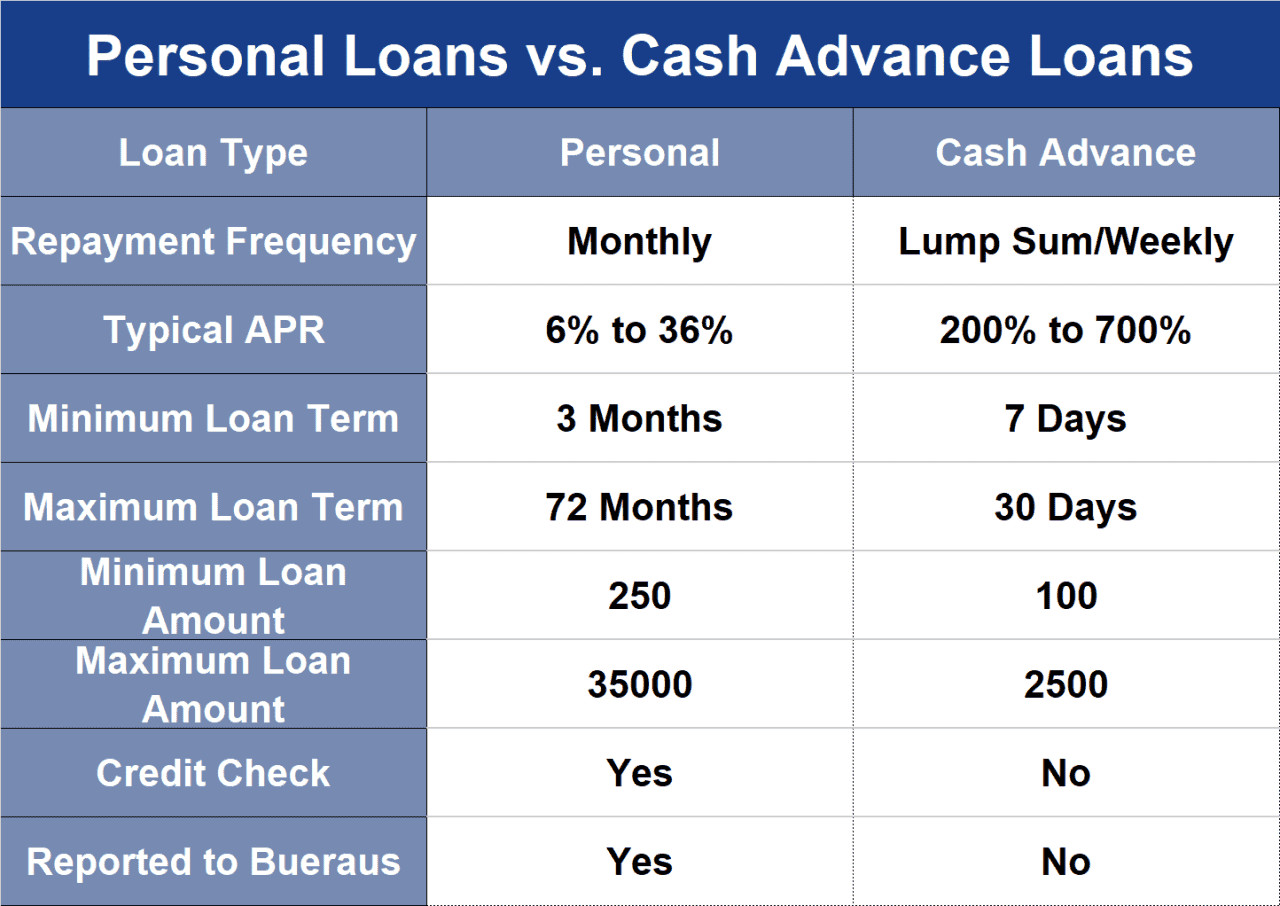
| Feature / Aspect | Traditional Payday Cash Advance | Installment Loan Structure |
|---|---|---|
| Repayment Term | Single payment (typically 7–31 days) | Multiple scheduled payments (weeks to months) |
| Payment Frequency | Lump sum on next payday | Weekly, bi-weekly, or monthly installments |
| Principal Amount | Generally smaller (capped by state statute) | Varies; often higher due to multi-payment design |
| Cost Transparency | Flat fee per hundred borrowed | Finance charges plus interest over time |
| Regulatory Oversight | Heavily restricted by state deferred presentment laws | Governed by state consumer lending statutes |
Alternatives to Short-Term Cash Advances
Before applying for an online installment cash advance or payday loan, consumers should evaluate alternative financial strategies that may carry lower costs and reduced financial risk.
- Emergency Savings Funds: Utilizing liquid savings is the most cost-effective method for handling unexpected expenses, entirely avoiding interest and fee burdens.
- Credit Union Pal (Payday Alternative Loans): Many federal credit unions offer small-dollar PAL programs with strictly capped interest rates and lower application fees compared to commercial payday lenders.
- Employer-Sponsored Earned Wage Access (EWA): Numerous employers partner with financial technology platforms that allow workers to access wages they have already earned prior to their official payday for minimal or no fees.
- Local Community and Non-Profit Assistance: Charitable organizations, religious groups, and local municipal agencies often emergency assistance grants for utility bills, medical expenses, or rent.
- Negotiating with Creditors: Contacting utility companies, landlords, or medical billing departments to request temporary hardship extensions or structured payment plans can prevent the need for high-cost credit.
Frequently Asked Questions
Can I apply for an Amscot cash advance or installment loan entirely online?
Yes, Amscot provides digital application channels for select financial products. However, specific product availability, maximum loan amounts, and regulatory terms depend heavily on your state of residence and current licensing frameworks.
Do short-term loans affect my credit score?
Many alternative financial service providers do not run hard credit inquiries or report on-time repayment history to major credit bureaus. However, failing to repay the loan as agreed can result in the account being sent to third-party collection agencies, which negatively impacts credit reports.
What happens if I miss a scheduled installment payment?
Missing a payment can result in late fees, additional interest charges, and automated re-initiation of payment pulls by the lender. This can also trigger insufficient funds (NSF) fees from your bank, further compounding your financial difficulty.
Are Amscot cash advances regulated by the government?
Yes. Financial service providers operating in this sector are subject to state regulations, such as those enforced by the Florida Office of Financial Regulation, which establish maximum fee caps, database tracking mandates, and consumer protection guidelines.
What documents do I need to prepare before applying?
Applicants typically need a government-issued photo ID, proof of a steady income source (such as recent pay stubs or electronic direct deposit records), an active checking account in their name, and a working telephone number and email address.
Conclusion and Next Actions
Evaluating an online installment cash advance requires a transparent assessment of your immediate financial necessity versus the long-term cost of borrowing. If you decide to proceed, carefully review all TILA disclosures, verify the lender's state licensing credentials, and establish a concrete repayment budget to ensure the debt is settled without triggering additional fees. For ongoing financial stability, prioritize building an emergency savings buffer and exploring lower-cost credit alternatives such as credit union loans or employer-backed wage access programs.