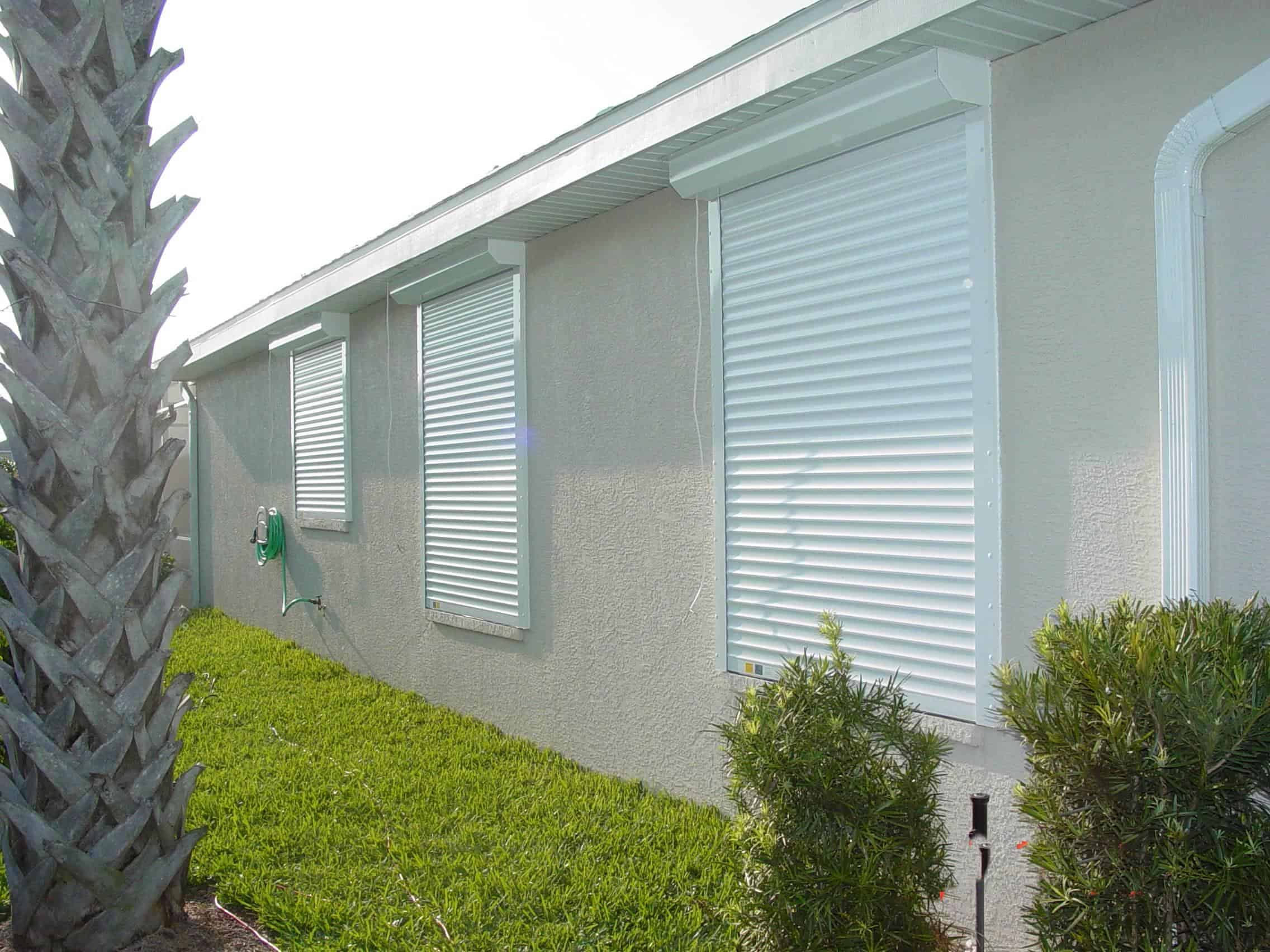
Aluminum roll down hurricane shutters are permanently installed protective systems that deploy vertically along tracks to shield windows and doors from high-velocity wind and flying debris. Constructed from high-strength extruded aluminum, they provide the highest level of storm protection, security, and energy efficiency, often controlled via motorized smart systems or manual cranks.
Understanding the Engineering of Aluminum Roll Down Shutters
To appreciate why aluminum roll down hurricane shutters are considered the "gold standard" in coastal protection as of 2026, one must look at their structural engineering. Unlike removable panels or fabric screens, roll down shutters (also known as rolling shutters) are built into the architecture of the home.
The system consists of several primary components: the slat curtain, the side tracks, the axle, and the housing box (or hood). The slats are the individual horizontal pieces that interlock to form the protective barrier. In high-end 2026 models, these slats are almost exclusively made of extruded aluminum, typically using the 6063-T6 alloy. This specific grade of aluminum offers an optimal balance of tensile strength and corrosion resistance, which is vital for homes located within a few hundred feet of saltwater.
The manufacturing process involves forcing the heated aluminum through a die to create complex, hollow shapes. These hollow chambers are often filled with high-density polyurethane foam. While the foam is frequently marketed for its insulation properties, its primary structural role is to provide "ribbing" support, preventing the aluminum skin from buckling under the extreme pressure of 150+ mph winds.
Extruded vs. Roll-Formed Aluminum
It is essential for homeowners to distinguish between extruded and roll-formed aluminum. Roll-formed shutters are made from thin sheets of aluminum that are bent into shape. While lighter and less expensive, they lack the impact resistance required for the most severe storm zones. Extruded aluminum is significantly thicker and more rigid, making it the preferred choice for the High Velocity Hurricane Zone (HVHZ) requirements found in jurisdictions like Miami-Dade and Broward County.
Performance Standards and Impact Ratings in 2026
In 2026, the regulatory landscape for hurricane protection is more stringent than ever. To be legally classified as a "hurricane shutter," a roll down system must pass rigorous testing protocols established by organizations such as ASTM International and the Florida Building Code (FBC).
The Large Missile Impact Test
The most critical evaluation is the Large Missile Impact Test (TAS 201). This test involves firing a 9-pound 2x4 wooden stud at the shutter at a speed of 50 feet per second (approximately 34 mph). To pass, the shutter must not only remain in its tracks but must also prevent the missile from penetrating the curtain. Following the impact, the shutter undergoes thousands of cycles of positive and negative pressure (TAS 202) to simulate the "push-pull" effect of a passing hurricane's eye wall.
Wind Load Capacity
As global weather patterns shift, 2026 building codes often require shutters to withstand wind loads exceeding 180 mph in certain coastal regions. Aluminum roll down shutters are uniquely qualified for this because their side tracks are anchored deeply into the structural members of the building (concrete blocks or wood studs). The "end-retention" system—where the slats are physically locked into the side tracks using high-strength nylon or metal "end-retention" clips—prevents the curtain from being blown out of the tracks even under extreme atmospheric suction.
The Core Benefits: Beyond Storm Protection
While the primary intent is life and property safety during a cyclone, aluminum roll down shutters provide year-round utility that justifies their higher initial investment.
1. Superior Home Security
Because the slats are interlocked and the tracks are securely anchored, these shutters serve as an exceptional deterrent against forced entry. In 2026, many homeowners deploy their roll downs not just for storms, but whenever they leave for vacation. The physical barrier is nearly impossible to breach without heavy power tools and significant noise, making them a favorite for seasonal residents.
2. Thermal Insulation and Energy Efficiency
The air gap created between the window glass and the shutter curtain acts as a powerful thermal buffer. During the sweltering summer months, closing the shutters on the sun-facing side of a house can reduce solar heat gain by up to 90%. This significantly lowers the load on HVAC systems. Conversely, in winter, the shutters help retain interior heat, providing a secondary layer of insulation that traditional windows cannot match.
3. Noise Reduction and Light Control
For homeowners living near busy intersections, airports, or construction sites, the acoustic dampening properties of foam-filled aluminum slats are a major benefit. These systems can reduce ambient noise infiltration by 50% to 80%. Additionally, because they offer "blackout" capabilities, they are ideal for media rooms or for shift workers who need to sleep during daylight hours.
Operational Methods: The Shift to Smart Integration
As we navigate 2026, the technology used to deploy these shutters has evolved from simple manual cranks to sophisticated automated systems.
Manual Overrides and Crank Systems
Manual shutters are operated via a "gear and crank" system. A handle is inserted into a universal joint inside the home, allowing the user to wind the shutter up or down. While reliable and independent of the power grid, manual systems can be labor-intensive for large homes with 20 or more windows.
Motorized Systems and Smart Home Connectivity
Modern motorized roll down shutters use tubular motors hidden inside the axle. In 2026, these motors are increasingly compatible with Matter and Thread protocols, allowing them to integrate seamlessly with Apple Home, Google Home, and Amazon Alexa.
Homeowners can now set "Automated Weather Triggers." For instance, if a connected weather station detects winds exceeding 40 mph, the shutters can be programmed to close automatically. Furthermore, many systems now include battery backups or solar-powered motor options, ensuring that the shutters can still be deployed even if the municipal power grid fails hours before a storm makes landfall.
| Feature | Extruded Aluminum Roll Down | Accordion Shutters | Hurricane Fabric/Screens |
|---|---|---|---|
| Primary Material | 6063-T6 Aluminum | Extruded Aluminum | High-strength PVC/Kevlar |
| Operation | Motorized or Manual | Manual Side-to-Side | Manual Attachment |
| Security Level | Maximum (Burglary Resistant) | Moderate | Low |
| Visual Impact | Hidden in box when up | Visible vertical stacks | No permanent visibility |
| Deployment Time | Seconds (via Remote/App) | Minutes per window | 15-30 mins per window |
| Average Lifespan | 20-30+ Years | 15-20 Years | 10-15 Years |
| Relative Cost | High | Moderate | Moderate/Low |
Installation Requirements and Technical Considerations
Installing aluminum roll down hurricane shutters is not a DIY project; it requires structural knowledge and, in most jurisdictions, a building permit.
Pre-Installation Inspection
A professional installer must first assess the "substrate" or the material to which the shutters will be attached. In 2026, installers use ultrasonic sensors to locate the exact center of concrete headers or wood framing. This ensures that the heavy-duty lag bolts have maximum "pull-out" resistance.
The Housing Box Size
One common concern for homeowners is the aesthetic impact of the housing box. The size of the box depends on the height of the window; a taller window requires a longer slat curtain, which results in a larger roll diameter. Typical box sizes range from 6 inches to 12 inches square. In new constructions, architects often design "recessed housings" where the box is tucked into the soffit or the wall itself, making the shutter completely invisible when retracted.
Electrical Requirements
For motorized units, a dedicated electrical circuit is often recommended, especially for large "banks" of shutters. Each motor typically draws between 1.5 to 3 amps. In 2026, many installations include a "Central Control Station" that allows for a "Master Close" function—one button that secures the entire perimeter of the home in under 60 seconds.
Cost Analysis and ROI in 2026
The cost of aluminum roll down shutters remains the highest among all storm protection options, but the return on investment (ROI) is multifaceted.
As of 2026, prices generally range from $45 to $85 per square foot, including professional installation. The variance depends on the choice of motorization, the complexity of the mounting (e.g., second-story installs or "build-outs" for decorative trim), and the color finish.
However, the financial benefits extend beyond protection:
- Insurance Premiums: Most insurers in hurricane-prone states provide significant "Wind Mitigation" discounts for homes with 100% opening protection using rated roll down shutters.
- Property Value: Appraisers in 2026 frequently cite permanent hurricane shutters as a high-value "hard asset" that increases the resale value of a home.
- Energy Savings: The reduction in cooling costs can lead to the system "paying for itself" over a 10-to-15-year period.
Maintenance and Longevity
To ensure that aluminum roll down shutters function during a crisis, a basic maintenance schedule is mandatory. Aluminum does not rust in the traditional sense, but it can undergo galvanic corrosion or "pitting" if salt spray is allowed to sit on the surface.
- Bi-Annual Cleaning: Wash the slats and tracks with mild soap and fresh water twice a year. This removes the salt crust that can grind down the finish.
- Track Lubrication: Use a dry silicone spray in the side tracks. Never use oil-based lubricants (like WD-40) as they attract dust and grit, which can jam the system.
- Monthly Operation: Even if there is no storm, motorized shutters should be cycled (opened and closed) at least once a month to keep the motor internal components lubricated and to ensure that insects or birds haven't built nests in the housing box.
Frequently Asked Questions
Can aluminum roll down shutters be opened from the outside?
Generally, no. When fully deployed, the internal locking mechanism of the motor or the manual gear system prevents the curtain from being lifted. Some models also feature manual "locking bars" for added security. This makes them highly effective against intruders.
What happens if the power goes out before I can close my motorized shutters?
In 2026, most high-quality motorized systems come with a "Manual Override" (MO) motor. This features a small port where a hand-crank can be inserted to operate the shutter manually during a power failure. Alternatively, many homeowners now opt for integrated battery backup systems (UPS) designed specifically for shutter motors.
Are these shutters noisy during high winds?
When properly installed with end-retention technology, aluminum roll down shutters are very quiet. The side tracks contain felt or brush inserts that dampen vibration. Unlike accordion shutters or metal panels, they do not "rattle" significantly, even in tropical-storm-force winds.
Do I need a permit to install roll down shutters on my home?
In almost all hurricane-prone regions (such as Florida, Texas, and the Carolinas), a building permit is required. This ensures that the product used is "Miami-Dade Approved" or has a valid "Florida Product Approval" number, and that the anchoring follows the engineered specifications for your specific wind zone.
How do roll down shutters compare to impact-resistant glass?
Impact glass is always "on duty" and doesn't change the look of the home. However, roll down shutters offer two things glass cannot: complete light blockage and a "sacrificial layer." While impact glass may not break through, the outer pane can shatter upon impact, requiring an expensive window replacement. A shutter protects the window glass entirely and provides a much higher level of thermal insulation.
Final Recommendation
For homeowners seeking the highest level of convenience, security, and protection, aluminum roll down hurricane shutters are the premier choice in 2026. While the initial cost is substantial, the combination of automated storm readiness and daily security makes them an invaluable asset for coastal living. If you are building a new home or retrofitting a high-value property, prioritize extruded aluminum slats with motorized smart-home integration and a manual override to ensure your home remains a fortress regardless of weather or power conditions.