The best alternatives to Followup CRM include industry-specific platforms like JobNimbus and Contractor Foreman for specialized trade workflows, or robust general-purpose tools like HubSpot and Pipedrive for advanced sales automation. Selecting the right replacement depends on whether your organization prioritizes pure bid management or requires a comprehensive project management suite with integrated CRM capabilities.
Choosing a Customer Relationship Management (CRM) platform in 2026 requires a focus on more than just contact storage. For construction firms and trade contractors, the software must bridge the gap between initial lead generation, the complex bidding process, and eventual project handoff. Followup CRM has long been a staple in this niche due to its construction-specific sales pipeline, but as companies scale or diversify their services, the need for more flexible integrations, advanced automation, or combined project management often leads them to seek alternatives.
Understanding the Need for Followup CRM Alternatives
Followup CRM was built specifically for the construction industry, focusing heavily on the "bidding" aspect of the sales cycle. However, the market in 2026 has evolved. Many firms now find that specialized tools can sometimes create data silos if they do not integrate seamlessly with accounting software like Sage or Viewpoint, or if they lack the robust marketing tools found in general-purpose CRMs.
The primary reasons organizations look for alternatives typically fall into three categories:
- Functional Breadth: A desire to manage the entire project lifecycle—from lead to punch list—within a single pane of glass, rather than using a dedicated sales tool and a separate project management tool.
- Customization Requirements: Followup CRM provides a structured workflow, but firms with unique sales processes may find the rigidity limiting compared to highly customizable platforms.
- Technological Integration: As AI-driven lead scoring and automated communication become standard in 2026, firms may seek platforms that offer deeper native integrations with modern communication stacks and business intelligence tools.
Top Industry-Specific Alternatives
When replacing a construction-specific tool, it is often wise to look at other platforms built with the "boots on the ground" in mind. These tools understand the nuances of estimates, change orders, and subcontractor management.
JobNimbus: The Leader for Roofing and Exterior Trades
JobNimbus has established itself as a premier alternative, particularly for contractors in roofing, solar, and restoration. Unlike Followup CRM, which leans heavily into the sales and bidding side, JobNimbus provides a more balanced approach between sales and production.
- Key Strengths: Its visual boards are highly intuitive, allowing teams to drag and drop jobs through various stages. In 2026, JobNimbus continues to excel in mobile accessibility, allowing field reps to upload photos, create estimates, and collect e-signatures directly from the job site.
- Suitability: It is best for small to mid-sized trade contractors who need a high degree of mobility and want their CRM to act as their primary project hub.
- Integration Landscape: It maintains strong ties with financing partners and material suppliers, allowing for a more streamlined procurement process compared to more generalized CRMs.
Contractor Foreman: All-in-One Project Management
For firms that find Followup CRM too narrow in scope, Contractor Foreman offers a comprehensive suite of tools that covers everything from lead tracking to financial reporting.
- Key Strengths: It provides over 35 modules, including time tracking, safety meetings, and daily logs. Its CRM component allows for detailed lead tracking, but the real value lies in how that data flows into estimates and schedules.
- Cost Efficiency: Contractor Foreman often appeals to firms looking for a predictable cost structure, as they offer flat-rate pricing models that do not penalize companies for adding more users as they grow.
- Suitability: Ideal for general contractors and trade professionals who want to consolidate their tech stack and eliminate the need for multiple software subscriptions.
Procore: The Enterprise Standard
While Procore is often categorized as project management software, its "Project Financials" and "Sales" modules make it a formidable alternative for large-scale commercial contractors.
- Key Strengths: The sheer scale of Procore’s ecosystem is its greatest asset. It offers an "App Marketplace" with hundreds of integrations, ensuring that sales data can be pushed into almost any other business system.
- Suitability: Large enterprise construction firms that handle multi-million dollar contracts and require rigorous compliance, document control, and sophisticated financial tracking.
- Limitations: The price point and complexity are significantly higher than Followup CRM, making it less suitable for smaller residential contractors.
General-Purpose Sales CRMs Adapted for Construction
Sometimes, the best alternative isn't a construction tool at all, but a world-class sales tool that can be customized to fit the construction workflow. These platforms often offer superior automation and reporting.
HubSpot: Advanced Marketing and Sales Automation
HubSpot has become a favorite for construction firms that prioritize lead generation and brand awareness. By 2026, HubSpot’s AI-powered "Content Hub" and "Sales Hub" have made it easier for contractors to automate follow-up emails based on specific user behaviors.
- Why it works: HubSpot allows for extremely granular tracking of how a lead found your company. If you are a high-volume residential contractor, knowing which ads are driving the most profitable bids is invaluable.
- Customization: You can build custom objects to represent "Projects" or "Bids," effectively mirroring the Followup CRM structure while gaining access to HubSpot's superior marketing engine.
- The Trade-off: It lacks native construction features like takeoff integration or specialized project scheduling, requiring third-party connectors (like Zapier) to bridge the gap.
Pipedrive: Visual Pipeline Focus
Pipedrive is perhaps the closest spiritual successor to the "Followup" philosophy, as its entire design is centered around the activity-based selling model.
- Key Strengths: Its interface is remarkably clean and focuses on what needs to happen next. For sales managers who want to ensure their estimators are actually making their follow-up calls, Pipedrive’s activity reminders are world-class.
- Integration: In 2026, Pipedrive’s API is one of the most stable in the industry, making it easy to sync bid data with specialized estimating software.
- Suitability: Small sales teams that want a low learning curve and a tool that focuses exclusively on closing more bids.
Feature and Cost Comparison Table
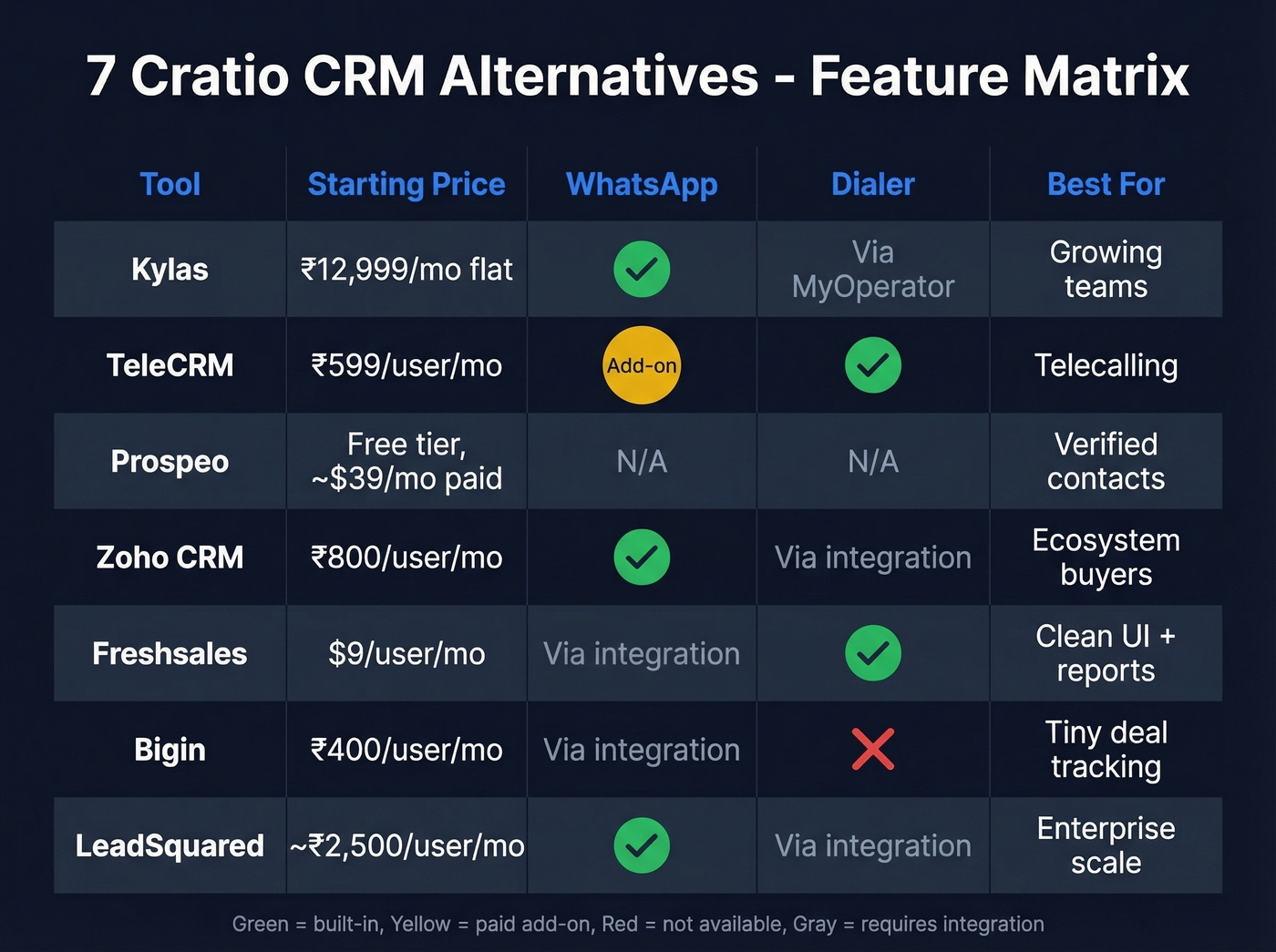
The following table compares key metrics for Followup CRM alternatives based on standard 2026 market data.
| Software | Primary Focus | Best For | Mobile Capability | Integration Depth |
|---|---|---|---|---|
| JobNimbus | Trades/Production | Roofing & Exterior | High (App-based) | Moderate (Industry-specific) |
| Contractor Foreman | All-in-One PM | General Contractors | High (Full feature) | High (Financial focus) |
| HubSpot | Marketing/Sales | High-volume Residential | Moderate (Sales focus) | Very High (Open API) |
| Pipedrive | Sales Pipeline | Small Sales Teams | Moderate (Lead focus) | High (Zapier/Direct) |
| Procore | Enterprise PM | Commercial/Large Scale | High (Complex docs) | Very High (App Store) |
| Zoho CRM | Customization | Tech-savvy Firms | Moderate (Custom) | Very High (Zoho Suite) |
Critical Selection Criteria: What to Look For
When evaluating these alternatives, it is essential to look beyond the feature list and consider how the software will function in the daily reality of a construction office or job site.
Bid Management vs. Lead Management
Followup CRM is unique because it treats a "Bid" as the primary unit of work. Many general CRMs treat a "Lead" or "Deal" as the primary unit. When switching, ensure the new software allows you to track multiple bids for the same client or project location without creating data duplicates.
Offline Accessibility
In the construction industry, field reps often work in areas with poor cellular reception. An alternative must have a robust offline mode that syncs data once a connection is re-established. JobNimbus and Procore are particularly strong in this area.
Implementation and Data Migration
Transitioning from Followup CRM requires moving years of historical bid data. Before committing, ask potential vendors about their migration services.
- Data Mapping: Can they map your existing custom fields (e.g., "Contract Value," "Estimator Name," "Bid Date")?
- Training: Does the vendor provide industry-specific onboarding, or is it a generic walkthrough?
Common Pitfalls During Transition
Many firms fail in their software transition because they underestimate the cultural shift required. If your team is used to the specific terminology of Followup CRM, moving to a general tool like Salesforce or HubSpot can feel alien.
- Over-complicating the Workflow: It is tempting to use every feature a new CRM offers. This often leads to "feature fatigue," where sales reps stop using the tool because it requires too much data entry.
- Neglecting the Accounting Sync: For construction firms, a CRM that doesn't talk to the accounting department is a liability. Ensure your choice supports two-way sync with tools like QuickBooks Online, Xero, or industry-specific ERPs.
- Ignoring Mobile Users: If the "Alternative" doesn't have a high-performing mobile app, your field teams will revert to using spreadsheets and paper notes, rendering the CRM data inaccurate.
Frequently Asked Questions
Which alternative is best for a small roofing company?
JobNimbus is generally considered the top alternative for small to mid-sized roofing companies. Its workflow is designed specifically for the roofing sales cycle, including features for storm tracking, photo management, and direct material ordering through suppliers like SRS Distribution or ABC Supply.
Can I use HubSpot for construction bid management?
Yes, but it requires setup. You will need to customize the "Deals" pipeline to reflect construction stages (e.g., Bidding, Pending Award, Under Contract). You may also want to use "Custom Objects" if you need to track multiple subcontractors associated with a single bid.
How much does it cost to switch from Followup CRM?
The cost includes the new software subscription (ranging from $50 to $300+ per user/month) plus implementation fees. Implementation can range from $2,000 for a simple setup to $20,000+ for enterprise-level data migration and custom integration.
Does Contractor Foreman replace the need for a separate CRM?
For many firms, yes. Contractor Foreman includes a lead management module that handles the core functions of a CRM. However, it may lack the advanced marketing automation (like automated drip campaigns) found in dedicated tools like HubSpot.
Is Procore too big for a trade contractor with 10 employees?
Generally, yes. Procore is designed for complex project environments. A 10-person trade firm would likely find the platform over-engineered and the cost-to-value ratio unfavorable compared to JobNimbus or Contractor Foreman.
Final Recommendation
If your primary goal is to maintain the construction-centric bidding focus of Followup CRM while gaining better project oversight, JobNimbus is the most logical step for trade contractors, while Contractor Foreman is the best fit for those seeking an all-in-one management tool. For firms that have outgrown the limitations of industry-specific software and want world-class sales automation, migrating to HubSpot or Pipedrive offers the most significant long-term scalability, provided you are willing to invest the time in initial customization.
Before making a final decision, conduct a "shadow test" where one or two of your most active sales reps use a trial version of the new software for a full week of real-world bidding to identify any friction points in the mobile interface or data entry process.