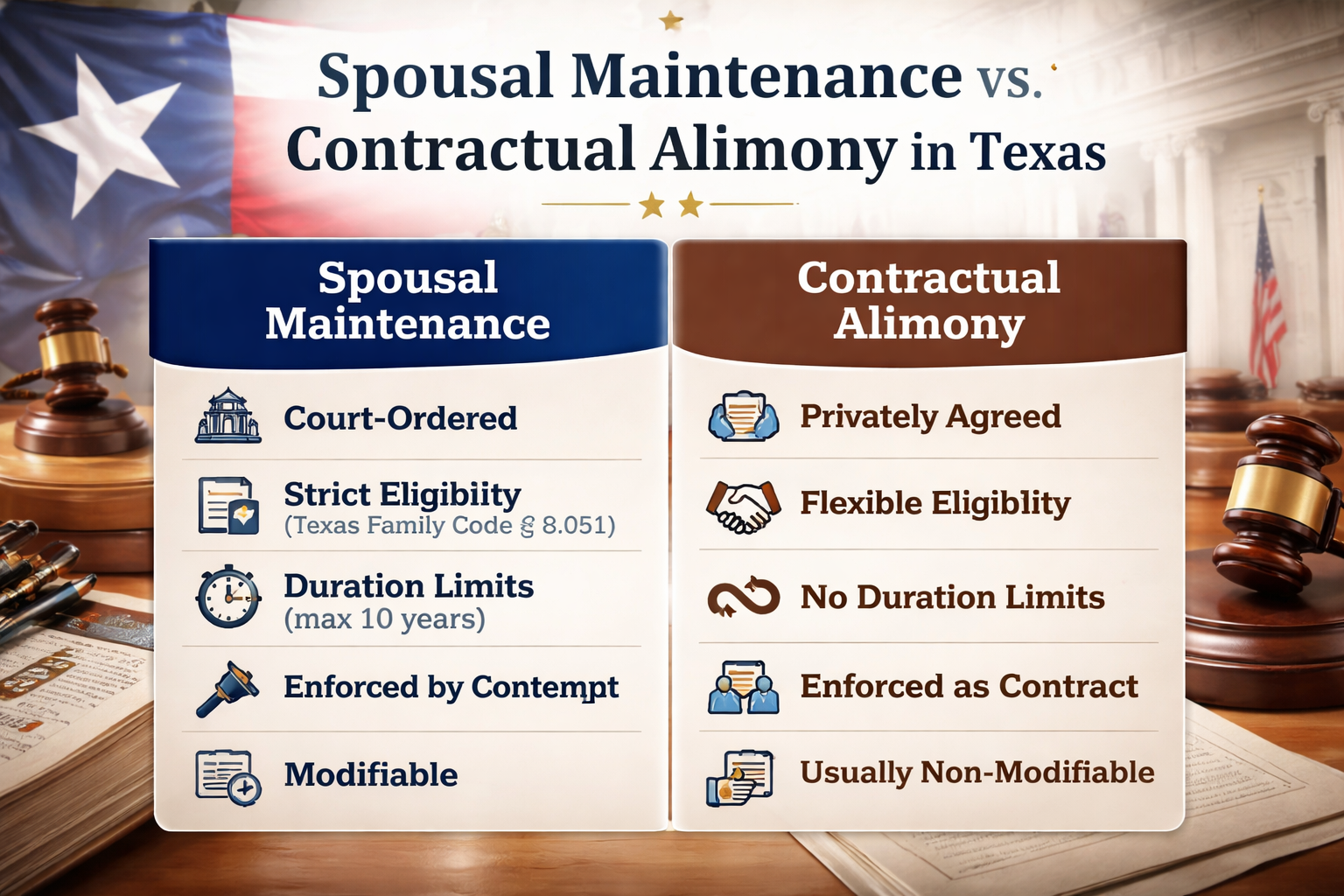
In Texas, alimony is formally known as court-ordered spousal maintenance and is governed by strict eligibility criteria. To qualify, a spouse must demonstrate they cannot meet their minimum reasonable needs and have been married for at least 10 years, suffer from a disability, or have been a victim of family violence.
Texas is historically one of the most restrictive states regarding post-divorce financial support. Unlike other jurisdictions where alimony might be granted to maintain a standard of living established during the marriage, Texas law views spousal maintenance as a temporary bridge to help a lower-earning spouse become self-sufficient. As we navigate the legal landscape in 2026, the Texas Family Code remains the primary authority, emphasizing that support is a necessity-based remedy rather than an automatic entitlement.
Understanding the Legal Landscape of Spousal Maintenance in Texas
In the Texas legal system, the term "alimony" is often used colloquially, but practitioners distinguish between spousal maintenance (court-ordered) and contractual alimony (agreed upon by parties). The overarching philosophy of the state is to encourage a "just and right" division of community property first. Courts generally prefer to award a larger share of assets—such as retirement accounts, home equity, or liquid savings—to the lower-earning spouse rather than ordering ongoing monthly payments.
Under Texas Family Code Chapter 8, the court starts with the presumption that spousal maintenance is not warranted unless the spouse seeking it has exercised "diligence" in earning sufficient income or developing the necessary skills to provide for their own "minimum reasonable needs." This term is a cornerstone of Texas litigation; it does not mean maintaining a lifestyle of luxury, but rather covering essential costs like housing, utilities, food, healthcare, and basic transportation.
Primary Eligibility Requirements for Court-Ordered Support
To even be considered for spousal maintenance in 2026, the requesting spouse must first prove they will lack sufficient property (including the property they receive in the divorce settlement) to provide for their minimum reasonable needs. Once that hurdle is cleared, they must meet at least one of the following four statutory triggers:
The 10-Year Marriage Rule
This is the most common path to maintenance. The marriage must have lasted for 10 years or longer. However, simply being married for a decade is not enough. The requesting spouse must also show they lack the ability to earn sufficient income. This might be due to a long absence from the workforce, a lack of education, or the age of the spouse.
Family Violence
If a spouse was convicted of or received deferred adjudication for a criminal offense that constitutes family violence, the 10-year rule is waived. The violence must have occurred during the marriage and within two years of the date the divorce suit was filed or while the suit was pending. This exception recognizes the urgent need for financial independence in cases involving domestic abuse.
Physical or Mental Disability
If the spouse seeking maintenance cannot provide for their own needs due to an incapacitating physical or mental disability, they may qualify regardless of the length of the marriage. These cases often require extensive medical testimony and expert evaluation to prove the "incapacitating" nature of the condition.
Caretaker Responsibilities
A spouse may qualify if they are the custodian of a child of the marriage (of any age) who requires substantial care and personal supervision because of a physical or mental disability. If this care prevents the parent from being employed outside the home, the court may award maintenance to ensure the child’s needs are met.
Calculating Payments: Limits, Caps, and Income Definitions
If the court determines that a spouse is eligible, it must then decide the amount of the payment. Texas law provides a strict ceiling on these awards to prevent excessive financial strain on the paying spouse.
As of 2026, the maximum amount a court can order for spousal maintenance is the lesser of:
- $5,000 per month; or
- 20% of the spouse’s average monthly gross income.
Defining "Gross Income"
For the purposes of calculating maintenance, gross income is broad. It includes wages, interest, dividends, royalty income, net rental income, and even retirement benefits. However, it specifically excludes items like Supplemental Security Income (SSI), veteran’s disability benefits, and certain foster care payments.
Courts look at the "net resources" available, but the 20% cap is applied to the gross. Judges have significant discretion to set an amount lower than the cap based on factors like the age and employment history of the parties, the emotional and physical condition of the spouse, and any acts of adultery or cruel treatment during the marriage.
Duration Guidelines: How Long Does Support Last?
Texas law mandates that any maintenance order be limited to the shortest reasonable period that allows the recipient to become self-sufficient. The only exception is when the recipient's ability to provide for themselves is permanently hampered by disability.
| Length of Marriage | Maximum Duration of Maintenance |
|---|---|
| Less than 10 Years (Family Violence Exception) | Up to 5 Years |
| 10 to 20 Years | Up to 5 Years |
| 20 to 30 Years | Up to 7 Years |
| 30 Years or More | Up to 10 Years |
| Physical or Mental Disability | As long as eligibility persists |
The court is required to review the order periodically if it is based on disability to ensure the condition still prevents the spouse from working. For all other categories, the clock begins ticking the day the order is signed. It is important to note that these are maximums, not guarantees. A judge may award three years of support for a 15-year marriage if they believe three years is sufficient for the spouse to finish a degree or vocational training.
Contractual Alimony: The Private Alternative
Because court-ordered maintenance is so difficult to obtain and limited in duration, many couples in Texas opt for contractual alimony. This is a private agreement included in the Final Decree of Divorce.
Contractual alimony is highly flexible. Unlike court-ordered maintenance, it does not have to follow the 20% or $5,000 caps, and it can last for any duration the parties agree upon. It is often used as a strategic tool in property division. For instance, if one spouse wants to keep the family home but lacks the cash to buy out the other’s interest, they might agree to pay monthly contractual alimony for a set number of years in exchange for the equity.
However, there is a significant trade-off. Contractual alimony is generally enforced as a contract, not as a court order. This means if the paying spouse stops paying, the recipient may have to sue for breach of contract rather than asking a judge to hold the payor in contempt of court. While wage withholding is available for court-ordered maintenance, it is not always available for purely contractual alimony unless specifically structured to meet the statutory requirements of spousal maintenance.
Factors Influencing the Court's Decision
Even if the 10-year rule is met, the judge will weigh several "relevant factors" listed in the Texas Family Code to decide if maintenance is appropriate and for how much. These factors include:
- Financial Resources: The assets available to each spouse after the property division.
- Education and Employment Skills: The time necessary for the recipient to acquire sufficient training or education.
- Marital Misconduct: While Texas is a "no-fault" divorce state, judges can consider adultery or "cruel treatment" when deciding on alimony amounts.
- Contribution as a Homemaker: The value of the spouse's contribution to the home and the other spouse's career.
- Asset Depletion: Whether one spouse wasted community assets (intentional dissipation) during the divorce process.
Modifying or Terminating Alimony Orders
Maintenance orders are not necessarily permanent until the expiration date. In 2026, Texas law remains clear on the circumstances that lead to termination:
- Remarriage: The obligation to pay maintenance ends immediately upon the remarriage of the recipient.
- Cohabitation: If the payor can prove that the recipient is cohabitating with another person with whom they have a "dating or romantic relationship" in a shared permanent residence, the court may terminate the maintenance.
- Death: The death of either the payor or the recipient terminates the obligation.
Modification of the amount is also possible, but usually only in one direction: downward. A payor can request a reduction if they have experienced a "material and substantial change in circumstances," such as a job loss or severe illness. However, the court cannot increase the amount of maintenance beyond the original order.
Tax Implications and Financial Reality
Historically, alimony was deductible for the payor and taxable for the recipient. However, following the Tax Cuts and Jobs Act of 2017—which remains the standard in 2026 for all divorces finalized after December 31, 2018—alimony payments are no longer tax-deductible for the payor, and the recipient does not report them as taxable income at the federal level.
This shift has changed how attorneys negotiate divorce settlements. Since the paying spouse is paying with "after-tax" dollars, they are often less willing to agree to high monthly amounts. It has increased the importance of focusing on the net-after-tax value of assets like 401(k)s and IRAs when balancing the books.
Common Mistakes to Avoid
- Assuming 10 Years Equals Automatic Alimony: Many people believe they are "owed" alimony after a long marriage. In Texas, the burden of proof is on the person asking for it to show they have tried and failed to find a way to support themselves.
- Ignoring the Property Division: If you receive a significant portion of a retirement account or the marital home, the court is very likely to say you have "sufficient property" and deny maintenance.
- Failing to Document Expenses: To prove "minimum reasonable needs," you must provide a detailed budget. Vague estimates are rarely successful in a Texas courtroom.
- Neglecting the "Diligence" Requirement: If you are not currently working, you must show you are actively seeking employment or training.
Frequently Asked Questions
Does adultery affect alimony in Texas?
Yes, adultery can influence the court’s decision. While it doesn't automatically qualify someone for alimony, a judge may consider the "fault" of the spouse when determining the amount and duration of maintenance. Conversely, if the spouse seeking alimony committed adultery, a judge might use that as a reason to deny or reduce the support.
Can I get alimony if we were married for only 5 years?
Generally, no, unless there is a conviction for family violence within the specified timeframe or you have a qualifying disability. Texas is very strict about the 10-year threshold for standard maintenance.
Is temporary spousal support the same as alimony?
No. Temporary support (often called "alimony pendente lite") can be ordered while the divorce is pending. Its purpose is to maintain the status quo and pay bills until the divorce is final. This is much easier to obtain than post-divorce maintenance, which is intended for the long term.
Can men receive alimony in Texas?
Yes. The Texas Family Code is gender-neutral. If a husband meets the eligibility requirements—such as being the lower-earning spouse in a 10-year marriage or having a disability—he is just as entitled to seek spousal maintenance as a wife.
Does cohabitation actually stop payments?
Yes, but it requires a court hearing. The payor must prove the recipient is living in a "permanent residence" with a romantic partner. Occasional overnight stays or dating are usually not enough to terminate the order.
Next Steps and Practical Advice
If you are facing a divorce in 2026 and believe you may be eligible for or subject to an alimony order, the first step is to compile a comprehensive financial profile. This includes a detailed list of monthly expenses, evidence of all income sources, and an inventory of community property.
Because of the high evidentiary bar for spousal maintenance in Texas, consulting with a family law attorney who specializes in complex property division is essential. They can help you determine whether your situation meets the "minimum reasonable needs" standard or if negotiating a contractual alimony agreement might be a more effective path forward.