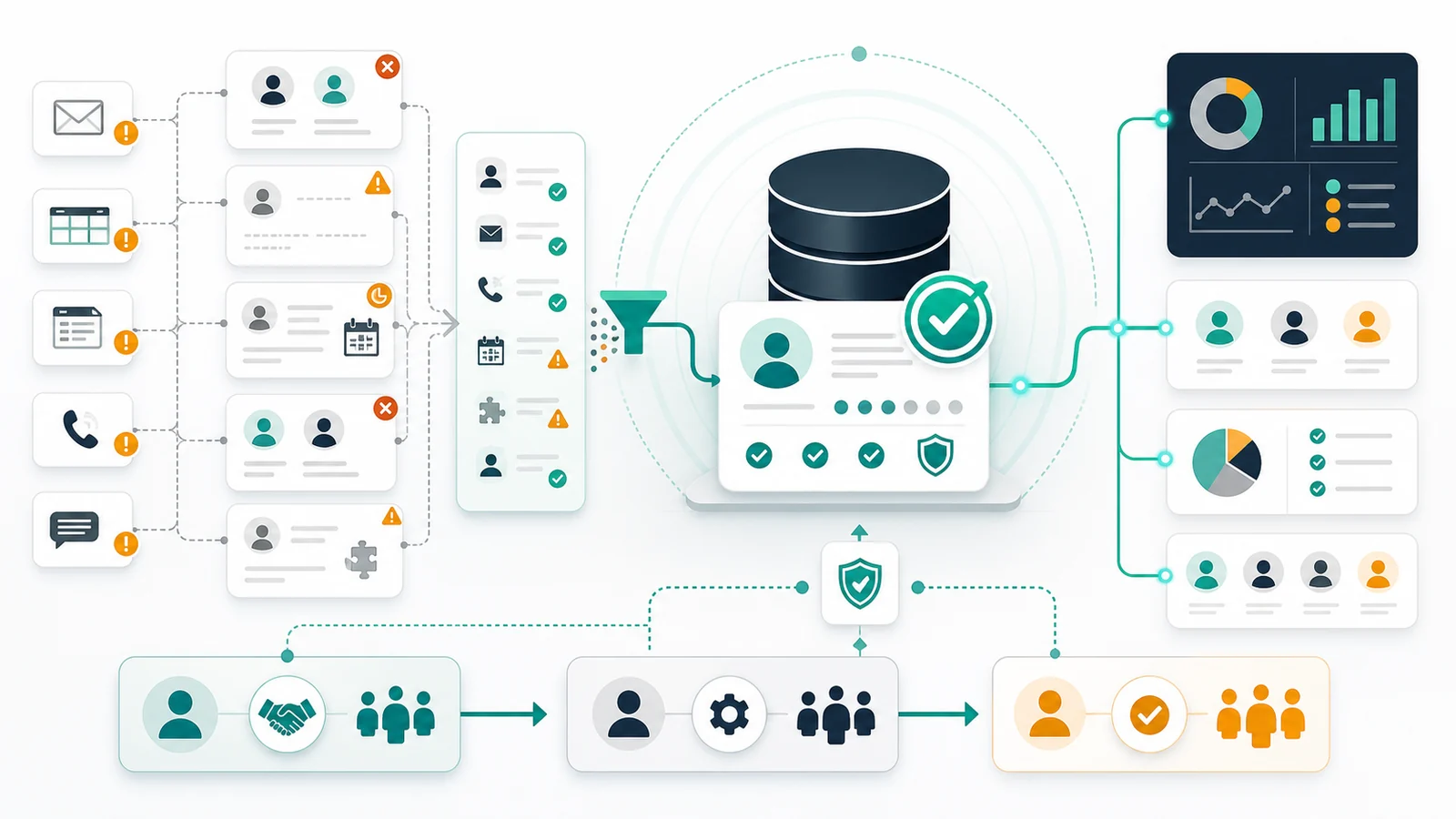
An agency CRM acts as the definitive system of record, centralizing communication, project history, and billing data to ensure every team member operates from a single source of truth. By eliminating information silos, this structural alignment reduces errors, enables personalized client interactions, and allows for data-driven strategic decisions that directly increase client retention and lifetime value.
The Role of the System of Record in Agency Operations
For professional services firms, the "system of record" refers to the primary software application where the most authoritative data regarding client relationships is stored. While teams may use various tools for project management, file sharing, or communication, the Customer Relationship Management (CRM) platform is the foundation upon which the entire client lifecycle is built.
When an agency lacks a unified system of record, information becomes fragmented. Sales notes might live in email threads, project milestones in a spreadsheet, and billing details in a legacy accounting system. This fragmentation is the primary cause of "client friction"—where a team member accidentally promises something already rejected by a client, or a billing discrepancy goes unnoticed because the data wasn't synchronized. By centralizing this data, the CRM becomes the "source of truth." When everyone, from the account manager to the billing specialist, accesses the same updated information, the agency can provide a seamless experience that reflects professionalism and competence.
Moving Beyond Simple Contact Management
Many agencies mistake their CRM for a glorified address book. In reality, modern agency CRM architecture is designed to map the entire client journey. It should track every touchpoint: the initial discovery call, the proposal submission, signed contracts, project status updates, and subsequent renewal conversations.
When the CRM is treated as the primary system of record, it enables "contextual intelligence." Contextual intelligence is the ability to understand a client's current sentiment and needs based on historical interactions. For example, if a client experienced a project delay three months ago, that information should be visible to the account manager before they hop on a quarterly business review call. This prevents the agency from repeating past mistakes and demonstrates to the client that they are valued as a partner rather than just another transaction.
Critical Infrastructure: Data Integrity and Standardization
The power of a system of record is entirely dependent on the quality of the data entered into it. An agency’s CRM is only as strong as its standard operating procedures (SOPs). If data entry is optional or left to the discretion of individual employees, the system will inevitably suffer from "data rot," where incomplete or inaccurate records lead to poor decision-making.
To maintain a robust system, agencies must enforce strict data hygiene:
- Mandatory Field Completion: Use system constraints to ensure that every new lead or client account contains essential metadata, such as industry vertical, key decision-makers, and current contract terms.
- Automated Syncing: Reduce human error by integrating the CRM directly with email servers, calendars, and accounting software. Data should move into the CRM without manual intervention wherever possible.
- Periodic Audits: Schedule quarterly reviews of the CRM data to identify duplicate entries, outdated contact details, or stale opportunity statuses that clutter the pipeline.
The Correlation Between CRM Maturity and Client Success
Client success is generally defined by the agency’s ability to deliver consistent results while maintaining a positive relationship. A mature CRM implementation supports this by enabling proactive account management.
When the CRM functions as a true system of record, it shifts the agency from a reactive state to a proactive one. For instance, if the CRM is integrated with project management software, the account manager can receive automated alerts when a project is behind schedule. They can contact the client before the client notices the delay, managing expectations and maintaining trust. Conversely, if the system is not integrated, the agency only discovers the issue when the client calls to complain. This proactive stance is often the difference between high-churn agencies and those that scale effectively through renewals and upsells.
Operational Comparison: Fragmented Systems vs. Unified System of Record
The following table illustrates the operational differences between agencies that utilize a centralized CRM and those that operate with fragmented, disjointed tools.
| Feature | Fragmented Tools (Silos) | Unified System of Record (CRM) |
|---|---|---|
| Data Visibility | High latency; requires manual requests | Real-time, permission-based access |
| Client Experience | Inconsistent messaging; repeating info | Consistent, personalized interactions |
| Billing Accuracy | Frequent discrepancies; manual checks | Automated, contract-aligned invoicing |
| Account Handover | High risk of lost context | Seamless transition; full history retained |
| Decision Making | Intuition-based; anecdotal | Data-driven; metrics-based reporting |
Solving Common Implementation Challenges
Transitioning to a robust system of record is rarely instantaneous. Many agencies struggle with adoption, where team members revert to legacy habits like storing notes in private documents. To overcome these barriers, leadership must treat the CRM as a foundational business asset rather than an administrative burden.
Overcoming Cultural Resistance
The most common barrier is the "administrative tax." Employees may feel that entering data into the CRM takes time away from billable work. To mitigate this, managers should demonstrate the direct benefit of the system to the individual. For example, show them how having a complete record of communications allows them to defend their work if a client disputes a previous agreement. When the system is framed as a tool for protecting the employee’s reputation, adoption rates climb significantly.
Ensuring Technical Interoperability
A CRM cannot exist in a vacuum. It must act as the hub for the agency’s "tech stack." Ensure that the CRM supports robust APIs (Application Programming Interfaces) to allow for bidirectional syncing with project management platforms (like Asana or Jira) and communication tools (like Slack or Microsoft Teams). If the system does not "speak" to the other tools used in daily operations, the integrity of the record will eventually fail.
Related Questions
How do I measure if my CRM is actually contributing to client success? Measure key performance indicators (KPIs) such as Client Retention Rate, Net Promoter Score (NPS), and the time taken to resolve client inquiries. If these metrics improve alongside an increase in CRM utilization, the system is successfully shaping client outcomes.
What is the best way to handle sensitive client data within a CRM? Implement Role-Based Access Control (RBAC). Ensure that sensitive information, such as financial details or proprietary strategy documents, is only accessible to authorized personnel. Regularly review audit logs to verify who has accessed specific records.
Should we move all communication to the CRM? While you should log significant client interactions, forcing every single internal email into the CRM can create "noise." Focus on capturing key decisions, project milestones, and significant feedback points to maintain a high signal-to-noise ratio in the system of record.
How often should we update our CRM strategy? Re-evaluate your CRM processes annually. As your agency’s service offerings or client base evolves, your data requirements will change. A biennial deep-dive audit is standard for agencies looking to maintain high levels of operational maturity.
Can an automated system replace human account management? No. A CRM provides the context necessary for high-level account management, but it cannot replace empathy, nuance, and strategic relationship building. The goal is to use the system to clear away administrative friction, allowing the human account manager to focus entirely on the client’s success.
Strategic Next Actions
To capitalize on your agency's CRM, conduct a "data audit" this week. Select three current client accounts and trace their journey from the first lead interaction to the most recent project delivery. Identify where information was missing, inconsistent, or difficult to find. Use these three accounts to create a "data map" that dictates exactly what fields must be filled and which tools must be integrated to ensure that every future client project has 100% data visibility. By standardizing this, you transition the CRM from a passive storage bin into an active engine for client success.