Finding affordable elderly life insurance for diabetics in the US requires navigating complex underwriting guidelines, distinguishing between Type 1 and Type 2 classifications, and evaluating specialized policies like whole life, guaranteed issue, and simplified issue plans to secure the most cost-effective coverage.
Navigating the life insurance market as an older adult with diabetes can feel overwhelming. Many seniors assume that managing a chronic condition like diabetes automatically prices them out of financial protection for their families, leaving funeral costs, medical debts, and final expenses uncovered. However, the life insurance landscape in the United States offers multiple pathways tailored specifically to older adults living with diabetes.
Understanding how insurance companies assess diabetes risk is the first step toward securing a policy that fits both your health profile and your budget. By evaluating underwriting criteria, controlling key health metrics, and comparing different policy types, elderly diabetics can find reliable coverage without overpaying.
Understanding How Life Insurance Companies View Diabetes
Insurance underwriters evaluate risk based on statistical data regarding longevity and health complications. When an applicant has diabetes, underwriters look past the simple diagnosis and dig deep into how well the condition is managed on a daily basis.
The primary distinction insurers make is between Type 1 diabetes (insulin-dependent from an early age, carrying a generally higher statistical risk profile) and Type 2 diabetes (often diagnosed later in life, sometimes managed through diet, exercise, or oral medication alone). However, having Type 1 diabetes in your golden years does not automatically disqualify you from getting coverage; it simply shifts which products and pricing tiers are available.
Underwriters evaluate several critical data points when reviewing a diabetic applicant's medical history:
- Hemoglobin A1c Levels: This three-month average of blood sugar control is the single most important metric. An A1c under 7.0 is typically viewed favorably, while levels consistently above 8.5 or 9.0 indicate poorly controlled diabetes and will result in higher premiums or postponement of coverage.
- Age of Diagnosis: Individuals diagnosed later in life generally present a lower cumulative risk of long-term organ damage than those diagnosed in early childhood or adolescence.
- Medication Regimen: Using oral medications like metformin is viewed more leniently than using insulin, though many older adults with Type 2 diabetes successfully manage their condition with insulin and still qualify for standard or sub-standard rates.
- Compliance and Consistency: Demonstrating a consistent relationship with a primary care physician or endocrinologist shows the underwriter that you take your health seriously.
- Secondary Complications: The presence of diabetic neuropathy, retinopathy, nephropathy, or cardiovascular disease significantly alters underwriting. Isolated diabetes is much easier and cheaper to insure than diabetes accompanied by heart issues or kidney impairment.
Types of Life Insurance Policies Available for Older Diabetics
Choosing the right type of policy is essential for balancing affordability with guaranteed protection. Depending on your age and the severity of your diabetes, certain products will offer a much better value than others.
Term Life Insurance
Term life insurance provides coverage for a specific period, such as 10, 15, or 20 years. For healthy older adults with well-controlled Type 2 diabetes, a 10-year term policy can provide high face values at a relatively low cost.
However, term life insurance becomes exponentially more expensive as you age, and most term policies expire by age 80 or 85. If your goal is to cover end-of-life expenses that will occur late in life, a term policy may not be the most practical long-term solution.
Whole Life Insurance
Whole life insurance is a type of permanent life insurance that offers level premiums, a guaranteed death benefit, and a cash value component that grows over time. For seniors with diabetes, whole life insurance provides peace of mind because the premium will never increase, and the policy cannot be canceled as long as payments are made. While initial monthly premiums are higher than term insurance, the financial stability makes it a popular choice for final expense planning.
Simplified Issue Life Insurance
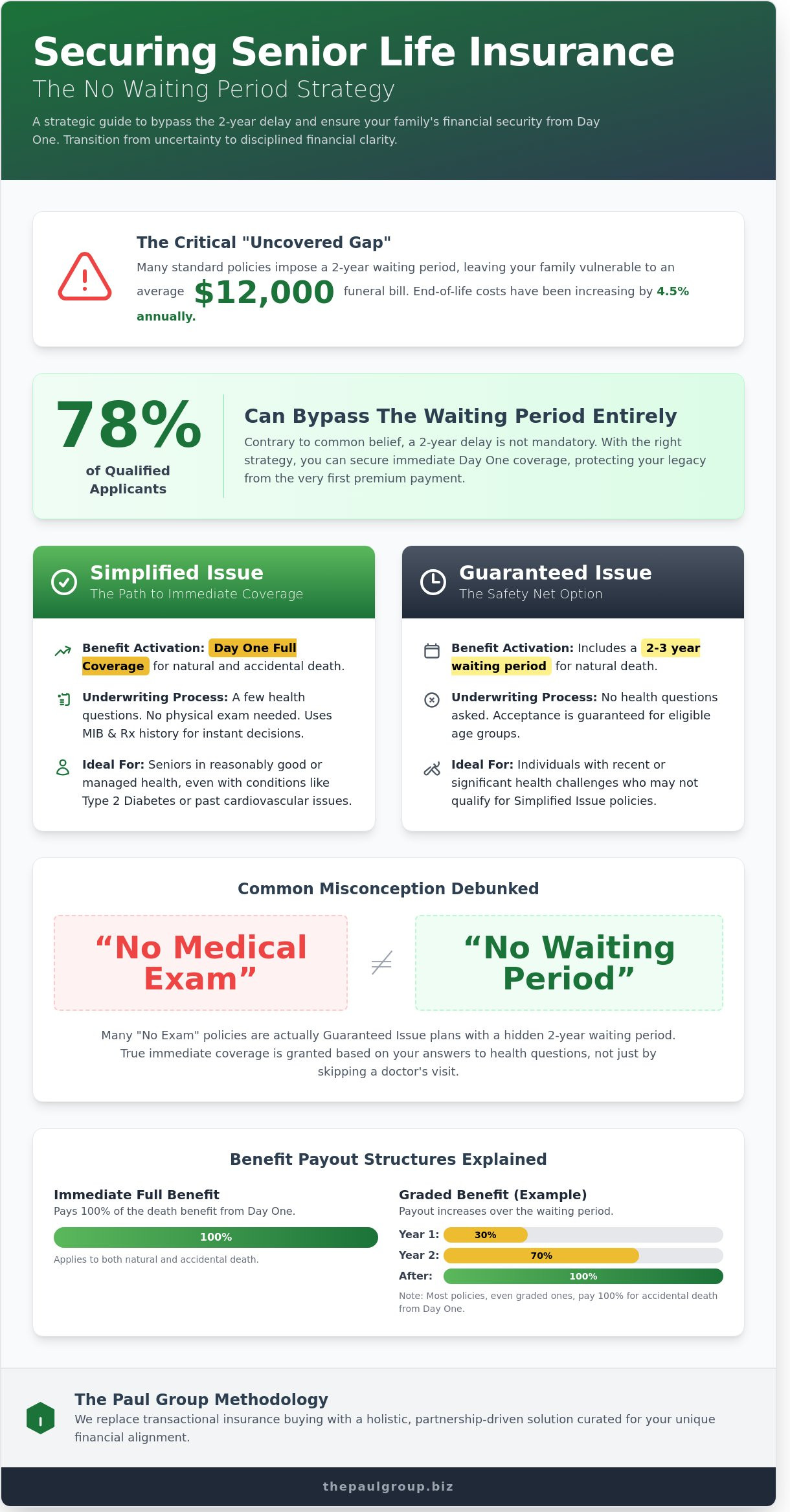
Simplified issue policies require no medical exam. Instead, applicants must answer a series of health questions on the application. While you will not have to undergo a nurse visit or blood draw, the insurance company will check your prescription history through databases like the Medical Information Bureau (MIB) and prescription history clearinghouses.
If your prescription records show steady use of diabetic medications and your A1c has been stable, simplified issue policies can be approved quickly and affordably.
Guaranteed Issue Life Insurance
Guaranteed issue (or guaranteed acceptance) life insurance requires no medical exam and no health questions. Anyone within the eligible age range—typically ages 50 to 85 depending on the carrier—is automatically approved.
While this sounds ideal for older adults with severe diabetic complications, there are two major trade-offs:
- Higher Premiurs: Because the insurer takes on unknown risks, the cost per thousand dollars of coverage is significantly higher.
- Graded Death Benefits: Most guaranteed issue policies feature a "graded period" (usually two years). If the insured passes away from natural causes during this window, the beneficiaries receive a refund of all premiums paid plus interest, rather than the full face benefit. Full benefits apply only to accidental death during the graded period or to any death occurring after the period ends.
| Policy Type | Medical Exam Required? | Health Questions? | Best For | Typical Cost Range |
|---|---|---|---|---|
| Term Life | Often Yes | Yes | Seniors under 75 needing temporary, high-value income replacement or mortgage protection. | Lowest for young seniors; rises sharply with age. |
| Whole Life | Rarely (Depends on face value) | Yes | Seniors wanting permanent coverage and fixed monthly rates for final expenses. | Moderate to High, but locked in permanently. |
| Simplified Issue | No | Yes | Diabetics with well-controlled A1c levels who want fast approval without a medical exam. | Moderate. |
| Guaranteed Issue | No | No | Seniors with severe diabetic complications or multiple chronic health conditions. | Highest per dollar of coverage. |
Key Factors Impacting Cost and Affordability
Affordability is subjective, but understanding the financial levers that influence life insurance pricing helps older adults avoid overpaying. Insurance companies place applicants into distinct health "rate classes" (such as Preferred Plus, Preferred, Standard Plus, Standard, or Sub-standard/Table ratings).
For a diabetic applicant, achieving a Standard or Standard Plus rating is often entirely possible with good management. A standard rating means you pay the baseline table rate for your age group, whereas a sub-standard rating (often called Table A through Table J or Table 1 through 10) adds a percentage surcharge to the base rate for every step down in health qualification.
To keep premiums manageable, consider the following practical strategies:
- Purchase Sooner Rather Than Later: Life insurance rates increase with every single year of chronological age. Locking in a policy at age 62 is significantly cheaper than waiting until age 68, even if your diabetes management remains identical.
- Opt for Realistic Face Amounts: You do not need a multi-million-dollar policy to cover final expenses. A burial or final expense policy ranging from $10,000 to $25,000 is often enough to cover funeral costs, caskets, and minor remaining debts while keeping monthly premiums below $100 to $200, depending on age.
- Work With an Independent Broker: Captive agents work for a single insurance company and can only offer that company's specific underwriting rules. An independent broker shops across dozens of top-rated carriers, identifying which insurance company is most lenient toward diabetic applicants.
Steps to Secure the Best Policy as a Diabetic Senior
Applying for life insurance requires preparation. Taking a strategic approach to the application process prevents unnecessary delays and helps secure the most favorable health classification.
- Gather Your Medical History: Know the exact names and dosages of your medications, the contact information for your primary care physician and endocrinologist, and the dates of your most recent A1c tests.
- Request an A1c Test From Your Doctor: If your last blood test was several months ago, schedule a checkup to ensure your levels are documented and stable before submitting an application. Underwriters rely heavily on recent, verified medical records.
- Compare Quotes From Multiple Carriers: Use an independent agency to compare quotes across multiple A-rated insurance companies. Ask specifically: "Which carrier has the most favorable underwriting guidelines for well-controlled Type 2 diabetes?"
- Disclose Accurately: Never hide details about your health history on an application. Insurance companies verify prescription histories and medical databases; omissions or misrepresentations can lead to claim denials later.
- Maintain Consistent Management: If you are undergoing a fully underwritten process that requires a paramedical exam, avoid high-sugar foods or heavy caffeine immediately before the nurse arrives, as temporary spikes can skew results.
Frequently Asked Questions
Can I qualify for life insurance if I take insulin for my diabetes?
Yes. While insulin use indicates a more advanced treatment plan, many insurance carriers offer standard or mild sub-standard rates to older adults whose diabetes is stable, who have no secondary organ damage, and who maintain consistent A1c levels below 8.0.
What is the maximum age to buy elderly life insurance with diabetes?
Most traditional whole life and simplified issue policies accept applicants up to age 85. Guaranteed issue policies are commonly available up to age 80 or 85, depending on the specific insurance carrier and the state in which you reside.
Will my life insurance rates go up if my diabetes gets worse later?
No. If you purchase a guaranteed renewable policy—such as a whole life, term, or simplified issue plan—your premium is locked in for the life of the policy. The insurance company cannot raise your rates or cancel your coverage as long as you pay your scheduled premiums on time.
Are diabetes complications an automatic disqualification?
Not necessarily, but they change your policy options. If you have neuropathy or mild retinopathy, you may still qualify for simplified issue or guaranteed issue policies. However, severe cardiovascular complications combined with diabetes will generally narrow your choices to guaranteed issue plans.
How long does it take to get approved for coverage?
Simplified issue and guaranteed issue policies can often be approved within 24 to 48 hours. Fully underwritten policies requiring medical exams and attending physician statements (APS) can take anywhere from two to six weeks to finalize.
Next Actions and Recommendations
Securing affordable elderly life insurance as a diabetic in the US starts with an honest assessment of your financial needs and current health status. Do not wait for your health to change or for your age bracket to shift higher.
Begin by requesting a copy of your recent lab work from your doctor, confirming that your A1c levels are stable, and reaching out to an independent insurance broker who specializes in senior coverage and impaired risk underwriting. By comparing multiple quotes side by side, you can lock in a policy that protects your loved ones and honors your budget.