Florida residents aged 50 to 80 can access life insurance through the AARP Life Insurance Program, underwritten by New York Life Insurance Company. Eligibility primarily requires active AARP membership, with coverage options ranging from term life to guaranteed acceptance whole life policies designed to provide financial security for final expenses or legacy planning.
The Partnership: AARP and New York Life in Florida
The AARP Life Insurance Program is not an insurance company itself but a branded program exclusively underwritten by New York Life Insurance Company. For Florida residents, this partnership combines the advocacy and resources of AARP with the financial stability of one of the oldest and most highly rated insurers in the United States. In 2026, New York Life continues to maintain strong financial strength ratings from major agencies like A.M. Best and Standard & Poor’s, which is a critical consideration for Floridians looking for long-term policy reliability.
The Florida insurance market is unique due to its high concentration of retirees and specific state regulations managed by the Florida Department of Financial Services (DFS). The AARP program is tailored to meet these state-specific requirements, ensuring that policyholders receive the consumer protections mandated by Florida law, such as specific "free look" periods and grace period notifications.
Core Eligibility Requirements for Florida Residents
To apply for any life insurance product under the AARP umbrella in Florida, applicants must meet three primary criteria:
- AARP Membership: You must be a member of AARP to apply. If you are not a member, you can typically join during the insurance application process. Membership is open to individuals aged 50 and older.
- Age Limits: Eligibility varies by product but generally spans from age 50 to 80. Some products may allow spouses of members to apply if they are between the ages of 45 and 80.
- Residency: You must be a legal resident of Florida (or another state where the product is offered) at the time of application.
Unlike some commercial life insurance policies that may require extensive medical histories or physical examinations, many AARP products use simplified underwriting. This means that for some policies, eligibility is determined by a few health questions rather than a full medical exam, while others offer "guaranteed acceptance" regardless of health history.
Types of Coverage Available in Florida
Florida members have access to three main types of life insurance through this program. Each serves a different financial purpose, ranging from temporary protection to permanent estate planning.
1. AARP Level Benefit Term Life Insurance
Term life insurance provides coverage for a specific period. In the AARP program, "Level Benefit" means the death benefit—the amount paid to your beneficiaries—remains the same throughout the life of the policy.
- Eligibility: Generally available to AARP members aged 50 to 74.
- Coverage Amounts: Often available up to $100,000 or more, depending on the current 2026 guidelines.
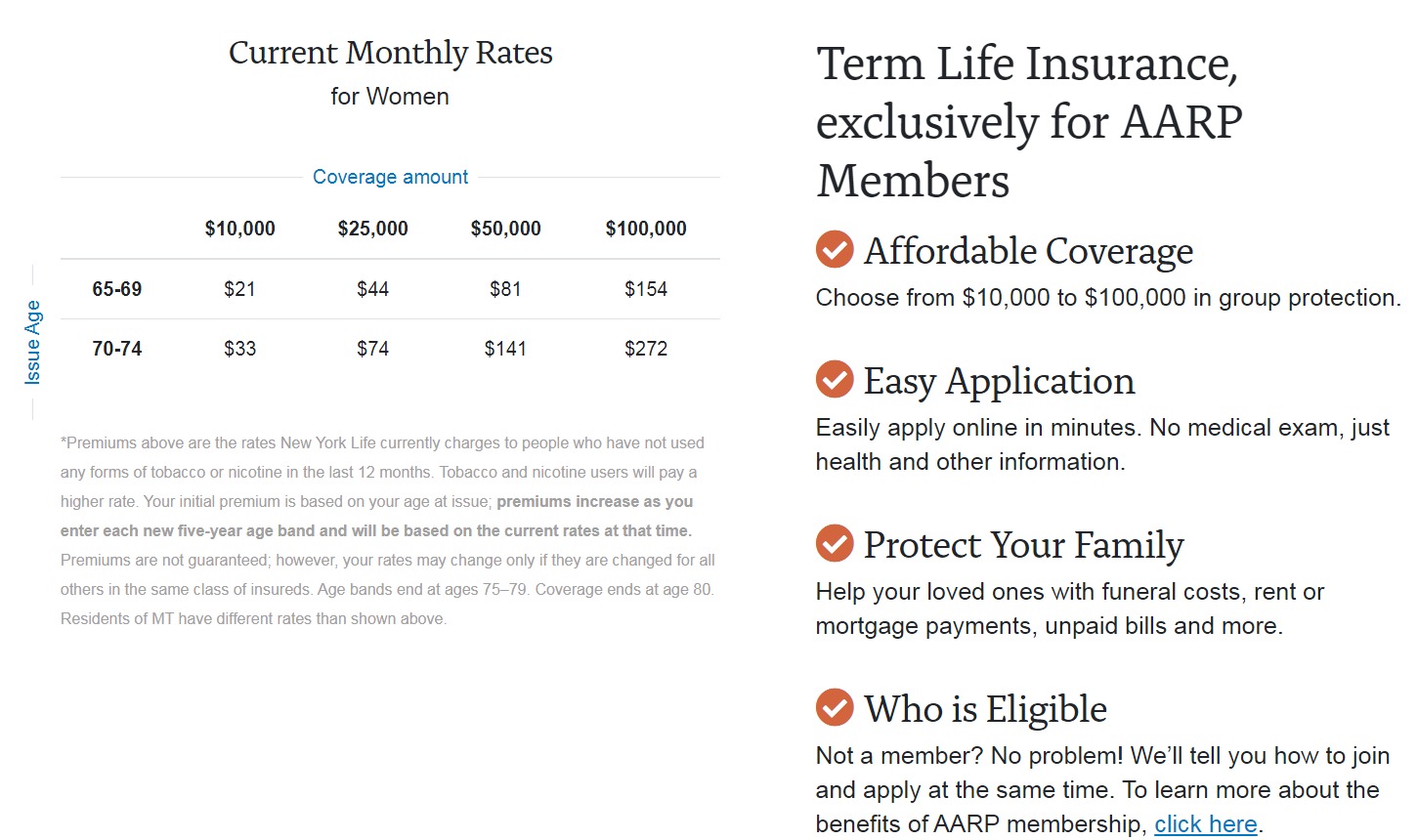
- Premium Structure: Premiums are not fixed for life. Instead, they are structured in five-year age bands. As you enter a new age bracket (e.g., moving from 64 to 65), your premium will increase.
- Key Feature: This policy can typically be converted to a permanent life insurance policy without a medical exam before a certain age (usually 80).
2. AARP Permanent Life Insurance (Whole Life)
This is a form of whole life insurance designed to last your entire lifetime, provided premiums are paid.
- Eligibility: Available to members aged 50 to 80.
- Coverage Amounts: Usually smaller than term policies, often topping out at $50,000.
- Premium Structure: Unlike term insurance, the premiums for permanent life insurance are fixed. Once you are accepted, your rate will never increase due to your age or changes in health.
- Cash Value: Over time, these policies build "cash value." This is a small portion of your premium that grows tax-deferred and can be borrowed against if necessary, though loans will reduce the final death benefit.
3. AARP Guaranteed Acceptance Life Insurance
This product is specifically designed for individuals who may have been turned down for other insurance due to chronic health conditions.
- Eligibility: Available to members aged 50 to 80.
- No Medical Exam: There are no health questions and no medical exams required for acceptance.
- The Waiting Period (Graded Death Benefit): In Florida, as in most states, these policies have a two-year "graded" period. If the insured passes away from natural causes within the first two years of the policy, the beneficiaries receive the premiums paid plus a small percentage of interest (usually 10%) rather than the full death benefit. After two years, the full benefit is active for any cause of death.
- Accidental Death: The two-year waiting period typically does not apply to accidental deaths, which are covered for the full amount from day one.
Florida-Specific Consumer Protections
Florida’s insurance laws provide specific safeguards for seniors. When purchasing AARP Life Insurance in the Sunshine State, residents benefit from the following:
The 14-Day Free Look Period
Under Florida Statute 627.455, life insurance policies must include a "free look" period. In Florida, this is generally 14 days from the date you receive the policy. During this time, you can review the terms and, if you are unsatisfied for any reason, cancel the policy and receive a full refund of any premiums paid.
Grace Period and Secondary Addressee
Florida law requires life insurance companies to provide a 30-day grace period for late premium payments. Additionally, for policyholders aged 64 and older, Florida law allows the designation of a secondary addressee. If a premium is not paid, the insurance company must notify both the policyholder and the designated secondary person before the policy can be lapsed for non-payment. This is a vital protection against unintended loss of coverage due to cognitive decline or simple oversight.
Accelerated Death Benefits (Living Benefits)
Most AARP policies in Florida include an "accelerated death benefit" rider. If a policyholder is diagnosed with a terminal illness and has a life expectancy of 12 months or less (or as defined by the 2026 policy terms), they may access a portion of their death benefit while still living. This money can be used for medical bills, hospice care, or any other needs. Note that accessing these funds reduces the final amount paid to beneficiaries.
Comparing AARP Life Insurance Options in Florida
| Feature | Level Benefit Term | Permanent (Whole Life) | Guaranteed Acceptance |
|---|---|---|---|
| Issue Ages | 50–74 | 50–80 | 50–80 |
| Max Coverage | Typically $100k - $150k | Typically $50k | Typically $25k |
| Premiums | Increase every 5 years | Fixed for life | Fixed for life |
| Medical Exam | No (Health questions only) | No (Health questions only) | None |
| Cash Value | No | Yes | Yes |
| Full Benefit Start | Immediate | Immediate | After 2 years |
Understanding the Application and Underwriting Process
Applying for AARP Life Insurance in Florida is streamlined compared to traditional life insurance. Because the program focuses on "simplified issue" or "guaranteed issue" products, the process generally follows these steps:
- Online Quote or Mailer: Florida residents often receive mailers from New York Life on behalf of AARP. These contain localized rate charts based on Florida-approved filings.
- Health Questionnaire: For Term and Permanent policies, you will answer several "Yes/No" questions regarding your medical history (e.g., history of heart disease, cancer, or stroke). In 2026, many of these applications are processed via real-time digital underwriting, which checks prescription drug databases to verify health status instantly.
- Beneficiary Designation: You must name at least one beneficiary. In Florida, if you name your estate as the beneficiary, the proceeds may be subject to probate and creditors. It is generally recommended to name individuals or a trust to ensure the death benefit passes outside of probate.
- Premium Payment: Florida allows for various payment methods, including Electronic Funds Transfer (EFT) and credit cards. Many seniors prefer EFT to ensure the policy does not lapse.
Common Mistakes to Avoid
When navigating AARP life insurance in Florida, applicants should be wary of several common pitfalls:
- Underestimating the Term Increases: Many applicants choose the Term Life option because it is the cheapest at age 55. However, because the premiums increase every five years, the policy can become prohibitively expensive by age 75 or 80.
- Missing the "Guaranteed" Waiting Period: Some Florida residents assume Guaranteed Acceptance means full coverage starts immediately. Failing to understand the two-year graded benefit can lead to financial disappointment for beneficiaries if the insured passes away shortly after enrollment.
- Inaccurate Health Disclosure: Even though there is no physical exam for the Level Benefit policies, "simplified issue" still requires honesty. If a policyholder misrepresents their health on the application, New York Life may deny a claim within the two-year "contestability period" allowed under Florida law.
- Neglecting the Secondary Addressee: As mentioned, Florida's protection for seniors is only effective if you actually name a secondary contact. Many fail to do this, leaving the policy at risk if the owner moves or faces health issues that interfere with bill paying.
Frequently Asked Questions
Does my spouse need their own AARP membership to apply?
No. If you are an AARP member, your spouse is generally eligible to apply for coverage as well, provided they meet the age requirements (usually 45–80 for term or 50–80 for permanent). They can have their own individual policy under your membership number.
Is the AARP Life Insurance Program cheaper than other Florida insurers?
Not necessarily. AARP policies are designed for convenience and ease of acceptance. If you are in excellent health, you might find lower premiums through a fully underwritten policy from another carrier that requires a medical exam. However, for those with minor health issues or those who want a quick process, AARP is often highly competitive.
Can I keep my AARP policy if I move out of Florida?
Yes. AARP life insurance policies are portable. If you move to another state, your coverage remains in effect as long as you continue to pay your premiums. However, the specific state regulations that apply to your policy are generally those of the state where the policy was originally issued.
How do beneficiaries file a claim in Florida?
Beneficiaries should contact the AARP Life Insurance Program from New York Life directly. They will need to provide a certified copy of the death certificate. In Florida, insurers are required to pay claims promptly—usually within 30 to 60 days once all required documentation is received—or they must pay interest on the proceeds.
Does this insurance cover cremation or funeral costs specifically?
While the policies are often marketed for "final expenses," the death benefit is paid in a lump sum of cash to your beneficiaries. They can use the money for any purpose, including funeral costs, cremation, outstanding medical bills, or simply as an inheritance.
Practical Recommendation for Floridians
Before committing to a policy in 2026, Florida residents should first calculate their actual "final expense" needs, accounting for the rising costs of funeral services in the state, which often range from $7,000 to $12,000.
If you are between 50 and 70 and in relatively good health, the Level Benefit Term or Permanent Life options are usually the best starting points because they provide immediate full coverage. If you have significant health issues, the Guaranteed Acceptance plan is a reliable fallback, but ensure you have other arrangements to cover the two-year graded benefit period. Always take advantage of the Florida-mandated 14-day free look period to read the actual policy document—not just the brochure—to confirm the premium schedule and benefit details align with your expectations.