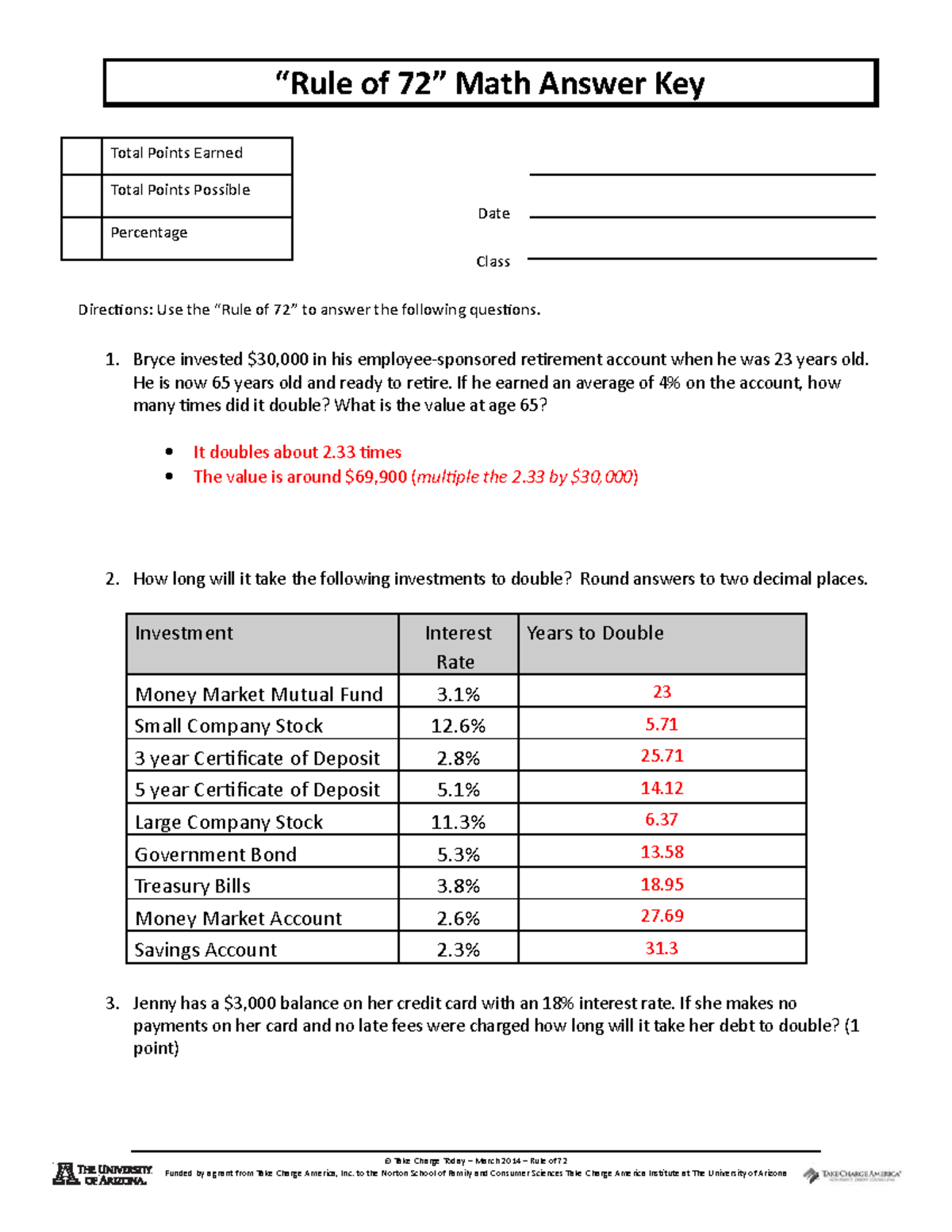
The Rule of 72 is a simplified mathematical formula used to estimate the number of years required to double an investment at a fixed annual rate of interest. By dividing 72 by the annual rate of return, investors can quickly approximate the effects of compound interest without performing complex logarithmic calculations.
Understanding the velocity of capital is a fundamental skill for any investor navigating the financial landscape of 2026. Whether you are managing a retirement portfolio, evaluating a high-yield savings account, or analyzing corporate growth projections, the Rule of 72 serves as a reliable mental shortcut. While modern financial software provides precision to the fourth decimal point, the ability to perform "back-of-the-envelope" calculations allows for rapid decision-making and a better intuitive grasp of exponential growth.
The Mathematical Foundation of the Rule of 72
To appreciate why the Rule of 72 works, one must look at the underlying mathematics of compound interest. The standard formula for continuous compounding is based on the natural logarithm. Specifically, to find the time ($T$) it takes for an investment to double, we solve for the equation $2 = e^{rt}$, where $r$ is the interest rate and $t$ is time. Taking the natural log of both sides gives us $ln(2) = rt$.
The natural log of 2 is approximately 0.693147. Therefore, for an investment to double, the product of the rate and the time must be approximately 0.693. When expressed as a percentage (multiplying by 100), this becomes 69.3. In a perfectly precise world, we would use the "Rule of 69.3."
However, 69.3 is a difficult number to use for mental math. Finance professionals and educators adopted 72 because it is a "highly composite number," meaning it has many small divisors. It can be easily divided by 2, 3, 4, 6, 8, 9, and 12. This flexibility makes it far more practical for quick estimates across a wide range of common interest rates. For example, an 8% return yields an even 9 years ($72 / 8 = 9$), whereas $69.3 / 8$ results in 8.6625.
How to Calculate Investment Doubling Time
The application of the Rule of 72 is straightforward. You do not need to convert the percentage to a decimal; you simply use the whole number of the interest rate as the divisor.
The Formula: Years to Double = 72 / Expected Annual Rate of Return
Step-by-Step Example:
- Identify the Interest Rate: Suppose you are looking at an index fund that has a projected annual return of 9%.
- Apply the Rule: Divide 72 by 9.
- Determine the Result: $72 / 9 = 8$. It will take approximately 8 years for your initial principal to double in value, assuming all dividends are reinvested and the rate remains constant.
Conversely, the rule can be used to determine what interest rate you need to achieve a specific goal. If you want to double your money in 6 years, you would divide 72 by 6 to find that you need a 12% annual return.
Accuracy and Variations: When to Use 69.3, 70, or 73
While 72 is the standard, its accuracy varies depending on the interest rate and the frequency of compounding. Because the rule is an approximation of a logarithmic curve using a linear shortcut, it is most accurate when the interest rate is between 6% and 10%.
Lower Interest Rates (The Rule of 69.3)
For investments with very low returns, such as traditional savings accounts or government bonds yielding 1% to 3%, the Rule of 69.3 is technically more accurate. However, because 69.3 is cumbersome, some investors use the "Rule of 70" for these lower-yield environments. In the current 2026 economic climate, where certain "safe-haven" assets may hover around 2-4%, using 70 can provide a slightly more conservative and accurate estimate than 72.
Higher Interest Rates (The Rule of 73 or 74)
As interest rates climb significantly higher, the Rule of 72 begins to underestimate the time required to double. For an interest rate of 25%, the Rule of 72 suggests a doubling time of 2.88 years, while the actual time is closer to 3.1 years. For every three percentage points increase in the interest rate above 8%, some technicians add 1 to the numerator. Therefore, at a 15% interest rate, a "Rule of 74" ($72 + 2$) might provide a more precise figure.
Comparative Doubling Times by Interest Rate
The following table illustrates the relationship between various annual returns and the time it takes for an initial investment to double, comparing the Rule of 72 estimate against the actual mathematical doubling time.
| Annual Interest Rate (%) | Rule of 72 Estimate (Years) | Actual Doubling Time (Years) | Difference (Years) |
|---|---|---|---|
| 2% | 36.0 | 35.00 | +1.00 |
| 4% | 18.0 | 17.67 | +0.33 |
| 6% | 12.0 | 11.90 | +0.10 |
| 8% | 9.0 | 9.01 | -0.01 |
| 10% | 7.2 | 7.27 | -0.07 |
| 12% | 6.0 | 6.12 | -0.12 |
| 15% | 4.8 | 4.96 | -0.16 |
| 20% | 3.6 | 3.80 | -0.20 |
Note: Actual doubling time is calculated using the formula $ln(2) / ln(1 + r)$.
The Impact of Compounding Frequency
The Rule of 72 assumes annual compounding—meaning interest is calculated once per year. However, many modern financial products in 2026 utilize quarterly, monthly, or even daily compounding.
When interest is compounded more frequently, the "effective" interest rate is higher than the "nominal" interest rate. For instance, a 10% nominal rate compounded daily results in an annual percentage yield (APY) of approximately 10.52%. Because more frequent compounding accelerates growth, the actual doubling time will be slightly shorter than what the Rule of 72 predicts. If you are dealing with a product that compounds continuously, the Rule of 69.3 is the mathematically perfect choice, though 72 remains a useful "worst-case" approximation for quick mental checks.
Using the Rule for Inflation and Purchasing Power
The Rule of 72 is not just for measuring growth; it is an essential tool for understanding the erosion of purchasing power due to inflation. By applying the rule to the annual inflation rate, you can estimate how long it will take for the value of your money to be cut in half.
In 2026, if the central bank's target inflation rate is 3%, you can divide 72 by 3 to find that the purchasing power of your cash will decrease by 50% in approximately 24 years. This perspective is vital for long-term retirement planning. If a retiree's expenses are $50,000 today and inflation averages 4%, those same lifestyle requirements will cost $100,000 in just 18 years ($72 / 4 = 18$). This underscores the necessity of investing in assets that outpace inflation, rather than keeping excessive wealth in stagnant cash accounts.
Strategic Applications in Portfolio Management
Professional advisors often use the Rule of 72 to help clients visualize the "cost of waiting." If a 25-year-old delays investing for just 7 or 8 years, they may be missing out on an entire "doubling cycle."
The Rule of 114 and Rule of 144
Beyond doubling, the same logic can be extended to tripling and quadrupling your money:
- Rule of 114: Divide 114 by the interest rate to estimate how long it takes to triple your investment.
- Rule of 144: Divide 144 by the interest rate to estimate how long it takes to quadruple your investment.
These variations are useful for long-term goals, such as saving for a child's education or a multi-decade retirement plan. For example, at a 10% return, your money doubles in about 7.2 years, triples in 11.4 years, and quadruples in 14.4 years.
Limitations and Practical Constraints
While the Rule of 72 is a powerful conceptual tool, it has several limitations that an investor must account for in real-world scenarios.
1. Market Volatility
The rule assumes a "fixed" or "average" rate of return. In reality, equity markets are volatile. An average return of 8% over ten years might consist of years with 20% gains and years with 15% losses. Sequence of returns risk can significantly alter the actual time it takes to double your capital compared to a theoretical steady-rate calculation.
2. Taxation
Taxes can act as a massive drag on the doubling process. If your investment is in a taxable brokerage account, you may owe capital gains taxes or taxes on dividends each year. This effectively lowers your "r" (rate of return). For an investor in a 25% tax bracket, an 8% pre-tax return might functionally be a 6% post-tax return, extending the doubling time from 9 years to 12 years.
3. Investment Fees
Management fees, expense ratios, and trading commissions must be subtracted from the gross return before applying the Rule of 72. In 2026, while many platforms offer zero-commission trading, specialized funds or actively managed portfolios may still carry fees that shave 0.5% to 1.5% off your annual return, adding years to your doubling timeline.
4. Contributions and Withdrawals
The Rule of 72 only measures the growth of a single, lump-sum investment. It does not account for ongoing monthly contributions (Dollar Cost Averaging) or periodic withdrawals. If you are adding money to an account regularly, the total balance will double much faster than the rule predicts.
Professional Advice Limitation
This information is for educational purposes only and does not constitute financial, legal, or tax advice. The Rule of 72 is an approximation and should not be used as the sole basis for critical financial decisions. Investment returns are never guaranteed, and past performance is not indicative of future results. Consult with a certified financial planner or tax professional regarding your specific jurisdictional regulations and individual financial situation.
Frequently Asked Questions
Does the Rule of 72 work for all types of investments?
Yes, the Rule of 72 is a mathematical principle that applies to any asset that experiences compound growth, including stocks, bonds, real estate, and even cryptocurrency. However, its accuracy is dependent on the stability of the growth rate. It is most useful for assets with relatively predictable long-term averages rather than highly speculative assets with extreme short-term fluctuations.
Why is 72 used instead of 69 or 70?
The number 72 is chosen primarily for its "divisibility." Because it has a large number of divisors (2, 3, 4, 6, 8, 9, 12), it allows for easy mental calculations without a calculator. While 69.3 is the mathematically "pure" number for continuous compounding, 72 provides a close enough approximation for annual compounding while being significantly easier to use.
How do I use the Rule of 72 to account for taxes?
To account for taxes, you must use the "net" or after-tax interest rate. For example, if you earn 10% on an investment but pay 20% of your gains in taxes, your after-tax rate is 8%. You would then divide 72 by 8 to find that your money doubles every 9 years, rather than the 7.2 years a pre-tax calculation would suggest.
Can the Rule of 72 be used for debt?
Absolutely. The Rule of 72 is a double-edged sword. If you have credit card debt at an 18% interest rate, you can divide 72 by 18 to see that the amount you owe will double in just 4 years if you only make minimum payments that don't cover the interest. This is a powerful way to visualize the danger of high-interest consumer debt.
Is the Rule of 72 still relevant in 2026?
Yes. Despite the prevalence of advanced AI-driven financial planning tools, the Rule of 72 remains a foundational concept in financial literacy. It allows investors to quickly vet "too good to be true" claims. For example, if an investment claims it will double your money in 2 years, you can quickly calculate ($72 / 2 = 36$) that the investment requires a 36% annual return, which is exceptionally high risk and likely unsustainable.
Practical Recommendation
When using the Rule of 72, always treat the result as a baseline estimate rather than an exact date. For the most realistic outlook, subtract estimated taxes and inflation from your expected rate of return before performing the division. This will give you the "Real Doubling Time" in terms of actual purchasing power, which is the most meaningful metric for long-term wealth building. For example, if you expect a 9% market return but anticipate 3% inflation and 1% in fees/taxes, use a net rate of 5% ($72 / 5 = 14.4$ years) to set your expectations.