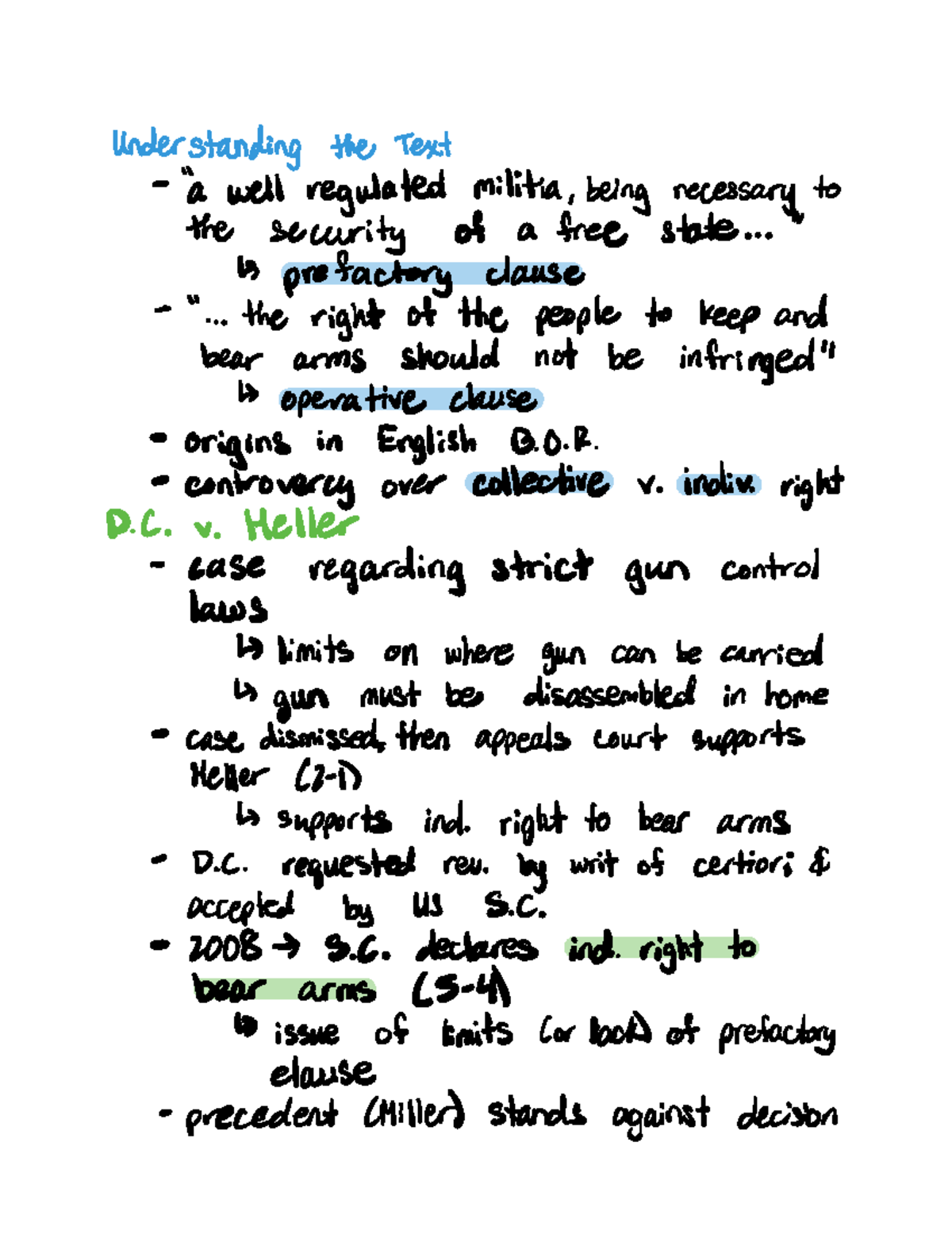
The phrase "a well regulated militia," found in the text of the Second Amendment, has served as a central focal point for legal scholars, historians, and jurists analyzing the constitutional right to keep and bear arms. Historically and legally, the term "well regulated" implied functioning properly, disciplined, and equipped according to established standards, rather than subjected to heavy modern government oversight. This phrase connects directly to the broader legal debate regarding whether the Second Amendment protects an individual right independent of military service or a collective right tied strictly to state-organized military forces.
Historical Foundations of the Militia in Early American Law
To understand the meaning of "a well regulated militia" within the Second Amendment, one must examine the socio-political and military framework of the American colonies and the early republic. The concept of the militia was not a standing army; rather, it was a fundamental institution of public defense comprising the citizenry at large.
The Colonial Defense Model
Before and during the American Revolution, European powers maintained large, professional standing armies, which many colonists viewed as instruments of tyranny. Conversely, the traditional English and colonial model relied on the general populace for local defense. Every able-bodied free male within a certain age range was legally required to possess arms and participate in local muster days.
These musters were designed to ensure that citizens maintained functional equipment, ammunition, and basic tactical proficiency. The term "well regulated" in 18th-century English commonly meant properly functioning, ordered, or disciplined. Therefore, a "well regulated militia" described a body of armed citizens who were organized, equipped, and trained to defend their communities and the broader polity against foreign invasion or internal insurrection.
The Transition from Collective Defense to Constitutional Text
When the framers drafted the United States Constitution and subsequently the Bill of Rights, they sought to balance two competing priorities:
- Providing for the national defense without maintaining a large, permanent standing army that could threaten civil liberties.
- Ensuring that individual states retained a defensive counterweight against potential federal overreach.
The Second Amendment emerged from these debates during the ratifying conventions. Anti-Federalists expressed deep concern that the new federal government might disarm the populace by failing to organize or arm the state militias, or by selectively disarming political opponents. The resulting text—"A well regulated Militia, being necessary to the security of a free State, the right of the people to keep and bear arms, shall not be infringed"—intertwined the security of a free state with the preservation of the individual's right to possess weapons.
Grammatical and Textual Analysis of the Second Amendment
Constitutional interpretation relies heavily on textualism, originalism, and grammatical analysis of 18th-century English. Legal historians and linguists have dedicated extensive study to the relationship between the prefatory clause ("A well regulated Militia, being necessary to the security of a free State") and the operative clause ("the right of the people to keep and bear arms, shall not be infringed").
Prefatory Clause vs. Operative Clause
In English grammar of the late 18th century, prefatory clauses often served to explain the purpose or motivation behind a command or right, without necessarily limiting its scope.
- The Prefatory Clause: Explains why the right is protected—because a well-regulated militia is necessary for a free state's security. It highlights the ultimate political and security objective.
- The Operative Clause: States what is protected—"the right of the people to keep and bear arms."
Scholarly debates often center on whether the prefatory clause restricts the operative clause. One school of thought argues that the amendment only protects arms-bearing directly tied to active militia service. The opposing school argues that "the people" refers to the individual citizenry, matching the usage of the phrase in other parts of the Bill of Rights (such as the First and Fourth Amendments), where it unambiguously denotes individual rights.
Semantic Meaning of Key Terms
- "Militia": In 18th-century usage, this encompassed all able-bodied male citizens capable of bearing arms, distinct from a select militia or professional standing army.
- "Well Regulated": Means disciplined, properly supplied, and operational, rather than bureaucratically restricted by administrative regulations.
- "The Right of the People": Denotes a right belonging to individual citizens collectively and severally, analogous to "the freedom of speech" or "the right of the people peaceably to assemble."
- "Keep and Bear Arms": To possess and carry weapons for confrontation, defense, or military utility.
Evolution of Legal Interpretation and Landmark Supreme Court Jurisprudence
For much of American history, the judicial interpretation of the Second Amendment remained relatively sparse. However, 20th- and 21st-century Supreme Court jurisprudence has provided definitive rulings that clarify the scope of the Amendment and the meaning of its clauses.
United States v. Miller (1939)
For decades, lower federal courts and legal analysts relied primarily on United States v. Miller (1939) as the definitive interpretation of the Second Amendment. In Miller, the Supreme Court evaluated whether the National Firearms Act of 1934 violated the Second Amendment by regulating short-barreled shotguns.
The Court held that the federal government could regulate such weapons because the defendants failed to show that a short-barreled shotgun had "some reasonable relationship to the preservation or efficiency of a well regulated militia." While some lower courts interpreted Miller as establishing a "collective rights" model that protected gun ownership solely within the context of a state National Guard, subsequent scholarship and later Supreme Court rulings clarified that Miller focused on the type of weapon protected—specifically, whether it was of militia-suitable utility—rather than requiring active militia membership for every gun owner.
District of Columbia v. Heller (2008)
A profound doctrinal shift occurred with District of Columbia v. Heller (554 U.S. 570). The Supreme Court undertook a comprehensive historical analysis of the Second Amendment, examining its text, historical antecedents, and founding-era state constitutions.
The Court ruled that the Second Amendment protects an individual right to possess a firearm unconnected with service in a militia, and to use that arm for traditionally lawful purposes, such as self-defense within the home. Justice Antonin Scalia, writing for the majority, analyzed the phrase "a well regulated militia," concluding that the prefatory clause announced the purpose of the amendment but did not limit or restrict the substantive scope of the operative right belonging to "the people."
McDonald v. Chicago (2010) and New York State Rifle & Pistol Association, Inc. v. Bruen (2022)
- McDonald v. Chicago (2010): The Supreme Court extended the holding of Heller, ruling that the Second Amendment applies to state and local governments through the Fourteenth Amendment's Due Process Clause.
- New York State Rifle & Pistol Association, Inc. v. Bruen (2022): The Court reinforced individual rights by striking down proper-cause requirements for public carry licenses, establishing that firearms regulations must align with the historical tradition of firearm regulation in the United States.
Comparative Perspectives on Militia and Individual Rights Models
To evaluate the ongoing constitutional discussion, it is helpful to examine the two primary legal frameworks that have dominated American jurisprudence regarding "a well regulated militia."
| Interpretive Model | Primary Focus | View of "Militia" | View of "The Right of the People" | Key Judicial Precedent |
|---|---|---|---|---|
| Collective / States' Rights Model | The prefatory clause; institutional defense. | Restricted strictly to organized state forces (e.g., National Guard). | Conditional upon active service in a government-recognized military unit. | United States v. Miller (historical lower-court interpretations) |
| Individual Rights Model | The operative clause; personal self-defense and civic duty. | Composed of the general body of able-bodied citizens (the populace). | An individual right belonging to all citizens, independent of military service. | District of Columbia v. Heller (2008) |
Frequently Asked Questions
What does "well regulated" mean in the context of the Second Amendment?
In 18th-century terminology, "well regulated" did not mean subject to government bureaucratic rules, licensing schemes, or administrative statutes. Instead, it meant properly trained, disciplined, functioning, and equipped with the necessary arms and ammunition to perform effectively.
Does the Second Amendment require someone to be in a militia to own a gun?
No. In District of Columbia v. Heller (2008), the U.S. Supreme Court ruled that the Second Amendment protects an individual right to keep and bear arms for lawful purposes, such as self-defense in the home, completely independent of service in a formal militia.
How did the founders view standing armies versus militias?
The founders viewed professional standing armies with deep suspicion, considering them potential tools for tyranny and political oppression. Conversely, they viewed a citizen-based militia—drawn from the general populace—as essential for maintaining public liberty, repelling invasions, and preserving a free state.
Does the Second Amendment apply to state and local governments?
Yes. While the Bill of Rights originally applied only to the federal government, the Supreme Court ruled in McDonald v. Chicago (2010) that the Second Amendment is fully incorporated against state and local governments via the Fourteenth Amendment.
What is the difference between the prefatory clause and the operative clause?
The prefatory clause ("A well regulated Militia, being necessary to the security of a free State") states the historical reason and purpose behind the amendment. The operative clause ("the right of the people to keep and bear arms, shall not be infringed") establishes the legal right protected for individual citizens.
Practical Considerations and Next Actions
For legal researchers, policy analysts, and citizens seeking a deeper understanding of constitutional law, exploring primary source documents provides invaluable clarity. Reviewing the Federalist Papers (particularly Federalist No. 46), Anti-Federalist essays, and the full text of Supreme Court opinions such as District of Columbia v. Heller and Bruen offers direct insight into how the judiciary interprets historical texts and constitutional principles. When evaluating modern legislation or litigation involving firearms, consulting constitutional scholars and legal commentaries specializing in Second Amendment jurisprudence ensures a comprehensive grasp of current legal standards.