The 160th Judicial District Court is a Dallas County civil court handling high-stakes litigation, including personal injury, contract disputes, and property law. Located in the George L. Allen, Sr. Courts Building, it operates under the Texas Rules of Civil Procedure and specific local rules governing electronic filing, scheduling, and courtroom conduct.
Understanding the Role of the 160th Judicial District Court
The 160th Judicial District Court serves as a cornerstone of the civil justice system in Dallas County, Texas. Unlike municipal or justice of the peace courts, which handle minor claims or traffic violations, the 160th is a court of general jurisdiction. This means it is empowered to hear a vast array of civil matters, often involving significant financial stakes, complex legal theories, and multi-party disputes.
In the Texas judicial hierarchy, district courts are the primary trial courts for civil matters where the amount in controversy exceeds a certain threshold (historically $500, but practically much higher in a major metropolitan hub like Dallas). As of 2026, the 160th remains a key venue for residents and businesses seeking to resolve grievances ranging from corporate breaches of contract to catastrophic personal injury claims.
The court’s operations are governed not only by state statutes but also by the Dallas County Local Rules. These rules provide the granular detail necessary for the efficient flow of cases, specifying how motions are filed, how hearings are set, and how the court manages its "docket"—the list of all pending cases. Understanding these nuances is essential for any litigant or legal professional appearing before the court.
Jurisdiction and Case Types
The 160th Judicial District Court exclusively hears civil cases. It does not have jurisdiction over criminal matters, which are handled by the Dallas County Criminal District Courts. The breadth of civil law covered by the 160th includes, but is not limited to:
- Commercial and Business Litigation: Disputes between corporations, partnership breakups, and allegations of unfair business practices.
- Personal Injury and Tort Law: Cases involving motor vehicle accidents, premises liability (slip and fall), and professional malpractice.
- Real Estate Disputes: Title disputes, foreclosure appeals, and complex commercial lease disagreements.
- Employment Law: Claims regarding wrongful termination, discrimination, or non-compete agreement violations.
- Debt and Contract Actions: Lawsuits involving the failure to pay for services rendered or goods delivered.
The court is tasked with interpreting the law, overseeing the discovery process (where parties exchange evidence), and presiding over both bench trials (where the judge decides the outcome) and jury trials. Because Dallas County is a major economic engine for the United States, the 160th frequently handles cases with national or even international implications, requiring a judge with a deep understanding of complex statutory frameworks.
The Presiding Judge and Court Staff
As of 2026, the presiding judge of the 160th Judicial District Court is Judge Aiesha Redmond. Judges in Texas are elected officials, serving four-year terms. Judge Redmond brings a specific judicial philosophy to the bench, emphasizing efficiency, transparency, and a strict adherence to the Texas Rules of Evidence and Civil Procedure.
The "court" is more than just the judge; it is a team of professionals who ensure the machinery of justice functions smoothly. When interacting with the 160th, you will likely encounter the following key roles:
- The Court Coordinator: This is perhaps the most important contact for attorneys. The coordinator manages the judge's calendar, sets hearings, and handles requests for continuances (delays). If a party needs to know when their case will be heard, the coordinator is the primary point of contact.
- The Court Reporter: Responsible for creating a verbatim written record of all proceedings. In the event of an appeal, the court reporter’s transcript is the official account of what happened during the trial.
- The Bailiff: A law enforcement officer responsible for maintaining order and security within the courtroom. They also assist with the management of the jury during trials.
- The District Clerk’s Staff: While the District Clerk is a separate county-wide office, their deputies are assigned to specific courts to manage the official case files and process new filings.
Procedures for Filing and Litigation
Litigation in the 160th Judicial District Court must adhere to the Texas Rules of Civil Procedure (TRCP). In 2026, the court continues to rely heavily on technology to manage its caseload.
Electronic Filing (E-Filing)
All filings in Dallas County civil courts must be submitted electronically through the EFileTexas system. This system allows for the 24/7 submission of legal documents, which are then reviewed and "accepted" by the District Clerk. For pro se litigants (individuals representing themselves), there are limited exceptions and public access terminals available at the courthouse, but the standard expectation is electronic submission in PDF format.
The Scheduling Order
Once a lawsuit is filed and an answer is received, the court will typically issue a Scheduling Order. This document is the roadmap for the entire case. It sets deadlines for:
- Joinder of additional parties.
- Expert witness designations.
- Discovery completion (the period for depositions and document exchange).
- The filing of dispositive motions (motions to dismiss or for summary judgment).
- The trial date itself.
Adhering to these deadlines is critical. In the 160th, as in most Dallas courts, failure to meet a deadline in the Scheduling Order can result in the loss of rights, such as the ability to call a witness or present specific evidence.
Discovery Levels
Texas law classifies cases into three "Discovery Levels" under Rule 190 of the TRCP. The level determines how much time and how many questions (interrogatories) parties are allowed.
| Discovery Level | Type of Case | Time Limit for Discovery | Interrogatories Allowed |
|---|---|---|---|
| Level 1 | Expedited Actions (Claims < $250,000) | 180 days after first request | 15 questions |
| Level 2 | Standard Cases (Most litigation) | Ends 30 days before trial | 25 questions |
| Level 3 | Complex/Custom (Ordered by Judge) | Defined by Scheduling Order | Defined by Scheduling Order |
Motion Practice and Hearings
In the 160th District Court, motions are the primary way parties ask the judge to make a ruling before a trial. Common motions include Motions for Summary Judgment, where one party argues that there are no facts in dispute and they should win as a matter of law, and Discovery Motions, where parties fight over the production of evidence.
Submission vs. Oral Hearing
The court often utilizes a "submission" docket. This means the judge will rule on a motion based solely on the written briefs and evidence submitted by the parties, without a live hearing. If a party believes an oral argument is necessary, they must specifically request it, and the judge will decide whether to grant it. In 2026, many oral hearings for non-dispositive motions are conducted via remote video conferencing (such as Zoom or Microsoft Teams), a practice that has become standard to save time and costs for litigants.
Mediation Requirements
It is standard practice in Dallas County for judges to require parties to undergo mediation before a case is allowed to proceed to trial. Mediation is a confidential process where a neutral third party (the mediator) helps the sides reach a settlement. The 160th District Court views mediation as a vital tool for docket management, as it resolves a high percentage of cases without the need for a lengthy and expensive trial.
Accessing Court Records and Information
Transparency is a hallmark of the Texas judicial system. Members of the public, journalists, and legal researchers can access records for the 160th Judicial District Court through several channels.
The Dallas County District Clerk Portal
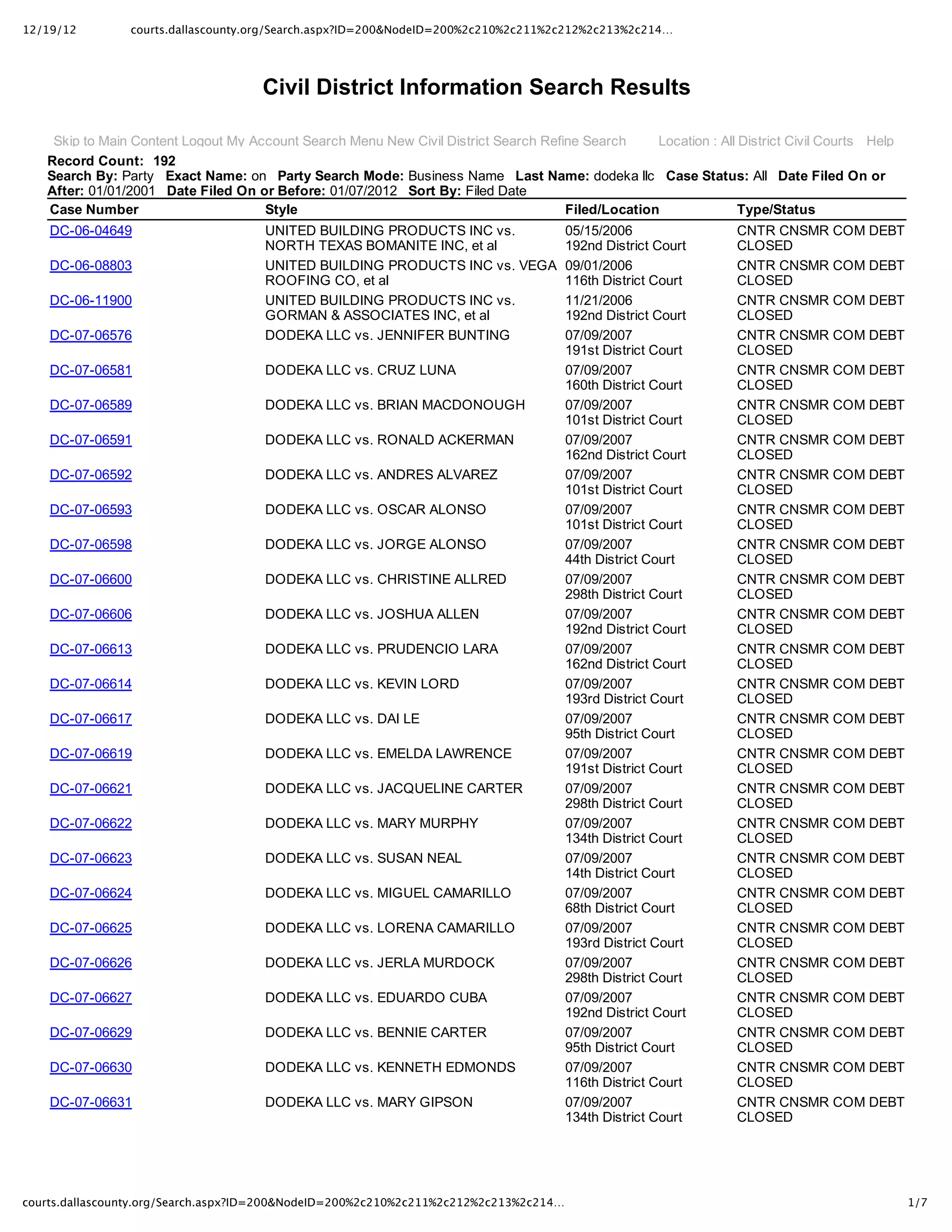
The Dallas County District Clerk’s website provides an online search tool. By entering a case number or a party's name, you can see the "register of actions," which lists every document filed and every order signed by the judge. While viewing the docket sheet is generally free, downloading actual copies of filed documents usually requires a paid subscription or a per-page fee.
Attending Proceedings
Unless a case involves sensitive matters that a judge has ordered sealed (which is rare in general civil litigation), the 160th Judicial District Court is open to the public. Anyone may sit in the gallery and observe hearings or trials. This is a fundamental right that ensures the accountability of the judiciary.
Physical Location
The court is located at: George L. Allen, Sr. Courts Building 600 Commerce Street Dallas, TX 75202
Visitors should arrive early to clear security, which involves passing through a metal detector. The building is centrally located in downtown Dallas, accessible via DART (Dallas Area Rapid Transit) and surrounded by several paid parking lots.
Trial Decorum and Professionalism
The 160th Judicial District Court maintains high standards for behavior. Whether you are an attorney or a self-represented litigant, certain expectations apply:
- Punctuality: Being late for a docket call or a hearing is viewed with extreme disfavor and can result in a case being dismissed for "want of prosecution."
- Dress Code: Professional attire is required. For attorneys, this means suits; for litigants, "business casual" is the minimum standard.
- Communication: All remarks should be addressed to the judge ("Your Honor"), not directly to the opposing party or counsel.
- Electronic Devices: Phones must be silenced or turned off. Recording proceedings without express judicial permission is strictly prohibited.
The "Dallas Bar" is known for a tradition of civility. The 160th District Court expects parties to attempt to resolve minor procedural disputes (like scheduling a deposition) between themselves before bringing the matter to the judge’s attention.
Common Challenges in Civil Litigation
Navigating a case in the 160th can be daunting due to the procedural complexity. One of the most common mistakes is the failure to properly authenticate evidence. Simply having a document is not enough; you must prove it is what you say it is according to the Texas Rules of Evidence.
Another challenge is the Statute of Limitations. In Texas, most personal injury claims must be filed within two years of the incident, while contract claims generally have a four-year window. Filing in the wrong court or missing these windows is a fatal error that the 160th cannot "fix" for a litigant.
Frequently Asked Questions
How do I find the trial date for my case in the 160th District Court?
You can find your trial date by searching the Dallas County District Clerk’s online portal using your case number. Alternatively, you can check the court’s official docket, which is often posted on the Dallas County website. If you are represented by an attorney, they will receive a "Notice of Trial Setting" through the e-filing system. Note that trial dates are often "tentative" and may be pushed back if earlier cases on the docket take longer than expected.
Can I represent myself in the 160th District Court?
Yes, individuals have the right to represent themselves, known as appearing "pro se." However, the court will hold a pro se litigant to the same standards as a licensed attorney regarding knowledge of the law and procedural rules. Because the 160th handles complex civil matters, representing yourself is risky, especially against a party with legal counsel. Corporate entities (LLCs, Corporations) are generally required by Texas law to be represented by an attorney and cannot appear pro se.
What is the difference between a "District Court" and a "County Court at Law" in Dallas?
The primary difference is the amount of money at stake. County Courts at Law in Dallas typically handle cases where the amount in controversy is between $500 and $250,000. District Courts, like the 160th, have "concurrent jurisdiction" with county courts but are the only venue for cases where the value exceeds the county court's limit. Additionally, certain types of cases, such as disputes over land titles or defamation, are traditionally handled in District Courts.
How do I contact Judge Aiesha Redmond's staff?
The best way to contact the staff is via the phone numbers listed on the Dallas County 160th District Court official webpage. Most inquiries should be directed to the Court Coordinator. It is important to remember that you cannot speak directly to the judge about your case outside of a formal hearing (this is called "ex parte" communication and is prohibited by judicial ethics).
What happens if I miss a court date in Dallas County?
Missing a court date can have severe consequences. If you are the plaintiff (the one who sued), the judge may dismiss your case for Want of Prosecution (DWOP). If you are the defendant, the judge may enter a "Default Judgment" against you, meaning you lose the case automatically and may owe the amount requested by the plaintiff. If an emergency arises, you must contact the Court Coordinator and the opposing party immediately to request a continuance.
Practical Recommendation for Litigants
If you find yourself involved in a lawsuit in the 160th Judicial District Court, the first step is to perform a thorough review of the Dallas County Local Rules. These rules often contain specific requirements for motion headers, page limits, and "certificates of conference" that are not found in the statewide rules.
Secondly, leverage the Dallas County District Clerk's online resources to track your case. Set up alerts if possible, and ensure your contact information is always current. In a high-volume court like the 160th, staying proactive is the only way to ensure your legal rights are protected. If the matter involves significant financial assets or complex legal questions, seeking a board-certified civil trial attorney is highly recommended to navigate the rigorous requirements of this specific bench.