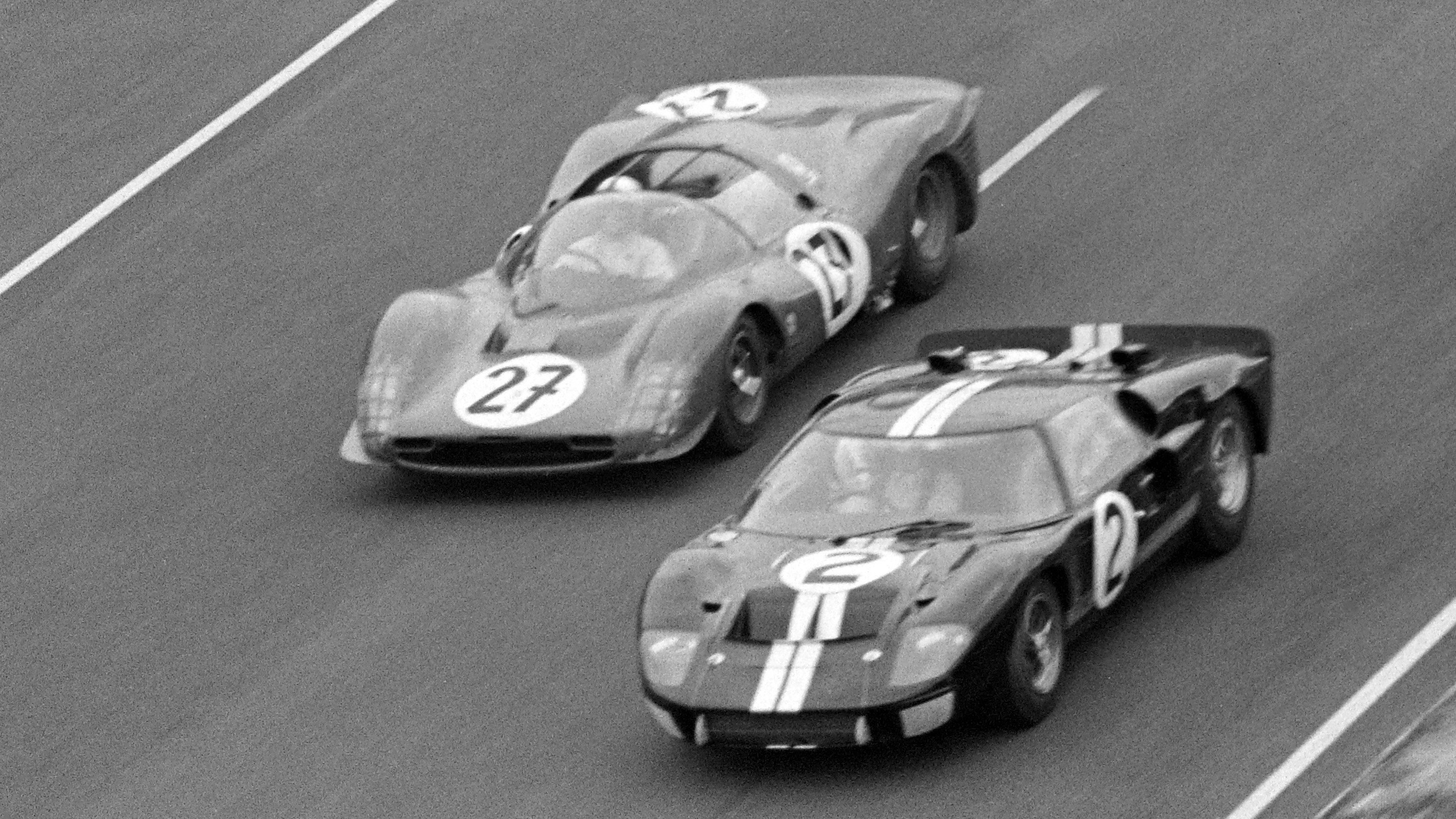
The 1966 24 Hours of Le Mans stands as the singular moment when the Ford Motor Company, led by an uncompromising mandate from Henry Ford II, achieved an unprecedented victory against Ferrari. By finishing first, second, and third, Ford ended years of Italian dominance, marking a definitive shift in international endurance racing that combined American industrial scale with professional motorsport strategy.
The Genesis of the Ford-Ferrari Feud
The impetus for Ford’s assault on Le Mans began in the early 1960s with a failed acquisition. Henry Ford II had sought to purchase Ferrari to bolster Ford's image and enter the lucrative European sports car market. Negotiations were well underway in 1963, but Enzo Ferrari abruptly walked away from the deal at the final hour. This insult galvanized Henry Ford II, who issued a directive to his racing department: build a car capable of beating Ferrari on the world stage, specifically at the grueling 24-hour race in France.
The project was not merely a vanity effort; it was an exercise in corporate warfare. Ford bypassed the traditional, often slower, internal development processes and sought external expertise. They engaged Eric Broadley of Lola Cars to assist with the chassis design and eventually brought in Carroll Shelby, the legendary American constructor and driver, to lead the racing program.
Technical Specifications: The Ford GT40 Mk II
The car that secured the 1966 victory was the Ford GT40 Mk II. The "40" in its name referred to its height—exactly 40 inches from the ground to the roof, a constraint necessary to minimize aerodynamic drag while maintaining a cockpit that could house a driver and a passenger-sized seat, as per the race regulations.
The engineering challenge was significant. The GT40 had suffered from aerodynamic instability at high speeds in its previous iterations, particularly during the 1964 and 1965 campaigns. For 1966, the technical team implemented major upgrades:
- Engine: The displacement was increased to a 427-cubic-inch (7.0L) V8 engine, producing roughly 485 horsepower. This massive powerplant offered the torque necessary for the long Mulsanne Straight, where the car could exceed 200 mph.
- Chassis: The steel monocoque was lightened and reinforced to withstand 24 hours of sustained vibration and mechanical stress.
- Braking Systems: Because the GT40 Mk II was significantly heavier than the nimble Ferrari 330 P3, Ford implemented a revolutionary "quick-change" brake system. Mechanics could replace the entire brake rotor and pad assembly in minutes, a vital advantage during the race.
- Transmission: A reinforced four-speed manual gearbox was utilized to handle the massive torque output of the 7.0L big-block engine, a deviation from the sophisticated, yet fragile, gearboxes often seen in European prototypes.
The Race Strategy: Brutal Reliability
In 1966, the strategy adopted by the Ford team was a departure from traditional "sprint" endurance racing. While Ferrari pushed their lighter prototypes to the edge of mechanical failure to keep pace, Ford utilized a strategy of managed intensity.
The race began on June 18, 1966. The Ferraris were faster in the technical sections of the Circuit de la Sarthe, but the Fords were built for the long haul. As the heat of the day turned into the cool of the night, the reliability of the 427-cubic-inch engine became the deciding factor. Ferrari’s P3 models began to suffer from cooling and electrical issues, eventually succumbing to total mechanical failure. By the morning of June 19, the Ford fleet had assumed total control of the front of the pack.
The Controversial Finish
The climax of the race remains one of the most debated moments in racing history. As the cars entered the final lap, the lead Ford driven by Ken Miles and Denny Hulme was followed by the car driven by Bruce McLaren and Chris Amon.
Ford executives, led by Leo Beebe, ordered a "photo finish" to create a marketing image of the three Ford cars crossing the line in unison. Ken Miles, who had driven the majority of the race and was on the verge of becoming the first person to win the "Triple Crown" of endurance racing (Sebring, Daytona, and Le Mans in a single year), slowed down to allow McLaren to draw alongside.
Because the McLaren/Amon car had started several meters behind the Miles/Hulme car, officials ruled that McLaren had traveled a greater distance in the same amount of time. Consequently, the victory was awarded to Bruce McLaren and Chris Amon. This decision effectively robbed Miles of a historic achievement, a point of contention that remains a central element of the 1966 legend.
Comparative Analysis: Ford vs. Ferrari (1966)
| Feature | Ford GT40 Mk II | Ferrari 330 P3 |
|---|---|---|
| Engine Displacement | 7.0L (427 cu in) | 4.0L (242 cu in) |
| Configuration | V8 | V12 |
| Estimated Power | 485 hp | 420 hp |
| Primary Advantage | Durability & Straight-line Speed | Agility & Cornering |
| 1966 Result | 1st, 2nd, 3rd Place | Did Not Finish (All) |
Impact on Motorsports and Industry
The victory changed the DNA of American racing. It demonstrated that American industrial precision, when combined with European track experience, could overwhelm the boutique engineering of the established European elite. Ford leveraged the win to market its consumer cars, solidifying the GT40 as a performance icon that remains a benchmark for automotive design.
Furthermore, the 1966 win established the feasibility of "big-block" engines in endurance racing, forcing every other manufacturer to reconsider their powertrain architectures. It signaled the end of an era where lightweight, high-revving engines were the only path to success in 24-hour endurance events.
Frequently Asked Questions
Why did Ferrari fail to win in 1966? Ferrari’s 1966 entries, the 330 P3 models, were designed for agility. They pushed their limits to stay ahead of the Fords, resulting in mechanical failures—largely in the transmission and electrical systems—due to the sustained, brutal pace set by the American cars.
Who were the drivers for the winning Ford? The winning car, chassis number P-1046, was driven by Bruce McLaren and Chris Amon. While Ken Miles and Denny Hulme crossed the line in the second-place car, they were the leaders for most of the event.
What happened to Ken Miles? Ken Miles, the lead test driver and instrumental force behind the GT40’s development, died only two months after the 1966 Le Mans race. He was killed while testing the J-car, a successor to the GT40, at Riverside International Raceway in California.
How many Ford GT40s finished the race? Ford entered a large fleet of cars. The top three spots on the podium were claimed by Ford: the McLaren/Amon car first, the Miles/Hulme car second, and the Bucknum/Hutcherson car third.
Is it true that Ford forced a tie for the finish? Yes. Leo Beebe, the racing manager for Ford, instructed the drivers to slow down to create a side-by-side finish. This decision resulted in the official disqualification of a tie, as the race officials ruled based on total distance covered from the staggered starting positions.
Practical Lessons for Racing and Engineering
For those studying the 1966 victory as an engineering case study, the primary lesson is the importance of "systems redundancy." Ford did not simply build a faster car; they built a more serviceable one. The ability to change brake discs during a pit stop is a clear example of prioritizing maintenance speed over pure, theoretical performance. In any high-stakes project, identifying potential points of failure and engineering rapid recovery protocols is often more valuable than chasing absolute maximum power.
If you are researching the GT40 for restoration or replica building, verify original documentation regarding the MK II specific chassis modifications. Many replicas on the market today are based on later GT40 iterations (like the MK IV) which feature different structural properties and engine bays. Always prioritize technical archives from the Ford Heritage Vault or certified historic racing registries to ensure accuracy in your projects.