A Phase 1 Environmental Site Assessment provides a comprehensive baseline review of a property's history and current conditions to identify potential environmental liabilities, soil contamination, or hazardous substance impacts before commercial real estate transactions or major developments occur.
Introduction to Environmental Site Assessments
Navigating commercial real estate transactions, corporate mergers, and property development projects requires a rigorous understanding of potential environmental liabilities. Among the most critical risk-management tools in these processes is the Phase 1 Environmental Site Assessment, often referred to as a Phase 1 ESA. This preliminary investigation serves as the industry-standard methodology for evaluating whether a property harbors recognized environmental conditions that could threaten human health, devalue the asset, or impose substantial cleanup liabilities on future owners.
Understanding the architecture of a Phase 1 study helps stakeholders—including buyers, sellers, lenders, and developers—protect their capital and comply with federal and state regulations. While the process may appear daunting, its core objective is straightforward: to establish whether past or present land uses have introduced hazardous substances or petroleum products onto a site. By executing a systematic, standardized review of records, historical aerial photographs, regulatory databases, and physical site conditions, an environmental professional can determine if further invasive testing is warranted.
The Regulatory Framework and All Appropriate Inquiries
The modern standard for conducting a Phase 1 Environmental Site Assessment is deeply rooted in federal environmental law, specifically the Comprehensive Environmental Response, Compensation, and Liability Act. Commonly known as Superfund, this legislation holds property owners strictly liable for environmental cleanup costs, regardless of whether they caused the contamination.
To mitigate this severe financial risk, Congress amended Superfund through the Small Business Liability Relief and Brownfields Revitalization Act. This amendment established the Innocent Landowner Defense, which protects property owners from liability if they can prove they performed "All Appropriate Inquiries" prior to acquisition. The American Society for Testing and Materials developed a consensus standard that satisfies these federal requirements, known widely as ASTM E1527. Environmental professionals must adhere strictly to these guidelines to ensure that the resulting assessment grants legal protections to the client.
Scope and Core Components of a Phase 1 Study
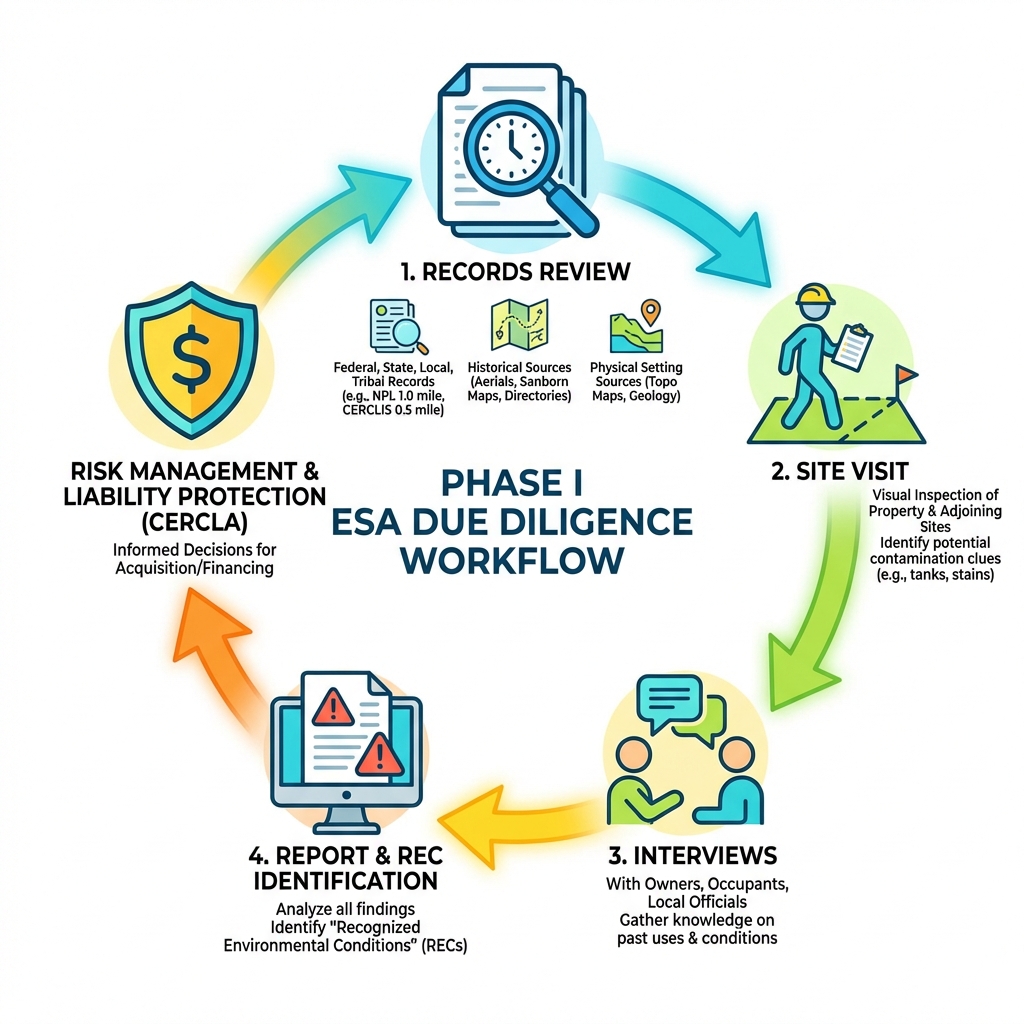
A standard Phase 1 Environmental Site Assessment is strictly a non-invasive study. It does not involve collecting soil samples, drilling boreholes, testing groundwater, or analyzing building materials for asbestos. Instead, the investigation relies on historical research, observation, and interviews. The methodology is divided into four primary components:
- Records Review: Examination of federal, state, and local environmental databases to identify registered waste generators, leaking underground storage tanks, spills, and landfills within specified radius distances from the subject property.
- Site Reconnaissance: A physical inspection of the property and its structures conducted by an environmental professional to observe current uses, chemical storage, stained surfaces, stressed vegetation, and potential indicators of contamination.
- Interviews: Discussions with current and past owners, occupants, and local government officials to gather institutional knowledge about historical property operations and waste management practices.
- Historical Research: Utilization of historical sources—such as aerial photographs, city directories, fire insurance maps, and chain-of-title records—to trace the property's use back to its first developed use or 1940, whichever is earlier.
Understanding Recognized Environmental Conditions
The ultimate deliverable of a Phase 1 study is a detailed written report that explicitly identifies or rules out Recognized Environmental Conditions. The ASTM standard defines a REC as the presence or likely presence of any hazardous substances or petroleum products in, on, or at a property under conditions that indicate an existing release, a past release, or a material threat of a release into structures, soil, groundwater, or surface water of the property.
Environmental professionals also categorize findings into related subsets, such as Controlled Recognized Environmental Conditions, which are past releases that have been addressed to the satisfaction of regulatory authorities but leave hazardous substances managed in place through institutional controls. Additionally, reports may note De Minimis Conditions, which represent very low-level environmental issues that generally do not present a threat to human health or the environment and would not trigger an enforcement action.
| Finding Category | Definition | Potential Transaction Impact |
|---|---|---|
| Recognized Environmental Condition (REC) | Presence or likely presence of hazardous substances or petroleum indicating a past, current, or threatened release. | Requires further investigation (Phase 2) or risk mitigation before closing. |
| Controlled REC (CREC) | A past release addressed to regulatory standards, but with hazardous substances left in place under restrictions. | Requires monitoring of institutional controls and deed restrictions. |
| Historical REC (HREC) | A past release that has been cleaned up to unrestricted residential standards with no ongoing controls. | Generally does not require further action or impact the transaction. |
| De Minimis Condition | Minor environmental conditions that do not present a threat to health or safety and require no remediation. | Negligible impact; noted for completeness without altering deal terms. |
Qualifications of Environmental Professionals
The integrity of a Phase 1 Environmental Site Assessment depends entirely on the qualifications and independence of the investigator. Under the ASTM E1527 standard and federal regulations, the study must be conducted or overseen by an Environmental Professional.
An EP must meet specific educational and professional licensing requirements, such as holding a professional engineer or professional geologist license, along with a specified number of years of relevant full-time environmental work experience. Alternatively, an individual with a science or engineering degree and several years of verifiable professional experience in environmental assessments can qualify. Engaging qualified personnel is vital; lenders and regulatory agencies routinely reject reports compiled by unqualified individuals, rendering the assessment legally invalid for liability protection.
Timeline and Cost Considerations
Budgeting and scheduling are critical factors in commercial real estate transactions, where closing windows are frequently tight. A standard Phase 1 Environmental Site Assessment typically requires two to four weeks from the initial contract execution to the delivery of the final written report.
Several variables influence the duration and cost of a study, including the geographic size of the property, its historical complexity, the accessibility of historical records, and whether the site encompasses multiple parcels or heavy industrial pasts. While a straightforward undeveloped plot or small retail storefront might be assessed quickly and affordably, a sprawling manufacturing plant with decades of chemical handling requires extensive historical research and interviewing, scaling costs and timeframes upward.
Transitioning from Phase 1 to Phase 2
When a Phase 1 study identifies one or more Recognized Environmental Conditions, the transaction faces a pivotal juncture. A Phase 1 report does not prove that contamination exists; it merely indicates a high probability or reasonable suspicion of contamination.
To resolve a REC, stakeholders must typically commission a Phase 2 Environmental Site Assessment. This subsequent phase is invasive and involves collecting physical samples of soil, soil vapor, groundwater, and indoor air to test for specific contaminants in a certified laboratory. The analytical data gathered during a Phase 2 study confirms or refutes the presence of contamination, establishes baseline concentration levels, and provides the necessary data to design a remediation plan if cleanup is required.
Common Mistakes and Limitations in Phase 1 Studies
Participants in commercial real estate transactions occasionally harbor misconceptions regarding what a Phase 1 study accomplishes. Recognizing these limitations prevents costly miscalculations during due diligence.
- Assuming a Phase 1 Cleans a Property: A Phase 1 is strictly an investigative and diagnostic tool. It does not remediate or clean up environmental contamination.
- Overlooking Non-Scope Considerations: Standard Phase 1 studies do not automatically include investigations into asbestos-containing materials, lead-based paint, radon, wetlands, or endangered species unless explicitly contracted as non-scope additions.
- Relying on Outdated Reports: Federal regulations dictate that a Phase 1 report has a shelf life of 180 days. If the transaction closes or financing is secured more than 180 days after the initial site visit and record reviews, specific components—such as interviews, database checks, and site reconnaissance—must be updated.
Frequently Asked Questions
How long is a Phase 1 Environmental Site Assessment valid?
Under federal guidelines and industry standards, a Phase 1 report remains valid for 180 days. If the report exceeds this window before property acquisition or loan closing, an update must be performed. Components older than 180 days—including the site visit, database reviews, and user questionnaires—must be refreshed, while components up to one year old may sometimes be updated rather than completely redone.
Can a buyer conduct their own Phase 1 study?
While a buyer can complete certain portions of the due diligence process, such as user questionnaires, federal regulations require that the actual investigation be performed by a qualified Environmental Professional who meets specific educational and licensing criteria to ensure liability protections under the Innocent Landowner Defense.
What happens if a Phase 1 study finds a Recognized Environmental Condition?
Discovering a REC does not automatically kill a real estate deal. It signals that further investigation is necessary, usually through a Phase 2 Environmental Site Assessment involving soil and groundwater sampling. Parties frequently use Phase 1 and Phase 2 findings to renegotiate purchase prices, establish escrow reserves for cleanup, or negotiate indemnification agreements.
Are residential properties subject to Phase 1 assessments?
Single-family residential homes are generally exempt from standard commercial Phase 1 requirements. However, multi-family apartment complexes, residential subdivisions undergoing development, and mixed-use properties frequently require Phase 1 assessments, especially when commercial lenders or federal agencies finance the transaction.
What is the difference between a Phase 1 and a Phase 2 ESA?
A Phase 1 ESA is entirely non-invasive, relying on historical research, regulatory database reviews, and visual inspections to identify potential contamination risks. A Phase 2 ESA is an invasive investigation that follows up on Phase 1 findings by drilling boreholes, extracting soil and groundwater samples, and running laboratory analyses to confirm the presence and concentration of pollutants.
Conclusion and Next Actions
Executing a thorough Phase 1 Environmental Site Assessment is an indispensable step in safeguarding commercial real estate investments and securing vital liability protections under federal law. Stakeholders should engage qualified environmental professionals early in the transaction timeline to allow adequate time for document review and site reconnaissance. If the assessment reveals Recognized Environmental Conditions, proceed immediately to scope a targeted Phase 2 evaluation to quantify risks and inform final negotiation and closing decisions.