Army Warrant Officers are highly specialized technical experts, combat leaders, and trainers who occupy a unique tier between the Non-Commissioned Officer (NCO) corps and the Commissioned Officer corps. They provide essential continuity and deep technical proficiency in complex fields such as aviation, intelligence, cyber security, and maintenance across the force.
The United States Army Warrant Officer (WO) cohort is a distinct professional body that represents less than 3% of the total Army strength. Unlike traditional commissioned officers, who are trained to be generalists as they rise through the ranks to assume command of increasingly larger units, Warrant Officers focus on becoming the "subject matter experts" of the military. They are the individuals the commander turns to when a technical problem requires a precise, high-level solution that exceeds the standard training of an NCO.
In 2026, the demand for these technical experts is higher than ever, driven by the increasing complexity of multi-domain operations and the integration of advanced artificial intelligence and electronic warfare systems. Understanding the rank structure, the progression of responsibility, and the requirements for entry is vital for any soldier considering this prestigious career path.
The Hierarchy of Warrant Officer Ranks
The Warrant Officer rank structure consists of five distinct grades, ranging from Warrant Officer 1 to Chief Warrant Officer 5. Each rank represents an increase not only in pay and seniority but also in the scope of influence and the level of technical mastery expected by the Department of the Army.
Warrant Officer 1 (WO1)
The WO1 is the introductory rank of the cohort. At this level, the soldier has transitioned from being an NCO or a civilian (in the case of flight school applicants) to a technical leader. In 2026, WO1s are primarily focused on refining their technical skills within their specific Military Occupational Specialty (MOS).
An important legal distinction occurs at this rank: Warrant Officers 1 are appointed by a warrant from the Secretary of the Army. They are not yet "commissioned" officers. Their primary role is tactical; they are the "doers" who ensure that specific equipment, systems, or flight operations are executed according to technical manuals and safety regulations. While they hold authority over NCOs and enlisted personnel, their focus remains narrow and specialized.
Chief Warrant Officer 2 (CW2)
Upon promotion to CW2, the individual receives a commission from the President of the United States, giving them the same legal status as traditional commissioned officers (Second Lieutenants through Generals). This shift from "appointed" to "commissioned" is a significant milestone in a Warrant Officer's career.
CW2s are expected to be fully proficient in their technical fields. They often serve at the company or battalion level, where they manage specific sections or detachments. For example, a CW2 in a maintenance unit might oversee a specialized repair shop, while a CW2 aviator might serve as a Pilot-in-Command. They are expected to begin mentoring junior soldiers and providing technical advice to company-grade commissioned officers.
Chief Warrant Officer 3 (CW3)
The CW3 rank marks the transition into a more senior advisory role. By the time a Warrant Officer reaches CW3, they are recognized as a master technician. Their responsibilities shift from the tactical execution of tasks to the management of technical systems at the battalion and brigade levels.
CW3s are often responsible for integrating their technical specialty into the broader mission. They serve as primary advisors to commanders on the capabilities and limitations of their specific equipment or systems. In the 2026 operational environment, a CW3 in the Signal Corps might be responsible for ensuring the integrity of a brigade’s data network during a high-intensity deployment, balancing technical troubleshooting with operational planning.
Chief Warrant Officer 4 (CW4)
CW4s are senior technical advisors who typically operate at the brigade, division, or corps levels. At this stage, the Warrant Officer is no longer just a technician; they are a manager of technical programs. They provide high-level mentorship to junior Warrant Officers and assist in the professional development of the NCO corps.
A CW4’s expertise is often utilized in staff positions where they help shape policy and operational doctrine. They are expected to have a deep understanding of the Army’s "big picture" and how their technical field supports strategic objectives. Because of their longevity and experience, they are frequently consulted by Colonels and General Officers for their candid, expert opinions.
Chief Warrant Officer 5 (CW5)
The CW5 is the highest rank in the Warrant Officer cohort. These individuals are the "master" technical experts of the Army. There are very few CW5s, and they are usually found at the highest echelons of command, including Major Commands (MACOMs) and the Pentagon.
CW5s are responsible for the overall health and professional development of the Warrant Officer cohort within their branch. They advise the most senior leaders in the Army on technical integration, procurement of new technology, and personnel management. A CW5 represents the pinnacle of technical achievement and leadership, often having served 20 to 30 years in the military.
Comparison of Army Warrant Officer Ranks
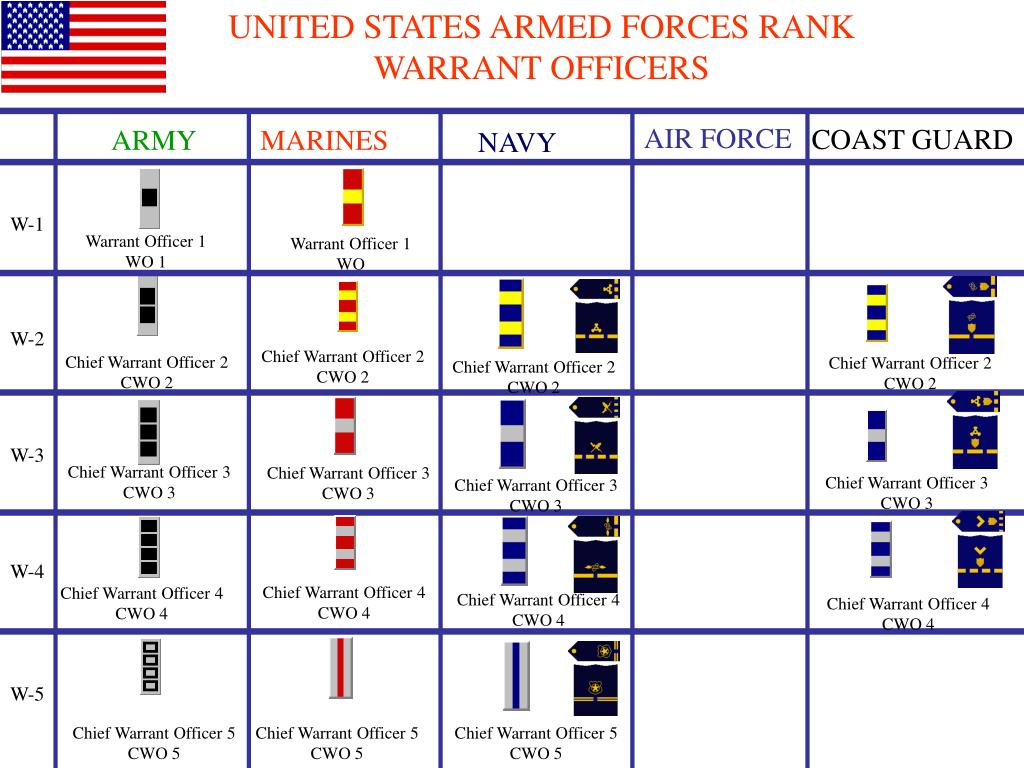
The following table outlines the pay grades, insignia, and primary focus areas for each rank as of 2026.
| Rank Title | Pay Grade | Insignia Description | Typical Level of Assignment | Primary Focus |
|---|---|---|---|---|
| Warrant Officer 1 | W-1 | Silver bar with one black square | Company / Platoon | Technical proficiency and tactical execution. |
| Chief Warrant Officer 2 | W-2 | Silver bar with two black squares | Company / Battalion | Intermediate technical mastery and leadership. |
| Chief Warrant Officer 3 | W-3 | Silver bar with three black squares | Battalion / Brigade | Advanced technical advice and section management. |
| Chief Warrant Officer 4 | W-4 | Silver bar with four black squares | Brigade / Division | Senior technical mentorship and staff integration. |
| Chief Warrant Officer 5 | W-5 | Silver bar with one vertical black stripe | Division / MACOM / HQDA | Strategic technical leadership and cohort management. |
The Three Pillars of Warrant Officer Responsibility
To understand the Warrant Officer ranks, one must understand the three specific pillars that define their daily operations: Technical Expertise, Leadership, and Advice.
1. Technical Expertise
This is the foundation of the Warrant Officer's existence. While a Commissioned Officer might spend 18 months in a job before rotating to a new type of leadership role, a Warrant Officer stays in their "track" for decades. If they are a Black Hawk pilot, they fly Black Hawks. If they are an Automotive Maintenance Officer, they manage vehicles. This continuity allows them to accumulate a level of knowledge that is impossible for generalist officers to achieve.
2. Leadership
Warrant Officers are not just "super-technicians"; they are officers. They are expected to lead by example and hold soldiers accountable to Army standards. While their leadership is often less formal than that of a Company Commander, their influence is profound. They mentor NCOs on technical standards and ensure that the junior enlisted soldiers under their supervision are becoming proficient in their crafts.
3. Advice to Command
The Warrant Officer serves as a bridge between the enlisted force and the commissioned leadership. A Battalion Commander may know that they need their tanks to move, but they may not understand the specific mechanical failure rate of a new engine cooling system. The Warrant Officer provides the commander with the ground truth: what the equipment can do, what it cannot do, and what resources are required to fix it.
Eligibility and the Path to Appointment
Becoming a Warrant Officer is a competitive process that requires a proven track record of performance. For most technical branches, applicants must already be NCOs (usually at the rank of Sergeant or higher) and have documented experience in their field.
General Requirements (2026 Standards)
- Citizenship: Must be a U.S. Citizen.
- ASVAB Score: Must have a General Technical (GT) score of 110 or higher.
- Security Clearance: Must be able to obtain and maintain a Secret or Top Secret clearance, depending on the MOS.
- Physical Fitness: Must meet the height and weight standards and pass the Army Combat Fitness Test (ACFT).
- Education: A high school diploma is required, though many technical branches now strongly prefer or require associate or bachelor’s degrees in relevant fields.
The Accession Process
- Application: The soldier submits a "Warrant Officer Accession Packet," which includes letters of recommendation from senior Warrant Officers and their current chain of command.
- The Board: A centralized selection board at the U.S. Army Recruiting Command (USAREC) reviews packets and selects the most qualified candidates.
- Warrant Officer Candidate School (WOCS): Candidates attend WOCS at Fort Novosel (formerly Fort Rucker), Alabama. This rigorous program focuses on leadership, ethics, and the transition from NCO to Officer.
- Warrant Officer Basic Course (WOBC): After graduating from WOCS and being appointed as a WO1, the new officer attends WOBC. This is where they receive advanced technical training specific to their MOS.
Aviation Exception: "Street to Seat"
The Army Aviation branch offers a unique path known as the "High School to Flight School" program. This allows civilians with no prior military experience to apply directly for Warrant Officer flight training. If selected, they attend Basic Combat Training (BCT), followed by WOCS, and then enter the flight training pipeline. This is one of the few ways to become an Army Officer without a four-year college degree.
Warrant Officers in Modern Warfare (2026 Context)
As the Army looks toward the challenges of 2026 and beyond, the role of the Warrant Officer is evolving to meet the demands of High-Intensity Conflict (HIC). In previous decades, Warrant Officers were often seen as "background" experts in motor pools or flight lines. Today, they are at the forefront of the following areas:
- Cyber and Electronic Warfare: Warrant Officers are the primary architects of defensive and offensive cyber operations. Their ability to understand complex code and signal frequencies is critical in a world where data is a weapon.
- Unmanned Aircraft Systems (UAS): With the proliferation of drone technology, Warrant Officers manage the complex logistics and piloting requirements of large-scale UAS fleets.
- Precision Logistics: As supply chains become more vulnerable to global disruptions, Warrant Officers in the Quartermaster and Transportation corps use advanced data analytics to ensure the right parts reach the right soldiers at the right time.
Frequently Asked Questions
Do you salute a Warrant Officer?
Yes. Warrant Officers are commissioned officers (from CW2 to CW5) or appointed officers (WO1). They are entitled to the same salutes and honors as any other officer. In the Army, they are typically addressed as "Mr. [Last Name]," "Ms. [Last Name]," or simply "Chief."
Is a Warrant Officer higher than a Sergeant Major?
In terms of the legal chain of command and pay grade, yes. A Warrant Officer 1 (W-1) outranks a Sergeant Major (E-9). However, in the practical world of the Army, a WO1 will almost always defer to the vast experience of a senior NCO in matters of general soldiering and unit discipline, while the Sergeant Major will defer to the WO1 in matters of technical specialty.
How long does it take to get promoted to CW2?
Under current Army regulations, the promotion from WO1 to CW2 is generally automatic after 24 months of time-in-grade, provided the officer remains qualified and recommended for promotion. Subsequent promotions (CW3 through CW5) are competitive and based on performance, education, and available vacancies.
Can a Warrant Officer command a unit?
While rare, Warrant Officers can and do exercise command. They frequently command small, specialized detachments, such as vessel masters in the Army Watercraft field or commanders of specialized intelligence teams. However, they do not typically command traditional companies, battalions, or larger tactical units, which are the purview of "Line" commissioned officers.
What is the difference between an Army Warrant Officer and those in other branches?
The Army makes the most extensive use of Warrant Officers. The Marine Corps also utilizes them as technical experts (often called "Gunners" in infantry units). The Navy and Coast Guard use them similarly to the Army. The Air Force currently does not have a Warrant Officer corps, though there have been ongoing discussions in 2025 and 2026 about reintroducing the rank to address technical shortages in cyber and pilot roles.
Practical Recommendations for Prospective Candidates
If you are currently serving as an NCO and are considering the transition to the Warrant Officer corps, the most important step you can take is to find a mentor. Seek out a Chief Warrant Officer in your current MOS and ask for an honest assessment of your technical skills.
- Exceed Technical Standards: Simply being "good" at your job is not enough. You must be the person everyone in your unit goes to for technical answers.
- Pursue Education: While not all branches require a degree for WO1, having one makes your packet significantly more competitive for promotion to the senior grades.
- Focus on Leadership: The board looks for NCOs who have already proven they can lead soldiers. Ensure your Evaluation Reports (NCOERs) reflect your leadership potential, not just your technical ability.
- Prepare for WOCS Early: Physical fitness and military bearing are the hallmarks of WOCS. Start training on the ACFT standards well before you submit your packet.
The Warrant Officer path is one of the most rewarding careers in the military, offering the chance to remain "hands-on" with technology and equipment while enjoying the status and responsibility of an officer.