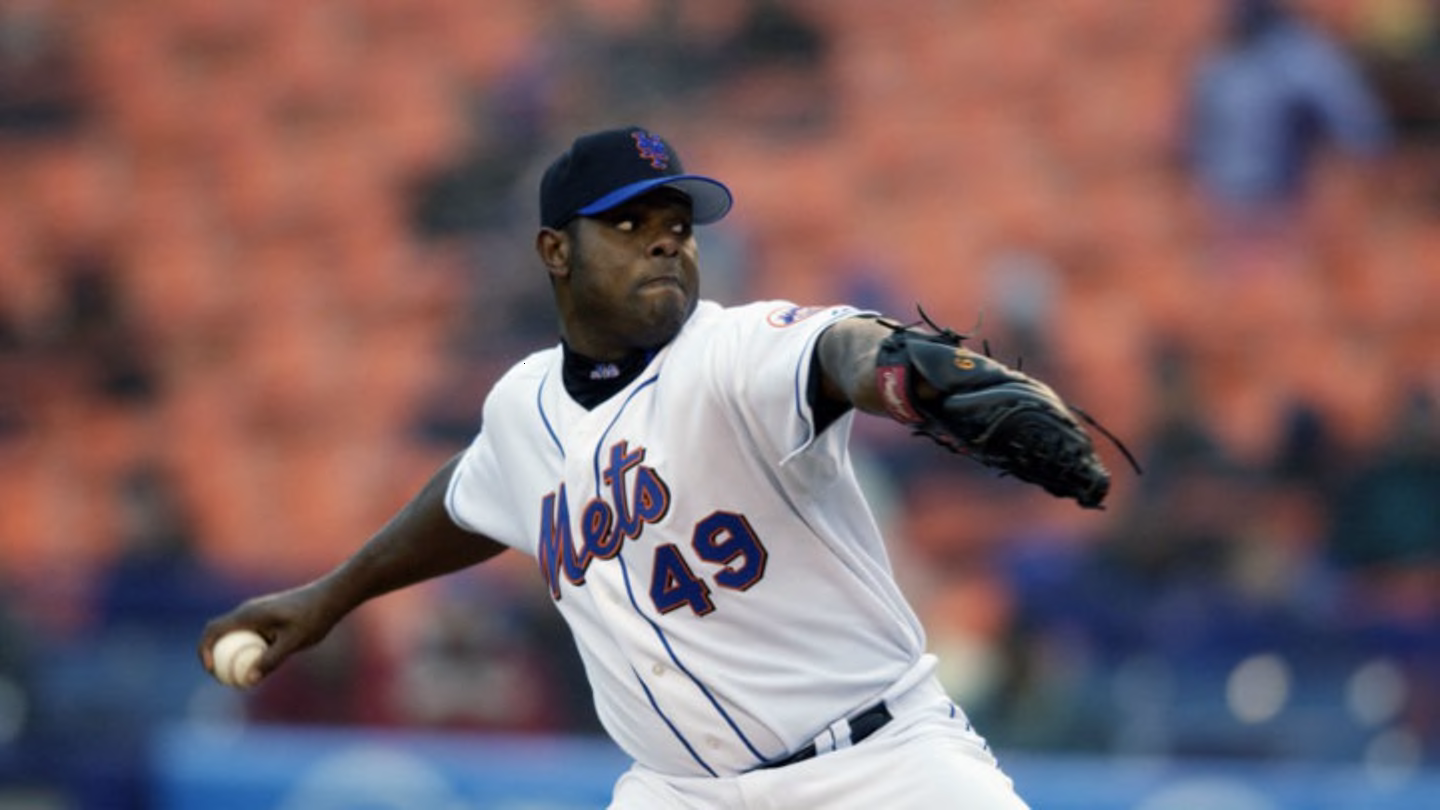
Armando Benitez was a dominant yet polarizing Major League Baseball closer who recorded 289 career saves over 15 seasons. Best known for his high-velocity fastball and devastating split-finger pitch, his career was defined by a striking contrast between regular-season dominance and high-profile struggles in the postseason.
The Physical Profile and Early Development in Baltimore
Born in 1972 in Ramón Santana, Dominican Republic, Armando Benitez entered professional baseball as a raw, hard-throwing right-hander. Signed by the Baltimore Orioles as an amateur free agent in 1990, Benitez possessed a physical frame—standing 6’4” and weighing over 250 pounds—that was perfectly suited for the burgeoning "power reliever" role of the 1990s.
During his ascent through the Orioles' minor league system, Benitez transitioned from a potential starter to a specialized late-inning weapon. His development coincided with a shift in MLB strategy where teams began prioritizing high-strikeout "fireballers" for the eighth and ninth innings. By the time he made his Major League debut on July 28, 1994, Benitez was already recognized for a fastball that consistently sat between 96 and 100 mph, a rare feat for that era.
In his early years with Baltimore (1994–1998), Benitez served primarily as the setup man for veteran closer Randy Myers. It was in this role that Benitez first displayed his elite ceiling. In 1997, he posted a 2.45 ERA and struck out 106 batters in just 73.1 innings—an incredible 13.0 K/9 ratio. However, these years also established the "mercurial" reputation that would follow him throughout his career, highlighted by occasional lapses in control and emotional volatility on the mound.
The 1998 Brawl and the End of the Baltimore Era
One of the most infamous moments of Armando Benitez’s career occurred on May 19, 1998, during a game against the New York Yankees. After surrendering a go-ahead three-run home run to Bernie Williams, Benitez threw his next pitch directly into the back of Yankees hitter Tino Martinez.
The resulting bench-clearing brawl was one of the most violent in modern baseball history, leading to a multi-game suspension for Benitez and several Yankees players. This event fundamentally altered the perception of Benitez; he was no longer seen merely as a talented young arm but as a volatile presence. The fallout from this incident, combined with the Orioles’ desire to move in a different direction, led to his trade to the New York Mets prior to the 1999 season in a three-team deal involving the Dodgers.
The New York Mets Years: Peak Performance and Postseason Pressure
The period from 1999 to 2003 represents the statistical apex of Armando Benitez's career. Transitioning into the full-time closer role for the New York Mets, Benitez became one of the most statistically impressive relievers in the National League. In 1999, he saved 22 games with a 1.85 ERA, helping lead the Mets to the National League Championship Series (NLCS).
In 2000, Benitez recorded 41 saves and struck out 106 batters in 76 innings. While his regular-season numbers were elite, his legacy in New York remains inextricably linked to the 2000 World Series against the Yankees. In Game 1, Benitez entered the game in the ninth inning with a one-run lead but surrendered a game-tying sacrifice fly. This blown save, occurring on the game's biggest stage, solidified a narrative that Benitez struggled in high-leverage October moments—a reputation that many Mets fans hold to this day despite his 160 total saves for the franchise.
From a technical perspective, Benitez’s success during this period was driven by the refinement of his split-finger fastball. While his 100-mph heater was his calling card, the "splitter" provided a vertical drop that caused hitters to swing over the top of the ball. When his command of both pitches was synchronized, he was virtually unhittable, often striking out the side in order.
The 2004 Renaissance with the Florida Marlins
After a turbulent 2003 season that saw him play for the Mets, Yankees, and Mariners, Benitez signed with the Florida Marlins for the 2004 campaign. This year proved to be the single best statistical season of his career and serves as a vital chapter in his legacy.
In 2004, Benitez was nearly perfect. He led the National League with 47 saves while maintaining a microscopic 1.29 ERA. He allowed only 36 hits in 69.2 innings of work and was selected to the All-Star team. For a brief window, he silenced his critics, proving that he could be the centerpiece of a contending bullpen. His performance that year was a masterclass in efficiency; he reduced his walk rate and relied more on his veteran savvy than pure, raw power.
Later Career: San Francisco and the Decline Phase
Following his historic 2004 season, Benitez signed a lucrative three-year, $21.5 million contract with the San Francisco Giants. His tenure in San Francisco (2005–2007) was marked by significant injuries and declining physical tools. A severe hamstring injury in early 2005 sidelined him for months, and upon his return, he struggled to regain the velocity that had defined his youth.
As his fastball velocity dipped into the low 90s, the margin for error with his splitter became razor-thin. By 2007, the Giants traded him back to the Florida Marlins, and he finished his career with brief stints in Toronto and the minor leagues. He officially exited the Major Leagues after the 2008 season with 289 saves, ranking him among the top 30 all-time at the time of his retirement.
Technical Breakdown: The Benitez Pitching Arsenal
To understand why Benitez was so successful—and why he occasionally failed spectacularly—one must analyze the mechanics of his delivery and the physics of his pitches.
- The Four-Seam Fastball: Benitez utilized a high-effort, high-velocity delivery. His release point was relatively high, creating a downward plane that made his 98-mph fastball feel even faster to the hitter. However, this high-effort delivery often led to fatigue in the latter stages of an inning, causing his pitches to "flatten out."
- The Split-Finger Fastball: This was his primary "out pitch." Unlike a traditional changeup, Benitez threw his splitter with nearly the same arm speed as his fastball. The late "tumble" of the ball as it reached the plate was responsible for his exceptionally high strikeout rates.
- The Mental Component: The role of a closer is as much psychological as it is physical. Critics often pointed to Benitez’s "body language" when things went wrong. Unlike the stoic Mariano Rivera, Benitez wore his emotions on his sleeve. This visibility often amplified the perceived severity of his blown saves in the eyes of the media and fans.
Comparative Career Statistics
The following table outlines the key statistical milestones of Armando Benitez's career across his primary teams:
| Team | Years | Saves | ERA | Strikeouts (K) | K/9 Ratio |
|---|---|---|---|---|---|
| Baltimore Orioles | 1994–1998 | 28 | 3.50 | 335 | 12.1 |
| New York Mets | 1999–2003 | 160 | 2.70 | 456 | 11.5 |
| Florida Marlins | 2004, 2007 | 56 | 1.94 | 107 | 10.1 |
| San Francisco Giants | 2005–2007 | 47 | 3.77 | 93 | 8.8 |
| Career Totals | 1994–2008 | 289 | 3.12 | 946 | 10.9 |
Data Source: Historical MLB Registry (Updated 2026).
The Legacy of Armando Benitez in 2026
As of 2026, the legacy of Armando Benitez is viewed through a more analytical lens than it was during his playing days. In the era of "Sabermetrics" and advanced data, modern historians give more weight to his career 3.12 ERA and his elite 10.9 K/9 ratio. While his postseason struggles are well-documented, his ability to dominate the regular season for over a decade is increasingly respected.
In New York, he remains a figure of intense debate. To some, he is the man who "blew" the 2000 World Series; to others, he is the greatest closer in Mets history not named Jesse Orosco or Billy Wagner. In Baltimore, he is remembered as a bridge between the great teams of the mid-90s and the rebuilding years that followed.
Benitez’s career also serves as a cautionary tale regarding the physical toll of the "fireballing closer" archetype. His late-career decline was a direct result of the high-stress innings and high-velocity demands placed on his arm and lower body. Despite the controversies and the heart-stopping blown saves, his 289 saves stand as a testament to a career spent on the razor's edge of professional sports.
Frequently Asked Questions
Was Armando Benitez ever considered for the Hall of Fame?
Armando Benitez appeared on the National Baseball Hall of Fame ballot in 2014 but received less than 5% of the vote, leading to his removal from future ballots. While his regular-season statistics were strong, his lack of 300 saves and his reputation for postseason struggles hindered his candidacy in the eyes of the Baseball Writers' Association of America (BBWAA).
Why was Armando Benitez so controversial during his time with the Mets?
The controversy stemmed from the disparity between his performance in low-leverage vs. high-leverage situations. While he often mowed down hitters in the regular season, he had several high-profile failures in the playoffs and during "Subway Series" matchups against the Yankees. This created a perception that he lacked the mental "toughness" required for the New York market.
What was Armando Benitez’s fastest recorded pitch?
At his physical peak with the Baltimore Orioles and New York Mets, Benitez was frequently clocked at 100–102 mph. He was one of the few pitchers in the late 1990s who could consistently maintain triple-digit velocity throughout a full inning of work.
How does Armando Benitez rank among all-time save leaders?
As of 2026, Benitez remains in the top 40 all-time for career saves with 289. While many modern closers have since surpassed him, his strikeout-to-walk ratios and K/9 rates remain elite compared to many of his contemporaries.
Did Armando Benitez win a World Series ring?
No, Armando Benitez never won a World Series championship. He reached the World Series with the New York Mets in 2000, but they lost to the New York Yankees in five games. He also had deep playoff runs with the Orioles in 1996 and 1997.
Practical Takeaway: Evaluating the Modern Closer
For students of the game and baseball analysts, the career of Armando Benitez highlights the importance of context. When evaluating a relief pitcher's legacy, it is essential to look past a few high-profile failures and consider the total body of work. Benitez provided his teams with elite, high-strikeout production for over a decade—a feat that is exceptionally difficult to achieve in the volatile world of Major League bullpens. For those researching sports history or relief pitching mechanics, Benitez’s 2004 season remains a "gold standard" for what a dominant closer can achieve.